Veterinary medicines are pharmaceutical products intended for the prevention, diagnosis, treatment or control of diseases in animals.
A veterinary pharmaceutical manufacturing business may manufacture medicines for:
Cattle
Buffalo
Sheep
Goats
Poultry
Pigs
Horses
Dogs
Cats
Aquaculture
Other livestock and companion animals
Although veterinary medicines are regulated under the same Drugs and Cosmetics framework used for pharmaceutical drugs, a veterinary manufacturing unit has several additional considerations.
These include:
Species-specific dosage
Veterinary indications
Withdrawal periods
Residue concerns
Veterinary-specific labelling
Animal safety
Veterinary biological standards
Different requirements for vaccines and sera
Therefore, starting a veterinary drug unit should not be treated simply as manufacturing human medicines at a different strength.
Quick Answer
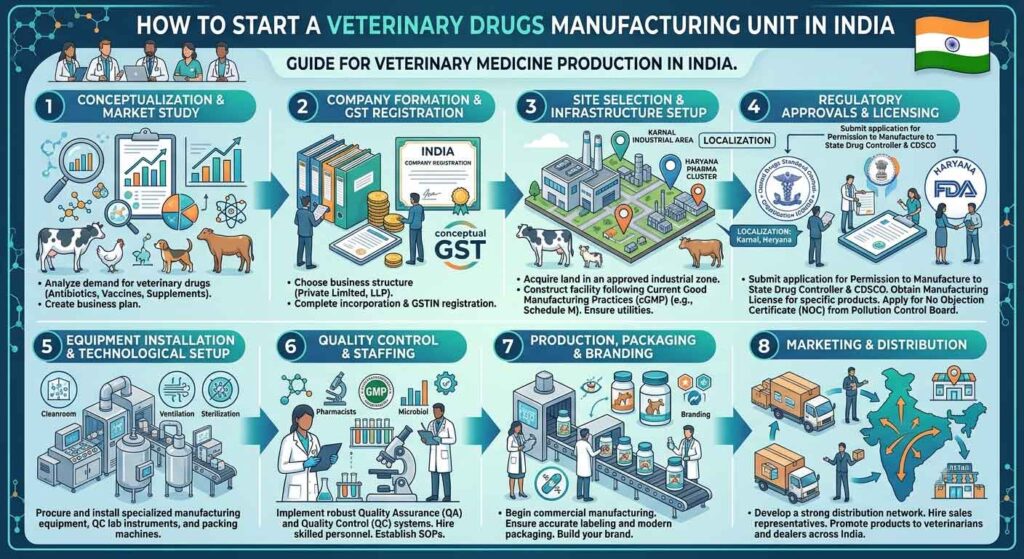
To start a veterinary medicine manufacturing unit in India:
Decide which veterinary products you intend to manufacture.
Determine whether they are ordinary pharmaceutical drugs, sterile products, vaccines, biologicals, Ayurvedic veterinary medicines or feed products.
Register the business.
Select suitable industrial premises.
Design the facility according to Schedule M.
Install dosage-form-specific machinery.
Appoint qualified manufacturing and testing staff.
Establish a quality-control laboratory.
Apply to the State Licensing Authority for the applicable manufacturing licence.
Obtain Central approval where required for new veterinary drugs or veterinary biologicals.
Obtain product permissions.
Validate the manufacturing process.
Prepare compliant veterinary labels.
Start commercial manufacturing only after the required approvals are obtained.
Is Veterinary Drug Manufacturing Licence Different From Human Drug Manufacturing Licence?
For ordinary pharmaceutical formulations, veterinary medicines generally use the same categories of manufacturing licences prescribed under the Drugs Rules.
For example:
Drugs Other Than Schedule C, C(1) and Schedule X
Application:
Form 24
Manufacturing licence:
Form 25
This may cover suitable non-sterile veterinary dosage forms such as:
Tablets
Boluses
Powders
Oral liquids
External preparations
Certain feed-administered medicinal preparations
subject to product classification.
Schedule C and C(1) Products
Application:
Form 27
Manufacturing licence:
Form 28
This applies to relevant biological and special products other than specified categories such as vaccines, sera and certain large-volume or r-DNA products.
Veterinary Vaccines, Sera and Certain Biologicals
Specialised veterinary biological products may require:
Form 28D
along with Central regulatory involvement.
Therefore, saying that there is only one “veterinary manufacturing licence” is incorrect.
The licence depends on the type of product being manufactured.
Major Categories of Veterinary Products
Before renting a building or purchasing machinery, decide exactly what you want to manufacture.
1. Veterinary Tablets and Boluses
Examples may include:
Anthelmintic boluses
Mineral preparations
Antibiotic tablets
Anti-inflammatory medicines
Digestive medicines
Reproductive-support medicines
Boluses commonly require larger tablet tooling and equipment compared with ordinary human tablets.
2. Veterinary Oral Liquids
Examples:
Oral suspensions
Anthelmintic liquids
Digestive tonics
Liver-support products
Vitamin preparations
Veterinary oral solutions
Depending on the animal category, pack sizes may range from small companion-animal bottles to several-litre livestock packs.
3. Veterinary Powders
Products may include:
Oral powders
Water-soluble powders
Medicated powders
Electrolyte preparations
Poultry medication powders
Dust control and cross-contamination prevention are especially important in powder manufacturing.
4. Veterinary Injections
Examples may include:
Antibiotic injections
Anti-inflammatory injections
Hormonal injections
Vitamin preparations
Antiparasitic injections
Injectable manufacturing requires substantially more sophisticated facilities, including sterile manufacturing controls.
5. Veterinary External Preparations
These may include:
Sprays
Ointments
Creams
Lotions
External antiseptic preparations
Certain ectoparasite-control products
The exact regulatory category should be confirmed before manufacturing insecticidal or pesticide-type products.
6. Veterinary Vaccines and Biologicals
Examples:
Poultry vaccines
Cattle vaccines
Sheep and goat vaccines
Veterinary sera
Toxoids
Diagnostic antigens
These products require specialised biological manufacturing facilities and additional regulatory controls.
A first-time entrepreneur should not treat vaccine manufacturing as equivalent to an ordinary tablet or syrup unit.
7. Ayurvedic Veterinary Medicines
Ayurvedic veterinary medicines may also be manufactured for animal healthcare.
These may include:
Herbal livestock tonics
Udder-care products
Digestive products
Herbal reproductive-support products
Herbal liver-support products
Where the product qualifies as an Ayurvedic medicine, the applicable Ayurvedic manufacturing licence and Schedule T requirements apply instead of the ordinary pharmaceutical manufacturing route.
8. Animal Feed and Feed Supplements
Not every animal-health product is a veterinary drug.
Products marketed purely as:
Animal feed
Mineral mixtures
Nutritional feed supplements
Feed ingredients
may fall under a different regulatory category.
However, if the product is promoted with therapeutic claims such as:
Treats disease
Prevents infection
Cures mastitis
Treats diarrhoea
Kills parasites
it may be treated as a drug depending on composition and intended use.
Product classification should be finalised before selecting the licence.
Is the Same Molecule Used for Human and Veterinary Medicines?
Sometimes yes, but not always.
Many active pharmaceutical ingredients are used in both human and veterinary medicine.
However, veterinary formulations can differ significantly in:
Strength
Dosage
Dosage form
Excipients
Route of administration
Species
Pharmacokinetics
Withdrawal period
Safety profile
Some medicines are specifically developed or approved for veterinary use.
Therefore:
A human drug formulation should not simply be converted into a veterinary product by increasing the strength.
The formulation and dosage must be scientifically justified for the intended animal species.
Veterinary Manufacturing Licence Authority
For most ordinary veterinary pharmaceutical manufacturing licences, the application is submitted to the:
State Licensing Authority / State Drugs Control Department
The manufacturing facility must comply with:
Drugs and Cosmetics Act
Drugs Rules
Schedule M
Product-specific standards
Applicable Central approvals
Certain veterinary biological products and new veterinary drugs also require CDSCO involvement.
New Veterinary Drugs
A particularly important distinction exists between human and veterinary new drugs.
The New Drugs and Clinical Trials Rules, 2019 primarily deal with new drugs for human use.
New veterinary drugs continue to be regulated through the applicable provisions of the Drugs Rules.
A new veterinary drug may require Central approval before the State Licensing Authority can permit commercial manufacture.
This may apply where the proposed product involves:
A new active ingredient
A new veterinary use
A new fixed-dose combination
A new route of administration
A new indication
Certain new dosage forms or strengths
The regulatory status should be confirmed before conducting commercial-scale production.
Veterinary Vaccines
Veterinary vaccines require substantially greater regulatory control than ordinary veterinary medicines.
CDSCO handles regulatory activities relating to veterinary vaccines including:
Permission for test manufacture
Field trials
Marketing authorisation
Import approvals
Form 28D licensing approval
Post-approval changes
Veterinary vaccine manufacturing also involves specialised requirements under Schedule F(1).
A vaccine unit may require facilities for:
Seed or strain management
Cell culture
Fermentation
Animal facilities where applicable
Sterile filling
Biological testing
Cold storage
Cold-chain distribution
Biosafety
Waste decontamination
A veterinary vaccine project should therefore be planned separately from a conventional veterinary formulation factory.
Premises Requirements
There is no single area requirement suitable for every veterinary manufacturing unit.
The required premises depend on:
Dosage forms
Production capacity
Products
Sterility requirements
Equipment
Number of manufacturing sections
The facility should normally include appropriate areas for:
Raw-material receipt
Quarantine
Approved raw-material storage
Dispensing
Manufacturing
Packing
Finished-goods quarantine
Approved finished-goods storage
Rejected materials
Returned goods
Quality Control
Quality Assurance
Change rooms
Utilities
Washing
Waste disposal
Separate areas may be required for different dosage forms or high-risk product categories.
Schedule M Compliance
Veterinary pharmaceutical manufacturing facilities must comply with applicable Schedule M requirements.
Schedule M covers areas such as:
Pharmaceutical Quality System
Quality Risk Management
Personnel
Premises
Equipment
Sanitation
Documentation
Production
Quality Control
Qualification
Validation
Complaints
Product recalls
Change control
Deviations
CAPA
Self-inspection
The manufacturing unit should be designed according to Schedule M before the licence application is filed.
Trying to modify an unsuitable building after inspection can be expensive.
Technical Staff Required
A veterinary manufacturing licence requires qualified whole-time technical personnel.
For ordinary veterinary drugs outside Schedules C, C(1) and X, the Drugs Rules recognise eligible graduates in fields including:
Veterinary Science
Pharmacy
General Science
Medicine
subject to the prescribed manufacturing experience.
For certain veterinary biological products, Veterinary Science graduates may also qualify along with other prescribed scientific qualifications and experience.
The exact personnel required should be approved by the State Licensing Authority.
Production Head
The person supervising manufacturing should:
Meet prescribed qualifications
Have applicable practical experience
Be a whole-time employee
Be approved by the Licensing Authority
Responsibilities include:
Production supervision
Batch documentation
Process compliance
Yield verification
Equipment use
Manufacturing controls
Deviation reporting
Quality Control Staff
A separate quality-control function is required.
QC personnel may be responsible for:
Raw-material testing
In-process testing
Finished-product testing
Stability testing
Water testing
Microbiological testing
Environmental monitoring where applicable
The testing unit should be independent of the manufacturing function.
Quality Assurance
A modern veterinary pharmaceutical unit should also establish an independent QA function.
QA responsibilities include:
Document control
Batch-record review
SOP approval
Deviations
CAPA
Change control
Qualification
Validation
Vendor qualification
Product complaints
Recall
Batch release system
Machinery Required
Machinery depends entirely on dosage form.
Veterinary Tablet/Bolus Section
May require:
Sifter
Rapid mixer granulator
Multimill
Fluid-bed dryer
Blender
Tablet compression machine
Bolus compression machine
De-duster
Coating machine
Packing machine
Oral Liquid Section
May require:
Manufacturing vessels
Storage tanks
Homogenizer
Filter
Transfer pumps
Filling machine
Capping machine
Labelling machine
Powder Section
May require:
Sifter
Pulverizer
Blender
Powder filling machine
Pouch sealing equipment
Dust extraction system
Ointment/Cream Section
May require:
Manufacturing vessel
Planetary mixer
Homogenizer
Storage vessel
Tube filling machine
Injectable Section
Requirements are much more extensive and may include:
Purified-water system
Water for Injection system
Clean rooms
Autoclaves
Sterilizing tunnel
Vial or ampoule washing
Filling machines
Sealing equipment
HVAC
HEPA filtration
Sterility-testing facilities
Utility Requirements
Depending on dosage forms, utilities may include:
Purified water
Water for Injection
Compressed air
HVAC
Steam
Electricity backup
Refrigeration
Cold rooms
Vacuum
Waste treatment
Utility systems should be appropriately qualified and maintained.
Quality-Control Laboratory
The veterinary unit should have suitable arrangements for testing the products it manufactures.
Possible sections include:
Chemical testing
Instrumental analysis
Microbiology
Stability
Packaging-material testing
Equipment may include:
HPLC
UV spectrophotometer
Dissolution apparatus
Disintegration tester
pH meter
Analytical balance
Moisture analyser
Incubators
Autoclave
The actual requirement depends on product range.
Product Approval Before Manufacturing
A manufacturing licence alone does not allow the factory to manufacture every veterinary drug.
Individual formulations must fall within the authorised manufacturing scope.
The manufacturer should submit the required:
Composition
Strength
Dosage form
Indications
Specifications
Stability information
Therapeutic justification
Labelling
Supporting data
Products considered new veterinary drugs may require prior Central approval.
Veterinary Product Standards
Veterinary drugs should comply with applicable standards of:
Indian Pharmacopoeia
Schedule F(1), where applicable
Recognised veterinary pharmacopoeial standards
Approved internal specifications where legally permitted
Specifications should be established for:
Raw materials
Packaging materials
In-process products
Finished products
Important Veterinary Labelling Requirements
Veterinary medicines require special labelling.
A medicine intended only for animal treatment should conspicuously carry wording such as:
“NOT FOR HUMAN USE; FOR ANIMAL TREATMENT ONLY”
along with the prescribed animal-head symbol where applicable.
Other usual label details include:
Brand name
Generic name
Composition
Strength
Dosage form
Species
Dosage
Route of administration
Batch number
Manufacturing date
Expiry date
MRP
Manufacturing licence number
Manufacturer details
Storage conditions
Schedule warning where applicable
Withdrawal Period for Food-Producing Animals
This is one of the most important differences between human and veterinary medicines.
Medicines used in:
Dairy cattle
Poultry
Fish
Goats
Sheep
Pigs
Other food-producing animals
may leave drug residues in:
Milk
Eggs
Meat
Fish
Therefore, veterinary medicines used in food-producing animals must carry the applicable withdrawal period.
The withdrawal period means the required interval between:
the last administration of the veterinary medicine
and
the time when milk, eggs, meat or other animal-derived food may safely enter the food chain.
A validated withdrawal period should be used wherever applicable.
Do not copy withdrawal periods from another brand without supporting evidence.
Storage Requirements
Storage conditions depend on the product.
Examples:
Ordinary Tablets and Boluses
May require:
Dry conditions
Protection from excessive heat
Suitable controlled storage
Veterinary Injections
May require:
Controlled temperature
Light protection
Veterinary Vaccines
Often require:
Refrigerated storage
Strict cold-chain management
The exact labelled storage condition must always be followed.
Documentation Required
The manufacturing unit should maintain documents such as:
Site Master File
Quality Manual
SOPs
Master Formula Records
Batch Manufacturing Records
Batch Packaging Records
Raw-material specifications
Finished-product specifications
Test methods
Validation protocols
Validation reports
Stability records
Calibration records
Cleaning records
Training records
Vendor qualification
Deviations
CAPA
Change controls
Complaints
Recall records
Distribution records
Process Validation
Commercial production should follow an appropriately validated process.
Validation may include:
Manufacturing process
Cleaning
Analytical methods
Water systems
HVAC
Equipment
Computerised systems where applicable
Sterilization
Aseptic processing
A veterinary product should be capable of being manufactured consistently from batch to batch.
Stability Studies
Stability studies help establish:
Shelf life
Storage conditions
Packaging suitability
Studies should be performed according to applicable regulatory requirements.
Veterinary formulations used under extreme field conditions may require particular attention to packaging and temperature stability.
Packaging
Veterinary products may use:
Blister packs
Strip packs
HDPE containers
PET bottles
Glass bottles
Vials
Ampoules
Sachets
Pouches
Large plastic containers
Pack size should match actual veterinary usage.
For example:
A poultry farm may require substantially different packaging compared with a pet clinic.
Step-by-Step Procedure to Start the Unit
Step 1: Decide the Product Range
Prepare a list such as:
Tablets
Boluses
Liquids
Powders
External products
Injections
Vaccines
Avoid selecting every dosage form initially.
Step 2: Check Product Classification
Determine whether each product is:
Pharmaceutical veterinary drug
Biological product
Vaccine
Ayurvedic veterinary medicine
Feed product
Medicated feed product
Step 3: Prepare a Project Report
Include:
Proposed products
Manufacturing capacity
Investment
Premises
Machinery
Staff
Quality-control requirements
Working capital
Sales plan
Step 4: Register the Business
Possible structures include:
Proprietorship
Partnership
LLP
Private Limited Company
Obtain other registrations such as GST and applicable local approvals.
Step 5: Select Industrial Premises
Verify the proposed layout with an experienced pharmaceutical consultant before major construction.
Step 6: Prepare the Layout
Include:
Material flow
Personnel flow
Manufacturing rooms
Packing
Stores
QC
Utilities
Change rooms
Avoid cross movement of:
Raw materials
Finished goods
Waste
Employees
Step 7: Install Machinery and Utilities
Purchase machinery according to:
Dosage form
Batch size
GMP requirements
Avoid buying machines before the final layout and regulatory plan are approved internally.
Step 8: Recruit Technical Staff
Appoint approved:
Manufacturing technical staff
QC personnel
QA personnel
Microbiologist where required
Other trained employees
Step 9: Establish the Quality System
Prepare:
SOPs
Specifications
Formats
Master documents
Validation plan
Calibration plan
Training system
Step 10: Apply for Manufacturing Licence
For ordinary drugs outside Schedule C/C(1)/X:
Form 24 → Form 25
For relevant Schedule C/C(1) products:
Form 27 → Form 28
Other specialised products require the applicable licence route.
Step 11: Arrange Inspection
The Licensing Authority will verify:
Premises
Staff
Machinery
Laboratory
Documentation
GMP compliance
Step 12: Obtain Product Permissions
Submit formulations and supporting documents.
Step 13: Conduct Validation and Stability Work
Complete applicable:
Process qualification
Testing
Validation
Stability studies
Step 14: Approve Artwork
Check veterinary-specific:
Species
Dosage
Warning
Withdrawal period
Storage
“Not for Human Use” statement
Step 15: Start Commercial Manufacturing
Manufacture only products covered by appropriate permission.
Loan Licence Option
An entrepreneur who does not want to establish a complete factory may consider a loan licence arrangement.
For ordinary drugs, Form 25A may apply where an applicant uses the manufacturing facilities of an existing Form 25 licence holder.
Similar loan-licence provisions exist for other applicable categories.
This option can reduce:
Initial capital
Construction time
Machinery investment
However, the applicant still has regulatory and quality responsibilities.
Third-Party Manufacturing as an Alternative
An even simpler entry route may be third-party manufacturing.
In this model:
Existing licensed manufacturer manufactures the veterinary products.
Marketing company owns or markets the brands.
Products are supplied under a manufacturing agreement.
This is often preferable for a new company wanting to first test the veterinary market.
Investment Required
There is no fixed investment.
It depends on:
Land/building
Dosage forms
Capacity
Machinery
Laboratory
HVAC
Utilities
Regulatory requirements
Working capital
A simple non-sterile formulation facility may require much less investment than:
Injectable unit
Hormonal unit
Biological plant
Vaccine facility
Before budgeting, prepare a dosage-form-specific project report.
Common Mistakes to Avoid
Assuming veterinary medicine is simply a stronger human medicine
Buying machinery before confirming licensing requirements
Mixing feed supplements and veterinary drugs under one classification
Ignoring withdrawal periods
Using human-product labels for veterinary drugs
Manufacturing new combinations without approval
Starting with too many dosage forms
Underestimating QC requirements
Ignoring Schedule M
Selecting unsuitable premises
Manufacturing vaccines without specialised regulatory planning
Copying another company’s veterinary dosage or claim
Ignoring species-specific safety
Frequently Asked Questions
1. Is the veterinary drug manufacturing licence the same as a human pharmaceutical licence?
Ordinary veterinary pharmaceutical formulations use many of the same manufacturing-licence forms, but veterinary products have additional technical, labelling, species and withdrawal-period requirements.
2. Which licence is required for veterinary tablets and boluses?
For applicable drugs outside Schedule C, C(1) and X, the usual route is application in Form 24 and manufacturing licence in Form 25.
3. Which licence is required for veterinary injections?
The exact licence depends on the formulation. Products falling under Schedule C/C(1) may require Form 28 or another specialised licence.
4. Which licence is required for veterinary vaccines?
Veterinary vaccines require specialised approval and licensing, including Form 28D arrangements and CDSCO involvement.
5. Can a veterinary doctor become the manufacturing technical person?
The Drugs Rules permit eligible Veterinary Science graduates to supervise certain veterinary drug-manufacturing operations subject to the prescribed practical-experience requirements.
6. Is Schedule M applicable to veterinary drugs?
Yes, pharmaceutical veterinary manufacturing facilities must comply with applicable Schedule M GMP requirements.
7. Can human medicines be labelled and sold for animals?
A product should not simply be relabelled for veterinary use. Veterinary indication, dose, formulation and regulatory approval must support the intended animal use.
8. What is a withdrawal period?
It is the interval required after the final veterinary medicine dose before products such as milk, eggs, meat or fish may safely enter the food chain.
9. Is an animal feed supplement a veterinary drug?
Not automatically. Classification depends on composition, intended use and claims.
10. Can veterinary Ayurvedic medicines be manufactured?
Yes, subject to the applicable Ayurvedic drug licensing and GMP requirements.
11. Can I start with third-party manufacturing?
Yes. Third-party manufacturing is usually less capital-intensive than constructing a complete factory and can be a practical way to test the market.
12. Is Central approval required for every veterinary medicine?
No. Many established veterinary formulations are licensed through State authorities, while new veterinary drugs, vaccines and certain biologicals can require Central regulatory involvement.
Final Thoughts
Starting a veterinary pharmaceutical manufacturing unit is similar in many respects to establishing a conventional pharmaceutical plant, but it should not be treated as identical.
The business requires special attention to:
Animal species
Veterinary dosage
Product safety
Drug residues
Withdrawal periods
Veterinary labelling
Appropriate regulatory approvals
GMP
Biological and vaccine requirements
For a new entrepreneur, the best starting point is usually to select one or two non-sterile dosage-form categories, such as veterinary boluses, oral liquids or powders, rather than immediately establishing a multi-dosage-form or vaccine facility.
Looking for Ayurvedic Franchise or Distribution Opportunities?
Elzac Herbal India offers opportunities for entrepreneurs interested in Ayurvedic and herbal product distribution, franchise marketing and third-party manufacturing.
Elzac Herbal India offers:
Ayurvedic & Herbal Product Range
Franchise & Distribution Opportunities
Third-Party Manufacturing
Product Development Support
Marketing Guidance
PAN India Business Opportunities
Whether you are an entrepreneur, retailer, distributor, or healthcare professional, our team can help you explore the right business opportunity in the growing Ayurvedic sector.
Ajay Kamboj is an entrepreneur and business owners associated with many Ayurvedic and Pharmaceutical start-ups. With years of experience in Ayurvedic product marketing, pharmaceutical distribution, franchise development, and client relationship management, he regularly shares practical business insights based on real-world experiences. His articles focus on business growth, entrepreneurship, customer management, and lessons learned from the healthcare and wellness industry.