India’s animal healthcare market offers business opportunities in dairy farming, poultry, livestock management, pet care and animal nutrition.
Entrepreneurs can enter this sector by starting a veterinary supplements marketing company and getting products manufactured by an established third-party manufacturer.
However, the term veterinary supplement can cover different product categories. Before completing registrations, designing labels or placing a manufacturing order, you must first determine whether the proposed product is:
An animal feed supplement
A nutritional or mineral supplement
A veterinary medicine
An Ayurvedic veterinary medicine
A pet wellness product
A medicated feed product
This classification determines the licences, manufacturing requirements, labelling rules and marketing claims that may apply.
Quick Answer
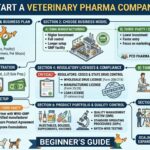
To start a veterinary supplements marketing company:
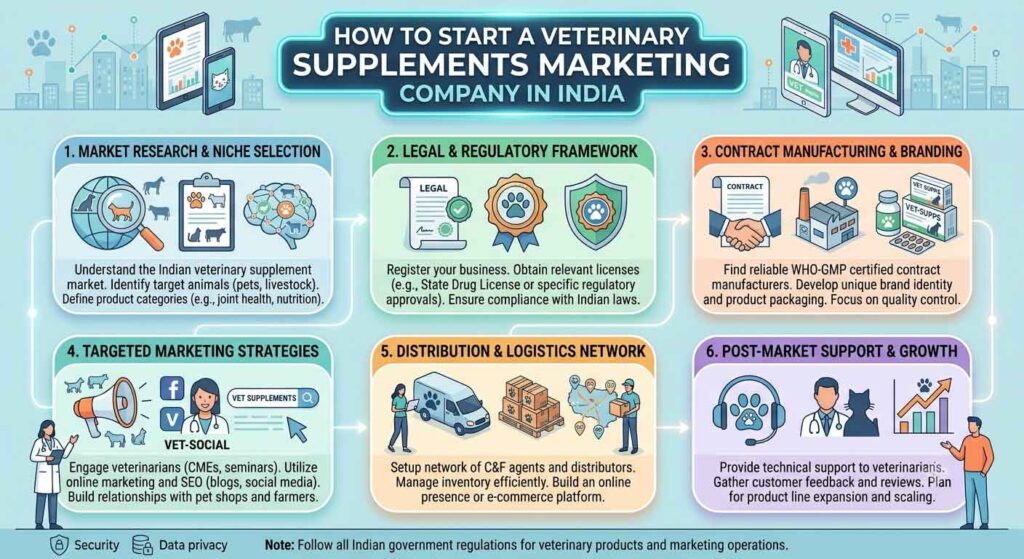
Select your target animal segment.
Finalize the product category and formulations.
Confirm whether each product is a feed supplement or veterinary medicine.
Register your business and obtain applicable tax registrations.
Register your brand name or trademark.
Select an appropriately licensed third-party manufacturer.
Prepare compliant labels and marketing materials.
Build a network of veterinary distributors, doctors, feed dealers and animal healthcare retailers.
Maintain proper invoices, batch records and quality documents.
Avoid medicinal claims on products classified only as feed supplements.
What Is a Veterinary Supplements Marketing Company?
A veterinary supplements marketing company sells animal healthcare products under its own company or brand name.
The products may be manufactured by another licensed company through third-party or contract manufacturing.
The marketing company normally focuses on:
Product selection
Brand development
Packaging design
Sales and distribution
Veterinary doctor promotion
Dealer appointments
Digital marketing
Customer support
The third-party manufacturer handles production, testing, packing and manufacturing-related documentation according to the applicable product category.
Step 1: Select Your Target Market
The veterinary sector is broad. A new company should not launch products for every type of animal at the beginning.
Choose one or more target segments:
Dairy and Livestock
Possible product categories include:
Calcium supplements
Mineral mixtures
Liver support products
Digestive supplements
Energy supplements
Fertility-support nutrition
Milk-production nutritional support
Post-calving nutritional products
Poultry
Possible categories include:
Vitamin and mineral supplements
Electrolytes
Liver-support supplements
Gut-health products
Toxin binders
Nutritional growth-support products
Pets
Possible categories include:
Multivitamin supplements
Calcium products
Skin and coat supplements
Joint-health supplements
Digestive products
Pet shampoos and grooming products
Equine and Other Animals
Specialized products may be developed for horses, goats, sheep, pigs and other animals depending on market demand.
Step 2: Determine the Legal Classification of Every Product
This is the most important step.
Do not assume that every veterinary supplement follows the same legal requirements.
Animal Feed or Nutritional Supplement
A product intended only to provide nutrition, minerals, vitamins or other feed-related support may be marketed as an animal feed supplement, subject to its formulation, presentation and claims.
Such products should not make claims that they:
Cure a disease
Treat an infection
Prevent a specific disease
Replace veterinary treatment
Act as antibiotics
Correct a diagnosed medical condition
Therapeutic claims can change how regulators classify the product.
Veterinary Medicine
A product intended to diagnose, treat, mitigate or prevent disease in animals may be treated as a veterinary drug.
Examples may include:
Veterinary antibiotics
Anthelmintics or dewormers
Anti-inflammatory medicines
Veterinary injections
Medicated oral liquids
Prescription veterinary formulations
These products must be manufactured and marketed according to the applicable drug laws and licence conditions.
Ayurvedic Veterinary Medicine
Herbal ingredients alone do not automatically make a product an unregulated supplement.
If an herbal or Ayurvedic product is presented as a medicine for animals and makes therapeutic claims, the applicable Ayurvedic drug requirements must be examined.
It should be manufactured by a unit holding the appropriate manufacturing permissions for that category.
Important Principle
Product classification depends on composition, intended use, label wording and promotional claims—not only on the product name.
Before launching, obtain written classification guidance from the manufacturer’s regulatory team or a qualified consultant.
Step 3: Register the Business
You may start the company under a suitable structure such as:
Proprietorship
Partnership firm
Limited Liability Partnership
One Person Company
Private Limited Company
The right structure depends on:
Number of promoters
Investment plan
Liability protection
Future expansion
Distributor confidence
Accounting and compliance requirements
A private limited company is not compulsory for starting a veterinary supplements marketing business. Many small businesses begin as proprietorships or partnerships and restructure later.
Step 4: Obtain Basic Business Registrations
Depending on your business structure and activities, commonly considered registrations include:
PAN
Business bank account
GST registration, where applicable
Local shop or establishment registration
Udyam registration for eligible MSMEs
Import Export Code for import or export
Trademark application for the brand name
The exact requirements depend on turnover, location, business model and whether goods are sold within or outside the state.
Step 5: Check Whether a Drug Licence Is Required
Whether your marketing company needs a drug licence depends on the products being stored, sold and distributed.
For Veterinary Medicines
A wholesale drug licence may be required for the premises from which veterinary medicines are stocked, invoiced, sold or distributed.
The products must come from a manufacturer holding the appropriate manufacturing licence.
For Animal Feed Supplements
A drug licence may not ordinarily apply where a genuine animal feed supplement:
Is not classified as a drug
Contains permitted nutritional ingredients
Does not make therapeutic claims
Is manufactured and labelled as an animal feed product
However, this position should be confirmed for the exact formulation and state of operation.
For Ayurvedic Veterinary Medicines
The manufacturing and marketing route should be confirmed with the manufacturer and the concerned state licensing authority.
Do not market an Ayurvedic veterinary medicine as an ordinary feed supplement merely to avoid licensing requirements.
Step 6: Understand the Role of FSSAI
FSSAI regulates food intended for human consumption.
Therefore, an animal feed supplement should not automatically be registered or labelled as an FSSAI product.
An FSSAI licence belonging to your human nutraceutical or food business does not by itself authorize the manufacture or sale of veterinary medicines or animal feed supplements.
The correct regulatory route must be selected according to the product’s intended use.
Step 7: Select a Reliable Third-Party Manufacturer
Most startups prefer third-party manufacturing because it avoids the cost of establishing a factory.
Before selecting a manufacturer, verify:
Company registration
Manufacturing licence
Product-category permissions
GMP status, where applicable
Manufacturing experience
Quality-control facilities
Batch testing procedure
Product stability
Minimum order quantity
Delivery period
Packaging support
Complaint-handling procedure
Previous client references
Do not select a manufacturer only because its rates are lower.
Quality, legal documentation and reliable delivery are more important than a small price difference.
Step 8: Obtain a Product-Wise Quotation
Ask for a detailed quotation mentioning:
Product name
Complete composition
Strength
Dosage form
Pack size
Minimum order quantity
Manufacturing rate
Packaging cost
Artwork charges
Testing charges
Applicable taxes
Delivery schedule
Payment terms
Clarify whether the quoted rate includes:
Bottle or container
Label
Outer carton
Measuring cup
Shipper
Product testing
Transportation
This prevents disputes after placing the order.
Step 9: Complete the Third-Party Manufacturing Documentation
The manufacturer may request documents such as:
Company registration proof
PAN
GST certificate
Address proof
Authorized person’s identity proof
Trademark application or brand-name affidavit
Marketing agreement
Purchase order
Approved product composition
Approved artwork
Applicable licence copies
Documentation varies according to the product category and manufacturer.
Step 10: Register and Protect the Brand Name
Conduct a trademark search before finalizing the company or product name.
Avoid names that are:
Already registered
Confusingly similar to an existing veterinary brand
Misleading
Suggestive of guaranteed cure
Similar to a well-known company
Prohibited under applicable laws
A trademark application provides stronger protection for your brand as the business grows.
Step 11: Prepare Compliant Product Labels
Veterinary product labels should be prepared according to their legal classification.
Depending on the category, the label may need to mention:
Brand name
Product category
Composition
Quantity per serving or dose
Net quantity
Target animal species
Recommended usage
Administration instructions
Batch number
Manufacturing date
Expiry or best-before date
Storage conditions
MRP
Manufacturer’s name and address
Manufacturing licence number, where applicable
Marketed by details
Customer-care information
Caution or warning
“For veterinary use only,” where applicable
The artwork should be reviewed by the manufacturer’s regulatory or quality team before printing.
Step 12: Avoid Unapproved Therapeutic Claims
Claims are one of the biggest risks in veterinary supplement marketing.
For a nutritional supplement, use responsible wording such as:
Supports normal growth
Helps maintain nutritional balance
Supports digestive function
Helps maintain bone health
Supports general animal wellness
Provides vitamins and minerals
Avoid claims such as:
Guaranteed treatment
Cures mastitis
Prevents every infection
Replaces antibiotics
Permanently treats infertility
Increases milk production by a guaranteed percentage
No veterinary consultation required
Claims should be supported by the product’s composition, intended use and available evidence.
Step 13: Maintain Quality Documentation
For every manufactured batch, obtain and maintain relevant documents such as:
Invoice
Batch number
Certificate of Analysis
Manufacturing record or batch summary, where provided
Product specification
Approved artwork
Test reports
Manufacturer’s licence copy
Complaint and recall contact details
These records are important for traceability, distributor confidence and complaint management.
Step 14: Build Your Distribution Network
Veterinary products can be marketed through:
Veterinary doctors
Veterinary hospitals and clinics
Animal-health distributors
Feed dealers
Dairy cooperatives
Poultry farms
Livestock farms
Pet shops
Pet clinics
Veterinary pharmacies
Regional franchise partners
E-commerce channels, where legally permissible
Choose channels according to the product category.
A dairy mineral mixture and a pet joint supplement require very different marketing strategies.
Step 15: Prepare Veterinary Promotional Material
Promotional materials may include:
Product visual aids
Veterinary doctor literature
Product brochures
Dealer price lists
Product cards
Sample packs
WhatsApp catalogues
Educational videos
Website product pages
Distributor appointment letters
All promotional claims should match the approved label and product category.
Step 16: Start With a Focused Product Range
A new company should avoid launching too many products.
Begin with a carefully selected range of approximately five to fifteen products based on:
Local demand
Target animal segment
Competition
Distributor feedback
Manufacturing MOQ
Product shelf life
Available working capital
A focused range is easier to market and manage than a large catalogue with slow-moving inventory.
Common Mistakes to Avoid
Treating every animal supplement as an unregulated product
Applying for FSSAI without understanding product classification
Making disease-treatment claims on feed supplements
Buying products from an improperly licensed manufacturer
Printing labels without regulatory approval
Starting with too many products
Ignoring batch-testing documents
Selecting manufacturers only on price
Giving long credit to new distributors
Using misleading before-and-after claims
Suggested Startup Checklist
Before launching, confirm the following:
Business structure finalized
GST position checked
Brand name searched
Trademark application filed
Target animal segment identified
Product classification confirmed
Manufacturer’s licences verified
Product composition finalized
MOQ and rates approved
Manufacturing agreement completed
Artwork technically approved
Quality documents agreed
Distributor policy prepared
Marketing claims reviewed
Complaint-handling system established
Final Thoughts
Starting a veterinary supplements marketing company can offer strong opportunities, but the business should begin with correct product classification.
A feed supplement, veterinary drug and Ayurvedic veterinary medicine cannot be treated as the same category.
Before investing in packaging or inventory:
Finalize the product.
Confirm its legal category.
Verify the manufacturer’s permissions.
Review the label and claims.
Obtain professional guidance for your state.
The success of a veterinary healthcare brand depends on product quality, legal compliance, market understanding and reliable distribution—not merely on launching a large product range.
Frequently Asked Questions
1. Is FSSAI registration required for veterinary supplements?
FSSAI is primarily concerned with food for human consumption. An animal feed supplement should not automatically be registered under FSSAI. The correct requirement depends on the product’s composition, purpose and claims.
2. Is a drug licence required to sell veterinary supplements?
A drug licence may be required if the product is legally classified as a veterinary medicine. A genuine non-medicinal feed supplement may follow a different route. Obtain product-specific classification advice before launch.
3. Can I start a veterinary marketing company without my own factory?
Yes. Products can be obtained through an appropriately licensed third-party manufacturer.
4. Can I market the products under my own brand name?
Yes. Subject to the manufacturing agreement, trademark availability and applicable labelling rules, products can be manufactured under your own brand.
5. Can herbal animal products be sold without an AYUSH licence?
Herbal ingredients alone do not decide the legal category. If a product is presented as an Ayurvedic veterinary medicine or makes therapeutic claims, applicable drug-licensing requirements must be checked.
6. What documents should I obtain from a manufacturer?
Important documents may include the manufacturing licence, GST details, product permission, Certificate of Analysis, invoice, approved artwork and batch details.
7. Which veterinary products are suitable for beginners?
Beginners may consider focused nutritional categories such as mineral mixtures, calcium supplements, electrolytes, liver-support nutrition, digestive supplements and pet wellness products, subject to correct classification.
8. Can veterinary supplements be sold online?
Online sale may be possible depending on product classification and marketplace rules. Prescription veterinary medicines and regulated products may have additional restrictions.
9. How much investment is required?
Investment depends on the product range, MOQ, packaging, branding, inventory and marketing plan. Starting with fewer products generally reduces working-capital risk.
10. Who should approve the product label?
The marketing company should check branding and commercial details, while the manufacturer’s regulatory or quality team should approve the technical and statutory matter before printing.
Looking for Ayurvedic Franchise or Distribution Opportunities?
Looking to start an Ayurvedic franchise, become a distributor, or launch your own herbal product range?
Elzac Herbal India offers:
Ayurvedic & Herbal Product Range
Franchise & Distribution Opportunities
Third-Party Manufacturing Services
Product Development Support
Marketing Guidance
PAN India Business Opportunities
Whether you are an entrepreneur, retailer, distributor, or healthcare professional, our team can help you explore the right business opportunity in the growing Ayurvedic sector.
Ajay Kamboj is an entrepreneur and business owners associated with many Ayurvedic and Pharmaceutical start-ups. With years of experience in Ayurvedic product marketing, pharmaceutical distribution, franchise development, and client relationship management, he regularly shares practical business insights based on real-world experiences. His articles focus on business growth, entrepreneurship, customer management, and lessons learned from the healthcare and wellness industry.




Leave a Reply Cancel reply
You must be logged in to post a comment.