Starting a pharmaceutical capsule manufacturing company requires much more than purchasing a capsule-filling machine and arranging a small room.
A legally compliant unit need:
A suitable industrial premises
Pharmaceutical manufacturing licence
Schedule M-compliant facility
Qualified production, Quality Control and Quality Assurance staff
Controlled HVAC and humidity
Approved machinery
Quality-control laboratory
Documented pharmaceutical quality system
Product permissions
Validated manufacturing processes
Stability and batch-release systems
Adequate working capital
A common query is:
“Please explain how to start a small-scale capsule manufacturing company with minimum machinery, space, staff and documents.”
The practical answer is:
A small hard-capsule unit is possible, but “small scale” does not provide an exemption from pharmaceutical quality, licensing or GMP requirements.
The project should be designed according to the products you intend to manufacture.
First Decide Which Type of Capsule You Will Manufacture
The word “capsule” can refer to several different dosage forms.
1. Hard Gelatin Capsules
These are two-piece capsules containing:
Powder
Granules
Pellets
Mini-tablets
Combination fills
This article mainly covers a small hard-capsule filling unit.
2. HPMC or Vegetarian Capsules
These are also two-piece capsule shells but use a cellulose-based material rather than gelatin.
The filling process may be similar to hard gelatin capsules, but:
Shell characteristics differ.
Humidity requirements may differ.
Filling behaviour may differ.
Stability must be verified.
3. Soft Gelatin Capsules
Softgels require a completely different manufacturing system involving:
Gelatin preparation
Oil or suspension preparation
Encapsulation
Tumble drying
Tray drying
Washing
Inspection
Special temperature and humidity controls
A softgel plant requires considerably higher investment, space, technical expertise and utilities.
Do not treat hard-capsule filling and softgel manufacturing as the same project.
4. Empty Capsule-Shell Manufacturing
Manufacturing empty gelatin or HPMC shells is also a separate industry.
Most small capsule-filling units purchase empty shells from qualified suppliers rather than manufacturing the shells themselves.
Choose a Narrow Product Scope
A beginner should consider starting with:
Non-sterile hard capsules
Non-beta-lactam products
Immediate-release powder-filled capsules
A limited product range
Standard domestic-market formulations
Avoid beginning with highly complex categories such as:
Penicillin or cephalosporin antibiotics
Cytotoxic products
Hormonal products
Immunosuppressants
Highly potent drugs
Modified-release pellets
Gastro-resistant pellets
Controlled substances
Schedule X products
These may require dedicated facilities, specialised containment or additional approvals.
Small Scale Does Not Mean Reduced GMP
A plant may have low output and still be required to comply with:
Schedule M
Approved manufacturing procedures
Qualified technical staff
Batch testing
Stability requirements
Documentation
Data integrity
Cleaning validation
Process validation
Complaint handling
Product recall
Pharmacovigilance responsibilities, where applicable
The Licensing Authority evaluates whether the plant can consistently manufacture safe and quality medicines—not merely whether it owns a capsule machine.
How Much Space Is Required?
The capsule-filling section itself needs a dedicated enclosed area with:
Air conditioning
Dehumidification
Airlock
Dust control
Suitable material and personnel flow
In addition, the plant requires several other rooms and support areas.
Practical Space Planning
For a basic non-beta-lactam hard-capsule manufacturing unit with one semi-automatic line, a practical initial planning range may be approximately:
2,500 to 4,500 square feet of total built-up area
This is not a universal statutory minimum.
The final area depends on:
Production capacity
Number of products
Machinery size
In-house laboratory
Warehouse requirements
Packaging operations
HVAC design
Personnel flow
State Licensing Authority requirements
A plant handling multiple dosage forms will require substantially more space.
Recommended Area-Wise Layout
1. Material Receiving Area
For unloading and initial verification of:
APIs
Excipients
Empty capsule shells
Bottles
Foils
Cartons
Labels
The receiving area should prevent material mix-up and exposure to weather.
2. Raw-Material Quarantine
Received materials should remain under quarantine until:
Sampling is completed.
Testing is completed.
Quality Control approves or rejects them.
3. Approved Raw-Material Store
Approved materials should be segregated from:
Quarantine material
Rejected material
Returned material
Temperature and humidity should be monitored as required.
4. Empty Capsule-Shell Store
Capsule shells require controlled storage because excessive or inadequate moisture can cause:
Brittleness
Softening
Deformation
Locking problems
Filling difficulties
5. Packaging-Material Store
Printed and unprinted materials should be controlled separately.
Printed materials require strict reconciliation because they contain:
Brand names
Batch-printing spaces
Company details
Regulatory information
6. Sampling and Dispensing Area
A controlled dispensing room or booth is needed for weighing raw materials.
It should provide:
Dust extraction
Calibrated balances
Controlled airflow
Prevention of mix-up
Proper cleaning
7. Sifting and Blending Room
Raw-material powders may require:
Sifting
Milling
Blending
Lubrication
Granule preparation
The room should control airborne dust and cross-contamination.
8. Capsule-Filling Room
The filling room should be:
Enclosed
Air-conditioned
Dehumidified
Provided with an airlock
Designed for easy cleaning
Supported by suitable dust extraction
Environmental conditions should be established according to:
Capsule-shell type
Product characteristics
Equipment
Stability requirements
9. Capsule Polishing and Inspection Area
Filled capsules should undergo suitable operations such as:
Dust removal
Polishing
Visual inspection
Sorting
Metal detection, where adopted
Defective capsules should be segregated and accounted for.
10. Bulk Capsule Holding Area
Approved bulk capsules awaiting packing should be stored in:
Closed containers
Properly labelled status-controlled areas
Suitable temperature and humidity
11. Primary Packaging Area
Depending on the product, capsules may be packed in:
PVC blister
PVC/PVdC blister
Alu-Alu blister
Strip pack
HDPE bottle
PET bottle
Packaging selection should be supported by stability and compatibility considerations.
12. Secondary Packaging Area
This area may handle:
Cartoning
Labelling
Insertion of literature
Shipper packing
Coding and reconciliation
13. Finished-Goods Quarantine
Packed batches remain under quarantine until final Quality Assurance release.
14. Released Finished-Goods Store
Released goods should be separated from:
Quarantined stock
Rejected stock
Returned stock
Recalled stock
15. Quality Control Laboratory
A capsule unit requires adequate facilities for testing:
Raw materials
Empty capsule shells
Packaging materials
In-process samples
Finished products
Stability samples
16. Quality Assurance and Documentation Area
QA requires controlled space for:
Batch-record review
SOPs
Deviations
CAPA
Change control
Training
Product release
Document archives
17. Stability Chamber Area
Stability samples should be maintained under specified controlled conditions.
18. Washing and Equipment-Cleaning Area
Cleaning activities should not contaminate production rooms.
Provide facilities for:
Equipment washing
Utensil washing
Drying
Clean-equipment storage
Dirty-equipment segregation
19. Personnel Change Rooms
Personnel movement should follow a controlled sequence:
Outside clothes → Change room → Hand washing → Protective garments → Production area
Toilets should not open directly into manufacturing or storage areas.
20. Utilities and Engineering Area
This may include:
HVAC/AHU
Electrical panel
Air compressor
Vacuum system
Dust extraction
Power backup
Maintenance workshop
Water system
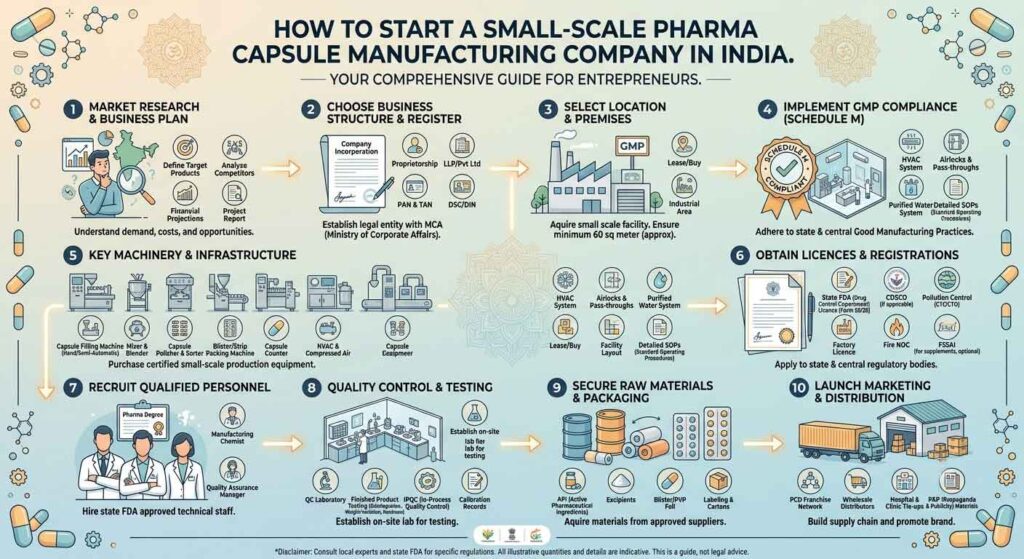
Minimum Production Machinery for Hard Capsules
1. Dispensing Balances
You may require:
Precision balance
Platform balance
Bench balance
All balances should be:
Suitable for their weighing range
Calibrated
Periodically verified
Identified with status labels
2. Vibro Sifter
Used to:
Remove lumps
Standardise powder size
Support uniform blending
Remove foreign particles
Suitable screens and sieve-integrity controls are required.
3. Milling Equipment
A multimill, cone mill or other suitable equipment may be required when:
Lumps need size reduction.
Granules need sizing.
Powder flow needs improvement.
It may not be necessary for every simple formulation, but the process should be assessed product-wise.
4. Mixing and Blending Equipment
Possible options include:
Double-cone blender
Octagonal blender
Bin blender
V-blender
Conta blender
The capacity should match the intended batch size.
An excessively large blender may not mix small batches properly.
5. Capsule-Filling Machine
Options include:
Hand-Operated Machine
A manual machine may be useful for:
Laboratory trials
Small development batches
Training
It is generally not a sensible basis for a commercial licensed unit because of:
Low output
Greater manual handling
Higher contamination risk
Weight-variation challenges
Operator dependence
Semi-Automatic Capsule-Filling Machine
This is usually the practical starting point for a small commercial unit.
Advantages include:
Moderate investment
Better output
Better fill-weight control
Lower manual handling than hand filling
Automatic Capsule-Filling Machine
Suitable for:
Higher output
Larger product range
Better automation
Reduced manual handling
It involves higher investment, maintenance and validation requirements.
6. Capsule Polishing Machine
Used to remove powder from the outer surface of filled capsules.
7. Capsule Inspection or Sorting System
This may include:
Visual-inspection belt
Capsule sorter
Empty-capsule rejection system
Damaged-capsule detection
8. Metal Detector
A suitable pharmaceutical metal detector is strongly advisable for detecting metal contamination after filling or polishing.
9. Capsule Counter
Required when capsules are packed in bottles.
It may be:
Manual counting tray
Semi-automatic counter
Electronic counting machine
Commercial operation normally benefits from a validated electronic counter.
10. Blister or Strip Packing Machine
The machine should match the selected packaging:
PVC-Aluminium blister
Alu-Alu
Strip pack
Related equipment may include:
Batch coder
Online camera system
Leak tester
De-blistering device for controlled recovery, where permitted
11. Bottle-Packing Equipment
Bottle packing may require:
Capsule counter
Bottle cleaner
Desiccant inserter
Cotton inserter, where appropriate
Capping machine
Induction sealer
Label machine
Shrink-banding machine
12. Dust-Extraction System
Dust should be controlled at:
Dispensing
Sifting
Blending
Capsule filling
Polishing
Dust extraction is necessary for:
Product protection
Worker safety
Cross-contamination control
Cleanliness
13. HVAC and Dehumidification
HVAC is a critical system rather than an optional accessory.
It may need to control:
Temperature
Relative humidity
Air changes
Pressure differentials
Filtration
Dust movement
A domestic split air conditioner alone is not an adequate pharmaceutical HVAC design.
Quality-Control Equipment
The precise QC equipment depends on the proposed products and pharmacopeial specifications.
A basic laboratory may require:
Analytical balances
pH meter
Disintegration test apparatus
Dissolution test apparatus
UV-visible spectrophotometer
HPLC, according to product requirements
Hot-air oven
Muffle furnace, where required
Moisture analyser or Karl Fischer equipment
Melting-point apparatus, where relevant
Friability or hardness equipment where tablet-filled capsule components are handled
Stability chambers
Refrigerator
Glassware
Fume hood
Water-testing equipment
Microbiological facilities where required
The laboratory should be independent of production.
Specialised testing may be contracted to an approved laboratory where legally permitted, but outsourcing does not remove the manufacturer’s responsibility for product quality and batch release.
Main Tests for Hard Capsules
Depending on the formulation, testing may include:
Description
Identification
Average fill weight
Uniformity of dosage units
Assay
Dissolution
Disintegration
Related substances
Moisture
Microbial limits
Locking and shell integrity
Stability
Packaging integrity
A capsule should not be released only because it looks properly filled.
Required Technical Staff
The exact qualifications and experience must be accepted by the State Licensing Authority.
A small unit commonly needs the following functions.
Head of Production
Responsible for:
Manufacturing operations
Batch execution
Equipment use
Yield reconciliation
Cleaning
Production documentation
Manufacture should be conducted under the active direction and personal supervision of approved competent technical staff.
Head of Quality Control
Responsible for:
Sampling
Testing
Specifications
Analytical methods
Laboratory records
Stability testing
QC should remain independent from production.
Quality Assurance Personnel
Responsible for:
Pharmaceutical quality system
SOP control
Batch-record review
Deviations
CAPA
Change control
Validation
Training
Product release
Complaints and recall
Analytical Chemists
Required according to:
Number of products
Batch volume
Testing workload
Instruments
Microbiologist
May be required depending on:
Product range
Microbial testing
Water monitoring
Environmental monitoring
Warehouse Personnel
Responsible for:
Receipt
Status labelling
Storage
FEFO
Material issue
Traceability
Engineering and Maintenance Staff
Responsible for:
HVAC
Utilities
Preventive maintenance
Calibration support
Equipment breakdowns
Trained Operators and Packing Staff
All staff should receive documented training in:
GMP
Hygiene
SOPs
Equipment operation
Safety
Data recording
Business and Premises Documents
Common documents include:
Proprietorship declaration, partnership deed, LLP registration or incorporation certificate
PAN
GST registration
Memorandum and Articles of Association, where applicable
Board resolution or authorization
Ownership deed or registered lease
Landlord’s NOC
Industrial land-use approval
Building plan
Site plan
Premises layout
Utility bill
Local registrations
The exact checklist differs by state.
Drug-Manufacturing Licence
For ordinary hard capsules outside Schedules C, C(1) and X:
Application is generally made in Form 24.
Manufacturing licence is generally issued in Form 25.
The application is submitted to the concerned State Licensing Authority.
The authority may arrange a joint inspection involving State and Central drug inspectors.
Do not begin commercial manufacturing merely after submitting the application.
Product Permission
The manufacturing licence does not automatically authorize every capsule formulation.
Product-wise permission should be obtained for the exact:
Active ingredients
Salt forms
Strength
Dosage form
Release characteristics
Manufacturing site
A general capsule section approval does not permit any combination requested by a customer.
New Drugs and Fixed-Dose Combinations
Before selecting the product list, determine whether a capsule is:
An established approved formulation
A new drug
A subsequent new drug
A new fixed-dose combination
A modified-release product
A gastro-resistant product
A prohibited or restricted combination
New drugs and certain FDCs may require prior approval from the Central Licensing Authority.
The State Licensing Authority cannot be treated as a shortcut for an unapproved combination.
Test Licence
Where development, examination, testing or analysis batches are required before obtaining the complete commercial permission, the applicant may need a test-manufacturing licence.
The conventional process involves:
Application in Form 30
Test licence in Form 29
The exact current portal process and product category should be confirmed with the Licensing Authority before making trial batches.
Site and Regulatory Approvals
Depending on the state and premises, approvals may include:
State Pollution Control Board consent
Factory registration or licence
Fire-safety approval
Industrial land-use approval
Local authority approval
Electrical-load sanction
Boiler approval, if a boiler is installed
Hazardous-waste authorization, where applicable
Employee and labour registrations
Legal Metrology compliance for packaged products
GST registration
Not every approval applies identically in every state.
Documents Required for the Manufacturing Application
A typical dossier may include:
Applicant Documents
Covering letter
Application form
Government fee receipt
Company constitution documents
PAN and GST
Authorized-signatory documents
Affidavits and declarations
Non-conviction declaration
Details of directors, partners or proprietor
Premises Documents
Ownership or lease documents
Building plan
Site layout
Room-wise area statement
Material-flow diagram
Personnel-flow diagram
Drainage and utility plans
Fire and pollution documents
Technical Documents
List of machinery
Equipment specifications
HVAC design
Pressure-differential plan
Water-system details
Dust-extraction plan
Calibration programme
Preventive-maintenance programme
Qualification documents
Personnel Documents
Qualification certificates
Experience certificates
Appointment letters
Identity and address proof
Staff declarations
Organization chart
Job descriptions
Quality Documents
Site Master File
Quality manual
Validation Master Plan
SOP master list
Sanitation programme
Pest-control programme
Environmental-monitoring programme
Training programme
Complaint procedure
Recall procedure
Pharmacovigilance procedure, where applicable
Self-inspection programme
Data-integrity controls
Product Documents
Product list
Complete quantitative formula
Manufacturing process
Master Formula Record
Finished-product specifications
Raw-material specifications
Methods of analysis
Pharmacopoeial monographs
Packaging specifications
Stability protocol and data
Proposed labels and cartons
New-drug approval, where applicable
Trademark and brand-name documents
Pharmaceutical Quality System
Revised Schedule M requires a functioning quality system—not merely files prepared for inspection.
The system should include:
Quality risk management
Deviation management
CAPA
Change control
Supplier qualification
Vendor audits
Material approval
Process validation
Cleaning validation
Equipment qualification
Computerised-system controls
Data integrity
Product-quality review
Complaints
Recall
Self-inspection
Management review
Records should be completed when the activity occurs.
Backdated or reconstructed documents are serious compliance failures.
Essential SOPs
A capsule unit may require SOPs covering:
Personnel entry and exit
Gowning
Hand washing
Area cleaning
Equipment cleaning
Line clearance
Material receipt
Sampling
Dispensing
Sifting
Blending
Capsule filling
Capsule polishing
Inspection
Packing
Batch coding
Reconciliation
In-process testing
Finished-product testing
Calibration
Maintenance
Deviation handling
Out-of-specification results
Change control
CAPA
Complaint handling
Recall
Product return
Destruction
Pest control
Waste disposal
Data backup
Stability testing
Equipment Qualification and Validation
Before commercial use, critical equipment and systems should undergo documented qualification.
Design Qualification
Confirms that the proposed design is suitable.
Installation Qualification
Confirms that the equipment is installed correctly.
Operational Qualification
Confirms that the equipment operates within defined ranges.
Performance Qualification
Confirms that it performs consistently under actual operating conditions.
Critical systems may include:
Capsule-filling machine
Blender
HVAC
Dust extraction
Balances
Packing machine
Stability chamber
Analytical instruments
Process Validation
Commercial batches should be supported by evidence that the manufacturing process consistently produces compliant capsules.
Validation may evaluate:
Blend uniformity
Filling speed
Fill-weight variation
Capsule locking
Yield
Reconciliation
Dissolution
Assay
Cleaning
Hold time
Validation is product- and process-specific.
Cleaning Validation
Capsule powder can remain in:
Blender corners
Hopper
Dosing disc
Tamping pins
Polisher
Dust-extraction ducts
Utensils
Cleaning validation should demonstrate that residues and cleaning agents remain below justified limits.
Visual cleanliness alone is not always enough.
Stability Studies
Shelf life should be supported by stability data in the proposed commercial packaging.
Stability studies should consider:
Temperature
Humidity
Capsule-shell behaviour
Moisture transfer
Dissolution
Assay
Degradation products
Packaging barrier
Changing from Alu-Alu to ordinary PVC blister can affect product stability.
Step-by-Step Procedure
Step 1: Conduct Commercial Feasibility
Decide:
Product range
Expected monthly volume
Own brands
Third-party customers
Target states
Expected selling price
Working capital
A capsule plant may remain underutilized without sufficient orders.
Step 2: Compare Own Manufacturing with Third-Party Manufacturing
Own manufacturing may be justified when you have:
Stable demand
Adequate capital
Technical management
Long-term production plan
Multiple clients or brands
For a very small initial volume, third-party manufacturing may be financially safer.
Step 3: Finalize the Product Scope
Start with one section:
Non-beta-lactam hard capsules
Avoid adding tablets, syrups and ointments merely to make the project look larger.
Step 4: Consult the State Licensing Authority
Before purchasing land or signing a long lease, discuss:
Proposed dosage form
Layout
Required area
Technical staff
Application portal
State-specific documents
Step 5: Select Industrial Premises
Check:
Industrial use
Road access
Water
Electricity
Drainage
Waste disposal
Expansion space
Local approval
A residential shop or ordinary office is not suitable.
Step 6: Prepare GMP Layout
Use a consultant or architect experienced in pharmaceutical facilities.
The design should control:
Cross-contamination
Mix-ups
Dust
Personnel movement
Material flow
Waste movement
Clean and dirty equipment
Step 7: Complete Civil and HVAC Work
Finish:
Smooth walls and ceilings
Cove joints
Cleanable floors
Airlocks
Change rooms
HVAC
Pressure control
Electrical system
Drains and utilities
Step 8: Purchase and Install Equipment
Select machinery based on:
Batch size
Capsule size
Product characteristics
Output
Cleaning requirements
Validation support
Spare parts
Step 9: Establish QC and QA Systems
Do not postpone the laboratory and documentation system until after inspection.
Step 10: Recruit and Approve Technical Staff
Complete:
Appointment
Qualification verification
Experience verification
Job descriptions
Regulatory approval
Step 11: Qualify Utilities and Equipment
Complete qualification before routine manufacturing.
Step 12: Prepare Application Dossier
Compile:
Form 24
Fees
Layout
Staff documents
Machinery
Quality documents
Product dossiers
Supporting approvals
Step 13: Face Regulatory Inspection
Inspectors may review:
Facility
HVAC
Equipment
Laboratory
Documentation
Staff
Utilities
Data controls
Product dossiers
Step 14: Resolve Inspection Observations
Respond with:
Root-cause analysis
Corrective actions
Documentary evidence
Revised procedures
Step 15: Obtain Licence and Product Permissions
Do not manufacture products not endorsed or permitted.
Step 16: Manufacture Validation Batches
Complete required:
Process validation
Cleaning validation
Analytical validation
Stability commitments
Step 17: Begin Controlled Commercial Production
Release every batch only after:
Manufacturing review
Packing review
QC testing
Deviation closure
QA approval
Indicative Investment Heads
A capsule plant should budget for:
Building deposit or land
Civil and clean-room work
HVAC and dehumidification
Production machinery
Packing machinery
QC laboratory
Stability chambers
Utilities
Qualification and validation
Licensing and consultancy
Salaries
Raw materials
Empty shells
Packaging materials
Product development
Working capital
A Schedule M-compliant unit should not be planned as a small ₹5–10 lakh workshop.
Obtain written quotations for:
Facility construction
HVAC
machinery
Laboratory instruments
Validation
Annual maintenance
Calibration
before finalizing the project.
Manufacturing Capacity
Capacity depends on:
Machine speed
Capsule size
Formulation flow
Changeover time
Cleaning
Batch size
Packing speed
QC release time
Do not calculate capacity only from the capsule machine’s advertised maximum speed.
Actual output is reduced by:
Setup
Cleaning
Breakdown
Product changeover
Inspection
Rejection
Packing bottlenecks
Common Mistakes to Avoid
Avoid:
Planning the factory in 5 m²
Starting construction without an approved GMP layout
Using a domestic AC instead of proper HVAC
Purchasing machines before finalizing batch sizes
Using only a manual capsule machine
Omitting dust extraction
Ignoring humidity control
Combining incompatible products
Appointing technical staff only for inspection
Depending entirely on an outside laboratory
Preparing SOPs only on paper
Launching unapproved FDCs
Printing labels before product permission
Underestimating working capital
Building a plant without confirmed sales
Confusing hard capsules with softgels
Is a Capsule-Only Unit Commercially Viable?
It can be viable when the unit has:
Own established brands
Contract-manufacturing clients
Adequate monthly production
Efficient changeovers
Strong quality record
Competitive conversion cost
Reliable product permissions
It may not be viable when:
Only two or three small products are planned.
Monthly orders are irregular.
Credit periods are long.
The line remains idle.
QC and HVAC costs are underestimated.
Third-party manufacturing is available at lower total cost.
Prepare a three-year business projection before investing.
Practical Answer to the Query
To establish a small hard-capsule manufacturing unit:
Select non-beta-lactam hard capsules as the initial scope.
Prepare a market and capacity study.
Form the business entity.
Select suitable industrial premises.
Design a revised Schedule M-compliant facility.
Install HVAC, dehumidification and dust extraction.
Purchase semi-automatic or automatic capsule machinery.
Establish an independent QC laboratory and QA system.
Recruit approved technical staff.
Prepare SOPs, validation and product dossiers.
Apply in Form 24 to the State Licensing Authority.
Complete joint inspection.
Obtain the manufacturing licence in Form 25.
Obtain product-wise permissions.
Validate the process and conduct stability studies.
Begin production only after QA release systems are operational.
Frequently Asked Questions
1. Can a capsule factory be started in 5 square metres?
No. That is not a realistic area for a complete compliant manufacturing unit. The capsule room is only one part of the facility.
2. What is a practical total area for a small capsule unit?
A preliminary planning range of approximately 2,500–4,500 square feet may be considered for a basic one-line unit, but the final layout must be accepted by the Licensing Authority.
3. Which licence is required for ordinary hard capsules?
For ordinary drugs outside Schedules C, C(1) and X, application is generally made in Form 24 and licence is issued in Form 25.
4. Is a manual capsule-filling machine sufficient?
It may be used for development work, but a semi-automatic machine is generally a more realistic minimum for controlled commercial manufacturing.
5. Is HVAC compulsory?
A controlled air-conditioning, humidity and dust-management system is essential for capsule manufacturing.
6. Can the QC testing be fully outsourced?
Certain tests may be outsourced to an approved laboratory where permitted, but the manufacturer must maintain an independent quality system and remains responsible for every batch.
7. Can tablets and capsules be made in the same room?
No. Processes and areas should be designed and segregated according to product and contamination risks.
8. Can antibiotic capsules be manufactured in the same section?
Sensitising beta-lactam antibiotics and other high-risk categories may require dedicated and separately controlled facilities. They should not be added to a simple non-beta-lactam line without regulatory review.
9. Is a pharmacist compulsory for the unit?
Manufacturing and testing must be supervised by competent technical personnel whose qualifications and experience are accepted under the Drugs Rules and by the State Licensing Authority.
10. Is third-party manufacturing better than starting a factory?
For low or uncertain volumes, third-party manufacturing is often commercially safer. Own manufacturing becomes more practical when demand and capital are sufficient to support the full GMP system.
Final Thoughts
A capsule manufacturing unit is not simply:
Small room + capsule machine + drug licence
A compliant project requires:
Suitable premises + HVAC and humidity control + Production equipment + Quality Control + Quality Assurance + Qualified staff + Documentation + Validation + Product permission + Working capital
The safest starting model is normally a focused, non-beta-lactam hard-capsule facility with a limited number of established formulations.
Before investing, compare the complete cost of owning the factory against the cost of third-party manufacturing. Build the unit only when expected sales can support the permanent cost of QA, QC, HVAC, staff, validation and regulatory compliance.
Looking for Ayurvedic Franchise or Distribution Opportunities?
Looking to start an Ayurvedic franchise, become a distributor, or launch your own herbal product range?
Elzac Herbal India offers:
Ayurvedic & Herbal Product Range
Franchise & Distribution Opportunities
Third-Party Manufacturing Services
Product Development Support
Marketing Guidance
PAN India Business Opportunities
Whether you are an entrepreneur, retailer, distributor, or healthcare professional, our team can help you explore the right business opportunity in the growing Ayurvedic sector.
Ajay Kamboj is an entrepreneur and business owners associated with many Ayurvedic and Pharmaceutical start-ups. With years of experience in Ayurvedic product marketing, pharmaceutical distribution, franchise development, and client relationship management, he regularly shares practical business insights based on real-world experiences. His articles focus on business growth, entrepreneurship, customer management, and lessons learned from the healthcare and wellness industry.






Leave a Reply Cancel reply
You must be logged in to post a comment.