Net rate is one of the most important pricing terms in the pharmaceutical business. Whether you are working in pharma franchise, PCD marketing, third-party manufacturing, distribution or wholesale supply, you must understand how net rates are calculated.
Many new pharma entrepreneurs get confused between MRP, PTR, PTS, trade rate and net rate. These terms are related, but they are not the same.
In this article, we will explain the meaning of net rate, how to calculate it, which expenses should be included and how pharma companies, distributors and franchise parties use it in daily business.
What Is Net Rate in Pharma?
Net rate in pharma is the actual billing rate between seller and buyer. It is calculated by adding product cost, packing cost, expenses, commission and profit margin, then subtracting discounts. GST may be added separately or included in the quoted rate depending on the invoice terms.
In simple words:
Net rate is the practical price at which goods are billed from one party to another after considering cost, margin, expenses, commission and discounts.
Net rate may also be called:
Net price
Net billing rate
Net invoice rate
Franchise rate
PCD rate
Distributor purchase rate
Company billing rate
Why Net Rate Is Important
Net rate is important because it helps decide:
Company profit
Distributor margin
Franchise margin
Stockist margin
Sales team commission
Product competitiveness
MRP planning
Scheme planning
Discount structure
Final invoice value
If the net rate is too high, the buyer may not get enough margin. If the net rate is too low, the company may lose profit.
So, proper net rate calculation is necessary for long-term business.
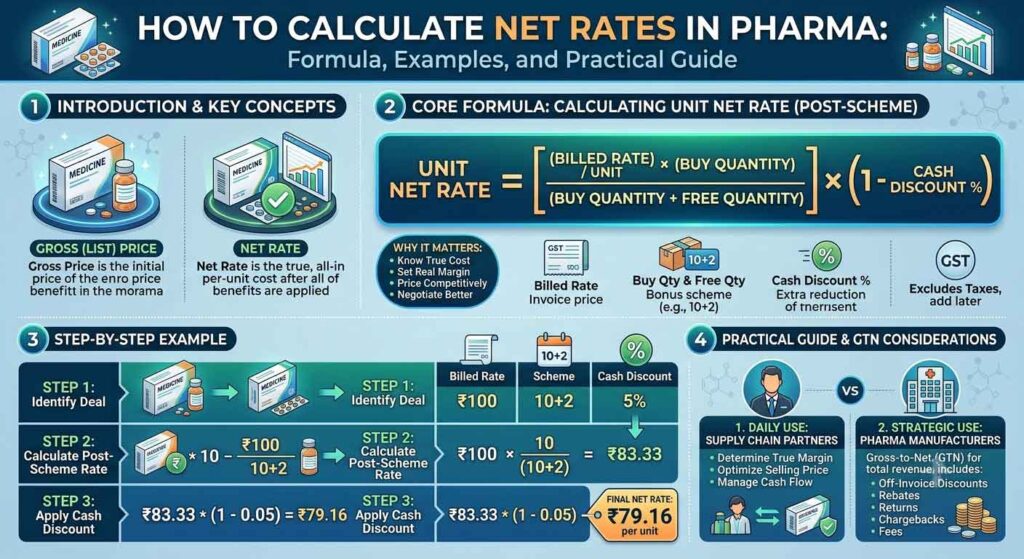
Basic Formula to Calculate Net Rate
A simple formula is:
Net Rate = Cost of Goods + Expenses + Commission + Profit Markup – Discount
If GST is included:
Final Invoice Rate = Net Rate + Applicable GST
In some cases, companies quote rates as GST inclusive. In that case:
GST-Inclusive Net Rate = Base Net Rate + GST
Main Components of Net Rate
1. Cost of Goods
This is the basic product cost.
It may include:
Manufacturing cost
Raw material cost
Packing material cost
Labour cost
Quality-control cost
Third-party manufacturing rate
Product testing cost
Batch documentation cost
For a marketing company, the cost of goods usually means the purchase rate from the manufacturer.
2. Packing Cost
Packing cost may include:
Outer carton
Foil
Label
Bottle
Tube
Cap
Measuring cup
Shipper
Printing charges
Cylinder or plate charges
Packing cost is very important in third-party manufacturing because initial packaging inventory can increase the first-batch cost.
3. GST or Applicable Taxes
GST must be calculated as per product category and applicable tax rate.
It is the price at which retailer buys from stockist or distributor.
PTS
PTS means Price to Stockist.
It is the price at which stockist buys from company or super stockist.
Net Rate
Net rate is the agreed billing rate between seller and buyer.
In franchise business, net rate may be much lower than PTR or PTS because the franchise partner manages its own sales and marketing.
Net Rate in Pharma Franchise Business
In pharma franchise business, companies usually offer products at net rates.
This helps the franchise partner calculate:
Own margin
Doctor promotion budget
Sales team expenses
Distributor margin
Retailer margin
Profitability
Product competitiveness
A franchise party should not select a company only by looking at low net rates.
Also check:
Product quality
Product availability
Packing quality
Company reputation
Promotional support
Monopoly terms
Replacement policy
Delivery time
Payment terms
How to Decide the Right Net Rate
To decide the right net rate, consider the following:
1. Product Cost
Know the actual cost of the product.
2. Competitor Rate
Check market rates of similar products.
3. Product Quality
High-quality products may justify slightly higher rates.
4. MRP
Net rate should allow reasonable margin according to MRP.
5. Distribution Margin
Retailer, stockist and franchise margins must be practical.
6. Promotional Cost
Products requiring heavy promotion may need better margin planning.
7. Freight and GST
Always decide whether freight and GST are included or extra.
8. Payment Terms
Advance payment, COD and credit terms affect pricing.
9. Expiry and Replacement Risk
Slow-moving products may require extra margin to cover expiry risk.
10. Long-Term Sustainability
Rates should be profitable for both company and buyer.
Common Net Rate Calculation Mistakes
Avoid these common mistakes:
Ignoring GST while calculating invoice value
Confusing MRP with net rate
Not including freight
Not adding packing cost
Giving too much discount
Comparing only rates without checking quality
Ignoring expiry and breakage risk
Not calculating distributor and retailer margins
Taking credit risk lightly
Not checking competitor pricing
Forgetting marketing expense
Not considering sales team cost
Practical Net Rate Calculator Method
Use this simple method:
Step 1: Add Direct Cost
Manufacturing cost + packing cost
Step 2: Add Business Expenses
Freight + storage + marketing + salary/commission
Step 3: Add Profit Margin
Add your desired company margin.
Step 4: Subtract Discount
Subtract any discount or scheme offered.
Step 5: Add GST
Add applicable GST if your quoted rate is GST extra.
Step 6: Compare With Market
Compare final rate with competitor rate, MRP and expected buyer margin.
Simple Formula
Net Rate Before GST = Product Cost + Packing Cost + Expenses + Profit – Discount
Final Invoice Rate = Net Rate Before GST + Applicable GST
When Should Net Rate Be Low?
A lower net rate may be required when:
Product is highly competitive
Market has many substitutes
Product is generic
Order quantity is high
Buyer pays advance
Promotional support is low
Product is fast-moving
When Can Net Rate Be Higher?
A higher net rate may be possible when:
Product is unique
Quality is superior
Packing is premium
Brand has strong demand
Promotional support is included
Product has less competition
Supply is reliable
Company offers strong service
Final Thoughts
Net rate calculation is not only a mathematical formula. It is a business decision.
A correct net rate should cover cost, taxes, freight, promotional expenses, commission, risk and profit while still giving enough margin to the buyer.
In pharma franchise and distribution business, net rate should be practical for both parties.
A company should earn profit, and the distributor or franchise partner should also get enough margin to promote and sell the product successfully.
Before finalizing net rates, always calculate:
Product cost
Packing cost
Applicable GST
Freight
Marketing expense
Commission
Discount
Buyer margin
Market competition
MRP feasibility
Good pricing creates long-term business. Wrong pricing creates disputes, low margins and poor sales.
Frequently Asked Questions
1. What is net rate in pharma?
Net rate is the actual billing or supply rate at which a pharma product is sold by one business party to another, before or after GST depending on agreement.
2. Is net rate the same as MRP?
No. MRP is the maximum price charged to the final customer. Net rate is the trade price charged to distributor, stockist, franchise partner or buyer.
3. Is GST included in net rate?
It depends on the company’s quotation. Some companies quote rates as “plus GST,” while others quote “including GST.”
4. How do I calculate net rate before GST?
Use this formula: Product cost + packing cost + expenses + profit – discount.
5. How do I calculate GST-inclusive net rate?
Add applicable GST to the base net rate. For example, if base net rate is 100 and GST is 5%, GST-inclusive rate becomes 105.
6. What is the difference between PTR and net rate?
PTR is the price to retailer. Net rate is the agreed billing rate between seller and buyer. In franchise business, net rate is usually lower than PTR.
7. What is the difference between PTS and net rate?
PTS is price to stockist. Net rate may refer to company-to-franchise or company-to-distributor billing rate depending on business model.
8. Why do net rates vary between companies?
Net rates vary because of differences in manufacturing cost, quality, packing, promotional support, brand value, quantity, GST, freight and company margin.
9. Should I choose the lowest net rate?
Not always. Low rates may indicate low quality, poor packing or weak service. Always compare quality, delivery, documentation and replacement policy.
10. What is the best net rate policy for pharma franchise?
The best policy is one that gives reasonable margin to franchise partners while maintaining product quality, company profit and long-term business stability.
Looking for Ayurvedic Franchise or Distribution Opportunities?
Looking to start an Ayurvedic franchise, become a distributor, or launch your own herbal product range?
Elzac Herbal India offers:
Ayurvedic & Herbal Product Range
Franchise & Distribution Opportunities
Third-Party Manufacturing Services
Product Development Support
Marketing Guidance
PAN India Business Opportunities
Whether you are an entrepreneur, retailer, distributor, or healthcare professional, our team can help you explore the right business opportunity in the growing Ayurvedic sector.
Ajay Kamboj is an entrepreneur and business owners associated with many Ayurvedic and Pharmaceutical start-ups. With years of experience in Ayurvedic product marketing, pharmaceutical distribution, franchise development, and client relationship management, he regularly shares practical business insights based on real-world experiences. His articles focus on business growth, entrepreneurship, customer management, and lessons learned from the healthcare and wellness industry.
One response to “How to Calculate Net Rates in Pharma: Formula, Examples and Practical Guide”
how to put the the formula in excel file for calculation on excel sheet





how to put the the formula in excel file for calculation on excel sheet