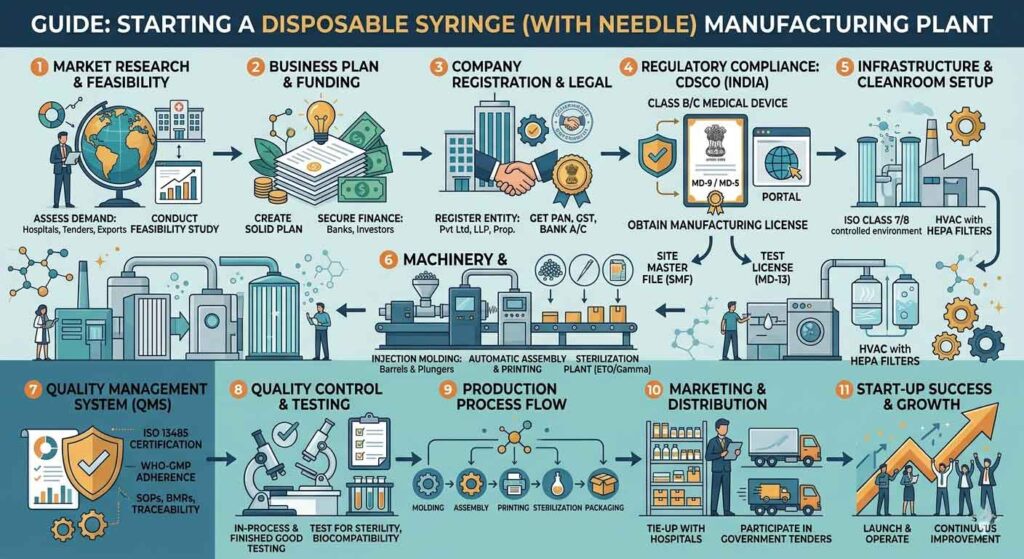
Setting up a disposable syringe factory in India requires compliance with medical-device regulations, proper factory layout, specialized equipment, and quality systems. Disposable syringes (and needles) are notified medical devices under India’s Drugs & Cosmetics Act, so you must obtain a CDSCO (State Drug Control) manufacturing license (Class B medical device) before production. Below is a comprehensive guide covering regulations, factory requirements, costs, suppliers, and quality controls for such a plant.
Regulatory and Licensing Requirements
Medical Device Classification: In India, single-use syringes and needles are regulated as Class B medical devices. The Central Drugs Standard Control Organization (CDSCO) mandates a manufacturing license for these devices. Specifically, you will apply to the State Licensing Authority in Form MD-9 (“Licence to manufacture for sale/distribution of Class A or B devices”). If you already hold a license for Class A/B devices, it remains valid in perpetuity (renewal replaced by retention fee).
Quality Management System: The plant must implement a QMS (e.g. ISO 13485) as per the Fifth Schedule of the Medical Devices Rules. A declaration of QMS compliance is required with the application. Class B device sites undergo an audit by a Notified Body (approved auditor) before license grant. Keep detailed documentation (Device Master File, Plant Master File, SOPs) to support your application.
Personnel: A “competent person” (typically a graduate or diploma in pharmacy/pharmaceutical chemistry/medical device technology) must be appointed as per rules. This individual oversees manufacturing and must be named in the license.
Sterilization Facility: Sterilization is part of manufacturing. You can install an in-house Ethylene Oxide (ETO) sterilizer (common for plastic syringes) or outsource. If you do not have sterilization on-site, you need a loan license (Form MD-6) to use another licensed sterilization facility. (Under MDR 2017, subcontracting sterilization of Class A/B devices requires MD-6.)
Other Licenses/Approvals: Besides the drug license, obtain GST registration and set up a company entity. Secure local approvals: environmental clearance (SPCB/NOC), fire safety, building plan approval, water & effluent treatment (ETO scrubbers), and business permits. If you plan to export, get an Import-Export Code (IEC) and consider obtaining a Export Quality Certificate or Free Sale Certificate (if required by the buyer country).
Standards Compliance: Ensure your products meet Indian/ISO standards. For example, IS 10258:2002 (identical to ISO 7886-1) specifies design and sterility tests for syringes, and IS 10654:2002 (ISO 7864) covers needles. You will need to perform (and document) sterility testing, endotoxin (pyrogen) tests, dimensional and mechanical tests as per these standards.
Factory Layout and Utilities
Production Areas: Plan separate zones for molding, assembly/packaging, and quality control. For basic setup, industry sources recommend ~30 m² for the injection-molding section and ~15 m² for assembly/packaging. The assembly/packaging area must be air-conditioned and equipped with HEPA-filtered air to maintain a clean environment. The molding area should have appropriate ventilation or exhaust (dust-free, with 5-micron filters) and can be non-AC if needed.
Utilities: You need reliable power (depending on machine load, typically 20–50 HP for a small plant), plus backup (generator). Compressed air (oil-free) is needed for injection machines and assembly. Chilled water/cold water is required for cooling the molds (chillers or cooling towers). Purified water is used for any cleaning; ensure storage tanks. Install an ETO sterilization room with gas handling and exhaust scrubber (ethlyene oxide is toxic). Provide compressed and vacuum lines, drainage for any effluent, and proper waste disposal (especially ETO exhaust treatment).
Storage Areas: Allocate space (≥10 m² each) for raw material storage, quarantine, and finished goods. Raw polypropylene and needles should be kept in dust-free, sealed conditions. Sterile finished syringes must be stored in a clean, humidity-controlled area.
Laboratory/QC Room: Include a small QC lab (weighing balance, microscope, camera, etc.) for in-process and final inspection. This room should have basic utilities and be kept clean.
Machinery and Materials
Major Equipment:
The core machinery includes:
Injection Molding Machines: You will need at least one precision injection-press (hydraulic or all-electric) sized for medical syringes. Multiple machines or multi-cavity molds allow high output. These machines melt and mold the polypropylene barrel and plunger parts.
Molds: High-grade steel molds for each syringe size (e.g. 1 mL, 2 mL, 5 mL, 10 mL, 20 mL). Each mold set includes cavities for the barrel, plunger, and possibly tip. Molds must be polished to medical clarity and designed for high-cycle use.
Syringe Assembly Line: An automated assembly machine aligns and inserts needles (and rubber gaskets, if 3-piece design) into the plastic parts. This line typically includes infeed, welding (ultrasonic welding or press-fit), testing (leak/dot) and output.
Screen Printing/Marking Machine: Syringe barrels require scale marks and branding. A precision screen printer or pad-printing unit is used to print graduation lines, logos, etc..
Sterilization Chamber: A medical ETO sterilizer (appropriate volume and controls) is needed to sterilize the assembled syringes. It must include vacuum pump and gas aeration. (Alternatively, contract sterilization at an external ETO facility is possible under a loan license.)
Packaging System: High-speed blister-packing machines to seal syringes in sterile packs. Usually a “blister” or “peel pouch” pack machine is used, sealing each syringe individually with a barrier film.
Auxiliary:Air compressor, vacuum pump, chiller, water pump, scrap grinder, dust collector, weighing scales, and counters. Provide UPS or stable power for control systems.
Raw Materials:
Key inputs include:
Polypropylene Resin: Medical-grade PP pellets (with Certificate of Analysis) for injection molding.
Needles: Stainless steel hypodermic needles (sterile). Note: Needles are also Class B devices; you typically procure these from licensed needle manufacturers. If you plan to produce needles in-house (rare due to complexity), that is a separate venture.
Rubber Gaskets/Plugs: Thermoplastic rubber or silicone gaskets for 3-piece syringes (to seal the plunger).
Ethylene Oxide Gas: For sterilization, often purchased in high-pressure cylinders. Ensure a licensed supplier.
Packaging Materials: Blister film, foils, cartons, labels. Use medical-grade packaging with sterilization compatibility.
Printing Inks: Certified inks for medical products (non-toxic, solvent-resistant) for markings.
Ancillaries: Cleaning solvents, lubricants (special for medical mold), gloves, ethanol, etc.
(“Major raw materials: Polypropylene, Ethylene Oxide, Packing Paper, Needles, Rubber Gaskets etc”) provides a quick list of inputs.
Capital and Operating Costs (Estimated)
A small syringe plant (e.g. ~20,000 pieces/day, 15 staff) is a medium investment venture. For example, a Government pre-feasibility report estimated a total project cost of **₹34.44 lakh** for a 2,000 sq.ft facility. That includes:
Land & Building: Erecting a clean shed (2000 sq.ft). In the KVIC example, this was the bulk of costs (₹27.5L of machinery, with building not explicitly separated).
Machinery & Equipment: Injection moulders (multi-ton capacity each may cost ₹10–20L), assembly line, ETO sterilizer, blister packer, compressors etc. (the KVIC example allocated ₹27.5L to all plant & machinery).
Working Capital: Raw materials (PP resin ~50% of product cost), consumables, utilities (power, ETO gas, water), and salaries. KVIC budgeted ~₹5.5L working capital.
Others: Furniture & fixtures, quality lab setup (~₹1.4L in KVIC).
Typical machine prices (approximate) in India: Injection moulding press (30-50 ton) ₹8–12L; ETO chamber ₹4–6L; blister packer ₹4–6L; compressor ₹1–1.5L; chiller ₹1–1.5L. These vary by vendor and capacity. Add plot preparation, storage racks, and contingencies.
Operating Expenses: Raw materials (PP, needles, ETO) will be the biggest recurring cost. Power consumption is significant (heating/molding machines + chillers + HVAC). Salaries (skilled technicians, operators, QC) for ~10–20 people must be budgeted. Maintenance (mold repair, part replacement) is also ongoing.
Despite costs, disposable syringes have high demand and low variable cost. A consultancy notes India’s syringe demand is very high, so a well-run plant can achieve good margins. (As per KVIC, projected annual sales ~₹109 lakhs vs. raw material 45–55% of costs).
Suppliers and Technical Support
Injection Moulding Machines: You can procure presses from manufacturers like Arburg, Milacron, JSW, Pratishna Engineers (India), or Haitian, Engel (imports). Many machines are sold with medical-grade certification. Ensure the machines have precision controls and clean-room options (e.g. covered barrels).
Syringe Moulds: Specialty toolmakers (e.g. Allied Way India, Anhui Rock Syringe, DKM, etc.) supply custom steel molds for syringes. These must meet high precision and mirror-finish standards.
Assembly/Packaging Lines: Companies like Nichrome, Uflex, BG Unitek offers automated syringe/needle assembly and blister-packing machines. Consult with vendors on medical device automation solutions.
Sterilization Equipment: For ETO sterilizers and related equipment, firms like Tuttnauer, Astell, Spire (formerly Axioma), and Regional Suppliers (Lanco, Korex) provide medical ETO sterilizers. They must comply with ISO 11135 (ETO sterilization standard).
Materials Suppliers: Bulk PP resin can be sourced from petrochemical companies (Reliance, LyondellBasell) or distributors. Needles are typically purchased from established needle manufacturers (e.g. Hindustan Syringes & Medical Devices, ROMSONS, Becton Dickinson India) with drug-device licenses.
Sterilization Services: If you plan to outsource sterilization (loan license route), CDSCO-approved contract sterilization service providers include Friendly Chemicals & Hullox, Regional Drug Testing Labs, etc. (must have an MD license MD-10/MD-6 for their process).
Consultants/Experts: Given the technical complexity, many startups consult experts (e.g. Pharmadocx, Rapidfacto) for plant layout, QMS documentation, and licensing assistance.
(No single “approved” supplier list exists; choose vendors with medical device experience and ensure they meet ISO or BIS standards.)
Quality Control, Testing, and Documentation
Quality assurance is critical for injectable devices:
Standards Testing: Perform all tests as per BIS/ISO standards. IS 10258 (ISO 7886-1) prescribes dimensional accuracy, leakage, and functional tests. Sterility testing (e.g. per ISO 11737) and pyrogen/LAL tests (per IS 12572/ISO 10993) must be done on final batches. Biocompatibility evaluation (ISO 10993 series) is also required (the BIS standard cross-references IS 12572 for guidance).
In-Process Checks: Inspect moulded parts (no flash, correct weight). Test assembled syringes for plunger smoothness and vacuum (to ensure no leaks). Perform sterility challenge on periodic samples (e.g. every lot) as part of validation.
Batch Documentation: Maintain detailed batch records: raw material batch/C of A, machine parameters, quantities produced, in-process QC results, sterilization cycle logs, etc. Per rules, retain at least one sample of each batch.
Quality System: Implement a formal Quality Management System (preferably ISO 13485-certified). Procedures should cover document control, change control, CAPA, internal audits, and complaint handling. A Device Master File (DMF) describing design, and a Plant Master File (PMF) describing facilities/operations should be prepared.
Regulatory Documentation: For the license application, you’ll need project reports, plant layout drawings, process descriptions, list of equipment, list of products (syringe sizes), and personnel qualifications. The Fifth Schedule of MDR 2017 lists GMP/QMS requirements (cleanliness, pest control, validated processes) that inspectors will verify.
Inspection and Audit: The State Licensing Authority (or an appointed Notified Body) will inspect your factory to confirm compliance. Be prepared for an on-site audit of cleanliness (e.g. mention of cleaning procedures allowed in guidance). After passing, you get the license (valid indefinitely with retention fees).
Export Compliance: If exporting, you may need: registration in the destination country, CE marking (ISO 13485 + CE 0123 audit for EU), and possibly a Free Sale Certificate from CDSCO. Ensure your products also comply with any foreign pharmacopeia or device directives.
Final Remarks
Starting a disposable syringe plant is capital-intensive but can be profitable given India’s large demand. Success depends on rigorous quality control, compliance with medical-device regulations, and efficient manufacturing. In summary:
Treat syringes/needles as Class B medical devices requiring CDSCO licensing.
Design your plant for sterile manufacturing: adequate space (≈30+15 m²), HVAC/HEPA filtration, and ETO sterilization.
Invest in precision injection molding and assembly equipment, along with blisters and marking machines.
Hire qualified personnel and implement a ISO 13485-based QMS, maintaining complete documentation.
Prepare for regulatory audits: meet the Fifth Schedule GMP criteria and keep comprehensive batch records.
With proper planning and adherence to these guidelines, you can establish a compliant, high-quality disposable syringe manufacturing facility.
Sources: Indian Medical Device Rules and guidelines; industry project reports; and expert publications.
Partner with Elzac Herbal India
Looking to start an Ayurvedic franchise, become a distributor, or launch your own herbal product range?
Elzac Herbal India offers:
Ayurvedic & Herbal Product Range
Franchise & Distribution Opportunities
Third-Party Manufacturing Services
Product Development Support
Marketing Guidance
PAN India Business Opportunities
Whether you are an entrepreneur, retailer, distributor, or healthcare professional, our team can help you explore the right business opportunity in the growing Ayurvedic sector.
Ajay Kamboj is an entrepreneur and business owners associated with many Ayurvedic and Pharmaceutical start-ups. With years of experience in Ayurvedic product marketing, pharmaceutical distribution, franchise development, and client relationship management, he regularly shares practical business insights based on real-world experiences. His articles focus on business growth, entrepreneurship, customer management, and lessons learned from the healthcare and wellness industry.
33 responses to “How to Start a Disposable Syringe (with Needle) Manufacturing Plant”
I want to start manufacturing of disposablesyringe.Please guide me about documents required.And minimum budgetand building required. Thanks
We want to setup a Disposable Syringes manufacturing plant in Bangladesh. If you can supply complete set up for the said plan please inform us with details by return mail.
Hello, i want to start manufacturing of disposable syringe 3ml/5ml/10 ml but having some query 1) The capital cost for the production is high as molding machine / printing/ assembly machine costing is very high 2) printing and assembly machine are brought from korea so import duty is around 25% 3) So we planing only pack and sterilize the syringe and source the barrel and plunger from 3 party manufacturer 4) with syringe we also re- pack other related product which we sterilize in same facility
My self Hatte I am from ————– I want to start the manufacturing unit of Disposable syringe in Nanded MIDC area, Please help me for more details like Machineries cost Registration cost Raw materials cost Project report.
Dear sir
Can you please tell me full project plan for manufacturing of surgical belt.
Please tell me full details like how to start, where we can purchase raw material, what will be project cost, equipment etc.
Thank you
Awesome blog about how to start a syringe manufacturing plant.
if anyone is looking for medical device consulting services operon strategist will help you.
Services:
Medical Device Manufacturing Consultant | USFDA Consultant |
CDSCO Consultant | Primary Packaging Consultant | iso 13485 Consultant | iso 15378 Consultant
To,CEO, Syringe Manufacturers,Dear Sir/Madam, Some Syringe manufacturers in the world are planning to organize an association about syringe manufacturers at an International level. The name of this association is “International Syringe Manufacturers Association”.This will be the first ever association in history of the world syringe manufacturing. So therefore its scope and value is important for the benefit of the global syringe manufacturers businesses and issues.
As you know that the world governments are going to initiate the covid-19 vaccination program so the association at this global program will have great importance and benefit for world syringe manufacturers.
There is currently total 7.7 billion population of world and the covid-19 vaccination program will thus need about 14.14 billion syringes at this global vaccination initiative. So here in this regards the importance and role of world syringe manufacturers is very important. We request you that if you are willing to join the business community of world syringe manufacturers association then please contact us. This global association will work for the business benefits of its members at global as well as local level.
This association will soon establish its branch offices in every country of the world.Thanks & best regards,
Hi, I wish to start the business of syringes in or near New Delhi so please help me with all the requirements and budget that will be required.
Please do contact as soon as it is possible for on my mail.
Hello .
Sir,I WANT TO START A SYRINGE MANUFACTURING PLANT IN KANPUR NAGAR.
Please help me to getting the full information and knowledge.
As soon as possible
Thanks..!
हेलो सर मेरा नाम कुलदीप सिंह है और मैं एक छोटे स्तर पर निर्माण इकाई लगाना चाहता हूं सिरिंज कहां बेचना और किस कंपनी को बेचना है कृपया मेरा मार्गदर्शन करें
Hii my self abhishek yadav I want to open a syringe manufacturing plant in Ghazipur Uttar Pradesh can you help me to get a full knowledge of this thank you



I want to start manufacturing of disposablesyringe.Please guide me about documents required.And minimum budgetand building required. Thanks
I want to start manufacturing of disposablesyringe.Please guide me about documents required.And minimum budgetand building required. Thanks
We want to setup a Disposable Syringes manufacturing plant in Bangladesh. If you can supply complete set up for the said plan please inform us with details by return mail.
Hello, i want to start manufacturing of disposable syringe 3ml/5ml/10 ml but having some query 1) The capital cost for the production is high as molding machine / printing/ assembly machine costing is very high 2) printing and assembly machine are brought from korea so import duty is around 25% 3) So we planing only pack and sterilize the syringe and source the barrel and plunger from 3 party manufacturer 4) with syringe we also re- pack other related product which we sterilize in same facility
My self Hatte I am from ————–
I want to start the manufacturing unit of Disposable syringe in Nanded MIDC area,
Please help me for more details like
Machineries cost
Registration cost
Raw materials cost
Project report.
Thank You for this.
Dear sir
Can you please tell me full project plan for manufacturing of surgical belt.
Please tell me full details like how to start, where we can purchase raw material, what will be project cost, equipment etc.
Thank you
Please let me know which grade silicon oil need for syringe’s barrel and plunger lubrication process and where are available the silicon oil in india
Tell me the what amount will invest in syringe factory
Hi contact me I stay in Thane we are looking for investing in Syringe Manufacturing
I am interested to start manufacturing of Disposable Syringes with Needles.
Kindly suggest total cost of project along with market and profit.
I want started disposal machines
Please guide me how can start and how much cost
9711370284
I want disposal syring manufacturing
Factory so plz guide invest nd income nd required docoment
I want to setup disposable syringe small budget want to knw about 3rd party menufacture please contact us give your support
Reply
I am interested to start manufacturing of Disposable Syringes with Needles.
Kindly suggest total cost of project along with market and profit.
I want to start manufacturing of disposablesyringe.Please guide me about documents required.And minimum budgetand building required. Thanks
Awesome blog about how to start a syringe manufacturing plant.
if anyone is looking for medical device consulting services operon strategist will help you.
Services:
Medical Device Manufacturing Consultant | USFDA Consultant |
CDSCO Consultant | Primary Packaging Consultant | iso 13485 Consultant | iso 15378 Consultant
To,CEO, Syringe Manufacturers,Dear Sir/Madam, Some Syringe manufacturers in the world are planning to organize an association about syringe manufacturers at an International level. The name of this association is “International Syringe Manufacturers Association”.This will be the first ever association in history of the world syringe manufacturing. So therefore its scope and value is important for the benefit of the global syringe manufacturers businesses and issues.
As you know that the world governments are going to initiate the covid-19 vaccination program so the association at this global program will have great importance and benefit for world syringe manufacturers.
There is currently total 7.7 billion population of world and the covid-19 vaccination program will thus need about 14.14 billion syringes at this global vaccination initiative. So here in this regards the importance and role of world syringe manufacturers is very important. We request you that if you are willing to join the business community of world syringe manufacturers association then please contact us. This global association will work for the business benefits of its members at global as well as local level.
This association will soon establish its branch offices in every country of the world.Thanks & best regards,
mail us at pharmafranchiseehelp@gmail.com
Hi, I wish to start the business of syringes in or near New Delhi so please help me with all the requirements and budget that will be required.
Hi, I wish to start the business of syringes in or near New Delhi so please help me with all the requirements and budget that will be required.
Please do contact as soon as it is possible for on my mail.
Hi, I want to start a syringe manufacturing plat in Maharashtra . kindly help regarding this business with full information .
Hello , I want to start a syringe manufacturing unit setup in Sikkim. kindly help regarding this business with full information.
Interested in disposable medical syringes manufacturing full production line requirements. Kindly assist with the necessary information
Sir, I want to start the business please guide me regarding every thing including total budget ..
Hello .
Sir,I WANT TO START A SYRINGE MANUFACTURING PLANT IN KANPUR NAGAR.
Please help me to getting the full information and knowledge.
As soon as possible
Thanks..!
I want to start manufacturing of disposablesyringe.Please guide me about documents required.And minimum budget and building required. Thanks
I want to start manufacturing of disposablesyringe.Please guide me about documents required.And minimum budget and building required. Thanks
हेलो सर मेरा नाम कुलदीप सिंह है और मैं एक छोटे स्तर पर निर्माण इकाई लगाना चाहता हूं सिरिंज कहां बेचना और किस कंपनी को बेचना है कृपया मेरा मार्गदर्शन करें
Hii my self abhishek yadav I want to open a syringe manufacturing plant in Ghazipur Uttar Pradesh can you help me to get a full knowledge of this thank you
hi i want to start syringe manufacturing business can you provide me all details. if any big firm franchise details to helf growing busines.
I want to start business in syringes manufacturing pl guide me