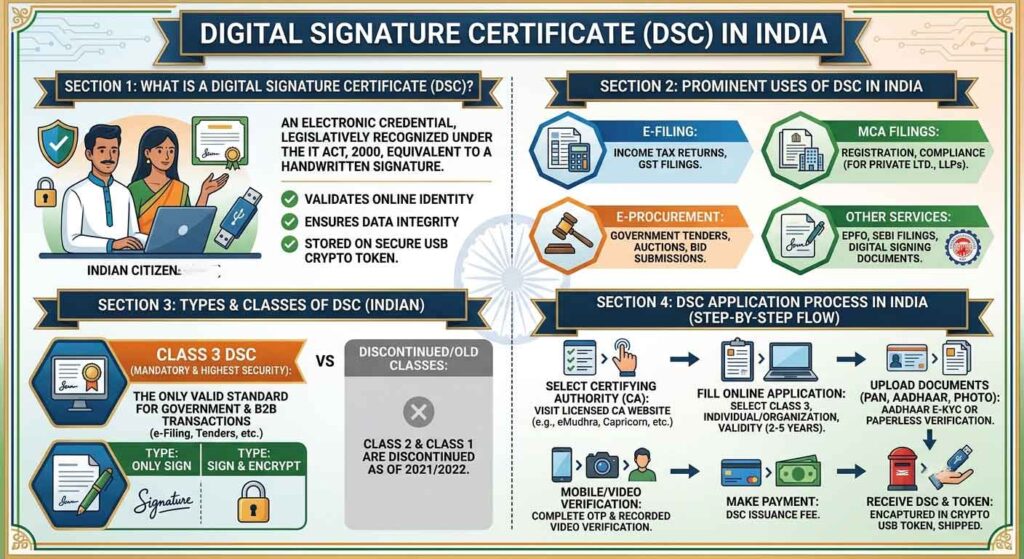
A Digital Signature Certificate, commonly called a DSC, is an electronic certificate used to verify the identity of a person or organization while signing documents online.
In simple words, a DSC works like an online identity proof and digital signing tool. Just as a handwritten signature confirms your approval on a physical document, a digital signature confirms your identity and approval on an electronic document.
Today, Digital Signature Certificates are widely used for company registration, income tax filing, GST work, trademark applications, tender filing, e-procurement, MCA filings and many other online government and business services.
Quick Answer
A Digital Signature Certificate is an electronic certificate issued by a licensed Certifying Authority. It helps individuals, companies and professionals sign documents online securely and prove their identity on digital platforms.
It is commonly required for:
Company registration
MCA filings
Trademark applications
Income tax filing
GST-related work
E-tendering
E-procurement
Signing PDF documents
Professional certifications
Business compliance filings
What Is a Digital Signature?
A digital signature is an electronic method of signing online documents, forms, files and applications.
It confirms:
Who signed the document
Whether the document was changed after signing
Whether the signature is valid
Whether the signer can be authenticated
A digital signature uses cryptographic technology to protect the authenticity and integrity of an electronic document.
What Is a Digital Signature Certificate?
A Digital Signature Certificate is an electronic certificate that contains identity details of the certificate holder.
It may include:
Name of the individual or organization
Email address
PAN details, where applicable
Organization name, where applicable
Certifying Authority details
Public key
Validity period
Certificate serial number
The DSC is issued by a licensed Certifying Authority after verifying the applicant’s identity and address.
Why Is a Digital Signature Certificate Required?
A DSC is required because many online portals need legally valid authentication before accepting forms, returns, applications or documents.
It provides:
Identity verification
Document authentication
Data integrity
Secure online transactions
Legal recognition for digital signing
Protection against document tampering
Proof that a specific person signed the document
Without DSC, many professional and government filings cannot be completed.
Legal Validity of Digital Signature in India
Digital signatures are legally recognized in India under the Information Technology Act, 2000.
A valid DSC issued by a licensed Certifying Authority can be used for electronic authentication and online signing of documents.
This makes digitally signed documents legally acceptable for many official and commercial purposes.
Where Is DSC Used?
A Digital Signature Certificate is used on many government and business platforms.
Common uses include:
1. Company Registration
A DSC is required for many filings on the Ministry of Corporate Affairs portal, including company incorporation and compliance forms.
Directors, designated partners and authorized signatories often need DSC for MCA-related filings.
2. Trademark Registration
DSC may be required for online trademark filing, especially when applications are filed by professionals, companies or authorized representatives.
3. Income Tax Filing
DSC is used for signing income tax returns, statutory forms, responses to notices and certain verification processes on the Income Tax e-filing portal.
Companies and certain taxpayers may require DSC for return verification.
4. GST Compliance
DSC may be used for signing GST applications, returns or documents, especially in the case of companies and LLPs.
5. E-Tendering and E-Procurement
Government tenders and procurement portals often require DSC for bid submission, document signing and authentication.
6. Signing PDF and Business Documents
DSC can be used to digitally sign:
Agreements
Invoices
Declarations
Audit reports
Certificates
Authorizations
Application forms
Compliance documents
7. Import Export and DGFT Work
Businesses involved in import-export activities may require DSC for DGFT-related filings and online applications.
8. Professional Filings
Chartered Accountants, Company Secretaries, Cost Accountants, advocates and consultants often use DSC for certifying or filing documents on behalf of clients.
Benefits of Digital Signature Certificate
A DSC offers several benefits:
Saves time in online filings
Reduces physical paperwork
Provides legal authentication
Improves document security
Helps prevent forgery
Supports paperless compliance
Enables faster government and business transactions
Can be used from anywhere with a valid token and system setup
Who Issues Digital Signature Certificates?
Digital Signature Certificates are issued by licensed Certifying Authorities.
These Certifying Authorities operate under the framework of the Controller of Certifying Authorities in India.
Common licensed Certifying Authorities include:
eMudhra
SafeScrypt
nCode
Capricorn
VSign
PantaSign
IDSign
XtraTrust
ProDigiSign
SignX
Care4Sign
RISL / RajComp
Before applying, always check the latest list of licensed Certifying Authorities on the official CCA website.
Classes of Digital Signature Certificates
Digital Signature Certificates are issued in different classes depending on the level of identity verification and intended use.
Class 1 DSC
Class 1 DSC is generally used for basic identity verification.
It provides a lower level of assurance and is suitable for limited use cases where basic authentication is sufficient.
Class 2 DSC
Class 2 DSC was earlier widely used for many filings. However, many portals and applications now prefer or require higher-assurance certificates.
Users should check the specific portal requirement before purchasing.
Class 3 DSC
Class 3 DSC provides a higher level of identity verification.
It is commonly used for:
MCA filings
Company registration
E-tendering
E-procurement
Trademark filing
GST and income tax use cases
Professional and business compliance work
For most business and professional purposes, Class 3 DSC is generally preferred.
Types of Digital Signature Certificates
Digital Signature Certificates may be issued for different purposes.
1. Signature Certificate
A Signature Certificate is used to digitally sign documents, forms and files.
It proves that the document has been signed by the certificate holder and that the document has not been altered after signing.
Common uses:
MCA forms
Income tax forms
PDF signing
Tender documents
Agreements
Declarations
2. Encryption Certificate
An Encryption Certificate is used to encrypt data and messages.
It helps protect confidential information so that only the intended recipient can access it.
This is useful where secure data exchange is required.
3. SSL Certificate
An SSL certificate is used for websites and servers.
It helps secure communication between a website and users by enabling HTTPS.
SSL certificates are commonly used by:
Business websites
E-commerce stores
Web applications
Online portals
Payment-related platforms
4. Code Signing Certificate
A Code Signing Certificate is used by software developers and companies to sign software, applications, scripts and code.
It helps users verify that the software came from a trusted source and has not been modified after signing.
5. Document Signing Certificate
A Document Signing Certificate is used to authenticate documents in digital form.
It is commonly used for:
PDF documents
Certificates
Reports
Official records
Business documents
Individual DSC vs Organization DSC
Individual DSC
An Individual DSC is issued in the name of a person.
It may be used by:
Directors
Proprietors
Partners
Professionals
Authorized signatories
Consultants
Individual taxpayers
Organization DSC
An Organization DSC includes organization details along with the individual holder’s details.
It may be used by:
Companies
LLPs
Partnership firms
Trusts
Societies
Institutions
Authorized company signatories
The required type depends on the portal and purpose of use.
Validity of Digital Signature Certificate
A DSC is generally issued for a limited validity period, commonly one, two or three years depending on the Certifying Authority and product selected.
After expiry, the DSC must be renewed or a new DSC must be obtained.
A DSC may also need to be re-registered on portals such as Income Tax or MCA after renewal.
Documents Required for DSC
Document requirements may vary depending on the applicant type and Certifying Authority.
For Individuals
Commonly required documents include:
PAN card
Aadhaar card
Passport, voter ID or driving licence
Address proof
Mobile number
Email ID
Passport-size photograph
Video verification or eKYC, where applicable
For Companies or Organizations
Commonly required documents may include:
PAN of authorized signatory
Identity proof of authorized signatory
Address proof of authorized signatory
Company PAN
Certificate of Incorporation
Memorandum and Articles of Association, where applicable
Board resolution or authorization letter
GST certificate, where applicable
Organization address proof
Email ID and mobile number
The final document list should be confirmed with the selected Certifying Authority.
How to Apply for a Digital Signature Certificate
The application process is generally simple.
Step 1: Choose a Licensed Certifying Authority
Select a CCA-licensed Certifying Authority or its authorized registration partner.
Step 2: Select DSC Type
Choose whether you need:
Individual DSC
Organization DSC
Signature DSC
Encryption DSC
Class 3 DSC
Tender DSC
Step 3: Fill the Application Form
Enter applicant details such as name, PAN, email ID, mobile number and address.
Step 4: Complete KYC Verification
KYC may be completed through:
Aadhaar eKYC
PAN verification
Video verification
Document upload
Physical verification, where required
Step 5: Make Payment
Pay the applicable DSC fee based on type, class and validity.
Step 6: Receive USB Token
For many DSC uses, the certificate is stored in a USB crypto token.
This token must be safely kept because it contains the private key used for signing.
Step 7: Install Token Driver and Utility
Install the required driver and signing utility such as emSigner or emBridge depending on the portal.
Step 8: Register DSC on Required Portal
After receiving the DSC, register or associate it on the relevant portal such as:
MCA
Income Tax
GST
Trademark portal
E-tender portal
Important Safety Tips
Never share your DSC token password.
Keep the USB token in safe custody.
Do not give your DSC to unauthorized persons.
Change the default token password.
Renew the DSC before expiry.
Use only licensed Certifying Authorities.
Verify portal requirements before buying DSC.
Keep your PAN, email and mobile number consistent.
Re-register renewed DSC on required portals.
Common Mistakes to Avoid
Avoid these mistakes:
Buying the wrong class of DSC
Applying with mismatched PAN details
Not checking portal-specific requirements
Losing USB token password
Sharing DSC token with staff or agents
Not renewing DSC on time
Using expired DSC for filing
Not installing correct signing utility
Not registering DSC on the required portal before filing
Difference Between Digital Signature and Digital Signature Certificate
A digital signature is the electronic signing method.
A Digital Signature Certificate is the certificate issued by a Certifying Authority that enables a person or organization to create valid digital signatures.
In simple terms:
DSC is the identity certificate.
Digital signature is the actual electronic signature applied using that certificate.
Final Thoughts
A Digital Signature Certificate is now an essential tool for online business, compliance and government filings in India.
Whether you are starting a company, filing income tax, applying for a trademark, participating in tenders or signing business documents, a DSC helps you complete the process securely and legally.
Before applying, check the exact requirement of the portal where you want to use it and select the correct type and class of certificate.
Frequently Asked Questions
1. What is a Digital Signature Certificate?
A Digital Signature Certificate is an electronic certificate used to verify identity and digitally sign documents online.
2. Is DSC legally valid in India?
Yes. A DSC issued by a licensed Certifying Authority is legally recognized in India for electronic authentication.
3. Which DSC is required for company registration?
For company registration and MCA filings, Class 3 DSC is commonly used by directors, designated partners and authorized signatories.
4. Can one DSC be used on multiple portals?
Yes, one valid DSC can often be used on multiple portals, provided it meets the required class, type and identity details required by those portals.
5. Is DSC required for income tax filing?
DSC is required for certain users and services, such as company return verification and statutory forms. Other taxpayers may have alternative verification options depending on the situation.
6. What is a USB token in DSC?
A USB token is a secure hardware device used to store the digital signature certificate and private key.
7. What is the validity of DSC?
A DSC is usually valid for a fixed period such as one, two or three years, depending on the certificate purchased.
8. Can I renew my DSC?
Yes. A DSC can be renewed or reissued before or after expiry, depending on the Certifying Authority’s process.
9. What happens if my DSC expires?
You cannot use an expired DSC for signing. You must renew it and re-register it on relevant portals.
10. Who can issue DSC in India?
Only licensed Certifying Authorities recognized under the Controller of Certifying Authorities framework can issue valid DSCs in India.
Looking for Ayurvedic Franchise or Distribution Opportunities?
Looking to start an Ayurvedic franchise, become a distributor, or launch your own herbal product range?
Elzac Herbal India offers:
Ayurvedic & Herbal Product Range
Franchise & Distribution Opportunities
Third-Party Manufacturing Services
Product Development Support
Marketing Guidance
PAN India Business Opportunities
Whether you are an entrepreneur, retailer, distributor, or healthcare professional, our team can help you explore the right business opportunity in the growing Ayurvedic sector.
Ajay Kamboj is an entrepreneur and business owners associated with many Ayurvedic and Pharmaceutical start-ups. With years of experience in Ayurvedic product marketing, pharmaceutical distribution, franchise development, and client relationship management, he regularly shares practical business insights based on real-world experiences. His articles focus on business growth, entrepreneurship, customer management, and lessons learned from the healthcare and wellness industry.





Leave a Reply
You must be logged in to post a comment.