What Does 10×10 Packing, Alu-Alu, Blister Pack & 10+1 Offer Mean in Pharma Franchise Business?

If you are planning to start a Pharma Franchise (PCD) business, you will frequently encounter terms such as:

  • 10×10 Packing
  • 10×6 Packing
  • Alu-Alu Packing
  • Blister Packing
  • Mono Carton
  • Outer Carton
  • PET Bottle
  • Vials
  • Ampoules
  • 10+1 Offer
  • 30+10 Scheme

For newcomers, these terms can be confusing. Understanding them is important because packaging affects product quality, shelf life, pricing, transportation, and ultimately your profitability.

This guide explains the most common pharmaceutical packaging terms and how to evaluate companies before starting a franchise business.

What Does 10×10 Packing Mean?

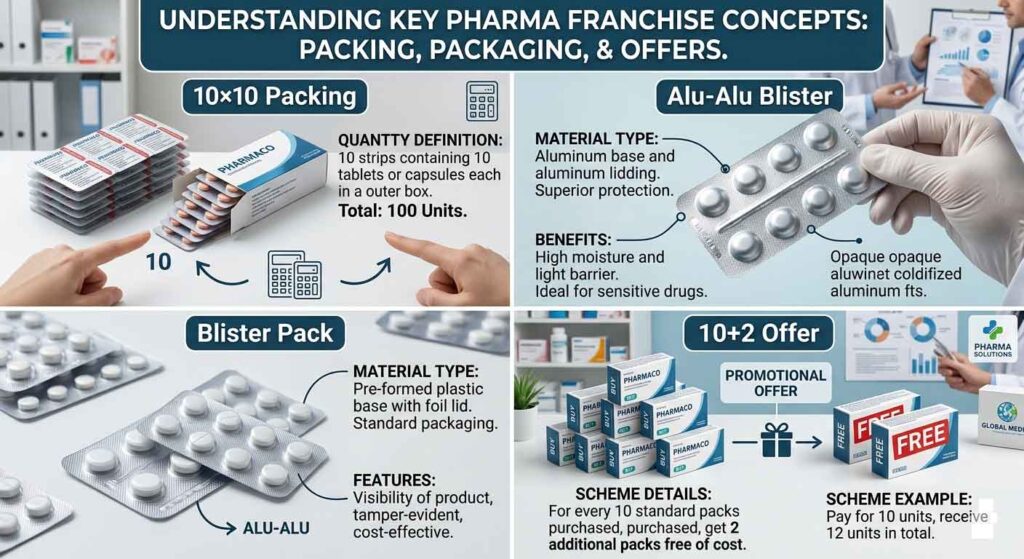
The format 10×10 refers to:

  • 10 strips inside one box
  • 10 tablets or capsules in each strip

Total quantity:

10 × 10 = 100 tablets/capsules per box

Example

A tablet pack labeled:

10×10

Contains:

  • 10 strips
  • Each strip contains 10 tablets
  • Total = 100 tablets

What Does 10×6 Packing Mean?

The format 10×6 means:

  • 10 strips in one box
  • 6 tablets/capsules per strip

Total quantity:

10 × 6 = 60 tablets/capsules per box

Different companies use different pack sizes depending on market demand and product category.

What Is Alu-Alu Packaging?

Alu-Alu (Aluminium-Aluminium) packaging uses aluminum foil on both the upper and lower sides of the strip.

Advantages of Alu-Alu Packing

✔ Better protection against moisture

✔ Better protection against light

✔ Improved product stability

✔ Longer shelf life

✔ Premium appearance

Alu-Alu packing is commonly used for moisture-sensitive medicines and premium pharmaceutical products.

What Is Blister Packaging?

In blister packing:

  • The bottom layer is aluminum foil.
  • The top layer is PVC or similar transparent material.

This allows customers to see the tablets or capsules inside the strip.

Advantages of Blister Packing

✔ Economical

✔ Lightweight

✔ Attractive appearance

✔ Easy product identification

Blister packs are widely used for general pharmaceutical products.

What Is a Mono Carton?

A mono carton is the printed box that contains the medicine.

It typically displays:

  • Product name
  • Composition
  • Batch number
  • Manufacturing date
  • Expiry date
  • MRP
  • Manufacturer information

Mono cartons improve branding and product presentation.

What Is an Outer Carton?

The outer carton is the larger box used to pack multiple mono cartons.

Benefits include:

  • Protection during transport
  • Easier storage
  • Reduced product damage

What Are PET Bottles?

PET (Polyethylene Terephthalate) bottles are commonly used for:

Advantages include:

✔ Lightweight

✔ Durable

✔ Cost-effective

✔ Easy handling

What Are Vials?

Vials are small containers used for:

  • Injectable medicines
  • Vaccines
  • Specialized formulations

They may be made from glass or plastic depending on the product.

What Are Ampoules?

Ampoules are sealed glass containers used primarily for injectable medications.

Advantages include:

✔ Sterility

✔ Tamper resistance

✔ Accurate dosing

They are commonly used in hospitals and clinical settings.

What Do Free Schemes Like 10+1 Mean?

A scheme such as:

10+1

Means:

  • Purchase 10 units
  • Receive 1 units free

The “unit” may refer to:

  • Boxes
  • Bottles
  • Strips
  • Pieces

depending on the company’s scheme.

What Does 30+10 Mean?

A 30+10 scheme means:

  • Purchase 30 units
  • Receive 10 units free

Such schemes effectively increase margins and are often used for promotional campaigns.

Example

If you buy:

30 boxes

You receive:

10 additional boxes free

Total received:

40 boxes

Are Higher Free Schemes Always Better?

Not necessarily.

Many new franchise partners focus only on free schemes.

However, you should also evaluate:

  • Product quality
  • Market demand
  • Product availability
  • Doctor acceptance
  • Customer service

A slightly lower scheme with better product quality can often generate more long-term business.

How to Choose Between Multiple Pharma Franchise Companies?

Suppose you receive offers from three different companies.

How do you decide?

Compare Product Quality

Product quality should always come first.

Quality products generate:

✔ Repeat prescriptions

✔ Customer satisfaction

✔ Long-term business growth

Compare Product Availability

Ask:

  • How frequently do products go out of stock?
  • What is the dispatch time?
  • How reliable is supply?

Availability directly impacts your sales.

Compare Product Portfolio

Evaluate:

  • Number of products
  • Product categories
  • Specialty products
  • Fast-moving products

A broader portfolio creates more opportunities.

Compare Pricing and Margins

Review:

  • Net rates
  • MRP
  • Retail margins
  • Franchise margins

Do not focus only on the lowest rates.

Compare Packaging Quality

Attractive packaging can improve product perception and market acceptance.

Evaluate:

  • Design quality
  • Printing quality
  • Strip quality
  • Product presentation

Compare Marketing Support

Ask whether the company provides:

  • Visual aids
  • Product cards
  • Samples
  • Promotional materials

Marketing support can significantly help in building your territory.

Speak to Authorized Company Representatives

Before finalizing any company:

  • Discuss terms clearly.
  • Clarify payment policies.
  • Understand monopoly rights.
  • Review support commitments.

Good communication reduces future misunderstandings.

Final Thoughts

Understanding pharmaceutical packaging terminology helps you make better business decisions when evaluating products and franchise opportunities.

While packaging, pricing, and free schemes are important, the most successful franchise businesses focus on:

✔ Product quality

✔ Product availability

✔ Customer service

✔ Marketing support

✔ Long-term business relationships

Always compare multiple companies before making a final decision and focus on overall value rather than just promotional offers.

Frequently Asked Questions (FAQs)

What does 10×10 packing mean?

It means a box contains 10 strips, and each strip contains 10 tablets or capsules, for a total of 100 units.

Which is better: Alu-Alu or Blister packing?

Alu-Alu packing generally provides better protection against moisture and light, while blister packing is more economical and widely used.

What does 10+1 scheme mean?

It means you receive 1 additional units free when purchasing 10 units.

Should I select a company based only on free schemes?

No. Product quality, stock availability, service, and market demand are often more important than free schemes.

Why is packaging important in pharma products?

Packaging protects products, improves shelf life, supports branding, and influences customer perception.

What should I compare before selecting a Pharma Franchise company?

Compare product quality, pricing, stock availability, packaging, marketing support, company reputation, and customer service.

Looking for a Reliable Ayurvedic Franchise Partner?

At Elzac Herbal India, we believe that quality products, professional packaging, transparent business practices, and reliable service are the foundation of long-term success.

Why Choose Elzac Herbal India?

✔ Extensive Ayurvedic & Herbal Product Range

✔ Attractive Packaging & Branding

✔ Franchise & Distribution Opportunities

✔ Marketing Support Materials

✔ Competitive Business Margins

✔ Reliable Product Availability

✔ Long-Term Partnership Focus

Whether you are new to Pharma Franchise marketing or an experienced distributor, our team is ready to help you build a successful healthcare business.

Contact today to request product catalog, franchise brochure, and partnership information.

Ajay Kamboj

Ajay Kamboj is an entrepreneur and business owners associated with many Ayurvedic and Pharmaceutical start-ups. With years of experience in Ayurvedic product marketing, pharmaceutical distribution, franchise development, and client relationship management, he regularly shares practical business insights based on real-world experiences. His articles focus on business growth, entrepreneurship, customer management, and lessons learned from the healthcare and wellness industry.

Leave a Reply