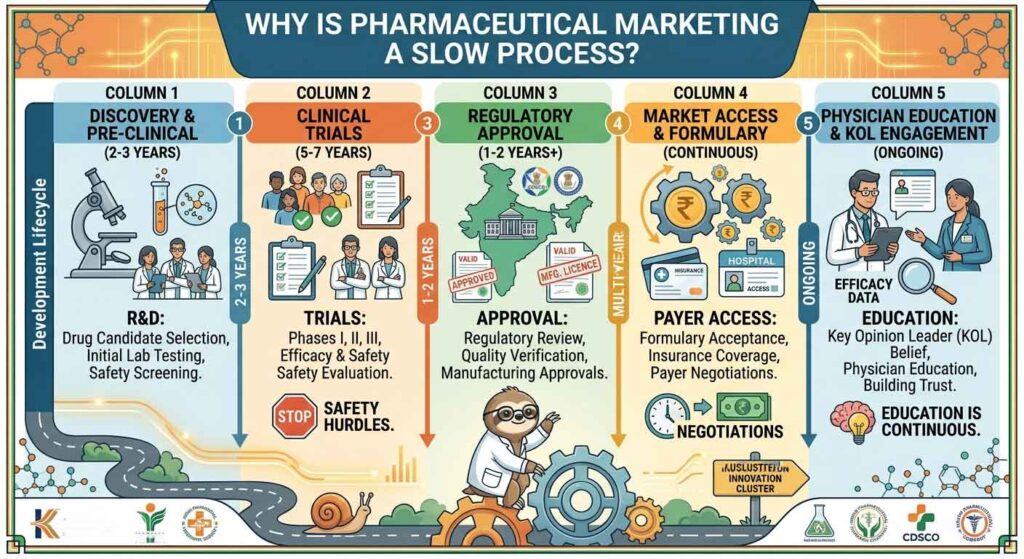
Skipping any one of these stages can slow the entire process.
For example, a doctor may prescribe your brand, but if it is unavailable at the pharmacy, the prescription may convert into a competitor’s product.
Similarly, a distributor may purchase your product once, but unless it moves from the distributor to retailers and finally to consumers, there may be no repeat order.
1. Pharmaceutical Marketing Is Based on Trust
A new consumer brand may sometimes generate sales after:
One advertisement
A discount
Social-media exposure
Influencer promotion
Prescription pharmaceutical marketing is very different.
A healthcare professional considers matters such as:
Active ingredient
Strength
Dosage form
Quality
Manufacturer
Clinical usefulness
Safety
Availability
Patient affordability
Previous experience with the product
A new medical representative generally cannot expect a doctor to begin prescribing a completely unfamiliar brand after one visit.
Trust normally develops over repeated interactions.
The Pharma Brand Adoption Cycle
A typical prescription-brand journey may look like:
Stage 1 — Recognition
The doctor first learns:
Company name
Brand name
Composition
Stage 2 — Understanding
The doctor understands:
Indication
Product positioning
Strength
Dosage
Relevant product information
Stage 3 — Trial
The doctor may prescribe the product for a limited number of suitable patients.
Stage 4 — Experience
The doctor observes:
Patient response
Tolerability
Availability
Affordability
Stage 5 — Repeat Prescription
If the experience is satisfactory, prescribing may increase.
Stage 6 — Brand Recall
The brand may eventually become one of the doctor’s regularly considered options.
This process cannot reliably be completed in one or two calls.
2. Prescription Pharma Has More Than One Decision-Maker
The person who consumes the medicine is often not the only person influencing the purchase.
A typical prescription sale may involve:
Pharma Company
↓
Medical Representative
↓
Doctor
↓
Prescription
↓
Pharmacy
↓
Patient
↓
Distributor Replenishment
This makes pharmaceutical marketing a multi-stage process.
A problem at any point can result in a lost sale.
Example
Suppose a doctor starts prescribing your brand.
But:
Pharmacy does not stock it.
Distributor does not know your company.
Stockist has no inventory.
Product takes four days to arrive.
The prescription may be substituted or the patient may purchase another available product.
Therefore:
Prescription generation without distribution creates weak sales.
3. Doctors Do Not Change Established Brands Easily
Doctors may already have experience with several competing brands containing the same molecule.
Your new company may therefore be competing against products that have been prescribed for:
Months
Years
Thousands of patients
The new brand must establish a reason to be considered.
That reason should be legitimate and relevant, such as:
Consistent quality
Appropriate formulation
Reliable availability
Patient affordability
Useful dosage form
Scientific communication
Dependable company service
Simply saying:
“Our quality is best.”
is unlikely to differentiate the product.
4. Competition Is Very High
Pharmaceutical markets frequently contain many companies selling the same or similar formulations.
For example, a commonly used molecule may be available from:
Large national companies
Regional companies
Generic companies
PCD companies
Local marketing companies
A doctor or retailer may therefore receive several competing product presentations.
The problem is not merely entering the market.
The challenge is obtaining sufficient share of attention and repeat business.
5. Pharma Promotion Is Regulated
Pharmaceutical marketing cannot use every promotional technique available to ordinary consumer businesses.
The Drugs and Magic Remedies (Objectionable Advertisement) Act restricts advertisements concerning specified diseases and prohibits misleading advertisements relating to drugs.
UCPMP also governs ethical pharmaceutical marketing and interactions with healthcare professionals. The Department of Pharmaceuticals’ current UCPMP portal describes it as a mandatory code applicable to pharma companies, employees, agents and third parties acting on their behalf.
This means companies must avoid practices such as:
Unsupported claims
Misleading comparisons
Improper inducements
Non-compliant gifts
Improper hospitality
Manipulative promotion
Pharmaceutical marketing must therefore build demand within a more controlled environment.
6. Price Regulation Can Affect Marketing Strategy
Pharmaceutical companies cannot always change pricing exactly as they would in an ordinary consumer market.
Scheduled formulations are subject to ceiling-price controls under DPCO 2013, and NPPA continues to administer pharmaceutical pricing requirements.
For non-scheduled formulations, companies have greater freedom over trade margins, but NPPA still operates within the DPCO pricing framework.
This affects decisions relating to:
MRP
PTR
Distributor margins
Product launch
Schemes
Profitability
A regulatory or price change may therefore require the company to modify its commercial strategy.
7. New Product Launch Does Not Guarantee Demand
Another common mistake is:
“We have launched 100 products, therefore sales should increase.”
A large product list does not automatically create demand.
Every product needs:
Target customers
Correct positioning
Promotion
Distribution
Stock
Sales follow-up
A smaller range of 30 actively marketed products may generate more business than 300 poorly supported products.
8. Pharma Marketing Requires Repeated Calls
Medical representatives normally need repeated interactions to develop:
Recognition
Product understanding
Professional relationship
Brand recall
A first call may simply introduce the company.
A later call may explain the product.
Another may reinforce the indication.
Further visits may develop familiarity.
Therefore, judging an MR after only a few doctor visits can be misleading.
Pharma Marketing Is Cumulative
Think of it as:
Call 1: Who is this company?
Call 2: I remember the company.
Call 3: I remember the product.
Call 4: I understand its positioning.
Later: I may consider prescribing it where appropriate.
The exact number of interactions varies considerably, but the principle is important:
Repeated quality interactions build recall.
9. Distribution Takes Time to Develop
Prescription generation is only half the process.
Products also need to be available through:
Stockists
Distributors
Retailers
Hospital pharmacies
A strong distribution network takes time because channel partners evaluate:
Product movement
Margins
Credit
Expiry
Company reputation
Supply reliability
A distributor may initially keep only small quantities until secondary sales develop.
Primary Sale Can Create a False Impression
Suppose you invoice:
₹5 lakh to a distributor.
That is primary sales.
But the distributor sells only:
₹1.5 lakh to retailers.
Your true market movement is much weaker than the ₹5 lakh primary billing suggests.
Therefore, monitor:
Primary sales
Secondary sales
Closing stock
Repeat orders
Expiry
Retail availability
10. Repeat Business Takes Time
The first order is not enough to judge whether a pharmaceutical brand has succeeded.
The business becomes meaningful when you see:
First Order → Product Movement → Repeat Order → Higher Repeat Order
This is especially important in PCD pharma.
A franchise partner purchasing ₹50,000 once and never ordering again is less valuable than a partner purchasing ₹25,000 every month.
11. PCD Pharma Marketing Is Slow for Different Reasons
PCD pharma marketing does not depend on doctor conversion at the company’s central level in exactly the same way as ethical marketing.
Here the company must first generate and convert a franchise partner.
The cycle may be:
PCD Lead
↓
Telephone Discussion
↓
Product List
↓
Price List
↓
Territory Discussion
↓
Company Verification
↓
Product Selection
↓
Drug Licence/GST Verification
↓
First Order
↓
Local Marketing
↓
Repeat Order
The potential franchisee may compare many companies before making a decision.
Therefore, receiving 100 enquiries does not mean receiving 100 franchise orders.
Why PCD Leads Take Time to Convert
Potential partners may compare:
Net rates
Product range
MRP
Monopoly availability
Manufacturing quality
Promotional material
Minimum order
Payment terms
Expiry policy
Company reputation
The sales team needs systematic follow-up.
12. Generic Pharma Marketing Works Differently
Generic marketing is generally more trade-oriented.
Important factors include:
Competitive price
Retailer margin
Product availability
Product range
Distributor service
Replacement policy
Here the slow process may arise from the need to build:
Distributor → Retailer → Repeat Retail Demand
instead of primarily developing doctor prescriptions.
13. OTC Marketing Can Be Faster—but Requires Scale
OTC and eligible consumer-health products can use a broader marketing approach than prescription brands, subject to their actual regulatory classification and applicable advertising laws.
But they may require substantial spending on:
Brand awareness
Digital marketing
Retail placement
Consumer communication
Distribution
Therefore, OTC may create demand differently, but establishing a recognizable brand can still take considerable time.
14. Institutional Marketing Has a Long Sales Cycle
Hospital and institutional business may involve:
Vendor registration
Product approval
Technical evaluation
Rate negotiation
Tender
Purchase committee
Supply agreement
Credit terms
One institutional order may be large, but the decision process may take months.
Therefore, institutional marketing should not be evaluated using the same timeline as retailer sales.
15. Innovation Changes the Market
New:
Molecules
Dosage forms
Delivery systems
Fixed-dose combinations
Treatment guidelines
can change prescribing patterns and product demand.
However, innovation does not automatically make every existing molecule obsolete.
Established products can continue to have substantial demand where they remain clinically useful and appropriately prescribed.
A smaller company therefore does not necessarily need to continuously chase every new molecule.
It needs a portfolio that is:
Relevant
Compliant
Commercially viable
Supported by demand
16. Relationships Matter—but Systems Matter More
Relationships are important in pharmaceutical marketing.
But long-term business cannot rely only on personal relationships.
The company also needs:
Product quality
Availability
Competitive commercial terms
Fast dispatch
Complaint handling
Regular field work
Documentation
Customer service
A good relationship may generate a first order.
A good system generates repeat orders.
17. Medical Representative Turnover Can Slow Growth
Every time a field employee leaves, the company may lose:
Relationship continuity
Territory knowledge
Doctor recall
Market information
A new MR may need to rebuild many of these connections.
Therefore, companies should invest in:
Recruitment
Training
Product knowledge
Fair incentive systems
Territory planning
Employee retention
18. Poor Follow-Up Makes Pharma Marketing Even Slower
A large percentage of potential business can be lost simply through inconsistent follow-up.
This applies to both:
Doctors
PCD enquiries
Distributors
Hospitals
For PCD enquiries, use a CRM or at least a structured lead sheet containing:
Name
State
District
Pharma experience
Interested products
Date of enquiry
Price list sent
Follow-up date
Lead status
Reason lost
Do not depend on remembering WhatsApp conversations.
19. Inconsistent Supply Can Destroy Months of Marketing
Imagine spending six months establishing a brand.
Doctors begin prescribing it.
Then the product becomes unavailable for three weeks.
The doctor may move to another brand.
Retailers may stop keeping it.
Rebuilding the lost momentum can take additional time.
Therefore:
Marketing and supply chain must grow together.
20. Credit Cycles Delay Visible Profit
Sales and profit are not the same thing.
Suppose monthly billing is:
₹10 lakh.
But distributors receive:
30-day credit
45-day credit
60-day credit
Cash may arrive substantially later.
At the same time the company must pay:
Manufacturer
Salaries
Freight
GST
Rent
Marketing expenses
Thus, a growing pharma business can still experience working-capital pressure.
21. Expiry Reduces Real Profitability
A product may appear profitable when sold to a distributor, but if stock later:
Expires
Is replaced
Is returned
Becomes non-moving
the original profit calculation changes.
This is why secondary sales and inventory control matter.
How Long Does It Take to Establish a Pharma Brand?
There is no reliable universal period.
A new product may grow rapidly when:
Company already has strong doctor relationships.
Distribution is established.
Product addresses an existing market need.
Sales team is experienced.
Another may take much longer.
Avoid promises such as:
“Any pharma brand becomes established in six months.”
Instead measure progress through real indicators.
Signs That Pharma Marketing Is Working
Do not judge success only by total billing.
Track:
Prescription Marketing
Increasing doctor coverage
Repeat prescribers
Prescription productivity
Retail availability
Secondary sales
Repeat orders
PCD Marketing
Qualified leads
Lead-to-franchise conversion
First orders
Repeat franchise orders
Territory retention
Average franchise sale
Generic Marketing
Active retailers
Repeat retailer orders
Product movement
Distributor inventory
Secondary sales
Institutional Business
Vendor approvals
Quotations
Tenders submitted
Tenders won
Repeat purchase orders
Why Some New Pharma Companies Still Grow Quickly
Pharmaceutical marketing is slow on average, but growth can accelerate when a company has:
Experienced promoters
Existing distribution
Strong sales team
Focused product portfolio
Good working capital
Consistent supply
Strong customer service
Systematic lead generation
The biggest advantage of an experienced promoter is often not money.
It is knowing:
which customers to approach, which products to focus on and which activities not to waste time on.
Common Mistakes That Make Pharma Marketing Slower
Avoid:
Launching too many products
Changing MRs frequently
Expecting prescriptions after one visit
Appointing distributors without secondary-sales potential
Giving excessive stock
Frequent stock-outs
Poor follow-up
Ignoring retailer availability
Focusing only on primary sales
Competing only on price
Making unsupported promotional claims
Spending excessively on non-compliant promotion
Ignoring expiry
Giving excessive credit
Changing strategy every month
Consistency vs Stubbornness
Patience is important, but patience should not mean continuing an unsuccessful strategy forever.
A company should distinguish between:
Strategy Needs Time
Examples:
Developing doctor recall
Building distribution
Converting genuine PCD leads
and:
Strategy Is Not Working
Examples:
Hundreds of calls with no qualified prospects
High primary sales but no secondary movement
Repeated expiry
Products continuously unavailable
Territory losing money for a long period
Good pharma marketing combines:
Patience + Measurement + Improvement
A Better 12-Month Approach for a New Pharma Company
Months 1–3
Concentrate on:
Product training
Target customer identification
Distributor setup
Doctor/customer coverage
CRM
Product availability
Months 4–6
Measure:
Product movement
Repeat prescriptions
Secondary sales
Lead conversion
Distributor stock
Field-force performance
Months 7–9
Strengthen:
Successful territories
High-performing products
Repeat customers
Distributor coverage
Reduce resources from consistently weak products or territories after proper analysis.
Months 10–12
Review:
Annual sales
Gross contribution
Repeat business
Customer acquisition cost
Expiry
Outstanding payments
Territory profitability
The specific timeline will differ by company; these are management checkpoints, not guaranteed growth periods.
Pharmaceutical Marketing Is a Compounding Process
The strongest way to understand pharma marketing is:
Month 1: Building contacts
Month 3: Building recognition
Month 6: Building repeat business
Later: Building a network and reputation
Every successful customer can contribute to:
Repeat sales
Referrals
Wider distribution
Brand recall
That is why consistency matters.
Final Answer
Pharmaceutical marketing is often a slow process because it requires more than advertising.
In prescription marketing, healthcare professionals remain an important part of the demand-generation process, but companies must operate within applicable promotional laws and UCPMP requirements.
In PCD marketing, the challenge is different: the company must first generate and qualify a potential franchise partner, convert the partner, support local marketing and then achieve repeat orders.
In generic marketing, distribution and retailer movement may be more important.
And in institutional marketing, purchase approvals and tender cycles may make the sales process naturally longer.
Therefore, the correct question is not:
“Why am I not getting big sales immediately?”
It is:
“Are awareness, customer conversion, secondary sales, product availability and repeat orders improving month by month?”
When those indicators improve consistently, the pharmaceutical business is moving in the right direction.
Frequently Asked Questions
Is pharma marketing really slow?
It can be, particularly when building a new prescription brand, distribution network or PCD customer base from zero.
Why don’t doctors prescribe a new brand immediately?
Doctors may already have experience with established products and generally need adequate product information, confidence and practical experience before regularly considering a new brand.
Is pharmaceutical advertising restricted?
Yes. Drug advertising is subject to legal restrictions, including prohibitions concerning certain diseases and misleading advertisements under the Drugs and Magic Remedies (Objectionable Advertisement) Act.
What is UCPMP?
UCPMP governs ethical marketing practices for medicines and applies to pharmaceutical companies, employees, agents and third parties acting on their behalf.
Does DPCO affect pharma marketing?
It can affect pricing strategy. NPPA administers price controls for scheduled formulations under DPCO 2013.
Is PCD marketing also slow?
It can be. A lead may need several discussions regarding products, rates, territory, investment and company credentials before placing an order.
Which is more important—first order or repeat order?
Repeat orders are a stronger indication that products are actually moving and the business relationship is sustainable.
Can having more products increase sales faster?
Not necessarily. A focused range supported with adequate marketing and availability can perform better than a very large range with weak support.
Why are secondary sales important?
They show products moving from the distributor into the market. High primary billing with low secondary movement may simply create excess distributor inventory.
Should a new pharma company be patient?
Yes, but progress should be measured. Patience should be combined with regular analysis of sales, secondary movement, repeat orders, expenses and territory performance.
Looking for Ayurvedic Franchise or Distribution Opportunities?
Looking to start an Ayurvedic franchise, become a distributor, or launch your own herbal product range?
Elzac Herbal India offers:
Ayurvedic & Herbal Product Range
Franchise & Distribution Opportunities
Third-Party Manufacturing
Product Development Support
Marketing Guidance
PAN India Business Opportunities
Whether you are an entrepreneur, retailer, distributor, or healthcare professional, our team can help you explore the right business opportunity in the growing Ayurvedic sector.
Ajay Kamboj is an entrepreneur and business owners associated with many Ayurvedic and Pharmaceutical start-ups. With years of experience in Ayurvedic product marketing, pharmaceutical distribution, franchise development, and client relationship management, he regularly shares practical business insights based on real-world experiences. His articles focus on business growth, entrepreneurship, customer management, and lessons learned from the healthcare and wellness industry.



Leave a Reply
You must be logged in to post a comment.