Third-party manufacturing is one of the most practical ways to start a pharmaceutical marketing company without setting up your own manufacturing unit.
However, many beginners get confused about two important questions:
What licence is required to market own brand products?
What is the minimum order quantity, or MOQ, for third-party manufacturing?
A common query is:
“I want to start a pharma marketing company on third-party manufacturing basis. My registered office is in Mumbai, sales office will be in Kolkata, and my family already runs a pharma wholesale business in West Bengal with a valid drug licence. Can I use that licence to manufacture and market my own brands across India? Also, what is the MOQ? Some manufacturers say 10 lakh tablets, while others say smaller orders are possible.”
Let us understand both topics clearly.
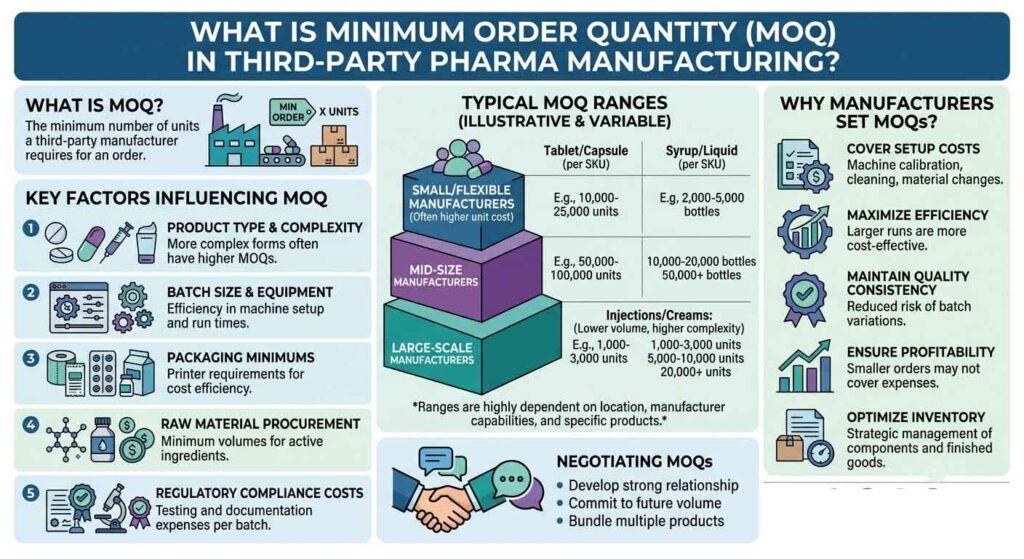
What Is MOQ in Third-Party Manufacturing?
MOQ means Minimum Order Quantity.
It is the minimum quantity a manufacturer agrees to produce in one batch or one order.
MOQ depends on:
Dosage form
Product composition
Batch size
Raw material cost
Packing material MOQ
Machinery capacity
Manufacturer size
Product demand
Brand-new artwork or common packing
Stability and testing requirements
Whether product is pharma, Ayurvedic, nutraceutical or cosmetic
There is no single fixed MOQ for all products.
General MOQ for Pharma Third-Party Manufacturing
The following quantities are practical industry ranges. Final MOQ depends on the manufacturer and product.
Tablets and Capsules
Common MOQ:
50,000 to 1,00,000 tablets or capsules per product
For common fast-moving products: around 1,00,000 tablets/capsules
For costly products: 30,000 to 50,000 may be possible
For trial batches: some manufacturers may allow 10,000 to 25,000, but rates may be higher
Earlier, some large manufacturers asked for very high quantities such as 10 lakh tablets. Such MOQ is usually difficult for startups.
A small or medium third-party manufacturer is often more suitable for beginners.
Liquid Syrups
Common MOQ:
1,000 to 5,000 bottles
Many manufacturers prefer 2,000 to 5,000 bottles
For 100 ml or 200 ml syrups, MOQ depends on bottle, label and carton availability
Liquid products are often easier for startups if the manufacturer allows smaller batches.
Dry Syrups
Common MOQ:
3,000 to 10,000 bottles
Depends on bottle size, powder filling, antibiotic category and packaging material
Dry syrup MOQ may be higher because of production and packing setup.
Ointments, Creams and Gels
Common MOQ:
1,000 to 5,000 tubes
Printed lami tube MOQ may be higher
If custom tube printing is required, MOQ may increase to 5,000 or 10,000 tubes
For small batches, manufacturers may use sticker labels or common tube options, where acceptable and compliant.
Injections
Common MOQ:
2,000 to 10,000 vials or ampoules
Depends on product, section, batch size, sterile facility and packing style
Injectables are not generally ideal for beginners unless there is strong hospital or institutional demand.
Sachets
Common MOQ:
5,000 to 30,000 sachets
Depends on sachet size, powder quantity and packaging roll
Vitamin D3 sachets, probiotics, collagen sachets and protein sachets may have different MOQ.
Softgel Capsules
Common MOQ:
30,000 to 1,00,000 softgels
Depends on shell, fill material, batch size and packing
Softgel MOQ may be higher than normal capsules.
Protein Powder and Granules
Common MOQ:
500 to 2,000 jars
Sachet or pouch packing may have different MOQ
Tin, jar, pouch and carton MOQ affect final order size
Ayurvedic Products
Common MOQ:
Syrups: 500 to 2,000 bottles
Capsules: 20,000 to 1,00,000 capsules
Tablets: 20,000 to 50,000 tablets
Oils: 500 to 2,000 bottles
Churna: 500 to 2,000 packs
Ayurvedic MOQ varies widely because many small Ayurvedic manufacturers offer flexible batches.
Nutraceutical Products
Common MOQ:
Tablets/capsules: 30,000 to 1,00,000 units
Syrups: 1,000 to 5,000 bottles
Protein powders: 500 to 2,000 jars
Sachets: 5,000 to 30,000 sachets
Gummies: often higher MOQ
Nutraceutical MOQ depends heavily on ingredient cost and FSSAI category.
Why Some Manufacturers Ask for 10 Lakh Tablets
Some manufacturers ask for high MOQ because:
Their machine capacity is large
Their batch size is fixed
Their packing-line setup cost is high
They work with big companies
They do not want small custom orders
Raw material MOQ is high
They want annual commitment
Packaging vendors require large quantities
For a startup, 10 lakh tablets of one product is usually too high unless the company already has strong sales.
Is It Possible to Sign Contract for 10 Lakh Tablets but Order 10,000 Each Time?
This depends on the manufacturer and agreement.
Sometimes, manufacturers may say:
Annual commitment: 10 lakh tablets
First dispatch: 10,000 or 25,000 tablets
Manufacturing batch: larger
Delivery: partial dispatch
But this arrangement can be risky for startups.
Before signing, check:
Are you legally bound to buy the full quantity?
What happens if sales do not happen?
Who will hold remaining stock?
Who will bear expiry loss?
Will the manufacturer produce all stock at once?
Will you pay advance for entire quantity?
Will packing material be printed for the full quantity?
Is the commitment product-wise or total order-wise?
Can the balance quantity be adjusted in other products?
Do not sign a large annual quantity contract without sales confidence.
Best MOQ Strategy for Startups
A new pharma marketing company should not start with very large batches.
Better approach:
Start with 10 to 20 products
Choose fast-moving products
Use manufacturers with flexible MOQ
Start with smaller batches where possible
Avoid slow-moving expensive products
Reorder after checking market response
Keep working capital for repeat orders
Do not block all money in stock
A small, fast-rotating product list is better than a large stock that expires.
Can You Start With 10,000 Tablets?
Sometimes yes, but not always.
10,000 tablets may be possible if:
Product is commonly manufactured
Manufacturer has flexible production
Packing material is available
You accept higher rate
You use ready foil or simple packing
Product is costly
It is a trial order
Manufacturer is small or medium-sized
But for many pharma products, 10,000 tablets may not be commercially viable for the manufacturer.
Why Small MOQ Has Higher Cost
Small batches generally cost more because:
Machine setup cost is same
Cleaning cost is same
Testing cost is same
Documentation cost is same
Packing artwork cost is same
Labour cost is not proportionally reduced
Raw material may be purchased in minimum packs
Wastage percentage is higher
Therefore, small MOQ is possible but usually at a higher per-unit rate.
Licence Requirement for Third-Party Manufacturing
Third-party manufacturing involves two sides:
Licensed manufacturer
Marketing company or product owner
The manufacturer must have a valid manufacturing licence for the product category and dosage form.
The marketing company must ensure proper legal arrangement for purchase, storage, billing, sale and distribution.
Do You Need a Drug Licence to Start a Pharma Marketing Company?
If you are dealing in allopathic medicines and you will purchase, stock, sell, distribute or invoice medicines, a wholesale drug licence is generally required for the premises and firm conducting those activities.
A marketing office that only handles promotion, administration, branding, digital work or customer communication may not require a drug licence if no drugs are stocked, sold or billed from that office.
However, the premises from where goods are purchased, stocked, billed, dispatched or sold must have proper licence support.
Can You Use Family Wholesale Drug Licence?
You may use the family wholesale business only if the transaction is legally routed through that licensed firm and licensed premises.
For example:
Manufacturer bills goods to the family wholesale firm.
Goods are received at the licensed premises.
Stock is stored under licence conditions.
Goods are billed and dispatched from that firm.
Records are maintained under that licence.
The business constitution supports such activity.
The marketing arrangement is documented.
But you should not casually use a family member’s drug licence for a separate company, separate office or separate premises without proper structure and approval.
A drug licence is not only a number. It is linked with a licensed premises, licensed firm and approved conditions.
Registered Office in Mumbai and Sales Office in Kolkata
You can have a registered office in Mumbai and a sales or corporate office in Kolkata.
But licensing depends on actual activity.
Mumbai Registered Office
If Mumbai office is only used for company registration, correspondence and address, it may not require a drug sale licence if no medicines are stocked, sold or billed from there.
Kolkata Sales Office
If Kolkata office is only used for marketing, calls, administration and sales coordination, it may not require a drug licence.
But if Kolkata office will:
Receive stock
Store medicines
Dispatch goods
Issue invoices
Sell medicines
Supply stockists
Maintain physical inventory
then a wholesale drug licence for that premises should be obtained.
Can You Market Pan India from One Wholesale Licence?
You may promote products across India, but physical sale, storage, dispatch and billing must follow licence conditions.
One licensed wholesale premises can supply to legally permitted buyers according to applicable rules and business feasibility.
However, if you create multiple stocking points, C&F locations, branch offices or warehouses, each location may need separate licence or approval as applicable.
Always confirm from the concerned State Drug Control Department before starting interstate stock movement.
What If You Operate Through C&F Agent Only?
If you appoint a C&F agent, the C&F premises must have proper drug licence support for storage and distribution.
You should also have a written C&F agreement covering:
Storage responsibility
Billing process
Stock ownership
Dispatch process
Expiry handling
Breakage handling
Recall procedure
Returns
Records
Taxation
Insurance
Payment terms
Regulatory inspection support
If your company itself purchases and sells medicines, your own licensing structure should be reviewed carefully.
Best Recommendation
For long-term business, take a separate wholesale drug licence in the name of your own pharma marketing company at the actual place of stock and billing.
You may keep:
Registered office in Mumbai
Corporate/sales office in Kolkata
Licensed warehouse or wholesale premises in West Bengal
C&F arrangement in other states later
This gives a cleaner and more professional structure.
Product Label: Marketed By Address
In third-party manufacturing, the label generally shows:
Manufactured by: Licensed manufacturer name and address
Marketed by: Marketing company name and address
The “marketed by” address should be truthful and connected with the marketing company.
If your Mumbai registered office is printed as marketed-by address, ensure it is legally connected with your business.
If you use Kolkata office as marketed-by address, ensure it is legally connected with your business.
Documents Required for Third-Party Manufacturing
Common documents may include:
Company registration documents
GST certificate
Wholesale drug licence, if applicable
PAN
Trademark application or brand-name proof
Marketed-by address proof
Product list
Brand names
Artwork approval
Agreement with manufacturer
Purchase order
Advance payment
Product composition
Packaging details
Final label matter
FSSAI licence, if nutraceuticals
AYUSH-related documents, if Ayurvedic products
The manufacturer may ask for additional documents depending on product category.
Documents to Collect From Manufacturer
Before placing order, collect or verify:
Manufacturing licence
GMP certificate, where applicable
Product permission
COA format
GST details
Manufacturing agreement
Product quotation
MOQ confirmation
Batch size
Delivery timeline
Packing material cost
Testing responsibility
Replacement policy
Stability responsibility
Defect handling policy
Do not finalize a manufacturer only because of low rates.
How to Select Products for First Order
Start with a limited and practical product range.
For example:
5 to 10 tablets/capsules
3 to 5 syrups
2 to 3 nutraceutical products
1 to 2 pain products
1 digestive product
1 liver product
1 calcium product
1 multivitamin product
Avoid launching too many products at once.
Which Products Need Lower MOQ?
Generally, lower MOQ may be easier for:
Syrups
Ayurvedic liquids
Oils
Protein powders
Ointments
Common tablets from flexible manufacturers
Nutraceutical capsules
Products with ready packing material
Higher MOQ may apply to:
Softgels
Sterile injectables
Printed lami tubes
Sachets with printed rolls
Uncommon molecules
Custom formulations
Imported raw materials
Products requiring special testing
How to Negotiate MOQ With Manufacturer
Ask these questions:
What is your minimum batch size?
Can you provide trial batch quantity?
Can I start with smaller quantity at higher rate?
Is packing material included in MOQ?
What is the MOQ for printed foil or carton?
Can balance packing material be kept for next batch?
Can you manufacture common products in smaller quantity?
What is delivery time?
What is expiry period?
Can you provide COA with every batch?
Negotiation should be based on practical production, not only price.
Packing Material MOQ
Many times, the real issue is not product MOQ but packing material MOQ.
Packing material includes:
Foil
Carton
Labels
Bottles
Caps
Measuring cups
Lami tubes
Sachet rolls
Shippers
For example, a manufacturer may allow 50,000 tablets, but printed foil vendor may require a larger minimum print quantity.
Ask separately:
Product MOQ
Packing material MOQ
Printing cost
Plate/cylinder cost
Balance packing material policy
First Order Strategy for Startup
For your first order:
Select fast-moving products
Avoid very costly products
Avoid large MOQ products
Avoid too many antibiotic combinations
Start with practical quantities
Choose products with at least 18 to 24 months shelf life, where possible
Keep enough budget for marketing
Keep working capital for reorder
Take COA with every batch
Verify batch and expiry before dispatch
Do not spend the full budget only on inventory.
Common Mistakes to Avoid
Avoid these mistakes:
Signing 10 lakh tablet commitment without sales
Using another firm’s drug licence casually
Stocking at an unlicensed office
Billing from an unlicensed premises
Starting with too many products
Ignoring packing material MOQ
Not checking product permission
Not checking banned or restricted FDCs
Not checking DPCO/price control
Selecting manufacturer only by lowest rate
Not signing written agreement
Not checking expiry and stability
Not calculating total landed cost
Practical Answer to the Query
For your situation:
You can keep registered office in Mumbai.
You can operate sales/admin office in Kolkata.
If Kolkata office only does marketing and no stock/billing, it may not require drug licence.
If Kolkata office stores or sells medicines, take wholesale drug licence there.
You should not casually use family wholesale licence for a separate company unless billing, storage and sale are legally routed through that licensed firm.
If you use a C&F agent, the C&F premises must have proper drug licence support.
For long-term professional working, obtain a separate wholesale drug licence in your company’s name at the actual stocking and billing location.
For MOQ, avoid very high commitments. Start with flexible third-party manufacturers that allow practical startup quantities.
Final Thoughts
The minimum order quantity in third-party manufacturing depends on product category, batch size, packaging material and manufacturer policy.
For most startups, common practical MOQ may be around:
Tablets/capsules: 50,000 to 1,00,000 units
Costly tablets/capsules: 30,000 to 50,000 units
Liquids: 1,000 to 5,000 bottles
Ointments/creams: 1,000 to 5,000 tubes
Sachets: 5,000 to 30,000 sachets
Protein powders: 500 to 2,000 jars
Do not select manufacturers asking for very high MOQ unless you already have confirmed market demand.
For licensing, remember that promotion and branding are separate from physical sale and distribution. Wherever medicines are stocked, billed, sold or dispatched, proper licence support is required.
The safest long-term approach is to create a clean company structure, take your own wholesale licence at the actual business location, select reliable manufacturers and start with controlled MOQ.
Frequently Asked Questions
1. What is MOQ in third-party manufacturing?
MOQ means minimum order quantity. It is the minimum quantity a manufacturer agrees to produce for one product or batch.
2. What is the normal MOQ for tablets?
Common MOQ for tablets is usually 50,000 to 1,00,000 tablets, but costly products may be accepted at 30,000 to 50,000 tablets by some manufacturers.
3. Can I start with 10,000 tablets?
Some small manufacturers may allow 10,000 tablets for trial or common products, but the per-unit cost may be higher.
4. What is the MOQ for syrups?
Syrup MOQ is commonly 1,000 to 5,000 bottles, depending on bottle size, label, carton and manufacturer policy.
5. Why do some companies ask for 10 lakh tablets?
Large manufacturers may have high batch sizes, high machine capacity or annual-order expectations. Such MOQ is usually not suitable for beginners.
6. Do I need a drug licence for third-party manufacturing?
The manufacturer needs a manufacturing licence. The marketing company needs proper licence support if it purchases, stocks, sells, bills or distributes allopathic medicines.
7. Can I use my family wholesale drug licence?
Only if transactions are legally routed through that licensed firm and premises. Do not use another firm’s licence casually for a separate company or separate premises.
8. Do I need a licence if I appoint a C&F agent?
The C&F premises must have proper licence support. Your own company’s licensing requirement depends on billing, ownership, stock transfer and sale structure.
9. Can I print my Mumbai registered office as marketed-by address?
Yes, if it is a truthful and valid business address of the marketing company and having a valid license for that location. The manufacturer’s address must be printed separately as manufactured-by.
10. What is best for a startup: high MOQ or low MOQ?
Low or moderate MOQ is better for startups. It reduces dead-stock risk and allows product testing in the market.
Looking for Ayurvedic Franchise or Distribution Opportunities?
Looking to start an Ayurvedic franchise, become a distributor, or launch your own herbal product range?
Elzac Herbal India offers:
Ayurvedic & Herbal Product Range
Franchise & Distribution Opportunities
Third-Party Manufacturing Services
Product Development Support
Marketing Guidance
PAN India Business Opportunities
Whether you are an entrepreneur, retailer, distributor, or healthcare professional, our team can help you explore the right business opportunity in the growing Ayurvedic sector.
Ajay Kamboj is an entrepreneur and business owners associated with many Ayurvedic and Pharmaceutical start-ups. With years of experience in Ayurvedic product marketing, pharmaceutical distribution, franchise development, and client relationship management, he regularly shares practical business insights based on real-world experiences. His articles focus on business growth, entrepreneurship, customer management, and lessons learned from the healthcare and wellness industry.
One response to “What Is the Minimum Order Quantity for Third-Party Pharma Manufacturing?”
which company (for third party manufacturing) is best for low minimum order quantity for tablet and syrup.




which company (for third party manufacturing) is best for low minimum order quantity for tablet and syrup.