Launching an OTC healthcare brand can be an attractive business opportunity.
Products commonly described as OTC may include:
Ayurvedic medicine
Herbal syrups
Pain-relief oils
Hair oils
Massage oils
Condoms
Antiseptic products
Nutritional supplements
Cosmetics
Certain non-prescription medicines
However, “OTC product” is mainly a market description. It does not automatically decide:
Which licence is required
Whether a drug licence is needed
Whether FSSAI applies
Whether the product is a medical device
Whether a trademark must be registered
What claims can be made
The legal category of each product must be identified separately.
A common query is:
“I am a registered pharmacist with D.Pharm qualification in Thane, Maharashtra. I want to start a marketing company for Ayurvedic medicines, condoms, oils and other OTC products. Which licences will I need? Is a drug licence required for Ayurvedic medicines? Is trademark registration compulsory for the brand?”
The practical answer is:
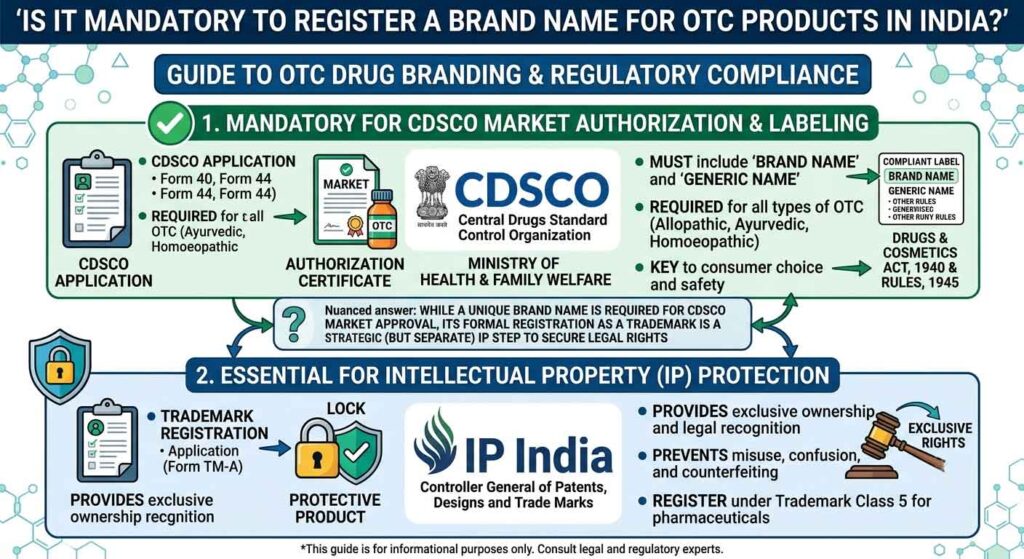
Trademark registration is generally not compulsory merely to use a brand name, but it is strongly recommended before investing substantially in packaging, promotion and distribution.
At the same time, trademark registration does not replace the product-specific licence or regulatory permission.
First Understand What “OTC” Means
OTC stands for:
Over the Counter
It usually refers to a product that consumers can purchase without presenting a prescription.
However, this description does not mean that every OTC product is regulated in the same way.
For example:
A condom is a medical device.
An Ayurvedic medicine is generally an AYUSH medicine when sold with Ayurvedic medicinal claims.
A vitamin capsule may be a nutraceutical or drug depending on formulation and claims.
A massage oil may be a cosmetic or Ayurvedic medicine.
An edible herbal oil may fall under food regulation.
An allopathic medicine may be subject to the Drugs Rules even when commonly sold without prescription.
Therefore, the first step is not:
“Apply for an OTC licence.”
The first step is:
“Classify every proposed product.”
Is There a Separate OTC Marketing Licence?
India does not provide one general “OTC marketing licence” that covers all healthcare products.
The licences and registrations depend on:
Product category
Ingredients
Claims
Dosage form
Manufacturing model
Whether you stock products
Whether you issue sales invoices
Whether you import products
Where the business premises are situated
A company dealing with five different categories may need different compliance arrangements for each category.
Is Trademark Registration Mandatory?
Trademark registration is generally not compulsory merely to begin using a brand, provided:
The name is legally available.
It does not infringe another party’s rights.
It is not deceptively similar to an earlier brand.
It does not create public or medication confusion.
It satisfies product-regulatory requirements.
However, proceeding without trademark registration creates significant commercial risk.
Risks of Not Registering the Brand
Another person may:
File the same or similar name
Claim earlier use
Oppose your later application
Send you a legal notice
Prevent you from expanding
Copy your brand presentation
Create confusion in the market
You may then have to:
Change the product name
Destroy printed cartons
Replace labels
Withdraw stock
Educate distributors again
Lose market goodwill
Defend a passing-off dispute
For an OTC product, the brand is often the main commercial asset because consumers may purchase it by name.
Trademark registration is therefore not merely paperwork. It protects the investment made in:
Packaging
Advertising
Distributor development
Online promotion
Customer recognition
Brand reputation
What Protection Does Registration Provide?
A registered trademark generally gives the owner stronger statutory rights to:
Use the mark for the registered goods or services
Prevent confusingly similar use
Bring an infringement action
License the brand
Assign or sell the brand
Build a legally identifiable business asset
An unregistered brand may still have certain passing-off protection based on genuine prior use and reputation.
However, proving prior use, goodwill and misrepresentation may be more complicated than relying on a valid registration.
Should You Register the Company Name or Product Brands?
Ideally, protect both were commercially important.
Company or House Brand
Suppose your company is:
XYZ Healthcare
This is the company or house mark.
It may appear on all your products, invoices, website and promotional materials.
Individual Product Brand
You may have separate names for:
Ayurvedic medicine
Pain oil
Cough syrup
Condom
Nutritional supplement
Each product brand is a separate commercial identity.
Registering only the company name does not automatically protect every individual product brand.
Similarly, registering one product brand does not automatically protect the company name.
Trademark Classes May Differ by Product
Trademark protection is filed according to classes of goods and services.
Common classifications may include:
Pharmaceutical and medicinal preparations
Cosmetics and personal-care products
Medical devices
Retail, wholesale or marketing services
For example:
Ayurvedic medicinal products are commonly considered in Class 5.
Cosmetic oils and personal-care products are commonly considered in Class 3.
Condoms and certain medical devices are commonly considered in Class 10.
Distribution, wholesale or retail services may involve Class 35.
The correct class and goods description should be selected after reviewing the exact product range.
Do not automatically file every proposed item only in Class 5.
Can the Same Brand Be Filed in Multiple Classes?
Yes, where the business genuinely proposes to use the brand for goods or services covered by different classes.
For example, one house brand may be used for:
Ayurvedic medicines
Cosmetics
Medical devices
Retail services
Separate class protection may then be considered.
Trademark fees generally apply class-wise.
Can You Start With a Pending Trademark Application?
A business may commercially use a brand while its application is pending, subject to the risk that:
The application may be objected to.
Another party may oppose it.
An earlier user may issue notice.
The mark may be refused.
Therefore, the safer sequence is:
Prepare several proposed names.
Conduct exact and phonetic searches.
Search pharmaceutical and consumer markets.
Select the strongest available name.
File the trademark application.
Start with limited packaging quantities.
Monitor objections and opposition.
You may generally use the ™ symbol to show that you claim the mark.
The ® symbol should be used only after registration.
Why OTC Brands Need Stronger Trademark Protection
Prescription medicines are often promoted primarily through healthcare professionals.
OTC products are commonly promoted directly to:
Consumers
Retailers
E-commerce buyers
Pharmacies
Distributors
Social-media audiences
The consumer may remember:
Brand name
Packaging
Colour
Logo
Tagline
Therefore, the brand may become more valuable than the underlying formulation.
A successful OTC product without adequate trademark protection is vulnerable to:
Similar names
Copycat packaging
Look-alike products
Distributor confusion
Online listing misuse
Product-Wise Licence Requirements
1. Ayurvedic Medicines
An Ayurvedic medicine marketed as an Ayurvedic medicine should be manufactured by a unit holding the applicable AYUSH manufacturing licence and product permission.
The product may be:
Classical Ayurvedic medicine
Patent or proprietary Ayurvedic medicine
The marketer should verify:
Manufacturer’s AYUSH licence
Exact product permission
Approved formula
Ingredient list
Applicable GMP documentation
Batch-wise Certificate of Analysis
Label and claim compliance
Shelf life
Complaint and recall system
Does the Marketing Company Need an AYUSH Manufacturing Licence?
Not when the company is only marketing products manufactured by a properly licensed third-party AYUSH manufacturer.
The actual manufacturing licence belongs to the manufacturer.
Your product label may show:
Manufactured by: Licensed Ayurvedic manufacturer Marketed by: Your company
However, the marketing company remains responsible for areas under its control, including:
Brand ownership
Artwork approval
Promotional claims
Distributor conduct
Complaint handling
Product traceability
Does the Marketing Company Need a Drug-Sale Licence?
The central licensing structure for sale of Ayurvedic medicines is not identical to the wholesale and retail licence framework applied to allopathic medicines.
Nevertheless, you should obtain written confirmation from the State FDA or concerned State AYUSH authority for your exact model, especially when you will:
Stock products at your own premises
Issue invoices
Operate a warehouse
Supply across states
Sell mixed product categories
Do not assume that “no licence is needed” for every activity merely because the product is Ayurvedic.
Important Claim Restrictions
Avoid unapproved or misleading claims such as:
Guaranteed cure
No side effects
Permanent treatment
Replaces surgery
Cures cancer
Cures diabetes
Treats infertility with certainty
Ayurvedic products remain regulated medicines and their advertisements are subject to applicable drug-advertising restrictions.
2. Condoms
Condoms are not Ayurvedic products or ordinary general consumer goods.
They are regulated medical devices intended for:
Contraception
Reduction of certain infection risks, according to approved claims
The manufacturer or importer should hold the applicable medical-device licence.
A marketer or distributor should verify:
Manufacturing or import licence
Product registration or licence details
Applicable quality standard
Batch or lot traceability
Shelf life
Storage conditions
Approved label
Complaint and recall process
Sale-Premises Requirements
The Medical Devices Rules contain a registration framework for premises selling, stocking, exhibiting or offering medical devices for sale.
The commonly relevant sale-premises application and certificate forms include:
Form MD-41
Form MD-42
The precise requirement may depend on:
Your existing drug-sale licence
Nature of the premises
Wholesale or retail activity
State authority implementation
Products stocked
Confirm the arrangement with state FDA before beginning stocking and invoicing.
Can You Put Your Own Brand on Condoms?
Yes, through a compliant private-label or contract-manufacturing arrangement with a licensed medical-device manufacturer.
You should have:
Brand ownership agreement
Trademark clearance
Manufacturing agreement
Quality agreement
Approved artwork
Medical-device licensing documents
Batch release and testing documentation
You should not purchase generic unbranded condoms and merely apply your own label without an authorized manufacturing arrangement.
3. Ayurvedic Medicinal Oil
An oil presented for medicinal Ayurvedic purposes may be an Ayurvedic drug.
Examples include oils promoted for:
Joint discomfort
Muscular support
Traditional therapeutic massage
Hair or scalp conditions under Ayurvedic medicinal positioning
The manufacturer should hold the applicable AYUSH manufacturing licence and product permission.
The marketer should verify:
Classical or proprietary category
Ingredient quantities
Reference text, where applicable
Product permission
Label claims
Testing
Shelf life
4. Cosmetic or Massage Oil
An oil may be a cosmetic when its primary purpose is:
Cleansing
Beautifying
Moisturising
Improving appearance
Hair conditioning
Cosmetic massage
Examples include:
Hair oil
Body massage oil
Skin-conditioning oil
Beard oil
The manufacturer should comply with the Cosmetics Rules and hold the applicable manufacturing licence.
A cosmetic oil should not make medicinal claims such as:
Treats arthritis
Cures fungal infection
Repairs nerve damage
Treats eczema
Permanently stops hair loss
Claims can change the regulatory category.
5. Edible Oil or Food Supplement
An orally consumed oil may fall under food regulation when it is genuinely intended as food and uses permitted ingredients and claims.
In that case, FSSAI licensing and food labelling may apply.
Examples might include certain:
Edible seed oils
Nutritional oils
Food supplements
An FSSAI licence does not authorize medicinal disease-treatment claims.
6. Allopathic OTC or Non-Prescription Products
Allopathic medicines remain subject to the Drugs and Cosmetics Act and Drugs Rules.
The term OTC should not be used to bypass:
Manufacturing licence
Product permission
Labelling
Storage
Sale-licence requirements
Advertisement restrictions
If your company purchases, stocks, sells and invoices allopathic medicines, an appropriate wholesale drug licence is generally required at the relevant premises.
A pharmacist qualification alone is not the licence.
Can One Drug Licence Cover All These Products?
No single licence should be assumed to cover:
Ayurvedic medicines
Condoms
Cosmetics
Food supplements
Allopathic drugs
Your business may need a category-wise structure.
For example:
Ayurvedic Products
Source from licensed AYUSH manufacturer and verify state marketing, storage and sale requirements.
Allopathic Drugs
Operate through an appropriate wholesale drug licence.
Medical Devices
Use licensed products and complete applicable sale-premises registration or licensing requirements.
Cosmetics
Source from licensed cosmetic manufacturers and follow cosmetic labelling and claims requirements.
Food Supplements
Use FSSAI-licensed manufacturing and trading structure.
Basic Business Registrations
Your marketing company may be organized as:
Proprietorship
Partnership
LLP
Private Limited Company
For a small startup, a proprietorship may be commercially simple, but the appropriate structure depends on:
Investment
Liability
Partners
Funding
Long-term plans
Trademark ownership
Common documents include:
PAN
Business address proof
Current bank account
GST, where applicable
Shop and Establishment registration
Udyam registration, where appropriate
Local municipal permissions
Trademark application
GST Requirements
GST registration is based primarily on:
Aggregate turnover
Nature of supply
State
Interstate transactions
E-commerce activity
Compulsory-registration provisions
It is not based on whether you are a pharmacist.
For exclusive suppliers of goods, the general threshold exemption can extend up to ₹40 lakh in many states, subject to the applicable notification, exclusions and compulsory-registration provisions.
However, a healthcare marketing company may take GST registration earlier because:
Manufacturers require GST details.
Distributors want tax invoices.
Input tax credit may be important.
Interstate business may be planned.
E-commerce may be used.
Multiple product categories may be involved.
Do not rely only on a general turnover figure. Have the proposed supply model checked by a GST professional.
How to Register Your Own Brand
Step 1: Decide the Legal Owner
The brand may be owned by:
Individual proprietor
Partnership
LLP
Private Limited Company
Choose the long-term owner carefully.
Step 2: Prepare Multiple Names
Prepare at least three to five distinctive options.
Do not create names by changing only one letter of an existing medicine or consumer brand.
Step 3: Conduct Trademark Search
Search for:
Exact matches
Similar spellings
Similar pronunciation
Similar prefixes and suffixes
Relevant product classes
Pending and registered applications
Step 4: Conduct Market Search
Search beyond the trademark database:
Google
Online pharmacies
E-commerce platforms
Distributor catalogues
Product directories
Local markets
An earlier user may have rights even without registration.
Step 5: File Form TM-A
A new trademark application is generally filed through Form TM-A.
It may be filed on:
Proposed-to-be-used basis
Prior-use basis
If prior use is claimed, supporting evidence and a user affidavit may be required.
Step 6: Track Examination
The application may face:
Formality check
Examination objection
Hearing
Journal publication
Third-party opposition
Filing is only the beginning of the process.
Step 7: Use the Brand Consistently
Maintain records such as:
First invoice
Packaging
Advertisements
Website records
Distributor invoices
Product photographs
Promotional materials
These can help establish use.
Does Every Product Need a Separate Trademark?
Every distinct product brand should be assessed separately.
Suppose you have:
One company name
Five product brands
You may consider:
One application for the company mark
Separate applications for the most important product brands
You do not need to register the generic composition.
For example, you cannot obtain exclusive ownership over ordinary generic expressions such as:
Ayurvedic medicine
Pain oil
Calcium tablet
Herbal syrup
The protectable part should be distinctive.
Can You Advertise OTC Products Directly to Consumers?
It depends on the category and claim.
Consumer advertising may be possible for some:
Cosmetics
Medical devices
Food supplements
Non-prescription products
However, advertising must still comply with:
Approved intended use
Drug-advertisement restrictions
Consumer-protection law
Medical-device rules
FSSAI claim rules
AYUSH advertising restrictions
Avoid:
Guaranteed cure
Permanent treatment
No side effects
Miraculous result
Clinically proven without evidence
Doctor recommended without substantiation
Disease claims outside the licensed category
Common Mistakes to Avoid
Avoid:
Treating every product as OTC
Assuming Ayurvedic means completely licence-free
Assuming D.Pharm registration is a business licence
Selling condoms as ordinary general merchandise without device-document verification
Using one licence for unrelated categories
Filing every brand only in Class 5
Printing before trademark search
Using the ® symbol before registration
Copying a similar pharma or consumer brand
Selecting manufacturers only by low price
Making disease-treatment claims on cosmetic oil
Making medicinal claims under FSSAI
Starting interstate business without GST review
Failing to define brand ownership
Practical Answer to the Query
For your proposed marketing company:
Ayurvedic Medicines
You do not require your own AYUSH manufacturing licence when the medicines are manufactured by a properly licensed third-party Ayurvedic manufacturer.
However, verify the manufacturer’s licence, product permission, formula, claims and quality documents.
Condoms
Treat them as regulated medical devices.
Verify the manufacturer or importer’s applicable licence and determine whether your selling or stocking premises require registration under the Medical Devices Rules.
Oils
First determine whether each oil is:
Ayurvedic medicine
Cosmetic
Food
Allopathic drug
The applicable licence follows that classification.
Trademark
Trademark registration is not generally compulsory merely to begin using a brand, but it is strongly recommended—especially for consumer-facing OTC products.
Conduct searches and file before investing heavily in packaging.
GST
GST depends on aggregate turnover, supply structure and compulsory-registration provisions. Commercial interstate, distributor and e-commerce plans should be reviewed before launch.
Frequently Asked Questions
1. Is trademark registration compulsory for an OTC product?
Generally, no. However, registration provides stronger statutory protection and is highly advisable.
2. Can I launch an Ayurvedic capsule without my own drug licence?
You may market it through a licensed third-party AYUSH manufacturer. The manufacturer must hold the applicable licence and product permission. Your own activity and premises should still be checked for any state-specific requirements.
3. Is a condom an OTC drug?
A condom is regulated as a medical device rather than an Ayurvedic or ordinary allopathic medicine.
4. Do I need a medical-device licence to sell condoms?
The product must come from a properly licensed manufacturer or importer, and the selling premises may require registration under the Medical Devices Rules. Confirm the exact state requirement.
5. Is hair oil an Ayurvedic medicine?
Not automatically. It may be a cosmetic or Ayurvedic drug depending on composition, permission, claims and presentation.
6. Can a cosmetic oil claim to treat arthritis?
Such a therapeutic claim may move the product outside an ordinary cosmetic category and should not be used without the appropriate drug pathway.
7. Does registering my company name protect every product brand?
No. Individual product brands are separate marks and may require separate applications.
8. Can I use ™ after filing?
The ™ symbol is commonly used for a claimed trademark. The ® symbol should be used only after registration.
9. Does trademark filing guarantee registration?
No. The application may face examination objections or opposition from earlier-rights holders.
10. Which licence should I obtain first?
First finalize the product categories and operating model. Then arrange the category-specific manufacturing, stocking, sale, GST and trademark requirements.
Final Thoughts
The correct question is not only:
“Is trademark registration compulsory for an OTC product?”
The complete question should be:
“What is the legal category of my product, which licences apply, and how should I protect its brand?”
Trademark registration protects the name.
It does not authorize:
Manufacturing
Import
Stocking
Sale
Medical claims
Product approval
For a mixed range such as Ayurvedic medicines, condoms and oils, follow this sequence:
Classify each product → Select licensed manufacturer → Verify product permission → Arrange sale and storage compliance → Search and file brand → Approve artwork → Start controlled commercial supply
For consumer-facing OTC businesses, trademark filing should be treated as an essential commercial safeguard even where it is not an absolute legal precondition to first use.
Looking for Ayurvedic Franchise or Distribution Opportunities?
Looking to start an Ayurvedic franchise, become a distributor, or launch your own herbal product range?
Elzac Herbal India offers:
Ayurvedic & Herbal Product Range
Franchise & Distribution Opportunities
Third-Party Manufacturing Services
Product Development Support
Marketing Guidance
PAN India Business Opportunities
Whether you are an entrepreneur, retailer, distributor, or healthcare professional, our team can help you explore the right business opportunity in the growing Ayurvedic sector.
Ajay Kamboj is an entrepreneur and business owners associated with many Ayurvedic and Pharmaceutical start-ups. With years of experience in Ayurvedic product marketing, pharmaceutical distribution, franchise development, and client relationship management, he regularly shares practical business insights based on real-world experiences. His articles focus on business growth, entrepreneurship, customer management, and lessons learned from the healthcare and wellness industry.




Leave a Reply Cancel reply
You must be logged in to post a comment.