Many Indian pharmacists and medical store owners want to expand their pharmacy business abroad. A common question is:
“I have a B.Pharm degree and medical stores in India. Can I open the same type of pharmacy in London or another western country? Will my Indian pharmacy degree help?”
The simple answer is:
Your Indian B.Pharm degree can help as an educational background, but it is not enough by itself to work as a pharmacist or open and operate a pharmacy in most western countries.
Before practising as a pharmacist in countries such as the UK, USA, Canada, Australia, New Zealand, or European countries, you generally need to get registered with the pharmacy regulatory authority of that country.
Each country has its own process, exams, documents, language requirements, internship or supervised practice, and business regulations.
Indian B.Pharm Degree: Is It Valid Abroad?
An Indian B.Pharm degree is a recognized pharmacy qualification in India, but it does not automatically give the right to practise pharmacy in another country.
In foreign countries, pharmacy is a regulated profession. This means you cannot simply start working as a pharmacist or open a pharmacy only on the basis of an Indian degree.
Your qualification may be assessed, but you may still need:
Credential evaluation
English language test
Pharmacy equivalency exam
Local pharmacy law exam
Internship or supervised practice
Registration with pharmacy council or board
Work visa or business visa
Pharmacy premises approval
Local business registration
Professional insurance
So, the Indian degree is useful, but it is only the starting point.
Can an Indian Pharmacist Open a Pharmacy in London?
If you want to open a pharmacy in London, you must understand two different things:
Working as a pharmacist
Owning a pharmacy business
To personally work as a pharmacist in London or anywhere in Great Britain, you must be registered with the General Pharmaceutical Council, commonly called GPhC.
An Indian-qualified pharmacist usually has to complete the overseas pharmacist registration route before becoming eligible to practise.
Route for Indian Pharmacist in the UK
For most pharmacists qualified outside the UK, the route generally includes:
Overseas Pharmacists’ Assessment Programme, also called OSPAP
52-week foundation training in Great Britain
GPhC registration assessment
English language requirement
Registration with GPhC
After registration, the person can work as a pharmacist in England, Scotland, or Wales.
Northern Ireland has a separate registration authority.
Can You Own a Pharmacy in the UK Without Being a Registered Pharmacist?
In some business structures, pharmacy ownership and pharmacist registration may be different. However, a registered pharmacy must comply with strict pharmacy laws and GPhC standards.
A pharmacy business needs proper professional supervision, responsible pharmacist arrangements, premises registration, and in company cases, superintendent pharmacist requirements.
So, even if a non-pharmacist investor can participate in business ownership in some structure, the pharmacy cannot operate like an ordinary retail shop. It must be managed under pharmacy law by properly registered professionals.
If your goal is to open a pharmacy in London, you should take advice from:
GPhC
UK pharmacy business consultant
NHS pharmacy market-entry consultant
Immigration consultant
UK accountant or solicitor
Can You Use the Same Indian Medical Store Model Abroad?
No. The Indian medical store model cannot be copied directly to western countries.
In countries like the UK, USA, Canada and Australia, pharmacy practice is more tightly connected with:
Insurance systems
Digital prescriptions
National health services or private insurers
Pharmacy benefit managers
Strict dispensing protocols
Patient counselling
Controlled drug laws
Professional liability
Clinical pharmacy services
Electronic health records
Audit and inspection systems
Therefore, business model, investment, documentation and compliance are different.
Requirements in Major Western Countries
1. United Kingdom
For an Indian pharmacist wanting to practise in Great Britain, the common route is:
Qualification assessment
English language proof
OSPAP course
52-week foundation training
GPhC registration assessment
GPhC registration
For opening a pharmacy, additional business and premises requirements apply.
You may also need to understand:
Registered pharmacy premises
Responsible pharmacist rules
Superintendent pharmacist requirement
NHS pharmacy contract, if you want NHS prescription business
Private prescription and retail sale rules
Controlled drug compliance
Pharmacy standards and inspections
2. United States
In the USA, pharmacy is regulated state by state. An Indian pharmacist cannot directly practise only on the basis of B.Pharm.
The common foreign pharmacist route may include:
FPGEC certification
Education evaluation
TOEFL iBT
FPGEE
NAPLEX
State pharmacy law exam
Internship hours, depending on state
State Board of Pharmacy licence
To open a pharmacy business, you must also follow state pharmacy board rules, business registration, premises permit, pharmacist-in-charge requirement, insurance, and federal/state drug laws.
The USA pharmacy system is complex because insurance billing, PBMs, Medicaid/Medicare, controlled substances and state-level rules are very important.
3. Canada
In Canada, an international pharmacy graduate usually needs to follow the PEBC certification pathway.
Structured practical training or internship, depending on province
After PEBC certification, you still need provincial licensing approval.
Pharmacy ownership rules may also vary by province.
4. Australia
In Australia, overseas-trained pharmacists usually go through the Australian Pharmacy Council assessment route.
For many Indian pharmacists, this may involve:
Eligibility check
OPRA exam
Skills assessment outcome
Provisional registration
Supervised practice
Registration examinations
General registration with the Pharmacy Board of Australia
Australia also has pharmacy ownership rules that vary by state and territory, so opening a pharmacy business requires separate legal and business guidance.
5. New Zealand
New Zealand also has its own pharmacy registration process.
An overseas pharmacist generally needs qualification assessment, competency requirements, possible examination or bridging pathway, and registration with the Pharmacy Council of New Zealand.
Business ownership and pharmacy operation must comply with New Zealand pharmacy laws.
What Documents May Be Required Abroad?
Document requirements vary by country, but commonly include:
Pharmacy degree certificate
Academic transcripts
State Pharmacy Council registration certificate
Good standing certificate
Experience certificate
Passport
Birth certificate
Name change proof, if applicable
English language test result
Police clearance certificate
Professional references
Internship or work record
Syllabus or course details
Identity verification
Visa documents
Business registration documents, if opening pharmacy
Documents may need notarization, verification, direct submission from university, or official translation.
Is Indian Pharmacy Council Registration Useful Abroad?
Yes, it can be useful, especially as proof that you are registered as a pharmacist in India.
Foreign regulators may ask for:
Registration certificate
Good standing certificate
No disciplinary action certificate
Verification from State Pharmacy Council
But Indian registration alone does not give automatic permission to practise abroad.
Can an Indian Pharmacist Work Abroad Without Re-Registration?
Generally, no.
You cannot work as a pharmacist in most western countries without registration with that country’s regulator.
However, you may be able to work in related roles while preparing for registration, such as:
Pharmacy assistant
Pharmacy technician, if eligible
Healthcare assistant
Regulatory affairs assistant
Pharmacovigilance associate
Pharmaceutical sales
Medical coding
Clinical data management
Pharma warehouse or distribution role
Quality assurance support role
Research assistant
These roles also depend on visa, employer and local rules.
Can You Open Pharmacy as an Investor?
In some countries, a person may invest in a pharmacy business even if not personally registered as a pharmacist, but the pharmacy must be supervised and operated by registered pharmacy professionals.
In other places, pharmacy ownership may be restricted only to pharmacists or pharmacist-controlled companies.
Therefore, do not assume that money and Indian experience are enough. Always check ownership rules of the specific country, state or province.
Difference Between Opening Pharmacy and Practising Pharmacy
This difference is very important.
Practising Pharmacy
This means working as a pharmacist, dispensing medicines, checking prescriptions, counselling patients and taking professional responsibility.
For this, registration as a pharmacist is required.
Opening Pharmacy
This means owning or operating a pharmacy business.
For this, business permission, premises registration, professional supervision, pharmacist appointment, and local pharmacy ownership rules are required.
In some countries, both may be connected. In some countries, business ownership and pharmacist registration may be separate but still heavily regulated.
Future of Indian Pharmacists in Foreign Countries
The future can be good, but the process is not easy.
Indian pharmacists can find opportunities abroad in:
Community pharmacy
Hospital pharmacy
Clinical pharmacy
Industrial pharmacy
Regulatory affairs
Pharmacovigilance
Quality assurance
Research and development
Pharma distribution
Healthcare management
Clinical trials
Medical writing
Pharmaceutical business
Countries like the UK, Canada, Australia and New Zealand have demand for healthcare professionals, but registration, language ability, local experience and immigration rules are major factors.
Is It Better to Open Pharmacy or First Work as Pharmacist Abroad?
For most Indian pharmacists, the better approach is:
Select the target country.
Understand registration pathway.
Clear required exams.
Work in that country as a pharmacist.
Understand local pharmacy business.
Study ownership and investment rules.
Then plan to open or acquire a pharmacy.
Opening a pharmacy directly without understanding the local system can be risky.
Can You Buy an Existing Pharmacy Abroad?
In some countries, buying an existing pharmacy may be possible, but it is a regulated transaction.
You may need to check:
Pharmacy ownership rules
Pharmacy premises registration
Existing licence status
Lease agreement
Prescription volume
NHS or insurance contracts
Staff and pharmacist availability
Financial records
Controlled drug compliance
Litigation or disciplinary history
Local competition
Business valuation
Professional legal and financial due diligence is essential.
Common Mistakes Indian Pharmacists Should Avoid
Avoid these mistakes:
Assuming Indian B.Pharm is automatically valid abroad
Opening business before checking pharmacist registration rules
Ignoring English language requirements
Ignoring visa and immigration rules
Depending only on agents
Not checking official regulator websites
Assuming all western countries have the same rules
Confusing pharmacy ownership with pharmacist registration
Not calculating investment and licensing cost
Trying to operate without registered pharmacist
Ignoring local tax, insurance and audit rules
Practical Plan for Indian Pharmacist
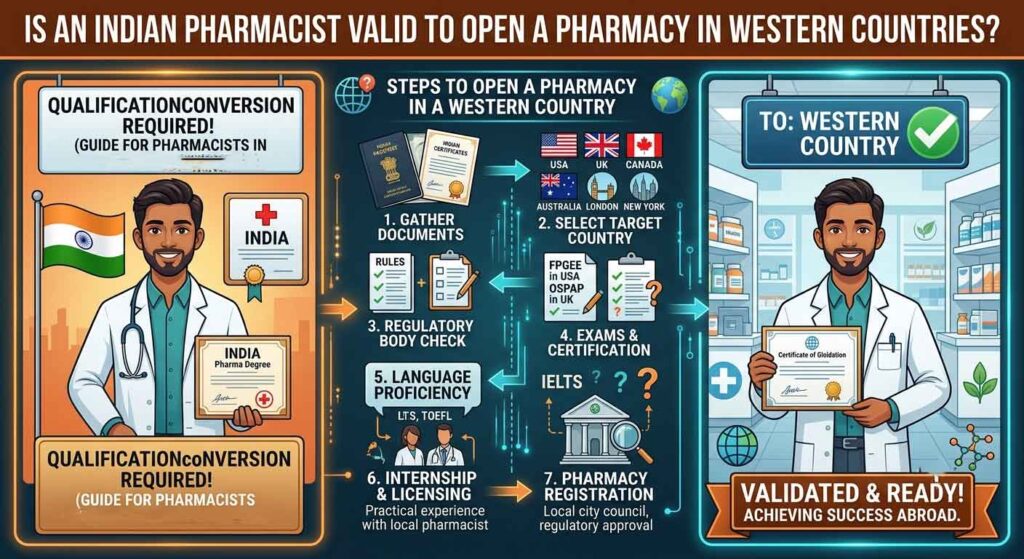
If you are an Indian pharmacist and want to expand abroad, follow this plan:
Step 1: Choose One Country
Do not plan for all western countries at once.
Select one target country such as:
UK
USA
Canada
Australia
New Zealand
Step 2: Check Official Regulator Route
Visit the official pharmacy regulator website of that country and check the overseas pharmacist pathway.
Step 3: Check Eligibility
Check whether your B.Pharm degree, registration and experience are acceptable for assessment.
Step 4: Prepare Documents
Arrange degree certificate, transcripts, registration certificate, good standing certificate, passport, references and experience proof.
Step 5: Clear Language Test
Most countries require English language ability through IELTS, OET, TOEFL or other approved route.
Step 6: Clear Required Exams
Prepare for country-specific exams such as OSPAP/GPhC route, FPGEE/NAPLEX, PEBC exams or OPRA.
Step 7: Complete Training or Internship
Many countries require supervised practice or internship before full registration.
Step 8: Get Pharmacist Registration
Only after registration can you practise as a pharmacist.
Step 9: Study Pharmacy Business Rules
Before opening pharmacy, study ownership restrictions, premises registration, insurance, tax, local healthcare system and pharmacy business model.
Step 10: Open, Buy or Partner
After understanding the market, you can consider opening a new pharmacy, buying an existing pharmacy, or partnering with a registered local pharmacist where legally allowed.
Final Answer
An Indian B.Pharm degree alone is not enough to open and run a pharmacy in western countries such as the UK, USA, Canada or Australia.
It can help you start the qualification assessment process, but you must meet the registration requirements of the target country.
For London, an Indian pharmacist generally needs to complete the overseas pharmacist pathway through OSPAP, foundation training and GPhC registration assessment before becoming a registered pharmacist in Great Britain.
If you want to open a pharmacy business, you must also follow pharmacy premises registration, responsible pharmacist, superintendent pharmacist, business ownership, tax, visa and local healthcare rules.
The best approach is:
First get registered as a pharmacist in the target country, understand the local pharmacy system, and then plan pharmacy ownership or business expansion.
Frequently Asked Questions
1. Is Indian B.Pharm valid in the UK?
Indian B.Pharm may be considered for overseas pharmacist assessment, but it does not automatically allow practice in the UK. You generally need OSPAP, foundation training, registration assessment and GPhC registration.
2. Can I open a pharmacy in London with Indian B.Pharm?
Not directly. You need to follow UK pharmacy registration and pharmacy business regulations. If you want to practise as a pharmacist, GPhC registration is required.
3. Can an Indian pharmacist work in the USA?
Yes, but only after completing the foreign pharmacist pathway, which generally includes FPGEC certification, exams, and state board licensure requirements.
4. Can an Indian pharmacist work in Canada?
Yes, but international pharmacy graduates generally need PEBC certification and provincial registration before practising.
5. Can an Indian pharmacist work in Australia?
Yes, but overseas-trained pharmacists generally need assessment through APC, OPRA exam, provisional registration, supervised practice and final registration requirements.
6. Can I open a pharmacy abroad without being a pharmacist?
It depends on the country and local ownership rules. Some places may allow investor ownership with registered pharmacist supervision, while others restrict ownership.
7. Is Indian State Pharmacy Council registration useful abroad?
Yes, it is useful as proof of Indian pharmacist registration and may be required for document verification or good standing certificate.
8. Which English test is required for pharmacists abroad?
It depends on the country. IELTS, OET, TOEFL or other approved tests may be accepted depending on the regulator.
9. Is it easy for Indian pharmacists to settle abroad?
It is possible, but not easy. It requires exams, registration, supervised practice, visa approval, local experience and financial planning.
10. What is the best country for Indian pharmacists?
There is no single best country. UK, Canada, Australia, USA and New Zealand all have opportunities, but each has different exams, cost, time and immigration rules.
Looking for Ayurvedic Franchise or Distribution Opportunities?
Elzac Herbal India offers opportunities for entrepreneurs interested in Ayurvedic and herbal product distribution, franchise marketing and third-party manufacturing.
Elzac Herbal India offers:
Ayurvedic & Herbal Product Range
Franchise & Distribution Opportunities
Third-Party Manufacturing
Product Development Support
Marketing Guidance
PAN India Business Opportunities
Whether you are an entrepreneur, retailer, distributor, or healthcare professional, our team can help you explore the right business opportunity in the growing Ayurvedic sector.
Ajay Kamboj is an entrepreneur and business owners associated with many Ayurvedic and Pharmaceutical start-ups. With years of experience in Ayurvedic product marketing, pharmaceutical distribution, franchise development, and client relationship management, he regularly shares practical business insights based on real-world experiences. His articles focus on business growth, entrepreneurship, customer management, and lessons learned from the healthcare and wellness industry.








Leave a Reply Cancel reply
You must be logged in to post a comment.