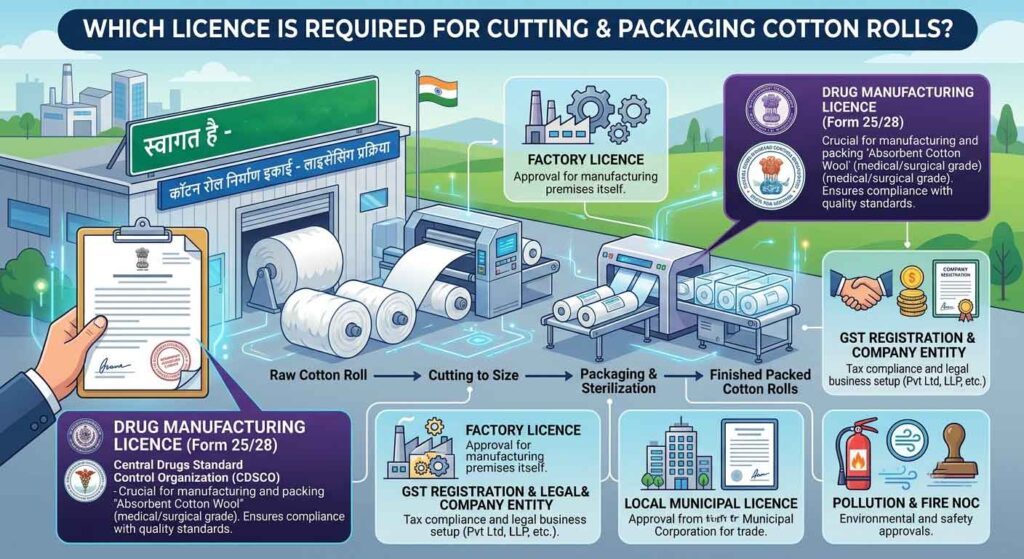
“Is any licence required for cutting and packing rolled cotton or cotton bandage? Many companies do not take a licence because they consider it a fabric product.”
The answer depends mainly on what type of cotton you are processing and how you intend to sell it.
If ordinary cotton or textile fabric is cut and packed for general, cosmetic, cleaning or industrial purposes without any medical intended use, medical-device licensing may not apply.
However, if the product is sold as:
Absorbent cotton wool
Surgical cotton
Cotton wool for wound dressing
Medical cotton roll
Dressing cotton
Cotton intended for hospitals, clinics or first-aid use
then it should not simply be treated as an ordinary fabric product.
Absorbent cotton wool intended for medical use is regulated as a medical device in India.
Quick Answer
Non-Sterile, Non-Measuring Absorbent Cotton Wool
If you purchase bulk absorbent cotton, cut it into smaller medical cotton rolls, label it and sell it under your own name or brand, this activity should be treated as manufacturing/repacking of a medical device.
For a Class A non-sterile and non-measuring medical device, a full MD-5 manufacturing licence is generally not required under the present exemption.
However, the manufacturer must obtain the applicable Class A medical-device registration number through the CDSCO online system and comply with the Medical Devices Rules, 2017.
Sterile Cotton
If the product is supplied as sterile, the simplified Class A non-sterile exemption does not apply.
A proper medical-device manufacturing licence and applicable quality-system requirements will generally be required.
Medicated Cotton
If cotton is impregnated or treated with an antiseptic, medicinal ingredient or other active substance, do not assume that the ordinary non-sterile cotton registration is sufficient.
Its classification and licensing should be confirmed with the concerned State Licensing Authority/CDSCO before manufacturing.
Is Cotton Roll a Fabric Product or Medical Device?
Both descriptions can be correct depending on the intended use.
Ordinary Textile Cotton
Cotton sold for purposes such as:
Cleaning
Craft
Cosmetic use
Industrial use
Upholstery
General household use
may remain an ordinary textile or consumer product if no medical intended use or medical claim is made.
Absorbent Surgical Cotton
If the same product is labelled or promoted for:
Cleaning wounds
Absorbing blood or body fluids
Surgical dressing
First aid
Hospital use
Clinical procedures
its intended purpose brings it within the medical-device regulatory framework.
Therefore, regulation depends not only on the physical material but also on:
Intended use
Labelling
Claims
Packaging
Sterility
Product specifications
Is Cutting and Repacking Considered Manufacturing?
Yes, it can be.
The legal meaning of manufacture is broader than producing cotton from raw fibre.
Manufacturing may include activities such as:
Cutting
Breaking bulk packs
Finishing
Repacking
Packing
Labelling
Adapting a product for sale or distribution
For example:
Suppose you purchase a 10 kg bulk roll of absorbent surgical cotton.
You then:
Cut it into 50 g, 100 g and 500 g rolls.
Pack each roll separately.
Print your company name and brand.
Sell the product as surgical or absorbent cotton.
You are not merely acting as a trader.
You are converting bulk medical-device material into finished saleable packs.
This activity should therefore be brought under the applicable manufacturing/registration framework.
Current Regulatory Position for Non-Sterile Absorbent Cotton
Medical devices in India are regulated under the Medical Devices Rules, 2017.
Devices are classified according to risk:
Class
Risk
Class A
Low risk
Class B
Low-moderate risk
Class C
Moderate-high risk
Class D
High risk
Absorbent cotton wool intended as a non-sterile medical dressing falls within the low-risk Class A category.
For Class A devices that are both non-sterile and non-measuring, the Government introduced a simplified system.
These products are:
Exempt from the normal medical-device manufacturing licensing regime, but not exempt from regulation.
The manufacturer must complete online registration.
What Registration Is Required?
For qualifying Class A non-sterile, non-measuring devices, the manufacturer registers the:
Manufacturing site
Device
Intended use
Construction/material details
Relevant specifications
through the designated online medical-device system.
A registration number is then generated.
The manufacturer must also self-certify compliance with applicable safety, performance and standards requirements.
Therefore, saying:
“No licence is required, so anyone can manufacture and pack surgical cotton”
would be misleading.
A more accurate statement is:
“Qualifying non-sterile, non-measuring Class A medical devices are exempt from the full manufacturing licence, but registration and regulatory compliance are still required.”
Is Form MD-5 Required?
For a qualifying Class A non-sterile and non-measuring absorbent cotton product, the current exemption means that a normal MD-5 licence is generally not required.
However, the exemption applies only when the device is genuinely:
Class A
Non-sterile
Non-measuring
If any one of these conditions changes, a different regulatory pathway may apply.
For example:
Non-Sterile Cotton Wool
Class A non-sterile/non-measuring registration route may apply.
Sterile Cotton Wool
Full medical-device licensing requirements may apply.
Medicated Cotton
Classification should be independently confirmed.
Cotton Incorporated Into a Higher-Risk Device
The applicable classification may change according to intended use and device rules.
What Information Is Required for Class A Registration?
The manufacturer should be prepared with information such as:
Name and address of manufacturing site
Generic name of device
Brand name
Model or pack details where applicable
Intended use
Material of construction
Dimensions or sizes where applicable
Shelf life where applicable
Device classification
Compliance declaration
Applicable standards
Safety and performance checklist
Manufacturer undertaking
The exact online requirements should be checked at the time of application.
Do I Need a Separate Registration for Different Pack Sizes?
Suppose you sell:
25 g
50 g
100 g
200 g
400 g
500 g
under the same absorbent cotton product.
Whether all pack sizes can be grouped under a single device registration or require separate listing details should be confirmed during CDSCO registration according to the current device-grouping rules.
Do not assume that one registration number automatically covers every:
Brand
Variant
Sterility status
Intended use
Requirements for the Manufacturing/Packaging Premises
Even when the simplified registration route applies, the premises should be suitable for producing a medical-use product.
Important considerations include:
Clean manufacturing area
Controlled cutting area
Hygienic packing area
Protection from dust
Pest-control programme
Proper raw-material storage
Finished-goods storage
Waste handling
Cleaning procedures
Equipment maintenance
Employee hygiene
Batch identification
Traceability
Absorbent cotton intended for wound use should not be cut and packed in an uncontrolled dusty textile area merely because it is non-sterile.
Raw Material Requirements
Bulk absorbent cotton should be purchased from a reliable supplier.
Maintain documents such as:
Purchase invoice
Supplier details
Material specification
Test certificate
Batch or lot number
Incoming quality-control record
Important product characteristics may include:
Absorbency
Cleanliness
Fibre quality
Acidity or alkalinity
Water-soluble substances
Foreign matter
Moisture
Whiteness
Applicable microbiological parameters
The exact testing specification should follow the applicable standard adopted for the product.
Is Testing Required?
The manufacturer is responsible for ensuring that the finished product conforms to applicable standards and declared specifications.
Testing may include:
Identification
Absorbency
Physical characteristics
Foreign matter
Chemical limits
Bioburden where relevant
Packaging integrity
Testing may be performed through an appropriate internal or external laboratory depending on the regulatory and quality-system arrangement.
Labelling Requirements
A medical-device cotton pack should not be labelled like an ordinary textile packet.
Applicable labelling requirements may include:
Name of device
Intended use
Manufacturer name
Manufacturing-site address
Net weight
Batch or lot number
Manufacturing date
Expiry or shelf-life details where applicable
Storage condition
Non-sterile declaration where appropriate
Registration/licence details required under the applicable rules
Warnings or precautions
Customer-care information
Claims should match the actual registered intended use.
Can I Write “Sterile” on the Pack After Simple Repacking?
No.
Sterile is a regulated product characteristic.
You cannot label a cotton roll:
STERILE
unless the product has undergone a validated sterilization process and complies with the applicable sterile medical-device manufacturing requirements.
Sterilization may involve methods such as:
Ethylene oxide
Radiation
Other validated processes
The process, packaging and shelf-life system must be validated.
Simply packing cotton in a sealed pouch does not make it sterile.
What About Medicated Cotton?
Medicated cotton requires particular care.
Examples might include cotton impregnated with:
Antiseptic
Alcohol
Iodine
Chlorhexidine
Another medicinal substance
The regulatory category may depend on:
Active ingredient
Intended action
Medical claim
Concentration
Whether the principal intended action is physical or pharmacological
Do not manufacture a medicated cotton product based only on the registration used for ordinary absorbent cotton.
Confirm its classification and licensing route before production.
Cotton Bandage vs Absorbent Cotton Wool
These products should not automatically be treated as the same item.
Cotton Bandage
A bandage is normally a woven or knitted material used for:
Holding a dressing
Providing support
Covering a wound
Compression, depending on type
Examples include:
Open-wove bandage
Cotton crepe bandage
Gauze bandage
Calico bandage
Absorbent Cotton Wool
Cotton wool primarily functions as an absorbent material.
Both may fall under medical-device regulation when intended for medical use, but their:
Specifications
Standards
Intended uses
Product registrations
can differ.
What If I Only Buy Finished Packs and Sell Them?
If you purchase fully packed and labelled finished medical cotton from an authorised manufacturer and sell it without:
Opening
Cutting
Repacking
Relabelling
Changing the product
you are acting as a trader/distributor rather than as the manufacturer.
Sale and distribution of medical devices have separate premises-registration requirements under the Medical Devices Rules.
Therefore, manufacturing registration and seller/distributor registration should not be confused.
What If I Buy Bulk Cotton and Put My Own Brand on It?
If you:
Purchase bulk product
Cut it
Change the quantity
Repack it
Apply your own label
Sell it as a medical cotton roll
you should not regard yourself as a simple marketing company.
The activity involves manufacturing/repacking steps and should comply with the medical-device requirements applicable to the finished product.
A safer alternative for a marketing company is to use a properly registered/licensed contract manufacturer to manufacture and pack the product under its brand.
Is BIS Certification Required?
Absorbent cotton and medical textiles may also be subject to applicable Bureau of Indian Standards specifications.
The company should check:
Current BIS standard
Whether certification is mandatory for the exact product
Tender requirements
Hospital procurement specifications
Government-supply requirements
A CDSCO registration and BIS conformity serve different purposes.
One should not automatically be treated as a substitute for the other.
Step-by-Step Procedure to Start Cutting and Packing Absorbent Cotton
Step 1: Define the Product
Decide whether the product is:
Medical absorbent cotton
Cosmetic cotton
Industrial cotton
Sterile surgical cotton
Non-sterile surgical cotton
Medicated cotton
Step 2: Confirm Classification
Confirm:
Intended use
Risk class
Sterile/non-sterile status
Measuring/non-measuring status
Step 3: Finalise the Premises
Arrange a clean and suitable cutting and packing area.
Step 4: Finalise Raw Material
Purchase compliant absorbent cotton from an approved supplier.
Step 5: Prepare Specifications
Create specifications for:
Raw cotton
Finished cotton roll
Packaging
Labels
Step 6: Register the Device
For eligible Class A non-sterile/non-measuring products, obtain the appropriate CDSCO online registration.
Step 7: Prepare SOPs
Prepare procedures for:
Material receipt
Cutting
Weighing
Packing
Labelling
Cleaning
Testing
Batch numbering
Complaint handling
Recall
Record retention
Step 8: Approve Packaging
Ensure the pack protects the cotton from:
Dust
Moisture
Contamination
Damage
Step 9: Approve the Label
Verify regulatory declarations before printing.
Step 10: Start Commercial Production
Maintain batch-wise records and traceability.
Documents You Should Maintain
Important records may include:
CDSCO registration
Business registration
GST documents
Premises documents
Raw-material invoices
Supplier qualification
Raw-material COA
Finished-product specifications
Test reports
Batch records
Packing records
Artwork
Labels
Sales invoices
Complaint register
Recall procedure
Training records
Cleaning records
Answer to the Original Query
If you are simply cutting ordinary cotton fabric that is not intended, labelled or marketed for medical use, medical-device registration may not apply.
However:
If you purchase absorbent surgical cotton in bulk, cut it into smaller rolls, pack it and sell it as surgical/medical cotton, the activity should be treated as manufacture/repacking of a medical device.
For a Class A non-sterile, non-measuring absorbent cotton wool product, the current rules provide an exemption from the full medical-device manufacturing licence, but the manufacturer must obtain the prescribed CDSCO online registration and comply with the Medical Devices Rules.
If the product is:
Sterile
Medicated
Measuring
Combined with another regulated product
a different or higher regulatory requirement may apply.
Do not start manufacturing only because other local companies are operating without visible licences or registrations.
Their compliance position does not determine your legal obligations.
Frequently Asked Questions
1. Is absorbent cotton wool a medical device?
When intended and marketed for surgical dressing or other medical purposes, absorbent cotton wool falls within the medical-device regulatory framework.
2. Is MD-5 required for non-sterile absorbent cotton?
A qualifying Class A non-sterile and non-measuring device is currently exempt from the normal manufacturing-licence regime, but CDSCO registration remains required.
3. Does cutting bulk cotton amount to manufacturing?
Cutting, breaking bulk quantities, packing and labelling a regulated product for sale may constitute manufacturing activity.
4. Can I sell medical cotton without registration because it is non-sterile?
Non-sterile does not mean unregulated. The Class A registration requirements still apply.
5. Can ordinary fabric cotton be sold without a medical-device registration?
If it genuinely has no medical intended use or claims, medical-device rules may not apply. Other consumer, textile, packaging and commercial laws may still apply.
6. Is sterile cotton covered by the same exemption?
No. The exemption is specifically for Class A devices that are both non-sterile and non-measuring.
7. Can a marketing company buy bulk cotton and repack it?
Repacking and relabelling a medical device may amount to manufacturing. The activity should be conducted under the applicable regulatory registration/licensing framework.
8. Can I write “surgical cotton” on ordinary cotton?
Only if the product meets the applicable medical-device specifications and regulatory requirements for its intended medical use.
9. Is a drug licence required for medicated cotton?
The classification may be different when a medicinal substance is incorporated. Obtain written regulatory confirmation before manufacturing.
10. Who regulates medical devices in India?
Medical devices are regulated under the Drugs and Cosmetics Act and Medical Devices Rules, 2017 through CDSCO and the relevant Central/State Licensing Authorities.
11. Is packing alone considered manufacturing?
Packing and labelling a regulated product for sale can form part of manufacturing under the Drugs and Cosmetics Act.
12. Should I take written clarification before investing?
Yes. If the exact product classification is uncertain, submit the intended-use statement, composition, sterility status, manufacturing process and proposed label to the relevant State Drugs Control authority or medical-device regulatory professional before purchasing machinery.
Looking for Ayurvedic Franchise or Distribution Opportunities?
Elzac Herbal India offers opportunities for entrepreneurs interested in Ayurvedic and herbal product distribution, franchise marketing and third-party manufacturing.
Elzac Herbal India offers:
Ayurvedic & Herbal Product Range
Franchise & Distribution Opportunities
Third-Party Manufacturing
Product Development Support
Marketing Guidance
PAN India Business Opportunities
Whether you are an entrepreneur, retailer, distributor, or healthcare professional, our team can help you explore the right business opportunity in the growing Ayurvedic sector.
Ajay Kamboj is an entrepreneur and business owners associated with many Ayurvedic and Pharmaceutical start-ups. With years of experience in Ayurvedic product marketing, pharmaceutical distribution, franchise development, and client relationship management, he regularly shares practical business insights based on real-world experiences. His articles focus on business growth, entrepreneurship, customer management, and lessons learned from the healthcare and wellness industry.
One response to “Which Licence Is Required for Cutting and Packaging of Cotton Roll?”
Which license is required for the manufacturing of surgical cotton and bandages?




Which license is required for the manufacturing of surgical cotton and bandages?