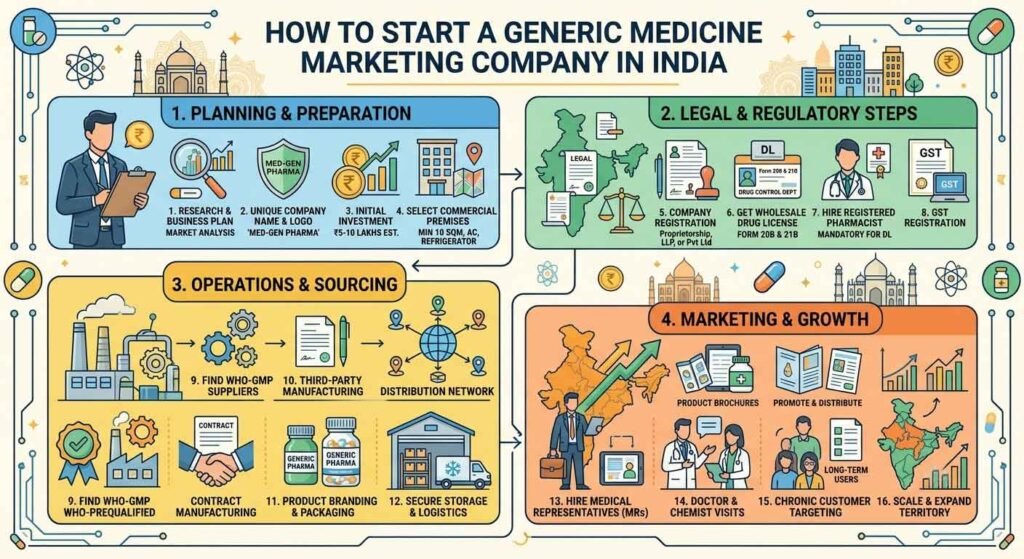
Starting a generic medicine marketing company does not require you to establish your own pharmaceutical manufacturing plant.
You can:
Form your own business entity
Obtain the required wholesale drug-licence structure
Select pharmaceutical products
Create your own company and product brands
Get products manufactured by licensed third-party manufacturers
Appoint distributors, wholesalers and sales representatives
Market the products through compliant channels
However, the business should be planned carefully because company registration, drug licensing, manufacturing permission, trademark protection, pricing and distribution are separate requirements.
A common query is:
“We want to start a generic medicine marketing company with one male and one female partner. Products will be manufactured by an out-of-state third-party manufacturer, while marketing will be carried out in Jharkhand. Should we form a partnership or Private Limited Company? Where should the company and drug licence be registered? Can another company with the same prefix operate in Jharkhand?”
The practical answer is:
Start with one clearly identified legal entity, obtain wholesale drug-licence support at the premises from which medicines will be stocked and distributed, and use licensed third-party manufacturers located anywhere in India.
A separate subsidiary or second company is not normally necessary at the beginning.
What Is a Generic Medicine?
A generic medicine contains an approved active ingredient in a particular:
Strength
Dosage form
Route of administration
Quality standard
For example:
Paracetamol Tablets IP 500 mg
The medicine may be marketed either under its proper or generic name or under a separate brand.
True Generic or Unbranded Generic
A true generic is marketed mainly under the approved or non-proprietary name.
Example:
Paracetamol Tablets IP 500 mg
Branded Generic
A branded generic contains an established generic medicine but is sold under a product brand.
Example:
Proposed Brand Name Paracetamol Tablets IP 500 mg
Trade Generic
In the Indian market, “trade generic” commonly refers to products supplied primarily through wholesalers and retailers at competitive net rates and with comparatively attractive channel margins.
This is a commercial expression rather than a separate legal class of medicine.
Do You Need Your Own Manufacturing Plant?
No.
You can get the medicines manufactured through:
Third-party manufacturing
Contract manufacturing
Loan-licence manufacturing
Third-party manufacturing is generally the simplest option for a new marketing company.
Under this arrangement:
The licensed manufacturer manufactures and tests the medicine.
Your company selects and markets the products.
Your company may own the brand names.
The actual manufacturer’s name and address appear on the label.
You do not need your own manufacturing licence when the product is manufactured entirely under the third-party manufacturer’s licence.
Which Business Entity Should You Choose?
For one man and one woman starting together, the main choices are:
Partnership firm
Limited Liability Partnership
Private Limited Company
1. Partnership Firm
A traditional partnership is comparatively simple to establish.
Advantages
Lower formation cost
Simpler internal management
Suitable for a small family-run business
Flexible profit-sharing arrangement
Limitations
Partners normally have personal liability
Ownership changes can be less convenient
Some investors and larger institutions may prefer a corporate structure
Disputes between partners can directly affect the firm
A strong registered partnership deed is essential.
2. Limited Liability Partnership
An LLP combines partnership-style management with limited liability.
Advantages
Separate legal identity
Limited liability
Lower routine compliance than many Private Limited Companies
Suitable for two active founders
Clear partner contribution and profit-sharing structure
Limitations
Some investors prefer equity in a Private Limited Company
Ownership and funding options are less flexible than company shares
Annual compliance is still required
For two founders who intend to run a medium-sized pharma marketing business, an LLP can be a practical structure.
3. Private Limited Company
A Private Limited Company is generally suitable where the promoters intend to:
Build a larger national brand
Raise investment
Introduce additional shareholders
Create subsidiaries
Offer employee equity
Separate ownership from management
Advantages
Separate legal identity
Limited liability
Easier shareholding structure
Greater institutional credibility
Better structure for future investment
Limitations
Higher incorporation and compliance cost
Regular company-law filings
Board and statutory requirements
More formal internal management
Which Structure Is Best?
For a small two-person startup:
LLP may provide a practical balance between limited liability and manageable compliance.
For a business with plans for investors, large-scale expansion or multiple subsidiaries:
Private Limited Company may be more suitable.
A traditional partnership may work for a small local business, but its personal-liability risk should be understood.
The final choice should be reviewed with a Chartered Accountant or Company Secretary after considering:
Investment
Expected turnover
Ownership percentage
Borrowing
Future investors
Personal liability
Succession plans
Do You Need a Separate Jharkhand Company?
Usually, no.
You can register one company or LLP with its registered office in one state and operate a branch, warehouse or sales office in another state, subject to applicable registrations.
A practical structure may be:
Registered office: Any selected state Licensed warehouse and sales premises: Jharkhand Third-party manufacturer: Any suitable Indian state Marketing territory: Jharkhand and later other states
You do not need to incorporate a new company merely because the manufacturer is located outside Jharkhand.
What Does “Subsidiary Company” Mean?
A subsidiary is not simply another business using the same prefix.
A subsidiary is a legally incorporated company controlled by a holding company through shareholding, board control or another applicable company-law relationship.
For example:
XYZ Pharma Private Limited
cannot casually call:
XYZ Pharma Jharkhand
its subsidiary unless a proper legal company and ownership structure has been created.
A separately owned firm using a similar prefix may create problems involving:
Trademark ownership
Drug licences
GST
Product billing
Brand authorization
Quality responsibility
Customer confusion
Outstanding payments
For a new business, one legal entity is usually cleaner.
Can the Registered Office and Drug-Licensed Premises Be Different?
Yes.
Your registered office and drug-storage premises can be different, but their legal functions should be clear.
Registered Office
Used for:
Corporate communications
Company records
MCA or LLP correspondence
Official notices
Marketing Office
Used for:
Sales team
Promotion
Customer service
Administration
Drug-Licensed Premises
Used for:
Receiving medicines
Stocking medicines
Invoicing and dispatch, according to the approved structure
Maintaining drug-sale records
A registered office that does not handle medicines may not need a wholesale drug licence merely because it is the company’s registered office.
However, the actual premises that stocks, sells or distributes medicines should have the appropriate licence.
Is a Wholesale Drug Licence Required?
If your company will:
Purchase allopathic medicines
Receive stock
Store medicines
Sell medicines
Issue wholesale invoices
Supply distributors or retailers
Dispatch medicines
then an appropriate wholesale drug licence is generally required for the relevant premises.
For common allopathic drug categories, wholesale licences are ordinarily issued in:
Form 20-B
Form 21-B
Additional forms or permissions may apply for:
Schedule X medicines
Special biological products
Other restricted categories
The application is commonly initiated through Form 19 or the current state online process.
The exact checklist should be confirmed with the Jharkhand State Drugs Control Directorate.
Common Documents Required for a Wholesale Drug Licence
The exact Jharkhand checklist may change, but applications commonly require:
Business Documents
Certificate of incorporation, LLP certificate or partnership deed
Memorandum and Articles of Association, where applicable
PAN
GST registration
Authorization or board resolution
Details of directors, partners or designated partners
Premises Documents
Ownership document or rent agreement
Landlord’s no-objection certificate
Site plan or layout
Utility bill
Address proof
Details of storage facilities
Competent-Person Documents
Wholesale drug operations must be supervised by a person meeting the qualification and experience requirements accepted under the Drugs Rules.
Documents may include:
Educational certificates
Experience certificate
Identity proof
Address proof
Appointment letter
Photograph
Declaration
Registration certificate, where the person is a registered pharmacist
Storage Documents
Depending on the product range:
Refrigerator
Temperature-monitoring arrangement
Air-conditioning or suitable storage
Power-backup details
Storage racks
Cold-chain arrangements
Application Documents
Prescribed application
Government fee
Affidavits and declarations
Constitution details
Inspection documents
The premises should not be used for drug stocking until the applicable approval is obtained.
Is GST Registration Required?
GST and drug licensing are separate.
Drug Licence
Authorizes the applicable purchase, stock, sale and distribution activities.
GST Registration
Covers taxation and invoicing under the GST framework.
A pharma marketing company commonly obtains GST because it may:
Purchase from manufacturers in another state
Sell to distributors
Claim input tax credit
Issue tax invoices
Conduct interstate business
Operate through online or institutional channels
The applicable GST registration structure should be reviewed according to:
Registered office
Warehouse location
Place of supply
Interstate transactions
C&F arrangement
Number of states holding stock
If stock is maintained in Jharkhand through your own establishment, a Jharkhand GST registration or additional place-of-business arrangement may be necessary according to the structure.
Other Useful Registrations
Depending on the business, you may also consider:
Shop and Establishment registration
Udyam registration
Professional tax, where applicable
Local municipal trade registration
Current bank account
Import Export Code for exports
Trademark applications
Employee registrations as the team grows
Not every registration applies to every company.
Can the Manufacturer Be Located Outside Jharkhand?
Yes.
Your third-party manufacturer may be located in:
Maharashtra
Himachal Pradesh
Uttarakhand
Gujarat
Telangana
Sikkim
Haryana
Another suitable state
The location itself is not the main quality criterion.
Select the manufacturer according to:
Valid manufacturing licence
Exact dosage-form approval
Product-wise permission
Schedule M compliance
Quality systems
Testing capability
Batch size
Delivery time
Transport cost
Complaint history
Regulatory history
A manufacturer located nearer to your market may reduce transport time, but a nearby factory should not be selected over a better-qualified facility merely because of distance.
How to Select Products for a Generic Company
Do not launch every available combination.
Start with a focused range of approximately 20 to 40 products based on the local market.
Possible therapy segments include:
Analgesic and anti-inflammatory products
Gastrointestinal products
Anti-infective products
Vitamins and minerals
Iron and calcium products
Antidiabetic medicines
Cardiovascular medicines
Dermatology products
Cough and cold products
General hospital-use products
The actual list should be selected after checking:
Jharkhand market demand
Local doctors and hospitals
Distributor demand
Existing competition
Price control
Product permission
Seasonal movement
Credit cycle
Expiry risk
A small focused range is usually safer than 100 slow-moving products.
Check the Regulatory Status of Every Product
Before placing an order, confirm whether the formulation is:
An established approved formulation
A new drug
A new fixed-dose combination
A prohibited combination
A restricted formulation
A Schedule H product
A Schedule H1 product
A Schedule X product
Covered by special labelling requirements
Third-party manufacturing does not allow an unapproved or prohibited medicine to be marketed.
Brand Name or Generic Name: What Should You Use?
You may choose either:
Non-Proprietary Generic Model
The approved medicine name is displayed as the main product identity.
This may be suitable for:
Institutional supply
Generic distribution
Tender-oriented business
Price-sensitive markets
Branded-Generic Model
You create a separate brand for each product.
This may provide:
Better product recognition
Easier sales tracking
Greater brand value
Stronger distributor identity
However, it also requires:
Trademark searching
Brand-name affidavit
Form 51 compliance
Artwork development
Greater packaging investment
Packaging and Artwork
Your artwork must include applicable information such as:
Brand name
Proper or generic name
Strength
Dosage form
Composition
Batch number
Manufacturing date
Expiry date
MRP
Storage conditions
Schedule warning
Manufacturer details
Marketing-company details
Manufacturing-licence details
Required cautions
The marketer and manufacturer should both approve the final artwork.
Do not print large quantities before:
Trademark search
Product-permission verification
Regulatory review
Manufacturer approval
Pricing of Generic Medicines
Low manufacturing cost does not mean that any MRP can be printed.
Before deciding MRP, check:
Manufacturing cost
Packaging cost
GST
Freight
C&F margin
Distributor margin
Retailer margin
Sales expenses
Expiry and return cost
Product price control
NPPA and DPCO Compliance
Medicines covered under the applicable National List of Essential Medicines may be subject to NPPA ceiling prices under DPCO 2013.
For such products:
MRP should not exceed the applicable ceiling price plus permissible taxes.
Price revisions must follow current NPPA orders.
Price lists and related filings may apply.
Existing stock and revised prices require proper handling.
Non-scheduled formulations are also subject to applicable price-increase controls and reporting requirements.
Check current NPPA notifications before approving artwork or changing MRP.
Distribution Models for a Generic Company
Model 1: Direct Wholesale
Your company supplies directly to:
Retail chemists
Hospitals
Nursing homes
This requires a strong delivery and collection system.
Model 2: District Distributors
You appoint one or more distributors for each district.
The distributor handles local retailer supply.
Model 3: Super Stockist
A super stockist receives larger quantities and supplies district-level distributors.
Model 4: C&F Agent
A C&F agent handles stock, warehousing and dispatch according to your instructions.
Model 5: Institutional Supply
You supply:
Hospitals
Charitable institutions
Corporate clinics
Government or private tenders
Institutional business may require:
Tender eligibility
Turnover conditions
EMD or security
Product samples
Test reports
Past supply experience
Generic Marketing Strategy
Generic medicine marketing should not depend only on offering the highest retailer margin.
A sustainable strategy includes:
Reliable quality
Consistent stock
Competitive net rates
Timely delivery
Clear expiry policy
Limited credit
Batch traceability
Responsive complaint handling
Professional sales support
Quality Is Especially Important in Generic Marketing
Lower price should never mean lower quality.
The marketing company should monitor:
Batch-wise COA
Product complaints
Dissolution and assay concerns
Packaging defects
Leakage
Breakage
Colour changes
Short expiry
Storage conditions
Manufacturer changes
Periodic independent testing of selected batches may be considered as part of quality oversight.
Manufacturer and Marketer Responsibility
The manufacturer is responsible for:
Manufacturing
Testing
Batch release
GMP
Production records
Product quality
The marketing company also has responsibility for:
Selecting the manufacturer
Brand and artwork
Promotional claims
Product complaints
Recall coordination
Distribution controls
Product traceability
The marketer should not respond to a quality complaint by simply saying:
“We only market it; contact the factory.”
Working Capital Planning
Your investment may be required for:
Business formation
Drug licence
Premises
GST and professional fees
Trademark applications
Manufacturer advance
Packaging development
Product inventory
C&F or distributor deposits
Sales team
Promotional material
Transport
Credit to distributors
Expiry replacements
The largest risk is often not incorporation cost.
It is money blocked in:
Slow-moving stock
Credit
Printed packaging
Expiry
Too many product launches
Recommended Startup Structure
For the situation described, a practical model would be:
Legal Entity
Create one:
LLP, or
Private Limited Company
Use the same entity as the brand owner and marketing company.
Registered Office
It may be located in the state selected by the promoters.
Jharkhand Operations
Establish:
Branch or additional place of business
Properly licensed wholesale premises
Jharkhand GST structure, where applicable
Local distribution team
Manufacturing
Appoint one or more licensed third-party manufacturers.
Brands
Register:
Company or house mark
Important individual product brands
Distribution
Begin with:
One licensed warehouse
Limited district distributors
Controlled credit
Focused product range
This is generally cleaner than forming two similarly named companies at the beginning.
When Is a Separate Jharkhand Company Justified?
A separate company may be useful when:
Different investors own the Jharkhand business.
The business requires separate liability.
A local joint-venture partner is involved.
Separate funding is planned.
The parent company wants a formal subsidiary structure.
Tax and legal advisers recommend it for documented reasons.
If a separate entity is created, it will need its own:
Incorporation
PAN
GST
Drug licence
Bank account
Agreements
Accounting
Statutory compliance
The brand owner should give it a written distribution or trademark-use authorization.
Documents Required to Begin Third-Party Manufacturing
Provide the manufacturer with:
Company constitution documents
PAN
GST
Drug licence, where applicable
Product list
Exact composition and strength
Dosage form
Brand names
Trademark or brand affidavit
Pack size
Packaging preference
Purchase order
Manufacturing agreement
Quality agreement
Artwork approval
Suggested 90-Day Launch Plan
Days 1–15: Business Setup
Select entity structure
Finalize founders’ ownership
Select company name
Complete incorporation
Open bank account
Days 16–30: Premises and Licensing
Select Jharkhand premises
Finalize competent person
Prepare drug-licence documents
Apply for GST and local registrations
Days 31–45: Product Planning
Study market
Select 20 to 40 products
Prepare expected sales quantities
Check NPPA and regulatory status
Days 46–60: Manufacturer Selection
Shortlist licensed manufacturers
Verify licences and product permissions
Compare MOQ, rates and lead time
Conduct factory visit or audit where practical
Days 61–75: Brands and Agreements
Select company and product brands
Conduct trademark searches
File important marks
Sign manufacturing and quality agreements
Days 76–90: Production and Distribution
Approve artwork
Place controlled first orders
Appoint initial distributors
Establish billing, expiry and complaint systems
Train the sales team
Commercial sale should begin only after the required licences and product documents are in place.
Common Mistakes to Avoid
Avoid:
Forming two companies without a clear need
Calling an independent company a subsidiary
Stocking drugs at an unlicensed office
Using another firm’s drug licence
Starting with too many products
Selecting manufacturers only by price
Not checking product permission
Launching prohibited or unapproved combinations
Printing before trademark clearance
Ignoring NPPA price controls
Offering excessive credit
Depending only on high retailer margins
Not obtaining batch-wise COAs
Having no expiry-return policy
Making unethical promotional payments
Confusing generic business with the Jan Aushadhi scheme
Generic Company vs Jan Aushadhi Kendra
A privately owned generic medicine marketing company is different from a Pradhan Mantri Bhartiya Janaushadhi Kendra.
Private Generic Company
Selects its own products
Uses its own supply chain
May create its own brands
Appoints private distributors
Purchases from selected manufacturers
Jan Aushadhi Kendra
Operates under the PMBJP framework
Procures approved products through the prescribed PMBI supply system
Uses the scheme’s authorized identity and procedures
A private generic company cannot use the Jan Aushadhi name or branding without authorization.
Practical Answer to the Query
For two promoters planning a generic medicine company in Jharkhand:
Form one LLP or Private Limited Company.
Keep the registered office wherever commercially suitable.
Take the wholesale drug licence at the actual Jharkhand stocking and distribution premises.
Arrange the correct Jharkhand GST establishment.
Select third-party manufacturers based on quality and permission—not only location.
Start with 20 to 40 products.
Verify every formulation’s approval and price-control status.
Register important company and product trademarks.
Sign manufacturing and quality agreements.
Build a controlled distributor and retailer network.
Maintain batch-wise quality documents.
Follow ethical marketing practices.
You do not need a separate outstation company and another similarly named Jharkhand company merely to start operations.
One properly structured company with licensed branches and distribution arrangements is usually easier to control.
Frequently Asked Questions
1. Do I need my own factory to start a generic medicine company?
No. You can use a licensed third-party pharmaceutical manufacturer.
2. Is a generic medicine company different from a PCD company?
The products may be similar, but the marketing arrangement differs. Generic marketing generally focuses on trade and distribution, while PCD involves territory-based franchise partners.
3. Do I need a wholesale drug licence?
Yes, when your company purchases, stocks, sells or distributes allopathic medicines from its premises.
4. Can my company be registered in one state and operate in Jharkhand?
Yes. The actual Jharkhand stock and sale premises must have the appropriate local licences and registrations.
5. Can the manufacturer be located in another state?
Yes. Verify its manufacturing licence, product permission, GMP compliance and quality history.
6. Should we form a partnership or Private Limited Company?
An LLP may suit two active founders seeking limited liability and manageable compliance. A Private Limited Company may be better for larger expansion and outside investment.
7. Can we use our own brand names?
Yes. Use a licensed manufacturer, conduct trademark searches and clearly define brand ownership.
8. Can we sell medicines only under their generic names?
Potentially yes, subject to compliant labelling, product permissions and your commercial model.
9. Are generic medicines lower in quality?
No. A legally marketed generic product must meet the applicable quality specifications. Low price is not permission to compromise quality.
10. Can a consultant arrange everything?
Consultants can assist, but licences, trademarks and government approvals cannot legitimately be guaranteed.
Final Thoughts
Starting a generic medicine marketing company is possible without owning a pharmaceutical factory.
The strongest beginner structure is usually:
One legal entity + One properly licensed operating premises + Reliable third-party manufacturers + A focused product list + Controlled distribution + Strong quality oversight
Do not create multiple firms only for appearance.
Do not choose products only because their manufacturing rates are low.
Build the business around:
Quality
Product availability
Competitive pricing
Ethical marketing
Timely supply
Credit control
Regulatory compliance
A generic medicine company can grow successfully when affordability is combined with consistent quality and professional distribution.
Looking for Ayurvedic Franchise or Distribution Opportunities?
Looking to start an Ayurvedic franchise, become a distributor, or launch your own herbal product range?
Elzac Herbal India offers:
Ayurvedic & Herbal Product Range
Franchise & Distribution Opportunities
Third-Party Manufacturing Services
Product Development Support
Marketing Guidance
PAN India Business Opportunities
Whether you are an entrepreneur, retailer, distributor, or healthcare professional, our team can help you explore the right business opportunity in the growing Ayurvedic sector.
Ajay Kamboj is an entrepreneur and business owners associated with many Ayurvedic and Pharmaceutical start-ups. With years of experience in Ayurvedic product marketing, pharmaceutical distribution, franchise development, and client relationship management, he regularly shares practical business insights based on real-world experiences. His articles focus on business growth, entrepreneurship, customer management, and lessons learned from the healthcare and wellness industry.






Leave a Reply
You must be logged in to post a comment.