Siddha is one of India’s traditional systems of medicine and has a well-established system of formulations, raw materials, preparation methods and therapeutic use.
An entrepreneur interested in starting a Siddha business generally has three options:
Start an independent Siddha manufacturing unit.
Obtain a loan licence and manufacture using another licensed factory.
Launch a Siddha marketing company and get products manufactured through an existing licensed Siddha manufacturer.
For most new entrepreneurs, the third-party manufacturing model is the easiest and least capital-intensive way to enter the market.
Quick Answer
To start a Siddha medicine business:
If You Want Your Own Factory
You generally need:
Suitable manufacturing premises
Schedule T GMP-compliant facilities
Qualified technical staff
Quality-control arrangements
Manufacturing machinery
Raw-material storage
Documentation system
Form 24-D application
Manufacturing licence in Form 25-D
Product permissions for the proposed Siddha medicines
If You Do Not Want Your Own Factory
You may:
Work through a licensed Siddha manufacturer on a third-party basis, or
Obtain a loan licence using another approved manufacturing facility.
If You Only Want Your Own Brand
You can select an eligible licensed Siddha manufacturer and manufacture products under your brand, subject to:
Product approval
Correct formulation
Proper manufacturing agreement
Compliant packaging
Business and GST requirements
Trademark due diligence
What Does “Siddha Pharmacy” Mean?
The term “Siddha pharmacy” can refer to two different businesses.
Siddha Manufacturing Pharmacy
This is a factory where Siddha medicines are:
Processed
Prepared
Manufactured
Packed
Tested
Released for sale
A manufacturing licence is required.
Siddha Retail or Marketing Business
This may involve:
Purchasing finished medicines
Marketing products
Selling products
Distributing products
Selling through a Siddha clinic
Selling through an online store
The registrations required depend on the exact activity and the state.
Do not confuse a Siddha manufacturing licence with a normal business, GST or retail registration.
Who Regulates Siddha Medicines?
Siddha medicines are regulated under the Drugs and Cosmetics Act, 1940 and Drugs Rules, 1945.
The rules dealing with Ayurvedic, Siddha and Unani drugs include provisions for:
Manufacturing
Licensing
GMP
Product approval
Labelling
Packing
Quality testing
Inspectors
Government analysts
Manufacturing licences are generally issued by the appropriate State Licensing Authority.
Types of Siddha Medicines
Before starting the business, determine which category of medicines you want to manufacture.
1. Classical Siddha Medicines
Classical Siddha medicines are formulations prepared according to formulae described in authoritative Siddha books recognised under the Drugs and Cosmetics Act.
These products must follow the relevant authoritative formulation.
The manufacturer should identify:
Classical name
Ingredients
Part used
Preparation method
Authoritative reference
Dosage form
A classical product should not be arbitrarily changed while continuing to be marketed as the same classical medicine.
2. Patent or Proprietary Siddha Medicines
A patent or proprietary Siddha medicine is a proprietary formulation prepared using ingredients permitted under the applicable Siddha regulatory framework.
The licensing authority may review:
Complete formula
Ingredient quantities
Botanical/mineral identity
Parts used
Authoritative references
Dosage form
Intended indications
Safety requirements
Evidence requirements
The manufacturer should obtain the required product permission before commercial manufacturing.
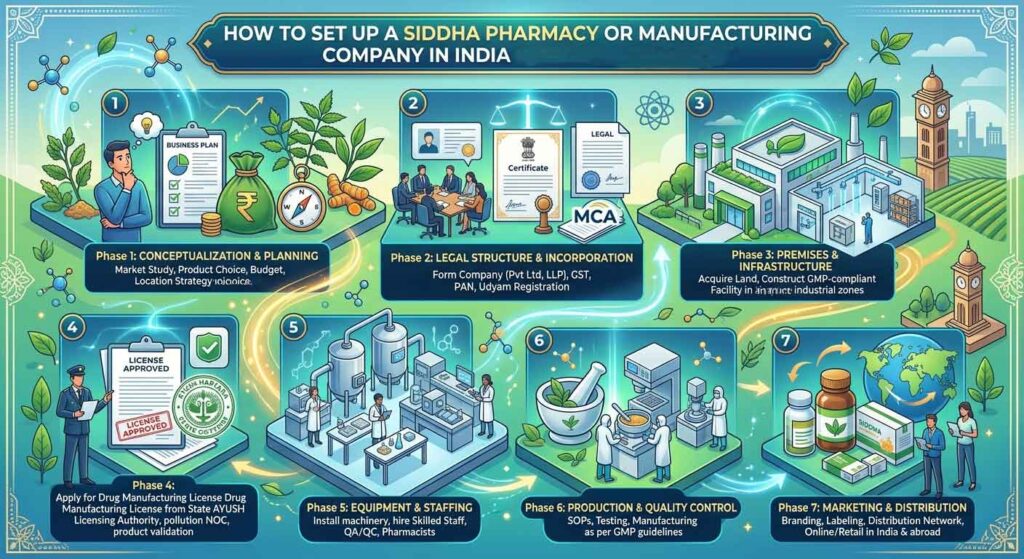
Question 1: How Can I Start Manufacturing Siddha Medicines?
If you want your own manufacturing unit, follow these steps.
Step 1: Prepare a Product List
First decide which products you want to manufacture.
Examples of Siddha dosage forms may include:
Chooranam
Kudineer
Mathirai
Parpam
Chendooram
Mezhugu
Thailam
Legiyam
Ennai
Manapagu
Other permitted Siddha dosage forms
Do not start by selecting every available dosage form.
A focused product range makes factory planning easier.
Step 2: Decide Classical vs Proprietary Products
Prepare separate lists of:
Classical Medicines
Products reproduced from recognised Siddha authoritative books.
Patent/Proprietary Medicines
Company-developed formulations permitted under the Siddha regulatory framework.
This distinction affects product documentation and approval requirements.
Step 3: Register the Business
Possible structures include:
Proprietorship
Partnership
LLP
Private Limited Company
You may also require:
PAN
Business bank account
GST registration, where applicable
Udyam registration
Local establishment permissions
Trademark applications
Step 4: Select Suitable Industrial Premises
Do not take a long-term factory lease before confirming that the premises can satisfy Siddha GMP requirements.
Consider:
Manufacturing area
Raw-material store
Packaging store
Finished-goods store
Quarantine areas
Quality-control area
Washing area
Drying area
Utilities
Personnel movement
Waste disposal
The final area depends on the dosage forms you intend to manufacture.
Step 5: Prepare a Schedule T-Compliant Layout
Schedule T specifies Good Manufacturing Practices for Ayurvedic, Siddha and Unani medicines.
The facility should be designed to prevent:
Contamination
Mix-ups
Cross-contamination
Raw-material deterioration
Pest infestation
Improper storage
The layout should provide suitable arrangements for:
Receiving raw materials
Identification
Quarantine
Approved storage
Processing
Packing
Finished-goods storage
Rejected materials
Quality control
Step 6: Arrange Required Machinery
Machinery depends on the dosage forms.
Possible equipment may include:
Pulverizer
Grinder
Sifter
Blender
Tablet or Mathirai equipment
Heating vessel
Oil-processing vessel
Storage vessels
Dryer
Filling machine
Packing equipment
Weighing balances
Products involving minerals or specialised traditional processes may require separate equipment and dedicated procedures.
Do not purchase machinery before finalising:
Product list
Batch size
Layout
Regulatory requirements
Step 7: Appoint Qualified Technical Staff
A Siddha manufacturing unit requires appropriate qualified technical personnel.
Staff may include qualified persons for:
Siddha manufacturing
Quality control
Chemistry
Pharmacognosy/botany
Production supervision
The qualifications and experience should satisfy the applicable Drugs Rules and State Licensing Authority.
Step 8: Establish Quality-Control Arrangements
Quality control is particularly important in Siddha medicines because raw materials may include:
Herbs
Minerals
Metals
Salts
Natural ingredients
Testing should confirm:
Identity
Purity
Strength
Contamination limits
Product specifications
The unit may maintain its own eligible quality-control laboratory or use recognised external testing arrangements where permitted.
Step 9: Prepare Documentation
Prepare documents such as:
Standard Operating Procedures
Master Formula Records
Batch Manufacturing Records
Raw-material specifications
Finished-product specifications
Testing procedures
Cleaning records
Equipment records
Calibration records
Training records
Complaint procedures
Recall procedures
Traditional medicine manufacturing still requires a controlled and documented quality system.
Step 10: Apply for Manufacturing Licence
The application for an independent Siddha manufacturing facility is made in:
Form 24-D
The manufacturing licence is granted in:
Form 25-D
by the appropriate State Licensing Authority after the required regulatory review and inspection.
Step 11: Obtain Product Permissions
The manufacturing licence alone does not mean you can manufacture every Siddha formulation.
The proposed products should be included within the approved manufacturing scope.
Submit the required information for:
Classical medicines
Patent/proprietary formulations
Ingredients
Dosage forms
Authoritative references
Safety/effectiveness documentation where required
Step 12: Complete Inspection
The licensing authority may inspect:
Premises
Machinery
Stores
Quality-control arrangements
Technical staff
Documentation
Hygiene
Schedule T compliance
Deficiencies must be corrected before approval.
Step 13: Approve Packaging and Labels
The label should comply with the applicable Siddha drug requirements.
Check details such as:
Product name
Ingredient list
Quantity of ingredients
Manufacturer name
Manufacturing licence number
Batch number
Manufacturing date
Expiry date
Net quantity
Dosage
Storage
Marketed-by details
Required warnings
Products containing substances covered by Schedule E(1) require the applicable caution regarding medical supervision.
Question 2: How Can I Get Siddha Medicines Manufactured by Someone Else and Sell Under My Own Brand?
It is often the most practical route for a startup.
You do not need to construct your own factory merely to launch a Siddha brand.
Third-Party Manufacturing Procedure
Step 1: Register Your Business
Create a business such as:
Proprietorship
Partnership
LLP
Private Limited Company
Step 2: Select Your Brand Name
Conduct a trademark search before finalising:
Company name
Product name
Logo
Consider filing a trademark application before investing heavily in packaging.
Step 3: Select a Licensed Siddha Manufacturer
Ask for:
Form 25-D manufacturing licence
GMP certificate
Approved product list
Manufacturing capabilities
Testing arrangements
Product permissions
Step 4: Select Products
Choose between:
Existing classical products
Existing proprietary products
New permitted proprietary combinations
Using formulations that the manufacturer already produces can reduce development time and MOQ.
Step 5: Finalise the Formula
For proprietary products, confirm:
Ingredient
Botanical or traditional name
Part used
Quantity
Specification
Extract details where applicable
Authoritative reference
Dosage
Step 6: Obtain Regulatory Confirmation
The manufacturer should confirm whether:
The product is already approved.
Additional product permission is required.
Safety/effectiveness documents are required.
Do not rely only on a sales quotation.
Step 7: Finalise the Commercial Terms
Discuss:
MOQ
Manufacturing rate
Packaging
Testing charges
Product approval charges
Advance payment
Delivery time
Freight
Replacement policy
Step 8: Prepare Packaging Artwork
Artwork may include:
Your brand
Your logo
“Marketed by” address
Manufacturer details
Licence number
Formula
Usage instructions
Warnings
The manufacturer’s regulatory/QA team should approve the artwork before printing.
Step 9: Sign a Manufacturing Agreement
The agreement should cover:
Product specifications
Brand ownership
Formula
Quality
Testing
Packaging
Delivery
Complaints
Recall
Confidentiality
Payment
Step 10: Manufacture and Test the Batch
Obtain:
Batch invoice
Certificate of Analysis
Test reports where applicable
Batch details
Manufacturing and expiry dates
Can the Product Be Sold in My Company Name?
Yes, a licensed Siddha manufacturer may manufacture the product while your company appears as the marketer or brand owner, subject to applicable labelling requirements.
A typical pack may state:
Manufactured by: XYZ Siddha Pharmaceuticals
Marketed by: ABC Healthcare
The manufacturer remains responsible for manufacturing quality, while the marketer also has responsibilities relating to the claims and marketing of the product.
Do I Need a Siddha Manufacturing Licence for Third-Party Manufacturing?
Not merely because you own the brand.
If another company holding the appropriate manufacturing licence manufactures the product and you operate only as the marketer, you do not automatically need your own Form 25-D manufacturing licence.
However, your business may still need:
Business registration
GST registration, where applicable
Trademark
Local establishment registration
Storage/distribution permissions where applicable
E-commerce compliance where applicable
State procedures should be checked before starting wholesale or retail operations.
Loan Licence Option
Third-party marketing and a loan licence are not exactly the same thing.
If you want a more formal licensed manufacturing position without owning your own factory, you may consider a loan licence.
Application:
Form 24-E
Loan licence:
Form 25-E
Under this arrangement, you use the facilities of an existing licensed Siddha manufacturing unit.
The Licensing Authority checks whether the host manufacturer has adequate:
Capacity
Equipment
Technical staff
Testing arrangements
Third-Party Manufacturing vs Loan Licence
Factor
Third-Party Marketing
Loan Licence
Own factory
No
No
Manufacturer holds Form 25-D
Yes
Yes
Marketing company owns brand
Usually
Can
Separate loan licence
No
Yes
Regulatory involvement
Lower for marketer
Higher
Suitable for startup
Very suitable
Suitable for larger/structured businesses
Question 3: What Are the Steps to Start a Siddha Pharmacy?
If by “Siddha pharmacy” you mean a business selling Siddha medicines, follow these steps.
Step 1: Decide Business Model
Choose:
Retail shop
Wholesale distribution
Online store
Siddha clinic pharmacy
Marketing company
Franchise business
Step 2: Register the Business
Arrange:
PAN
Bank account
GST registration where required
Local business registrations
Udyam where appropriate
Step 3: Select Licensed Suppliers
Purchase Siddha medicines only from authorised manufacturers or distributors.
Keep:
Purchase invoices
Batch details
Expiry details
Manufacturer information
Step 4: Arrange Suitable Storage
Follow product label storage conditions.
Protect medicines from:
Moisture
Excessive heat
Direct sunlight
Pest infestation
Contamination
Step 5: Maintain Inventory
Track:
Brand
Batch
Expiry
Purchase quantity
Sales quantity
Returns
Damaged goods
Use the first-expiry-first-out system.
Step 6: Check State-Specific Requirements
The central ASU drug rules focus heavily on manufacturing, product quality and labelling, but local or state requirements may also apply to:
Shop registration
Trade licence
Storage
Professional operation
Clinic-linked dispensing
Confirm these requirements with the concerned State AYUSH/Drug Licensing Authority.
Siddha Manufacturing Licence vs Marketing Company
Activity
Own Form 25-D Required?
Manufacturing Siddha medicines in own factory
Yes
Manufacturing under own loan licence
Form 25-E route
Brand owner using third-party manufacturer
Generally no Form 25-D merely for owning brand
Buying finished products and reselling
No manufacturing licence
Repacking or manufacturing products yourself
Manufacturing approval may be required
Classical vs Proprietary Siddha Product
This distinction is important.
Classical Siddha Medicine
The product should follow an authorised traditional formulation.
Advantages may include:
Established classical reference
Defined formulation
Easier product documentation than an entirely new proprietary formula
Patent/Proprietary Siddha Medicine
Useful when a business wants:
Unique formulation
New combination
Differentiated brand
Specific market positioning
However, regulatory documentation may be greater.
Siddha Raw-Material Quality
Raw materials should be purchased from qualified suppliers.
Maintain:
Supplier details
Purchase invoice
Batch/lot number
Identity
Test report
Storage records
Special care is required with:
Mineral ingredients
Metal-containing ingredients
Schedule E(1) ingredients
Ingredients requiring purification
Raw herbs prone to contamination
Purification Procedures
Traditional Siddha manufacturing may involve purification procedures.
These should not be performed based only on verbal tradition during commercial manufacturing.
Maintain documented:
Raw-material identification
Purification method
Process parameters
Yield
Batch record
Testing
The manufacturing process should correspond with the authorised formulation and company SOP.
Product Testing
Depending on the medicine, testing may involve:
Identity
Moisture
Ash values
Extractive values
pH
Microbial limits
Heavy metals
Pesticide residues
Aflatoxins
Assay/marker testing
Finished-product characteristics
The relevant pharmacopoeial or approved standard should be followed.
Heavy-Metal Testing
This requires particular attention in Siddha medicines containing mineral or metal ingredients.
Do not simply market such products as:
Completely safe
Non-toxic
Free from side effects
without adequate evidence.
The raw materials, purification process, manufacturing controls and finished-product specifications should all be properly documented.
Siddha Medicine Advertising
A licence does not provide permission to make unlimited advertising claims.
Avoid:
Guaranteed cure
Permanent cure
“No side effects”
Claims prohibited under applicable advertising laws
Misleading disease claims
Claims beyond the approved product scope
The same rules should be considered for:
Facebook
Instagram
YouTube
Website
Amazon listing
WhatsApp marketing
Printed advertisements
Can Siddha Medicines Be Sold Online?
Yes, subject to:
Product licensing
Business registrations
GST requirements where applicable
Marketplace policy
Proper invoicing
Label compliance
Advertising restrictions
Confirm documentation requirements with the intended marketplace before placing a large manufacturing order.
Documents to Ask From a Third-Party Siddha Manufacturer
Before placing an order, ask for:
Form 25-D licence
GMP certificate
Product permission
Approved formula
GST certificate
Manufacturing address
COA
Test reports
Manufacturing agreement
Approved artwork
Invoice
For a classical product, ask for the authoritative Siddha reference.
Investment Required
Investment depends heavily on your business model.
Third-Party Marketing Company
Main costs include:
Business registration
Trademark
Initial stock
Packaging
Marketing
Website
GST/compliance
Working capital
Loan-Licence Business
Additional costs may include:
Licensing
Regulatory documentation
Technical arrangements
Host-factory charges
Own Siddha Manufacturing Unit
Investment may include:
Factory premises
Civil work
Machinery
Quality-control arrangements
Technical staff
GMP compliance
Raw materials
Packaging
Regulatory fees
Working capital
For beginners, third-party manufacturing normally carries much lower financial risk.
Common Mistakes to Avoid
Assuming Siddha and food supplements are the same category
Manufacturing without Form 25-D
Calling a product Siddha without proper regulatory basis
Selecting an unlicensed contract manufacturer
Printing artwork before regulatory approval
Ignoring Schedule T
Buying unknown raw herbs without testing
Making unsupported claims
Assuming a trademark is the same as a product licence
Paying for large batches before checking documents
Mixing loan licence and third-party manufacturing concepts
Assuming every herbal product is a Siddha medicine
Answer to the Questions
Question 1: What Is the Procedure for Starting Siddha Medicine Manufacturing?
Establish a Schedule T-compliant manufacturing facility, appoint qualified staff, arrange quality control, apply in Form 24-D and obtain the manufacturing licence in Form 25-D from the appropriate State Licensing Authority.
The proposed medicines must also satisfy product-approval requirements.
Question 2: How Can I Get Medicines from Another Manufacturer and Sell Them Under My Name?
Select a properly licensed Siddha manufacturer and use a third-party manufacturing arrangement.
Your company can generally own the brand and appear as the marketer while the licensed manufacturer appears as the manufacturer.
Alternatively, you may obtain a loan licence in Form 25-E.
Question 3: What Are the Steps for Starting a Siddha Pharmacy?
Decide whether you want a manufacturing unit, retail shop, online business or marketing company.
For a marketing/retail business, arrange the business, GST and local registrations applicable to your activities and purchase only properly licensed Siddha medicines.
Do not assume that the manufacturing licence held by the product manufacturer replaces every registration needed for your own business.
Frequently Asked Questions
1. Which licence is required to manufacture Siddha medicines?
A manufacturing licence is issued in Form 25-D after an application in Form 24-D.
2. What is the loan licence for Siddha medicines?
A Siddha loan licence is issued in Form 25-E following the applicable Form 24-E application.
3. Is Schedule T applicable to Siddha medicines?
Yes. Schedule T contains GMP requirements for Ayurvedic, Siddha and Unani medicine manufacturing.
4. Do I need my own factory to launch a Siddha brand?
No. You may work with an existing licensed Siddha manufacturer.
5. Can my company’s name appear on the product?
Yes, subject to applicable labelling requirements, the pack may identify your company as the marketer while identifying the actual licensed manufacturer.
6. Is a manufacturing licence required only because I own the brand?
No. Brand ownership alone is different from performing manufacturing activity.
7. Can I make my own new Siddha combination?
Only after confirming that the proposed formulation satisfies the applicable patent/proprietary Siddha medicine rules and obtaining the required product permission.
8. Can Siddha medicines contain metals and minerals?
Certain authorised Siddha medicines may contain such ingredients, but raw-material quality, purification, manufacturing and testing requirements must be rigorously controlled.
9. Is AYUSH Premium Mark compulsory?
No. It is a voluntary quality-certification scheme and does not replace the statutory manufacturing licence.
10. Is GST compulsory?
GST liability depends on turnover, nature of supply, interstate transactions and other GST rules. It should be checked for the specific business model.
11. Can I sell Siddha medicines online?
Yes, provided the product and business comply with applicable manufacturing, labelling, tax, e-commerce and advertising requirements.
12. Who issues Siddha medicine manufacturing licences?
The appropriate State Licensing Authority issues the manufacturing licence under the Drugs Rules.
Final Thoughts
There are three practical routes to enter the Siddha medicine business:
Loan licence → greater regulatory control without own factory
Own Form 25-D manufacturing unit → highest investment and operational responsibility
For most new entrepreneurs, starting with a small, carefully selected range through a reliable licensed Siddha manufacturer is usually more practical than immediately building a complete factory.
Once demand, distribution and repeat sales are established, the business can evaluate whether a loan licence or independent manufacturing facility is commercially justified.
Looking for Ayurvedic Franchise or Distribution Opportunities?
Looking to start an Ayurvedic franchise, become a distributor, or launch your own herbal product range?
Elzac Herbal India offers:
Ayurvedic & Herbal Product Range
Franchise & Distribution Opportunities
Third-Party Manufacturing
Product Development Support
Marketing Guidance
PAN India Business Opportunities
Whether you are an entrepreneur, retailer, distributor, or healthcare professional, our team can help you explore the right business opportunity in the growing Ayurvedic sector.
Ajay Kamboj is an entrepreneur and business owners associated with many Ayurvedic and Pharmaceutical start-ups. With years of experience in Ayurvedic product marketing, pharmaceutical distribution, franchise development, and client relationship management, he regularly shares practical business insights based on real-world experiences. His articles focus on business growth, entrepreneurship, customer management, and lessons learned from the healthcare and wellness industry.







Leave a Reply Cancel reply
You must be logged in to post a comment.