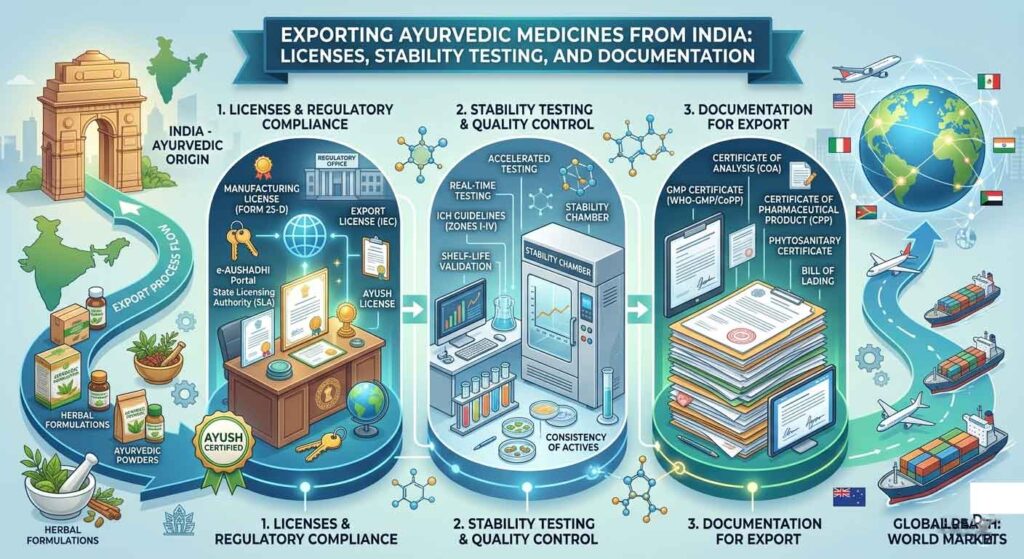
Exporting Ayurvedic products requires compliance with both Indian regulations (for production and export) and the import rules of the destination country. Below is a comprehensive guide to the key steps and requirements:
1. Ayurvedic Product Licensing in India
To manufacture or market an Ayurvedic medicine in India, you must first obtain the appropriate licence under the Drugs & Cosmetics Act (as administrated by the State AYUSH/Drug Control Authority). The type of licence depends on the product:
Classical Ayurvedic Product: If the formulation is described in an official Ayurvedic pharmacopeia or classical text (e.g. Charaka Samhita, Sushruta), you can apply under a Classical Medicine licence. This generally only requires proof of reference to the traditional text and compliance with that monograph.
Proprietary/Patent Ayurvedic Product: If the formulation is new or not found in classical texts, you need a Proprietary medicine licence. This requires additional data on safety and efficacy.
Application Requirements: For a proprietary product, you must submit an application (Form 24D under Schedule T) that includes, among other things:
Product formulation and process: Full ingredient list and composition.
Stability study reports: Shelf-life (expiry) data based on stability testing.
Safety and efficacy data: For proprietary products, pilot or clinical data as required.
Qualified staff details: Proof of qualified Ayurvedic experts involved.
GMP compliance: Certificate of compliance with Ayurvedic Good Manufacturing Practices.
These requirements are explicitly stated in official guidelines. For example, one review notes: “Product formulation details and ingredient composition… [and] stability study reports and safety data (for proprietary medicines)” must be submitted when applying for an Ayurvedic manufacturing licence.
Importantly, Indian regulations mandate that all Ayurvedic medicines have a scientifically justified shelf-life. According to the Drugs Rules, any licence application must include a “scientific data based shelf life… based on real-time stability studies” as per the Ayurvedic Pharmacopoeia guidelines. In practice, this means you cannot simply assign an arbitrary expiry – you must generate stability data.
2. Stability Testing Requirements
Since stability data are required for licensure, manufacturers must conduct formal stability studies. The Ayurvedic Pharmacopoeia of India (API) Part I, Vol. VIII provides guidance on stability testing of ASU (Ayurveda/Siddha/Unani) products. Key points include:
Number of batches: Test at least three consecutive primary batches of the final product. This is similar to international norms (e.g. ICH) and ensures reproducibility.
Test conditions: Studies should include both accelerated and long-term conditions. A recommended accelerated condition is 40 °C ±2 °C with 75% ±5% relative humidity (RH). One reference suggests running these accelerated studies for at least 12 months (some protocols use 6 months at 40°C/75% for accelerated, plus a 12-month long-term study at 25°C/60%RH or 30°C/65%RH).
Storage and testing intervals: At minimum, test each batch at 0, 3, 6, 9, and 12 months (for a 12-month protocol). Evaluate all relevant parameters (e.g. appearance, pH, assay, moisture, microbial load) per the API monograph.
Acceptance criteria: Generally, a product is considered stable if it shows “no significant change” (typically ≤10% change in active markers) under these conditions.
In summary, both accelerated and real-time (long-term) studies are needed to justify an expiry. The data from these studies are submitted with the licence application. As the Drugs Rules explain, the claimed shelf-life must be “based on real-time stability studies… in accordance with the guidelines prescribed in the Ayurvedic Pharmacopoeia of India”.
3. Export Certifications and Licenses
Once the product is licensed and manufactured, exporting it requires additional documentation:
Importer-Exporter Code (IEC): Obtain an IEC from the DGFT (Directorate General of Foreign Trade). No exports (or imports) can proceed without this 10‑digit code (issued in ~10 working days, using your PAN).
Free Sale Certificate (FSC) & Non-Conviction Certificate: These are issued by your State Drug Control Authority (AYUSH licensing authority). As per the Drugs Rules, on request the State Authority “shall…issue, within 15 days…Free Sale Certificate in Form 26 E2-I (for original licence) or Form 26 E2-II (for loan licence) and Non‑Conviction Certificate in Form 26 E3”. The FSC certifies that the products are freely sold and consumed in India in accordance with law.
Certificate of Pharmaceutical Product (COPP): Though not always mandatory, many countries (and tenders) request a WHO-style COPP. This is issued by CDSCO under the WHO Certification Scheme for those products manufactured in WHO-GMP certified units. Check if your buyer needs it.
Export Promotion Council Membership (RCMC): From 2023, the Ayush Export Promotion Council (AYUSHEXCIL) can issue RCMC certificates for Ayurvedic exports (per DGFT Notice No. 23/2023). An RCMC may be needed to claim export incentives or access council services.
Other prerequisites: Ensure your company is properly registered (sole proprietor, LLP, or company) and has GST registration. If you export ingestible products (foods, supplements), an FSSAI license may also be required, but for medicinal (ASU) products, the AYUSH/Drug licensing is the key license.
4. Country-specific Requirements
Before shipping, verify the import regulations of your destination country. Many countries require:
Product registration: Some nations (e.g. in the EU, U.S., GCC) require local product registration or import permits for traditional medicines.
Quality/Inspection: The importing country’s authorities may test consignments for heavy metals, pesticides, or microbiological safety. Ensure your lab tests cover these. In some cases, a consignment may need an export certification from an accredited lab.
Documentation: Typically, your shipment must include Commercial Invoice, Packing List, Bill of Lading/Airway Bill, Purchase Order or Letter of Credit, and relevant certificates (FSC, COPP, etc.). The buyer or local agent usually handles customs clearance in the destination country.
Example: DGFT regulations note that Ayurvedic/Unani products that do not contain prohibited plant materials can be exported freely without additional pre-approvals. (If your product does contain a Schedule E(1) ingredient, you may need special clearances.) Always confirm with the buyer and local authorities.
Obtain necessary certificates: IEC, FSC & NCC, (and COPP if needed) before shipment.
Manufacture & quality control: Produce and pack the goods. Obtain a Certificate of Analysis (COA) or Quality Certificate as per the buyer’s requirement.
Logistics: Arrange transport (by sea/air). Prepare Shipping Bill via Indian customs’ ICEGATE portal.
Customs clearance: Submit documentation (Invoice, Packing List, FSC, COA, etc.) to Customs. Customs may physically inspect the shipment.
Export order: Once Customs is satisfied, a “Let Export Order” is issued and shipping bills are generated (for exporter, bank, and carrier).
Arrival & clearance abroad: The buyer’s customs agent handles import clearance in the destination country using the provided documents.
Throughout, it is wise to work with a freight forwarder or export consultant experienced in pharmaceuticals.
Product documents: Stability reports, Certificate of Analysis, API and excipient specs, GMP certificate, label artwork.
Export documents: Commercial invoice, packing list, shipping bill, FSC (Form 26E2) & NCC (26E3), COPP (if requested), Bill of Lading/Airway Bill, insurance certificate, if applicable.
Regulatory certificates: As required by importer (e.g. export permit from AYUSH, phytosanitary for plant materials, halal certification for Muslim countries, etc.).
Each importing country has its own requirements, so always ask the buyer for a detailed list before shipping.
References: Export of Ayurvedic products is governed by the Drugs & Cosmetics Rules and international trade rules. For example, Rule 158C of the Drugs Rules mandates that a Free Sale Certificate (Form 26E2) be issued within 15 days of request. Similarly, Rule 161B requires real-time stability data as per the Ayurvedic Pharmacopoeia for licence applications. Industry literature recommends stability testing on at least three batches (accelerated and long-term) to establish shelf life. Application requirements (Form 24D) specifically list “stability study reports” as necessary for proprietary Ayurvedic medicines. For international export, these standards ensure your product meets both Indian licensing and foreign regulatory expectations.
Partner with Elzac Herbal India
Looking to start an Ayurvedic franchise, become a distributor, or launch your own herbal product range?
Elzac Herbal India offers:
Ayurvedic & Herbal Product Range
Franchise & Distribution Opportunities
Third-Party Manufacturing Services
Product Development Support
Marketing Guidance
PAN India Business Opportunities
Whether you are an entrepreneur, retailer, distributor, or healthcare professional, our team can help you explore the right business opportunity in the growing Ayurvedic sector.
Ajay Kamboj is an entrepreneur and business owners associated with many Ayurvedic and Pharmaceutical start-ups. With years of experience in Ayurvedic product marketing, pharmaceutical distribution, franchise development, and client relationship management, he regularly shares practical business insights based on real-world experiences. His articles focus on business growth, entrepreneurship, customer management, and lessons learned from the healthcare and wellness industry.
6 responses to “Exporting Ayurvedic Medicines from India: Licenses, Stability Testing, and Documentation”
my name is doctor, an ayurvedic doctor i am practiced my own hospital. The way off ayurveda i like to export an ayurvedic medicine and raw meterials also
Hi!
I am ayurveda doctor – practicing since 25 years, I want the way out to export ayurvedic face packs & lotions .
whom / where / which site should I visit or contact?
I am an Ayurveda doctor and need to export Ayurvedic herbal medicine to prague , czech republic, Can anyone please guide what are their rules and regulations?
I m ayurvedic medicine practitioner and interested in exports of Ayurvedic/Unani herbs and medicinal roots barks etc in raw as well as semi process cum packed forms ready to use pl help us to know which exports counciks registration and certificates require beside ADC NOC at time of export in customs while processing shipping Bill ?







my name is doctor, an ayurvedic doctor i am practiced my own hospital. The way off ayurveda i like to export an ayurvedic medicine and raw meterials also
Hi!
I am ayurveda doctor – practicing since 25 years, I want the way out to export ayurvedic face packs & lotions .
whom / where / which site should I visit or contact?
I am an Ayurveda doctor and need to export Ayurvedic herbal medicine to prague , czech republic, Can anyone please guide what are their rules and regulations?
I m ayurvedic medicine practitioner and interested in exports of Ayurvedic/Unani herbs and medicinal roots barks etc in raw as well as semi process cum packed forms ready to use pl help us to know which exports counciks registration and certificates require beside ADC NOC at time of export in customs while processing shipping Bill ?
Sir namaskar , kripaya bataye ayurvedic marketing firms export kar sakti hai
yes sir kar skti hai