Starting or restarting an Ayurvedic manufacturing company requires more than ownership of an old business, traditional formula or brand name.
A person does not necessarily need to hold a BAMS degree to own or manage an Ayurvedic manufacturing company. However, the company must meet current licensing, premises, technical-staff, manufacturing, quality-control and GMP requirements.
A common query is:
“My grandfather started an Ayurvedic company around 40 years ago using his own formulations. I am now taking responsibility for the company, but I do not have an Ayurvedic educational qualification. The manufacturing licence has also expired, and the business has reduced to a very small scale. Can I lead the company and continue manufacturing the same formulations?”
The practical answer is:
You may own, manage and lead the business, but you cannot restart manufacturing only on the strength of the old company or expired licence. You must obtain valid manufacturing permission, appoint approved technical staff and get the products accepted by the concerned State AYUSH Licensing Authority.
Can a Person Without a BAMS Degree Own an Ayurvedic Company?
Yes. A person without a BAMS degree may generally become:
Proprietor
Partner
Director
Shareholder
Managing director
Business head
Marketing head
Authorized signatory
Ownership and technical supervision are separate matters.
The owner may handle:
Investment
Administration
Accounts
Marketing
Distribution
Branding
Sales
Human resources
Business development
However, manufacturing and technical operations must be supervised by appropriately qualified and approved personnel.
Is BAMS Compulsory for the Owner?
No. BAMS is not necessarily compulsory for the proprietor, partner or director of the company.
However, the manufacturing unit must have approved technical staff according to:
Product category
Manufacturing sections
Applicable Drugs Rules
State licensing requirements
Qualification and experience of the proposed technical person
A BAMS-qualified person may be accepted for relevant responsibilities, but BAMS is not the only qualification that may be considered in every situation.
Depending on the applicable provisions and state authority’s assessment, other recognized qualifications and experience may also be relevant.
Do not appoint someone only on paper. The technical person must genuinely supervise the work for which they are approved.
Who Is the Qualified Technical Person?
The qualified technical person is responsible for supervising manufacturing activities.
Responsibilities may include:
Verification of raw materials
Manufacturing supervision
Batch documentation
Formula compliance
In-process controls
Cleaning and hygiene
Packing supervision
Finished-product release coordination
Complaint investigation
Recall support
Compliance with approved procedures
The State AYUSH Licensing Authority will determine whether the proposed person’s qualifications and experience are acceptable.
Can You Continue with an Expired Manufacturing Licence?
You should not manufacture Ayurvedic medicines under an expired licence.
First determine:
When the licence expired
Whether any retention or renewal fee was paid
Whether the premises still exist
Whether the old constitution of the firm still exists
Whether the technical staff have changed
Whether the product permissions are still recognized
Whether the plant still complies with current GMP requirements
Whether ownership has legally transferred
Depending on the period of expiry and state procedure, the authority may require:
Restoration or regularization, where legally available
Payment of applicable fees or penalties
Amendment of constitution
Change of technical staff
Inspection of premises
Fresh manufacturing licence application
Fresh product permissions
Where a licence has remained expired for many years and the unit is no longer compliant, a fresh application is often the practical route.
Obtain written guidance from the State AYUSH Licensing Authority before investing in machinery or restarting production.
Can the Grandson or Legal Heir Continue the Company?
Yes, subject to proper legal and licensing formalities.
You may need to establish:
Legal ownership of the business
Succession or inheritance
Transfer of assets
Transfer or reconstitution of the firm
Rights over the company name
Rights over trademarks
Ownership of product formulations
Rights over manufacturing records
Consent of other legal heirs, where applicable
If the original business was a proprietorship, the old proprietorship may not automatically continue merely because a family member takes over.
Consult a CA, CS or legal professional for reconstitution of the business.
Can You Manufacture the Same Formulations Created by Your Grandfather?
Possibly, but the old formulations must first be examined and legally classified.
An old family formula does not automatically receive permanent manufacturing permission.
Each formula should be reviewed for:
Complete ingredient list
Botanical names
Parts used
Quantity of each ingredient
Manufacturing process
Dosage form
Recommended dosage
Intended indication
Safety profile
Classical textual reference
Current ingredient restrictions
Presence of Schedule E(1) substances, where applicable
Heavy-metal or mineral ingredients
Label claims
Shelf life
Testing specifications
Classification of Old Ayurvedic Formulations
An old formulation may fall into one of the following categories.
1. Classical Ayurvedic Medicine
A classical medicine is manufactured according to a formula described in an authoritative Ayurvedic text recognized under the applicable law.
For such a product, you will generally need to identify:
Name of the authoritative book
Chapter
Verse or formulation reference
Ingredients
Manufacturing method
Dosage form
Permitted indication
The product should follow the recognized classical reference.
2. Patent or Proprietary Ayurvedic Medicine
A patent or proprietary Ayurvedic medicine is generally a formulation that is not a classical formula in its exact published form but is composed of ingredients recognized in authoritative Ayurvedic literature, subject to the applicable legal definition.
The licensing authority may require a proper product dossier containing:
Formula
Ingredient references
Rationale
Manufacturing process
Specifications
Safety information
Label claims
Shelf-life support
Testing methods
3. Traditional Family Formula
A formula used by a family for many years is not automatically approved only because it has a long history.
The authority will examine whether:
Its ingredients are legally permitted
The ingredients appear in recognized authoritative sources
Its proposed category is acceptable
Safety requirements are met
Its claims are permitted
Its manufacturing process is documented
If the formula cannot be appropriately classified under the applicable rules, it may not be accepted for commercial manufacturing as an Ayurvedic medicine.
Does the Old Product Permission Remain Valid?
Do not assume that an old product permission remains valid indefinitely.
Check:
Whether a formal product permission was issued
Name under which it was issued
Licence number
Composition recorded with the authority
Whether the firm constitution has changed
Whether the product has been manufactured continuously
Whether any ingredient or claim is now restricted
Whether the label is compliant with current requirements
Ask the State AYUSH Licensing Authority to verify the historical product records.
Documents to Collect from the Old Company
Before applying, search for all available historical documents.
These may include:
Old manufacturing licence
Renewal or retention receipts
Product-permission letters
Approved product list
Old inspection reports
GMP certificate
Company registration documents
Partnership deed
Proprietorship records
Trademark certificates
Product labels
Master formula records
Batch manufacturing records
Raw-material records
Testing reports
Sales invoices
Tax registrations
Technical-person approval
Premises documents
Machinery list
Old documentation can help establish the history of the company, although it does not replace current licensing requirements.
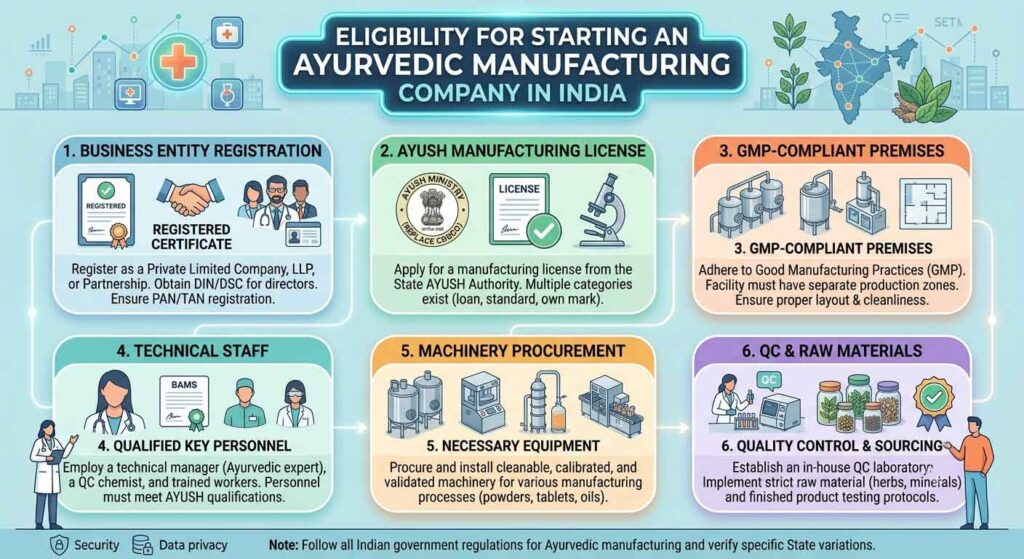
Basic Requirements for Restarting Ayurvedic Manufacturing
1. Legal Business Entity
Choose or update the business structure:
Proprietorship
Partnership
LLP
Private Limited Company
Complete ownership or succession documentation before submitting the licence application.
2. Approved Manufacturing Premises
The premises should be suitable for industrial and manufacturing activity.
Check:
Land-use permission
Building approval
Adequate space
Water supply
Electricity
Drainage
Ventilation
Storage
Waste disposal
Fire safety
Pollution-control requirements
Do not restart manufacturing in an old building without checking its present suitability.
3. Schedule T GMP Compliance
Ayurvedic manufacturing units must meet applicable GMP requirements.
The facility should generally provide appropriate areas for:
Raw-material storage
Quarantine
Manufacturing
Packing
Finished goods
Rejected materials
Quality control
Washing
Change rooms
Documentation
Utilities
The exact space and machinery depend on the dosage forms being manufactured.
4. Manufacturing Machinery
Machinery may be required for sections such as:
Churna and powder
Tablets and vati
Capsules
Syrups
Asava and arishta
Oils and taila
Avaleha
Ointments
Kwath
Proprietary liquid preparations
Do not purchase machinery until the proposed layout and product sections have been reviewed.
5. Approved Technical Staff
Appoint qualified technical staff according to the current requirements.
Verify:
Educational qualification
Institution recognition
Experience
Registration, where relevant
Full-time availability
Previous approvals
Employment documents
The final approval rests with the concerned licensing authority.
6. Quality-Control Arrangement
You will need a suitable system for testing raw materials and finished products.
This may include:
In-house quality-control laboratory
Approved external testing laboratory, where permitted
Raw-material specifications
Finished-product specifications
Microbial testing
Heavy-metal testing
Pesticide-residue testing, where applicable
Aflatoxin testing, where applicable
Physicochemical testing
Batch-wise Certificate of Analysis
Testing requirements depend on the product and ingredients.
7. Manufacturing and Quality Documents
Prepare documents such as:
Site Master File
Standard operating procedures
Master formula records
Batch manufacturing records
Batch packing records
Raw-material specifications
Finished-product specifications
Cleaning records
Equipment logbooks
Calibration records
Vendor-approval records
Training records
Complaint procedure
Recall procedure
Product-return procedure
Stability and shelf-life documentation, where required
8. Product Dossiers
Prepare a separate dossier for each product containing:
Product name
Dosage form
Complete composition
Quantity of each ingredient
Ayurvedic reference
Manufacturing procedure
Testing specification
Dosage
Indication
Precautions
Shelf life
Proposed label
Packaging details
9. Manufacturing-Licence Application
Apply to the State AYUSH Licensing Authority in the prescribed form with:
Government fee
Firm documents
Premises documents
Layout
Machinery list
Technical-staff documents
Product list
GMP documents
Quality-control arrangement
Formula details
The authority may inspect the premises before granting the licence.
Can the Company Use the Old Brand Name?
The old company or product name may still have commercial value, but first check:
Trademark registration
Trademark renewal status
Ownership of the trademark
Similar trademarks filed by others
Company-name status
Domain-name availability
Existing market use
An old brand does not remain legally protected forever unless its rights have been maintained.
Conduct a fresh trademark search before relaunch.
What Should Be Done If the Old Factory Is Too Small?
If the unit has reduced below a commercially viable scale, you have three practical options.
Option 1: Restart Your Own Manufacturing Unit
Choose this option if:
The premises can be upgraded
Machinery is usable
Product demand exists
You have enough capital
Qualified staff are available
You want long-term manufacturing control
This option requires the highest investment and compliance responsibility.
Option 2: Use Third-Party Manufacturing
This may be the most practical option for a small or collapsed business.
Under this model:
Preserve the old company identity
Retain or register the brand names
Review the old formulations
Get products manufactured by a licensed Ayurvedic manufacturer
Focus on marketing and rebuilding sales
Benefits include:
Lower investment
No immediate factory renovation
No machinery purchase
Faster relaunch
Lower compliance burden
Opportunity to test demand
Ensure that the selected manufacturer has the appropriate manufacturing licence, GMP compliance and permission for the products.
Option 3: Loan-Licence Arrangement
A loan-licence or similar approved manufacturing arrangement may be considered where legally available and accepted by the State AYUSH Licensing Authority.
It generally involves using another licensed unit’s manufacturing facilities under a separate licensing arrangement.
This model involves more documentation and responsibility than normal third-party manufacturing.
Best Strategy for Reviving a Heritage Ayurvedic Business
A practical revival plan may be:
Phase 1: Legal and Regulatory Audit
Collect old documents
Verify ownership
Check licence status
Check trademark status
Review each formula
Meet the State AYUSH Licensing Authority
Phase 2: Product Shortlisting
Select 5 to 10 products that have:
Historical recognition
Clear formula records
Good market demand
Simple compliance
Suitable manufacturing cost
Strong brand potential
Do not relaunch every old product immediately.
Phase 3: Manufacturing Decision
Compare:
Cost of factory renovation
Cost of machinery
Cost of technical staff
Cost of quality control
Third-party manufacturing rates
Expected annual sales
For a business with very low turnover, third-party manufacturing may initially be more economical.
Phase 4: Brand Relaunch
Improve:
Packaging
Labels
Website
Product photography
Distributor network
Digital marketing
Trademark protection
Customer service
Keep the heritage story, but do not make unsupported medical claims.
Phase 5: Own Manufacturing Later
After sales become stable, you may consider restarting your own manufacturing facility.
Important Compliance Warning
Do not:
Manufacture under the expired licence
Print the old licence number
Sell newly manufactured products as old stock
Use an unapproved formula
Employ a technical person only on paper
Make disease-cure claims without legal support
Use old labels without reviewing current requirements
Assume family ownership automatically transfers regulatory permission
These actions can lead to seizure, cancellation, prosecution or other regulatory action.
Practical Answer to the Query
You can lead and manage your grandfather’s Ayurvedic company even without holding a BAMS qualification.
However:
The company must have valid legal ownership and constitution.
The expired manufacturing licence must be reviewed by the State AYUSH Licensing Authority.
You must appoint approved qualified technical personnel.
The premises must meet current GMP requirements.
Each old formula must be reviewed and properly classified.
Product permissions and labels must be updated.
You should not manufacture until valid approval is obtained.
If the old factory is no longer financially viable, restart the brand through a reliable third-party Ayurvedic manufacturer and consider reopening your own unit after sales improve.
Frequently Asked Questions
1. Can a non-BAMS person own an Ayurvedic manufacturing company?
Yes. A non-BAMS person may own or manage the business, but approved qualified technical staff must supervise manufacturing.
2. Is BAMS compulsory for obtaining an Ayurvedic manufacturing licence?
The owner does not necessarily need BAMS. The unit must appoint technical staff whose qualifications and experience are accepted by the State AYUSH Licensing Authority.
3. Can manufacturing continue under an expired licence?
No. Manufacturing should not continue until the licence has been legally restored, regularized or freshly granted.
4. Can a legal heir use the grandfather’s Ayurvedic formulas?
Possibly, but ownership, formula classification, ingredient legality and product permission must be verified.
5. Is a traditional family formula automatically approved?
No. Long use by a family does not automatically provide commercial manufacturing approval.
6. Can old product permissions be transferred?
It depends on the licence, firm constitution, ownership change and state procedure. Obtain written confirmation from the licensing authority.
7. Can the company restart with only five products?
Yes. Relaunching a small number of well-documented and marketable products is often better than restarting a large range.
8. Is third-party manufacturing suitable for reviving an old company?
Yes. It can preserve the company and brand while reducing the immediate cost of premises, machinery and staff.
9. Can the same old labels be used?
Not without review. Labels must comply with current licensing, ingredient, warning, shelf-life and advertising requirements.
10. Which department grants an Ayurvedic manufacturing licence?
The concerned State AYUSH Drug Licensing Authority generally grants and administers Ayurvedic manufacturing licences.
Looking for Ayurvedic Franchise or Distribution Opportunities?
Looking to start an Ayurvedic franchise, become a distributor, or launch your own herbal product range?
Elzac Herbal India offers:
Ayurvedic & Herbal Product Range
Franchise & Distribution Opportunities
Third-Party Manufacturing Services
Product Development Support
Marketing Guidance
PAN India Business Opportunities
Whether you are an entrepreneur, retailer, distributor, or healthcare professional, our team can help you explore the right business opportunity in the growing Ayurvedic sector.
Ajay Kamboj is an entrepreneur and business owners associated with many Ayurvedic and Pharmaceutical start-ups. With years of experience in Ayurvedic product marketing, pharmaceutical distribution, franchise development, and client relationship management, he regularly shares practical business insights based on real-world experiences. His articles focus on business growth, entrepreneurship, customer management, and lessons learned from the healthcare and wellness industry.







Leave a Reply Cancel reply
You must be logged in to post a comment.