When a pharmaceutical marketing company approaches a third-party or contract manufacturer, the manufacturer commonly asks for a:
Brand-name affidavit
Trade-name affidavit
Trademark undertaking
Brand-ownership declaration
Form 51 undertaking
Indemnity relating to the proposed brand
Many new pharma entrepreneurs become confused and ask:
“Why is the manufacturer asking for an affidavit when the brand belongs to my company?”
The answer is:
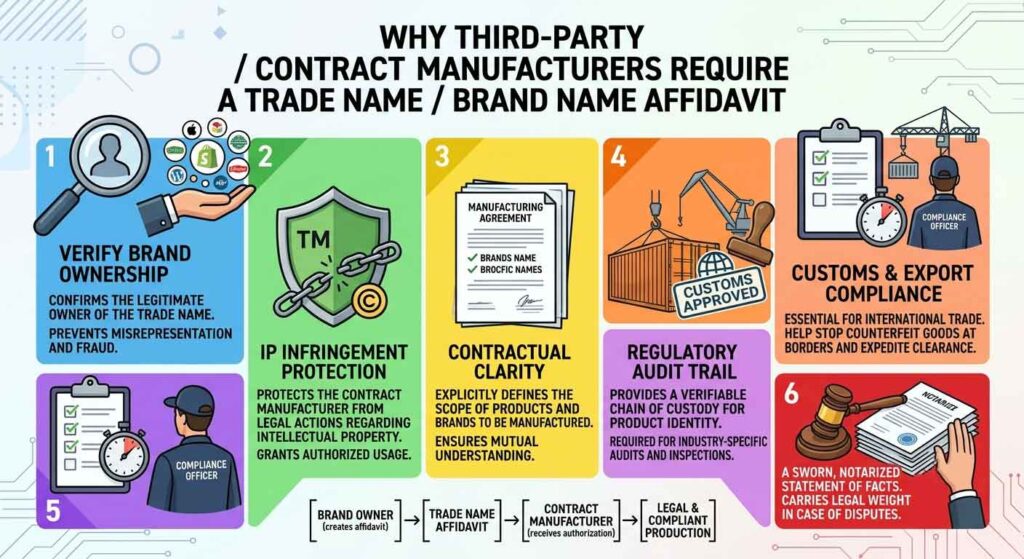
The manufacturer is being asked to manufacture and print a name selected by the marketing company. It therefore needs evidence that the marketer has searched the proposed name, claims a lawful right to use it and will accept responsibility if a trademark or drug-name dispute arises.
The affidavit also supports compliance with the Drugs Rules requirement relating to brand or trade names.
What Is a Pharmaceutical Brand Name?
A pharmaceutical product normally has two different names.
Generic or Proper Name
This identifies the active pharmaceutical ingredient.
Examples include:
Amoxicillin
Paracetamol
Pantoprazole
Telmisartan
Calcium and Vitamin D3
Brand or Trade Name
This is the distinctive commercial name selected for the product.
For example:
Generic composition: Amoxicillin Proposed brand: A newly coined and legally cleared product name
Many different companies may market the same permitted composition under different brand names, but each company must avoid names that conflict with existing rights or create medication confusion.
Why Does the Manufacturer Ask for an Affidavit?
1. To Support the Statutory Brand-Name Undertaking
Under the Drugs Rules, a manufacturer intending to market a drug under a brand or trade name must furnish an undertaking in Form 51 to the Licensing Authority.
The undertaking requires a search covering sources such as:
Trade Marks Registry
CDSCO’s brand or trade-name database
Pharmaceutical literature
Drug-reference books
Existing formulations in India
Internet sources
It also declares that, to the best of the applicant’s knowledge:
The same or a similar name is not already in use for another drug.
The proposed name will not cause confusion or deception.
The manufacturer may therefore ask the marketing company to provide a supporting affidavit before it signs or submits the required undertaking.
2. The Marketing Company Selects the Name
In most third-party manufacturing arrangements:
The marketer proposes the brand.
The marketer intends to own and promote it.
The marketer approves the artwork.
The marketer benefits commercially from the brand.
The manufacturer may not have selected or investigated the name independently.
It therefore asks the marketer to confirm that reasonable searches have been conducted.
3. To Reduce Trademark-Dispute Risk
Suppose another company already owns or has prior rights in a similar pharmaceutical name.
That company may:
Send a legal notice
Oppose the trademark application
File a passing-off action
File an infringement proceeding
Seek an injunction
Demand withdrawal of stock
Claim damages
Complain to the Licensing Authority
The contract manufacturer does not want to bear the entire cost of a dispute arising from a name supplied by the marketer.
4. To Prevent Medication Errors
Similar medicine names can create more than a commercial dispute.
They may result in:
Wrong prescribing
Wrong dispensing
Patient confusion
Confusion between different strengths
Confusion between unrelated compositions
For pharmaceutical products, brand-name clearance is also a patient-safety issue.
5. To Establish Brand Ownership
The affidavit helps record that:
The marketer proposed the name.
The marketer claims ownership or lawful use.
The manufacturer is using the name only for contract manufacturing.
The manufacturer does not acquire ownership merely by printing the name.
The manufacturing agreement should contain the same understanding.
Form 51 vs Private Brand-Name Affidavit
These documents are related but are not always identical.
Form 51
Form 51 is the prescribed undertaking under the Drugs Rules.
It contains details such as:
Name of drug
Dosage form
Composition
Proposed brand or trade name
Declaration regarding brand-name searches
Declaration that the name will not cause confusion or deception
It is signed by the manufacturer or on behalf of the manufacturer for submission to the Licensing Authority.
Private Brand-Name Affidavit
A third-party manufacturer may separately ask the marketing company to sign an affidavit or indemnity.
This document may state that:
The marketer selected the brand.
The marketer conducted reasonable searches.
The marketer has not intentionally copied another party.
The marketer will be responsible for trademark disputes.
The marketer will reimburse specified losses caused by an unlawful brand.
The manufacturer may stop production if an objection is received.
The exact format varies between manufacturers and states.
Is Notarisation Compulsory?
The manufacturer may request the affidavit:
On stamp paper
Notarised
Signed by the proprietor, partner or director
Carrying the company stamp
Supported by an authorization or board resolution
The statutory Form 51 and the manufacturer’s private affidavit should not be confused. Confirm which document is being requested.
Does an Affidavit Guarantee That the Brand Is Available?
No.
An affidavit is a declaration made on the basis of the information and searches available at that time.
It does not guarantee:
Trademark registration
Acceptance by the Trade Marks Registry
Absence of unregistered prior users
Absence of regional market use
Absence of future opposition
Approval by the Drug Licensing Authority
Freedom from legal proceedings
A name may not appear in the trademark database but may still be used by another company in the market.
That earlier user may have passing-off rights based on prior use.
Recommended Brand-Name Search Process
Step 1: Search the Trade Marks Registry
Search in Class 5 using:
Exact match
Contains search
Phonetic search
Similar spellings
Different spacing
Hyphenated versions
Singular and plural forms
Do not check only exact spelling.
Step 2: Search International Non-Proprietary Names
Make sure the proposed brand is not:
An INN
Deceptively similar to an INN
A common chemical name
Step 3: Search Pharmaceutical Databases and Directories
Search drug references and market directories for:
Existing brands
Similar formulations
Similar pronunciation
Similar names used for unrelated drugs
Step 4: Search the Internet
Search:
Google
Online pharmacies
Distributor catalogues
Manufacturer catalogues
E-commerce listings where relevant
News and regulatory notices
Step 5: Search Regional Markets
An unregistered brand may still have prior market use.
Ask:
Stockists
Retailers
MRs
Pharma distributors
because a regional product may not appear prominently online.
Step 6: Obtain Legal Clearance
For commercially important brands, obtain a trademark professional’s search and opinion before large-scale launch.
What Should a Brand-Name Affidavit Contain?
A practical affidavit may contain:
Legal name of proprietor, firm or company
Registered or principal address
Proposed brand name
Generic composition
Strength
Dosage form
Pack size
Name of contract manufacturer
Declaration of searches conducted
Declaration regarding existing similar brands
Confirmation of lawful ownership or proposed use
Confirmation that the marketer selected the name
Indemnity for specified trademark disputes
Agreement to stop using the name if legally required
Signature of authorized person
Date and place
Notary details, where requested
A lawyer should review any broad or unlimited indemnity clause before signing.
Does the Affidavit Protect the Manufacturer Completely?
No.
A private affidavit may allocate commercial responsibility, but it does not necessarily remove the manufacturer’s statutory duties.
The manufacturer should still:
Review the proposed name
Submit the applicable undertaking
Comply with licensing conditions
Ensure correct label information
Avoid knowingly printing an infringing or confusing name
Stop manufacture when a valid legal or regulatory prohibition arises
A manufacturer should not knowingly manufacture a copied brand merely because the marketer signed an affidavit.
What Happens if a Brand Dispute Arises?
Possible steps include:
Legal notice is received.
Production and dispatch may be paused.
Trademark records and prior-use evidence are reviewed.
A legal response is prepared.
The product may be renamed.
New artwork may be required.
Existing stock may need relabelling, recall or withdrawal, subject to regulatory permission.
Packaging material may become unusable.
Responsibility is reviewed under the manufacturing agreement.
The cost can be much higher than the cost of conducting a proper search before launch.
How to Reduce Brand-Name Risk
Follow these precautions:
Prepare three to five name options.
Prefer distinctive coined names.
Avoid one-letter changes to existing brands.
Avoid copying competitor prefixes or suffixes.
Conduct exact and phonetic searches.
Check unregistered market use.
File the trademark before printing large quantities.
Keep the brand in the true owner’s name.
Sign a clear manufacturing agreement.
Begin with limited packaging quantities.
Monitor trademark opposition and legal notices.
Brand Extensions Require Extra Care
A brand extension means using an existing core brand for additional variants or compositions.
Examples may include:
Brand
Brand Plus
Brand Forte
Brand CV
Brand DS
Brand Gold
Do not use the same core brand for unrelated compositions merely because it is already popular.
This can create:
Patient confusion
Prescription errors
Trademark complications
Regulatory objections
Every extension should be reviewed for composition, trademark risk and medication safety.
Practical Answer to the Query
You should generally do both:
Protect the Company Name
Consider trademark protection for the company or house mark if it will be used to identify your products and business.
Protect Each Important Product Brand
Choose and separately clear the individual brand name for each important product.
For example:
XYZ Pharma may be your company or house mark.
Your amoxicillin product should have a separately selected and cleared product brand.
Do not use a name like “Zovamox” merely because “Novamox” already exists and you have changed one letter.
Prepare a genuinely distinctive brand, search it thoroughly and file it in the true brand owner’s name.
The contract manufacturer asks for the affidavit because:
It must support regulatory brand-name declarations.
You selected the brand.
It wants written confirmation of your searches and ownership claim.
It wants commercial protection against future disputes.
Frequently Asked Questions
1. Is a brand-name affidavit compulsory for third-party manufacturing?
The Drugs Rules require a Form 51 undertaking for marketing a drug under a brand or trade name. Manufacturers may additionally require a private affidavit or indemnity from the marketer.
2. Is Form 51 the same as a notarised affidavit?
Not necessarily. Form 51 is the prescribed regulatory undertaking. A manufacturer may also request a separate notarised commercial affidavit.
3. Does an affidavit register my trademark?
No. Trademark registration requires a separate application before the Trade Marks Registry.
4. Should I register my company name or product name?
Consider protecting both. The company name and each product brand are separate trademark assets.
5. Does company registration protect my pharma brand?
No. MCA, GST or firm registration does not automatically provide complete trademark protection.
6. Can I manufacture before trademark registration is granted?
It may be commercially possible, but detailed searches and early filing are strongly advisable. Pending applications can still face objections and opposition.
7. Can I use the ® symbol after filing the application?
The ® symbol should be used only after registration. The ™ symbol is commonly used to indicate a claimed trademark.
8. Can I use a brand that is not registered but is already in the market?
That is risky. An earlier unregistered user may still claim passing-off rights.
9. Who should own the trademark—the marketer or manufacturer?
Normally, the person or company building and marketing the brand should own it. The agreement should clearly confirm ownership.
10. Can the manufacturer sell my brand to another customer?
It should not do so if your trademark rights and manufacturing agreement clearly restrict such use.
Final Thoughts
A brand-name affidavit is not merely unnecessary paperwork.
It supports:
Drug-licensing compliance
Trademark due diligence
Patient-safety protection
Brand-ownership documentation
Commercial risk allocation
However, the affidavit is not a substitute for:
Trademark search
Trademark filing
Product permission
Form 51
Manufacturing agreement
Legal clearance
The safest process is:
Create distinctive names → Conduct exact and phonetic searches → Check the pharmaceutical market → File the trademark → Sign the brand affidavit and agreement → Approve artwork → Manufacture a controlled first batch.
Looking for Ayurvedic Franchise or Distribution Opportunities?
Looking to start an Ayurvedic franchise, become a distributor, or launch your own herbal product range?
Elzac Herbal India offers:
Ayurvedic & Herbal Product Range
Franchise & Distribution Opportunities
Third-Party Manufacturing Services
Product Development Support
Marketing Guidance
PAN India Business Opportunities
Whether you are an entrepreneur, retailer, distributor, or healthcare professional, our team can help you explore the right business opportunity in the growing Ayurvedic sector.
Ajay Kamboj is an entrepreneur and business owners associated with many Ayurvedic and Pharmaceutical start-ups. With years of experience in Ayurvedic product marketing, pharmaceutical distribution, franchise development, and client relationship management, he regularly shares practical business insights based on real-world experiences. His articles focus on business growth, entrepreneurship, customer management, and lessons learned from the healthcare and wellness industry.




Leave a Reply
You must be logged in to post a comment.