However, one important question is often asked by new pharma entrepreneurs:
If a product manufactured by a third party causes adverse reactions or is found substandard, who is responsible — the marketing company or the manufacturer?
This is a serious question because medicine quality directly affects patient safety, company reputation and legal compliance.
First Understand the Difference: ADR vs Quality Defect
Before discussing responsibility, it is important to understand the difference between:
Adverse drug reaction
Substandard quality product
Manufacturing defect
These three situations are different.
What Is an Adverse Drug Reaction?
An adverse drug reaction means an unwanted or harmful reaction that may occur after using a medicine.
Even approved medicines can sometimes cause side effects in certain patients. This may happen due to:
Patient sensitivity
Allergy
Wrong dose
Drug interaction
Pre-existing disease
Improper use
Known side effect of the molecule
An adverse reaction does not always mean that the product is substandard.
What Is a Substandard Product?
A substandard product means the medicine does not meet the required quality standards.
Examples may include:
Low assay value
Poor dissolution
Incorrect API strength
Failed stability
Contamination
High impurities
Wrong composition
Poor packaging integrity
Failure in quality testing
This is a serious quality issue.
What Is a Manufacturing Defect?
A manufacturing defect may include:
Broken tablets
Moisture in blister packing
Air leakage in Alu-Alu pack
Crystallization in syrup
Leakage in bottles
Improper sealing
Wrong batch coding
Printing error
Colour variation
Tablet chipping
Capsule leakage
Poor suspension stability
Such defects should be reported immediately to the manufacturer.
Who Is Responsible for Product Quality in Third-Party Manufacturing?
In third-party or contract manufacturing, the manufacturer is primarily responsible for manufacturing the product as per approved standards, license conditions and quality specifications.
However, the marketing company also has responsibilities.
The marketing company should ensure that:
Products are manufactured by a licensed manufacturer.
Proper purchase and sale records are maintained.
Certificate of Analysis is received for each batch.
Product samples are checked periodically.
Complaints are recorded and investigated.
Defective batches are not sold knowingly.
Any serious issue is communicated to the manufacturer immediately.
In case of investigation, authorities may ask both the manufacturer and marketing company for records and explanation.
Can the Marketing Company Also Face Action?
Yes, in some cases, the marketing company may also be questioned or investigated, especially if:
It sold products without proper bills.
It ignored known quality complaints.
It marketed products with misleading claims.
It failed to maintain purchase and sale records.
It continued selling after receiving serious complaints.
It stored products improperly.
It supplied products after expiry.
It could not prove the source of purchase.
Therefore, even if the product is manufactured by another company, the marketing company should not ignore quality control.
How Can a Marketing Company Ensure Product Quality?
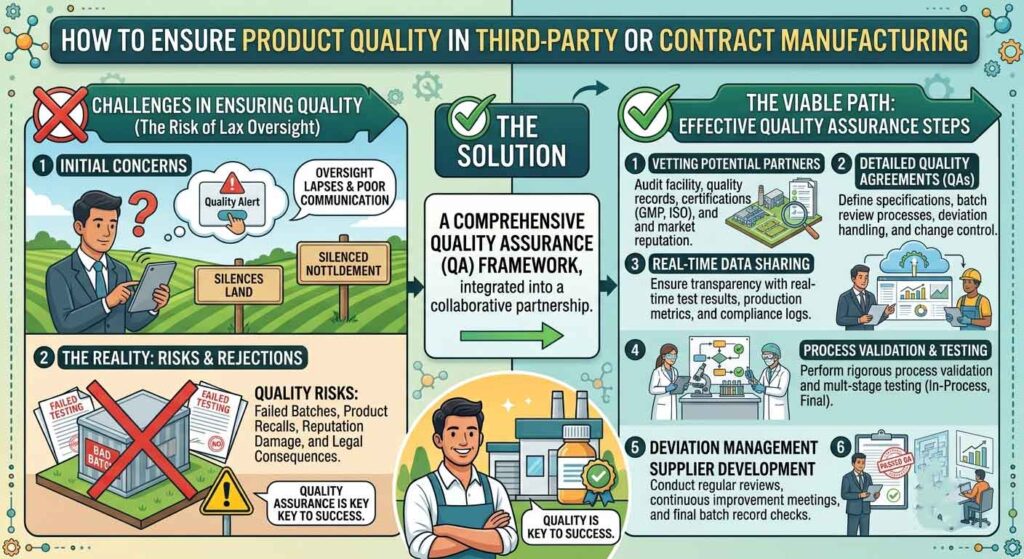
A marketing company can reduce risk by following a strong quality assurance system.
1. Select the Right Manufacturer
Do not choose a manufacturer only because of low rates.
Before finalizing a manufacturer, check:
Manufacturing license
GMP compliance
Product section approval
Market reputation
Existing client feedback
Quality control facility
Documentation support
Delivery record
Complaint handling system
Stability study support
Batch testing system
A slightly higher manufacturing cost is acceptable if the manufacturer is reliable and quality-focused.
2. Visit the Manufacturing Facility
If possible, visit the manufacturing unit before placing your first order.
During the visit, observe:
Cleanliness
Manufacturing area
Packing area
Raw material storage
Finished goods storage
Quality control laboratory
Documentation system
Staff discipline
Product handling
Temperature and humidity control
A physical visit helps build confidence and reduces future risk.
3. Sign a Quality Agreement
Before starting manufacturing, sign a written agreement with the manufacturer.
The agreement should clearly mention:
Product details
Batch size
Quality standards
Testing responsibility
COA requirement
Stability responsibility
Complaint handling
Defective batch replacement
Recall procedure
Liability clause
Documentation support
Delivery timeline
Packaging responsibility
Artwork approval responsibility
A proper agreement protects both parties.
4. Ask for Certificate of Analysis for Every Batch
Certificate of Analysis, also known as COA, is one of the most important documents in third-party manufacturing.
COA generally includes:
Product name
Batch number
Manufacturing date
Expiry date
Test parameters
Assay value
Dissolution result, where applicable
Description
Identification test
Microbial limits, where applicable
Final quality approval
Always collect COA with every batch.
5. Test Random Batches from Independent Laboratory
Do not depend only on the manufacturer’s COA.
Periodically send samples to an independent approved laboratory for testing.
This is especially important for:
New manufacturer
New product
High-value product
Sensitive molecule
Antibiotics
Vitamins
Clavulanic acid combinations
Products with repeated complaints
Products with stability concerns
Independent testing gives additional confidence.
6. Maintain Retention Samples
Keep retention samples from every batch supplied under your brand.
Retention samples are useful in case of:
Market complaint
Drug department inquiry
Customer complaint
Assay dispute
Stability issue
Packaging defect
Legal investigation
Store samples properly as per recommended storage conditions.
7. Check Stability of Sensitive Products
Some ingredients are more sensitive to moisture, heat, light or oxygen.
Examples may include:
Vitamins
Minerals
Clavulanic acid
Enzymes
Probiotics
Certain antibiotics
Herbal extracts
Liquid preparations
Suspensions
For such products, ask the manufacturer about stability data, overages, packaging selection and storage instructions.
8. Focus on Packaging Quality
Many quality complaints arise not because of formulation failure but because of poor packaging.
Check packaging issues such as:
Moisture in blister
Air leakage
Loose cap
Bottle leakage
Poor induction sealing
Weak lami tube sealing
Label misprinting
Wrong batch details
Poor carton quality
Broken tablets during transport
Good packaging protects product quality throughout shelf life.
9. Verify Batch Details Before Dispatch
Before dispatch from manufacturer, confirm:
Product name
Brand name
Composition
Batch number
Manufacturing date
Expiry date
MRP
Quantity
Packing style
COA
Tax invoice
Transport details
This avoids costly errors.
10. Maintain Proper Storage Conditions
Even a good quality product can deteriorate if stored incorrectly.
Marketing companies and distributors should ensure:
Cool and dry storage
Protection from sunlight
Temperature control where required
Proper stock rotation
First-expiry-first-out system
Clean storage area
No mixing with damaged goods
Separate storage for expired stock
Improper storage can create quality complaints.
11. Create a Complaint Handling System
Every marketing company should maintain a complaint register.
Record:
Customer name
Product name
Batch number
Nature of complaint
Date of complaint
Quantity affected
Photos, if available
Action taken
Manufacturer response
Replacement or recall details
A proper complaint record shows that the company takes quality seriously.
12. What to Do If a Product Complaint Is Received
If you receive a serious product complaint:
Stop further sale of the affected batch temporarily.
Collect batch number and product details.
Ask for product sample and photos.
Inform the manufacturer immediately.
Check available stock.
Send sample for testing if required.
Review COA and batch records.
Decide whether replacement, withdrawal or recall is required.
Maintain complete written records.
Do not ignore quality complaints.
13. What to Do If an Adverse Reaction Is Reported
If a patient or healthcare professional reports an adverse reaction:
Record the full details.
Note product name, batch number and expiry.
Ask whether the medicine was prescribed.
Record dose, duration and other medicines taken.
Inform the manufacturer.
Encourage reporting through the appropriate pharmacovigilance channel.
Preserve product samples if available.
Do not make medical conclusions without proper investigation.
An adverse reaction must be handled seriously and professionally.
14. Can Assay Reduce During Shelf Life?
Yes, in some products assay may reduce during shelf life, especially if the ingredient is sensitive or the packaging is unsuitable.
Manufacturers may add permitted overages in certain formulations to maintain potency throughout shelf life, depending on regulatory and formulation requirements.
Common reasons for assay reduction include:
Moisture exposure
Heat exposure
Light exposure
Poor packaging
Incompatible excipients
Poor storage
Formulation instability
Manufacturing process issue
This is why stability testing and packaging selection are important.
15. Can Defective Products Be Returned to Manufacturer?
Yes, this should be clearly mentioned in your agreement.
The agreement should state what happens in case of:
Failed assay
Leakage
Broken tablets
Crystallization
Wrong printing
Market complaint
Substandard quality
Stability failure
Drug department sample failure
The manufacturer’s replacement responsibility should be written clearly before production starts.
Important Documents to Collect from Manufacturer
Before and after manufacturing, collect documents such as:
Manufacturing license copy
GMP certificate, if applicable
Product permission, where applicable
COA of each batch
Tax invoice
Batch manufacturing record summary, if provided
Stability data, where applicable
Packaging approval copy
Artwork approval copy
Quality agreement
Product specification
Testing report
Transport document
These documents help protect the marketing company.
Quality Checklist for Marketing Companies
Before selecting a third-party manufacturer, ask:
Is the manufacturer licensed for this dosage form?
Does the manufacturer have proper QC facilities?
Will they provide COA with every batch?
Can they provide stability support?
What is their complaint handling policy?
What is their defective batch replacement policy?
What is their recall procedure?
Can you visit their facility?
Do they have experience with your product category?
Are their delivery timelines reliable?
Final Thoughts
Third-party manufacturing is a good business model, but product quality should never be taken lightly.
The manufacturer is responsible for manufacturing the product as per required standards. However, the marketing company must also perform due diligence, maintain records, collect COA, test random batches and respond properly to complaints.
Quality assurance is not only the manufacturer’s duty. It is a shared responsibility across the supply chain.
A good marketing company should remember:
Low rate can give short-term margin, but poor quality can destroy the entire brand.
Frequently Asked Questions
1. Who is responsible if a third-party manufactured product is substandard?
The manufacturer is generally responsible for manufacturing quality, but the marketing company may also be questioned if it failed to maintain records, ignored complaints or knowingly sold defective products.
2. Is COA enough to ensure product quality?
COA is important, but it is not always enough. Periodic independent testing is recommended, especially for new manufacturers or sensitive products.
3. Should marketing companies test every batch?
Testing every batch may not be practical for all companies, but random batch testing and testing of high-risk products is a good practice.
4. What is a quality agreement?
A quality agreement is a written document between manufacturer and marketing company that defines responsibilities related to testing, documentation, complaints, recall and defective products.
5. What should I do if I receive a product complaint?
Stop further sale of the affected batch if the complaint is serious, collect details, inform the manufacturer, review records and test the sample if required.
6. Can approved medicines still cause adverse reactions?
Yes. Some adverse reactions may occur due to patient sensitivity, allergy, interaction or known side effects, even when the product is manufactured properly.
7. What are common quality problems in third-party manufacturing?
Common issues include moisture in blister packing, broken tablets, leakage, crystallization in syrup, wrong printing, poor sealing and delayed stability failure.
8. Can I return defective products to the manufacturer?
Yes, if the agreement includes a defective product replacement or returns clause. This should be clearly written before manufacturing starts.
9. How can I check whether a manufacturer is reliable?
Visit the facility, verify licenses, check QC setup, ask for COA, review client feedback and start with limited quantities.
10. What is the best way to protect my pharma brand?
Choose a reliable manufacturer, use a written agreement, maintain documents, test random batches and respond quickly to complaints.
Partner with Elzac Herbal India
Looking to start an Ayurvedic franchise, become a distributor, or launch your own herbal product range?
Elzac Herbal India offers:
Ayurvedic & Herbal Product Range
Franchise & Distribution Opportunities
Third-Party Manufacturing Services
Product Development Support
Marketing Guidance
PAN India Business Opportunities
Whether you are an entrepreneur, retailer, distributor, or healthcare professional, our team can help you explore the right business opportunity in the growing Ayurvedic sector.
Ajay Kamboj is an entrepreneur and business owners associated with many Ayurvedic and Pharmaceutical start-ups. With years of experience in Ayurvedic product marketing, pharmaceutical distribution, franchise development, and client relationship management, he regularly shares practical business insights based on real-world experiences. His articles focus on business growth, entrepreneurship, customer management, and lessons learned from the healthcare and wellness industry.
One response to “How to Ensure Product Quality in Third-Party or Contract Manufacturing”
For showing marketed by address of Mumbai, you need to show Marketing or sales office there. You don’t need drug license in Mumbai but at least you need to have any place there from which you can show office there…





For showing marketed by address of Mumbai, you need to show Marketing or sales office there. You don’t need drug license in Mumbai but at least you need to have any place there from which you can show office there…