Many pharmaceutical distributors reach a point where sales become stable but do not grow further. Stock is available, customers are known, and the business is running, but growth becomes slow.
At this stage, the distributor usually asks:
“How can I increase sales in my pharmaceutical distribution business?”
Increasing sales in pharma distribution is not only about giving more discount or adding more products. It requires proper product selection, market understanding, stock availability, customer service, payment discipline, and relationship management.
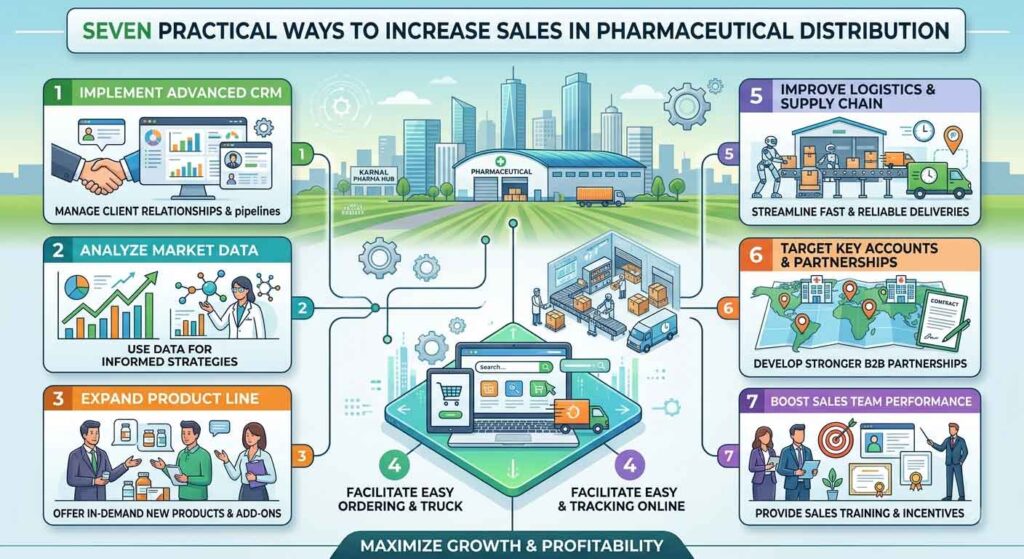
This article explains seven practical ways to increase sales in pharmaceutical distribution.
Why Pharma Distribution Sales Become Stuck
Pharmaceutical distribution sales may become stuck due to many reasons, such as:
Limited product range
Poor stock availability
High competition
Weak retailer relationship
Slow-moving inventory
Product shortage
Poor follow-up
No market gap analysis
Weak customer service
Excessive credit blockage
Lack of new product introduction
Dependence on only a few customers
Before increasing sales, you should first understand where your business is weak.
First Understand Your Customer
Every customer is different.
A hospital customer may need regular supply and credit discipline. A retail chemist may need fast delivery and replacement support. A doctor-linked counter may need specific prescription products. A rural retailer may need availability of essential medicines. A franchise distributor may need promotional support and monopoly products.
One sales strategy may work for one customer but may not work for another.
Before applying any strategy, study:
What does the customer buy?
Which products move fast?
Which products are not available in the market?
What margin does the customer expect?
What payment cycle does the customer follow?
What problems does the customer face?
Which competitor is supplying them?
Why would they buy from you?
Good sales planning starts with customer understanding.
1. Identify Best-Selling Products
The first way to increase sales is to identify your best-selling and fast-moving products.
Every market has certain products that move regularly. These products may include:
Chronic therapy medicines
Common antibiotics
Pain management products
Gastric products
Cough and cold products
Vitamins and supplements
Diabetic medicines
Cardiac medicines
Ayurvedic fast-moving products
OTC and wellness products
Hospital-use items
You should regularly check your sales data and identify:
Top-selling products
Fast-moving brands
Products with repeat orders
Products with better margin
Products with seasonal demand
Products demanded by multiple retailers
Products not easily available from competitors
Once you identify best-selling products, make sure these products never go out of stock.
How to Use Best-Selling Products for Growth
You can increase sales by:
Keeping adequate stock of fast-moving items
Offering combo supply with related products
Giving priority delivery to regular customers
Creating monthly purchase schemes
Sharing availability updates with retailers
Focusing on repeat orders
Promoting substitute options where legally and ethically appropriate
Fast-moving products bring regular billing and help build customer confidence.
2. Find Market Gap Products
Market gap means a product has demand, but supply is weak.
This can happen due to:
Company shortage
Product discontinuation
Seasonal demand
Limited distributor availability
Poor service by existing supplier
High rate from current supplier
New doctor prescription trend
Hospital demand
Rural market demand
If you identify market gap products, you can increase sales quickly by supplying what others are not supplying.
A distributor who solves availability problems becomes valuable to retailers and institutions.
How to Find Market Gaps
You can find market gaps by:
Asking retailers which products are not available
Checking doctor prescription trends
Talking to hospital purchase staff
Tracking repeated customer inquiries
Monitoring competitor shortages
Checking seasonal demand
Reviewing lost sales records
Studying local market complaints
Maintain a simple “market gap register” where your staff records products demanded but not supplied.
3. Increase Product Variety Carefully
Increasing product variety can increase sales, but it should be done carefully.
Many distributors make the mistake of adding too many products without demand. This blocks money and creates dead stock.
Product variety should be expanded according to customer needs.
Useful Product Variety Expansion
You can add:
Alternative brands of fast-moving molecules
Different pack sizes
Higher-margin products
OTC products
Surgical items
Ayurvedic products
Nutraceuticals
Personal care products
Seasonal products
Hospital supply items
Chronic care products
For example, if your retailers already buy gastric products from you, you can add related products like digestive enzymes, antacids, liver tonics, probiotics, and prescribed gastrointestinal products.
Do Not Add Products Blindly
Before adding any new product, check:
Is there demand?
Who will buy it?
What is the margin?
What is the expiry?
Is replacement available?
Is the company reliable?
Is the product already available with competitors?
What is minimum order quantity?
Will it block working capital?
Product variety should improve sales, not increase dead stock.
4. Use Add-On Selling
Add-on selling means offering a related product along with the main product purchased by the customer.
For example:
If a retailer buys an antibiotic, you may suggest a probiotic, antacid, or multivitamin, where appropriate.
If a retailer buys pain tablets, you may suggest pain relief gel or spray.
If a retailer buys cough syrup, you may suggest lozenges or herbal respiratory products.
If a retailer buys diabetic medicines, you may suggest glucometer strips or diabetic supplements, where suitable.
Add-on selling increases invoice value without forcing the customer.
How to Do Add-On Selling Properly
Add-on selling should be based on:
Customer’s existing purchase pattern
Product relevance
Market demand
Ethical business practice
Stock availability
Retailer interest
Real patient need
Do not push irrelevant products only to increase billing. If the customer feels you are dumping stock, trust will reduce.
5. Manage Inventory Properly
Inventory management is one of the strongest ways to increase sales in pharmaceutical distribution.
If the product is not available when the customer needs it, the customer will buy from another supplier. Repeated shortage can permanently shift your customer to competitors.
In pharma distribution, stock availability directly affects sales.
Why Inventory Management Matters
Good inventory management helps you:
Avoid stock-out
Reduce dead stock
Improve customer trust
Increase repeat orders
Control expiry loss
Improve cash flow
Supply urgent demand
Plan purchase better
Avoid overstocking
Short supply may look like a small issue today, but in the long run it can damage reputation.
Important Inventory Practices
Maintain:
Minimum stock level
Reorder level
Fast-moving product list
Slow-moving product list
Expiry tracking
Batch-wise stock
Replacement record
Monthly stock review
Purchase planning
Seasonal demand planning
Use billing software or inventory software to track movement.
ABC Analysis for Pharma Distribution
You can divide products into three categories:
A Category
High-value or high-demand products. Keep close control and regular stock.
B Category
Moderate sales products. Keep balanced stock.
C Category
Slow-moving or low-value products. Keep limited stock and avoid over-purchase.
This simple method can improve stock rotation and reduce unnecessary investment.
6. Use Schemes and Offers Smartly
Schemes and offers can increase sales if used correctly.
Common pharma trade schemes include:
10+1
10+2
Cash discount
Quantity discount
Monthly target scheme
Seasonal scheme
Launch scheme
Combo offer
Fast-payment discount
For example, if a customer usually buys 5 pieces, you can offer a scheme that encourages them to buy 10 or 11 pieces.
Scheme Should Not Become Loss
Before offering a scheme, calculate:
Product margin
GST impact
Expiry risk
Payment cycle
Net profit
Stockist margin
Retailer margin
Replacement cost
Free goods cost
A scheme is useful only if it increases profitable sales.
Do not offer schemes only to clear dead stock unless you clearly understand the loss.
Use Schemes According to Customer Type
Different customers need different schemes.
For example:
Fast-paying customers may get cash discount.
Bulk buyers may get quantity scheme.
New customers may get introductory offer.
Old customers may get loyalty benefit.
Slow-payment customers should not receive excessive credit-based schemes.
Sales should grow with profit, not only with turnover.
7. Improve Customer Service
Customer service is a major sales booster in pharmaceutical distribution.
Many customers do not buy only because of price. They buy because of trust, availability, quick service, replacement support, and clear communication.
What Good Customer Service Includes
Good customer service includes:
Fast order processing
Timely delivery
Correct billing
Proper packing
Polite communication
Product availability updates
Replacement support
Expiry information
Scheme communication
Payment statement clarity
Complaint handling
Product knowledge support
A distributor who gives reliable service can retain customers even in a competitive market.
Product Knowledge Support
Retailers and customers may ask basic product questions.
Your staff should know:
Product category
Composition
Pack size
Storage condition
MRP
Margin
Expiry
Substitute availability
Scheme details
Basic product use information
Do not give misleading medical claims. Provide only approved and factual product information.
Bonus Strategy: Improve Payment and Credit Control
Sales increase is useful only when payment comes on time.
Many distributors increase sales but lose money due to poor credit control.
Maintain:
Customer-wise credit limit
Payment due date
Outstanding report
Ageing report
Security system
Regular payment follow-up
Stop-supply policy for chronic defaulters
Written payment terms
High sales with bad recovery can damage the business.
Bonus Strategy: Use Sales Data
Your billing data is a powerful tool.
Review monthly:
Customer-wise sales
Product-wise sales
Area-wise sales
Fast-moving products
Slow-moving products
Lost sales
Expiry risk
Outstanding payment
Profit margin
Repeat order frequency
Data helps you make better decisions instead of guessing.
Retailers are important partners in pharma distribution.
Build relationships by:
Regular visits
Quick delivery
Fair dealing
Proper replacement
Honest scheme communication
Availability of required products
Payment discipline
Respectful behaviour
Support during urgent requirement
Strong relationships bring repeat business.
Bonus Strategy: Add Digital Ordering
Today, many distributors use WhatsApp, mobile apps, Google Forms, or ordering software.
Digital ordering can help customers place orders quickly.
Benefits include:
Faster order collection
Fewer missed orders
Better product list sharing
Easy scheme communication
Quick stock updates
Better follow-up
Reduced manual mistakes
Even a simple WhatsApp catalogue can help small distributors.
Bonus Strategy: Focus on Local Market Demand
Every market is different.
One area may have strong demand for diabetic products. Another may have more demand for antibiotics. Another may prefer Ayurvedic and OTC products. Another may have hospital-based sales.
Study local demand and adjust product range accordingly.
Bonus Strategy: Train Your Sales Staff
If you have field staff, train them regularly.
Training should include:
Product knowledge
Order booking
Customer handling
Payment follow-up
Scheme explanation
Complaint handling
Basic compliance
Competitor tracking
Sales reporting
Untrained staff may lose customers even if products are good.
Ethical and Legal Points to Remember
While increasing sales, never ignore compliance.
A pharmaceutical distributor should:
Sell only to licensed parties, where required
Maintain purchase and sale bills
Track batch number and expiry
Store medicines properly
Follow cold-chain requirements
Avoid misleading claims
Avoid unethical inducements
Avoid selling prescription medicines without rules
Follow applicable drug licence conditions
Follow GST and invoice requirements
Long-term pharma distribution business depends on trust and compliance.
Practical 30-Day Sales Improvement Plan
Week 1: Study Current Sales
Find top 50 products.
Find top 20 customers.
Find slow-moving stock.
Find stock-out products.
Find pending payments.
Week 2: Identify Market Gaps
Ask retailers for unavailable products.
Check competitor shortage.
Prepare new product requirement list.
Contact companies for supply.
Week 3: Improve Stock and Offers
Reorder fast-moving items.
Clear slow-moving stock carefully.
Prepare customer-wise schemes.
Share updated price list.
Week 4: Customer Follow-Up
Visit important customers.
Take feedback.
Offer add-on products.
Recover pending payments.
Review next month target.
This simple monthly system can improve sales discipline.
Final Takeaway
To increase sales in pharmaceutical distribution, do not depend on one method only.
Use a combination of:
Best-selling product focus
Market gap identification
Product variety expansion
Add-on selling
Inventory management
Smart schemes and offers
Better customer service
Along with these, maintain payment discipline, legal compliance, proper stock records, and strong customer relationships.
Pharma distribution sales grow when customers trust you for three things:
Availability, service, and reliability.
Frequently Asked Questions
1. How can I increase sales in pharma distribution?
You can increase sales by focusing on fast-moving products, finding market gaps, improving stock availability, adding relevant products, using schemes, improving customer service, and maintaining strong retailer relationships.
2. What is the most important factor in pharma distribution sales?
Stock availability is one of the most important factors. If products are not available when customers need them, they will shift to competitors.
3. Should I increase product variety to boost sales?
Yes, but carefully. Add only those products that have demand, reasonable margin, good replacement policy, and low expiry risk.
4. What is add-on selling in pharma distribution?
Add-on selling means offering a related product along with the main product purchased by the customer. It helps increase invoice value.
5. Are schemes useful in pharma sales?
Yes, schemes can increase sales, but they should be calculated properly so that they do not reduce net profit.
6. How can I find market gap products?
Ask retailers, hospitals, and field staff about unavailable products, repeated demand, competitor shortage, and products customers are asking for.
7. How can I reduce expiry loss?
Maintain batch-wise stock, follow FEFO system, review slow-moving products monthly, avoid overstocking, and push near-expiry stock carefully through legal and ethical channels.
8. What is FEFO in inventory?
FEFO means First Expiry, First Out. Products with earlier expiry should be sold or supplied first.
9. Why is customer service important in pharma distribution?
Good service improves customer trust, repeat orders, payment discipline, and long-term business relationships.
10. Can digital ordering help pharma distributors?
Yes, digital ordering through WhatsApp, mobile apps, online forms, or billing software can reduce missed orders and improve customer convenience.
Looking for Ayurvedic Franchise or Distribution Opportunities?
Looking to start an Ayurvedic franchise, become a distributor, or launch your own herbal product range?
Elzac Herbal India offers:
Ayurvedic & Herbal Product Range
Franchise & Distribution Opportunities
Third-Party Manufacturing
Product Development Support
Marketing Guidance
PAN India Business Opportunities
Whether you are an entrepreneur, retailer, distributor, or healthcare professional, our team can help you explore the right business opportunity in the growing Ayurvedic sector.
Ajay Kamboj is an entrepreneur and business owners associated with many Ayurvedic and Pharmaceutical start-ups. With years of experience in Ayurvedic product marketing, pharmaceutical distribution, franchise development, and client relationship management, he regularly shares practical business insights based on real-world experiences. His articles focus on business growth, entrepreneurship, customer management, and lessons learned from the healthcare and wellness industry.