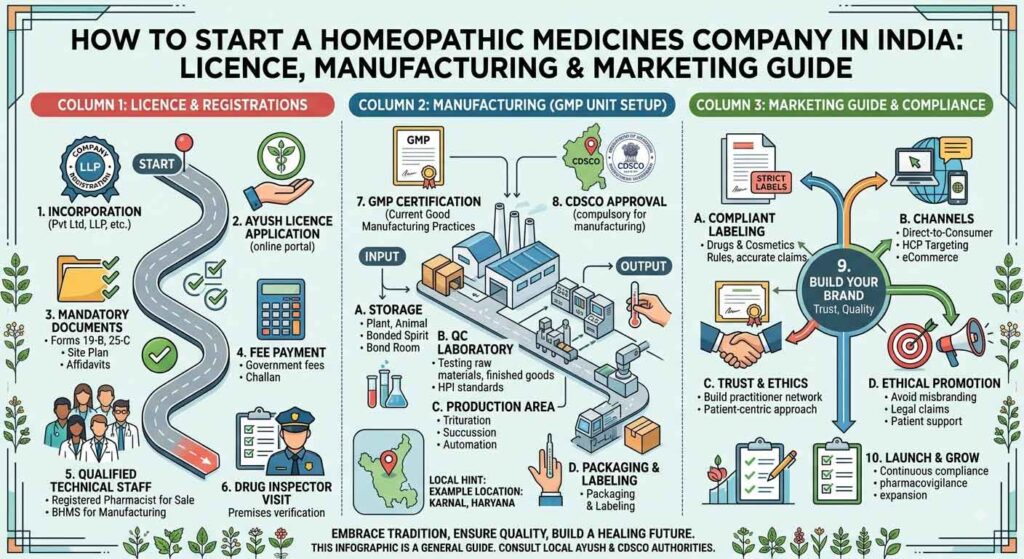
A Homeopathic medicines business can be started in India through several models. You can:
Open a retail Homeopathic pharmacy
Start wholesale distribution
Launch your own marketing brand through a licensed manufacturer
Obtain a loan licence
Establish your own Homeopathic medicine manufacturing unit
Each model has different licensing, investment, staffing and GMP requirements.
Quick Answer
Business Activity
Main Application
Licence/Approval
Homeopathic retail shop
Form 19-B
Form 20-C
Homeopathic wholesale
Form 19-B
Form 20-D
Own manufacturing unit
Form 24-C
Form 25-C
Loan licence manufacturing
Form 24-C-1
Form 25-C-1
GMP certification
Form 24-C-2
Form 26-C-1
New Homeopathic medicine
Prior regulatory approval/NOC as applicable
Before manufacturing
The retail and wholesale licensing route is also reflected in the current Online National Drugs Licensing System and State Drugs Control systems.
What Is a Homoeopathic Medicine?
Under the Drugs Rules, the legal definition covers medicines recorded in Homoeopathic provings or recognised through the specified authoritative Homoeopathic literature and prepared according to Homoeopathic pharmacy techniques. It also covers combinations of Homeopathic ingredients and excludes medicines administered by the parenteral route.
Homeopathic source materials can therefore include materials of:
Plant origin
Mineral or chemical origin
Animal origin
Other recognised sources
A product’s legal status depends on the applicable pharmacopoeia, literature, formulation and regulatory requirements—not simply on whether it contains a herb.
Who Regulates Homeopathic Medicines in India?
Homeopathic medicines are regulated under the Drugs and Cosmetics Act, 1940 and Drugs Rules, 1945, with the Ministry of AYUSH and the Central/State drug regulatory structure having respective functions.
Retail, wholesale and ordinary manufacturing licences are generally processed through the State Licensing Authority, while Central involvement becomes particularly important for matters such as new Homoeopathic medicines. CDSCO currently maintains a dedicated AYUSH section and, in May 2026, published a specific notice for submission of applications seeking an NOC to manufacture a new Homoeopathy medicine.
Four Ways to Start a Homeopathic Medicine Company
1. Homeopathic Retail Pharmacy
If you want to sell Homeopathic medicines directly to customers from a shop, the applicable licence is:
Form 20-C
Application:
Form 19-B
Current rules introduced through the 2024 amendment provide for applications to be processed through the e-AUSHADHI system, subject to the notified implementation arrangements.
2. Homeopathic Wholesale Business
If you want to supply medicines to:
Homeopathic pharmacies
Retailers
Clinics
Distributors
Other authorised purchasers
the wholesale licence is:
Form 20-D
through:
Form 19-B.
3. Homeopathic Marketing Company
A marketing company develops its own:
Company identity
Product range
Brands
Packaging
Sales network
and obtains products from a licensed Homeopathic manufacturer.
If the marketing company itself stocks, sells or distributes Homeopathic medicines, the appropriate Form 20-C/20-D licensing requirements should also be examined according to the actual activity.
4. Homeopathic Manufacturing Company
If you establish your own factory, the main manufacturing licence is:
Form 25-C
Application:
Form 24-C
The unit must comply with Rule 85E and Schedule M-I GMP requirements.
Homeopathic Retail Licence – Form 20-C
A Form 20-C licence permits retail sale, stocking and distribution of Homeopathic medicines from the approved premises.
The 2024 amendment made Form 20-C and 20-D licences perpetual, unless suspended or cancelled. The licensee must periodically submit the prescribed self-declaration of continuing compliance; failure to do so can lead to cancellation.
Who Can Supervise a Homeopathic Retail Shop?
Rule 67F recognises qualifications including:
Degree in Homoeopathy from a recognised university
Degree in Pharmacy from a recognised university
Bachelor’s degree plus one year of specified experience dealing in Homeopathic medicines
Diploma in Homeopathic Pharmacy
Diploma in Homeopathy Medicine and Surgery
subject to the Rule and approval of the Licensing Authority.
Homeopathic Wholesale Licence – Form 20-D
Form 20-D is used for wholesale operations.
The wholesaler should maintain appropriate:
Purchase records
Sales records
Supplier details
Product records
Alcohol-containing medicine records where applicable
A separate licence is generally required for each premises from which Homeopathic medicines are sold or stocked for sale.
Current Licence Fee for Retail and Wholesale Homeopathy
The Drugs (Fifth Amendment) Rules, 2024 revised the Form 19-B framework and prescribed a fee of ₹2,000 for the Homeopathic sale-licence application.
State portals, professional fees and other local charges may be additional, so applicants should check the applicable State Licensing Authority at the time of filing.
How to Start a Homeopathic Marketing Company
For many startups, manufacturing through an existing licensed company is considerably easier than constructing a factory.
A practical process is:
Register your business.
Select your product categories.
Search and protect your proposed trademarks.
Select a licensed Form 25-C manufacturer.
Verify the manufacturer’s GMP certificate.
Check whether the proposed products are already approved.
Finalise formulation, potency and pack size.
Prepare compliant artwork.
Sign a manufacturing/marketing agreement.
Obtain batch-wise COA and quality documents.
Obtain Form 20-C/20-D where your own sale/distribution activity requires it.
Start marketing only after regulatory and artwork approval.
Do not assume that having your name printed as “Marketed by” automatically permits manufacturing or wholesale operations.
Third-Party Manufacturing vs Loan Licence
The 2024 amendment introduced a specific loan-licence system for Homeopathic medicines.
Third-Party Manufacturing
An existing manufacturer manufactures products under its own manufacturing licence for your marketing company.
This is suitable for a startup that primarily wants to focus on:
Branding
Promotion
Distribution
Sales
Loan Licence
A company that does not own a manufacturing facility can apply to use the manufacturing facilities of an existing eligible manufacturer under a formal loan-licence arrangement.
Application:
Form 24-C-1
Licence:
Form 25-C-1.
The loan licence gives the applicant a more direct regulatory position than a simple marketing arrangement.
How to Establish Your Own Homeopathic Manufacturing Unit
Step 1: Finalise the Product Range
Decide whether you want to manufacture:
Mother tinctures
Mother solutions
Dilutions
Potencies
Triturations
Tablets
Pills/globules
Syrups
Oral liquids
Ointments
Lotions
Ophthalmic preparations
Do not design one factory for every dosage form unless your business plan actually requires all of them.
Step 2: Prepare a Project Report
Include:
Proposed products
Batch sizes
Manufacturing sections
Required machinery
Premises
Utilities
Technical staff
QC/QA
Investment
Working capital
Distribution strategy
Step 3: Select Industrial Premises
Homeopathic manufacturing premises should be distinct from residential premises and should comply with the applicable GMP and local requirements. Government drug-control guidance also requires industrial manufacturing premises to meet the specific schedule applicable to the requested licence.
Step 4: Design According to Schedule M-I
The Ministry of AYUSH notified G.S.R. 657(E) on July 24, 2026, substantially amending Schedule M-I for Homeopathic drugs. Existing stakeholders have until July 31, 2029 to comply with those amendments.
For a factory being designed now, it is commercially sensible to design according to the new 2026 Schedule M-I requirements immediately, rather than construct to an older standard and retrofit the plant later.
Important New Schedule M-I Requirements
The amended Schedule M-I strengthens requirements relating to:
Controlled manufacturing environment
Air filtration
Cross-contamination prevention
Personnel and material movement
Cleaning and sanitation
Equipment qualification and validation
Pest control
Material status identification
QA-controlled dispensing
Independent QA and QC
SOPs
Training
Documentation
Packaging and labelling
Stability
Record retention
For example, the amended rules call for logical/unidirectional production flow where possible, equipment positioning designed to avoid mix-ups and contamination, controlled material handling, validated systems, documented SOPs and separate QA/QC functions.
The new Schedule also specifies that amendments made in 2026 must be complied with no later than July 31, 2029.
Manufacturing Licence – Form 25-C
The main Homeopathic manufacturing application is:
Form 24-C
and the manufacturing licence is:
Form 25-C.
The 2024 amendment also changed the manufacturing licensing framework.
Current statutory fees include:
₹2,000 for any number of single-ingredient Homeopathic medicines
₹200 per product for combination Homeopathic medicines
All potencies of a single-ingredient Homeopathic medicine are treated as one product for this licensing-fee purpose.
State-specific filing charges or professional expenses may be additional.
GMP Certificate for Homeopathic Manufacturers
The 2024 rules introduced a dedicated GMP application and certificate system:
Application: Form 24-C-2 GMP Certificate: Form 26-C-1
The prescribed application fee is ₹5,000.
The manufacturing licence in Form 25-C/25-C-1 is now designed to remain valid perpetually unless suspended or cancelled, but the facility must maintain its GMP status. The GMP certificate is subject to the applicable retention requirements.
Technical Staff Qualification
Manufacturing must be carried out under a qualified whole-time technical person.
Following the 2024 amendment, Rule 85E recognises at least one whole-time person falling under specified qualification/experience routes, including:
Option 1
Graduate in Science with:
Chemistry, or
Botany, or
Zoology
as a subject, along with three years’ experience in manufacture of Homeopathic medicines.
Option 2
Graduate in Pharmacy with:
18 months’ experience in manufacture of Homeopathic medicines.
Option 3
A qualification covered by the schedules of the National Commission for Homoeopathy Act, 2020, along with:
18 months’ Homeopathic manufacturing experience.
Quality Assurance and Quality Control
The amended 2026 Schedule M-I places greater emphasis on having proper QA/QC arrangements.
QA and QC should have defined, separate responsibilities, and production personnel should not simultaneously function as independent QC testing personnel.
The facility should establish specifications and testing arrangements for:
Raw materials
Mother tinctures
Potencies
Excipients
Packaging materials
In-process products
Finished products
Water
Microbiological parameters where applicable
The Ministry/CDSCO also maintains information about approved/private testing laboratories for Homeopathic drugs.
Typical QC Equipment
Depending on the products manufactured, the laboratory may require equipment such as:
Microscope
Dissecting microscope
TLC apparatus
UV viewing system
Analytical balance
Hot-air oven
Distillation apparatus
Water bath
Polarimeter
Refractometer
Melting-point apparatus
pH meter
Magnetic stirrer
Centrifuge
Muffle furnace
Moisture-determination apparatus
UV spectrophotometer
Tablet-disintegration apparatus
The final equipment list should be based on your actual product scope, pharmacopoeial tests and the amended Schedule M-I, rather than copying an old generic machinery list.
Machinery for Mother Tinctures and Mother Solutions
Typical equipment may include:
Cutting/chopping facilities
Disintegrator
Sifter
Balances and measures
Macerators
Percolators
Filtration equipment
Stainless-steel mixing vessels
Storage vessels
Portable stirrers
Water purification system
Filling and sealing machinery
Where mother tinctures are manufactured, the manufacturer must also have suitable arrangements for identifying and testing raw materials and finished preparations.
Potentisation Section
The amended Schedule M-I continues to specify dedicated requirements for potentisation.
Typical facilities include:
Stainless-steel workbenches
Controlled storage for potencies and back-potencies
Measuring and dispensing devices
Potentisation phials
Potentiser with counter, where used
The 2026 Schedule M-I retains a 20 square metre area for basic installations in the potentisation section and states that mechanical potentisers are not mandatory; manual potentisation can be used with proper SOPs. Where a potentiser is used, it must be appropriately validated/calibrated.
Trituration, Tablets, Pills and Globules
Depending on the approved manufacturing scope, equipment may include:
Triturating machine
Sifter
Mixer
Granulator
Dryer
Oven
Tablet-compression machine
Coating pan
Tablet counter
Filling equipment
Balances
The equipment should be suitable for batch size and capable of being appropriately cleaned and controlled.
Syrups and Oral Liquids
Typical equipment may include:
Stainless-steel manufacturing vessel
Storage vessel
Stirrer
Homogeniser where applicable
Filtration equipment
Filling machine
Sealing/capping machine
pH meter
Alcohol-containing formulations require additional attention to storage, fire safety, excise requirements and current Drugs Rules.
Ointments and Lotions
Typical machinery can include:
Stainless-steel manufacturing vessels
Heated kettle
Planetary mixer
Homogeniser
Colloid/ointment mill
Filling machine
Crimping equipment
Filtration system
Balances
Ophthalmic Homeopathic Preparations
Ophthalmic products require more stringent manufacturing controls.
Depending on the exact formulation and process, facilities may include:
Controlled production area
Appropriate air handling
HEPA filtration
Laminar-air-flow facilities
Sterilisation equipment
Autoclave
Washing/drying equipment
Controlled filling
Inspection facilities
The final design should follow the amended Schedule M-I
Packing and Labelling Area
The 2026 Schedule M-I specifies a minimum 50 square metre area for packing and labelling, requires labels to be approved by Quality Control before use, and calls for appropriate storage conditions for labels.
Packaging materials should be controlled through:
Receipt
Quarantine
Approval
Issue
Reconciliation
Destruction of obsolete material
Homeopathic Medicine Labelling
A Homeopathic medicine label must comply with the specific provisions of the Drugs Rules.
Depending on the product, the label may need information such as:
“Homoeopathic medicine”
Name of the medicine
Potency
Ingredients and potencies in combinations
Manufacturer name and address
Batch number where applicable
Manufacturing licence number
Alcohol content where applicable
Net quantity
Other prescribed declarations
Single-ingredient Homeopathic medicines are also subject to specific rules regarding proprietary names.
The artwork should therefore be reviewed by the manufacturer’s QA/regulatory team before printing.
Alcohol-Containing Homeopathic Medicines
This area now requires extra care.
Homeopathic mother tinctures and many dilutions may contain alcohol. Existing Homeopathy-specific rules contain alcohol labelling, packing and recordkeeping provisions, and CDSCO also issued further amendments concerning restrictions on alcohol-containing drug products in July 2026.
For a new unit using alcohol, check:
Drug-rule requirements
State Excise requirements
Alcohol procurement/storage permission
Fire-safety requirements
Flame-proof electrical requirements
Pack-size restrictions
Label declarations
Government drug-control guidance also specifically identifies fire-safety/NOC concerns for manufacturing operations involving alcohol and other inflammable substances.
What Is a “New Homeopathic Medicine”?
Not every proposed new combination can simply be added to a Form 25-C licence.
The 2024 amendment updated the definition and regulatory pathway for New Homoeopathic Medicines, including certain:
Unrecognised medicines
New combinations
Combinations involving unrecognised ingredients
New ratios
New claims in circumstances covered by the rule
and introduced a formal approval framework.
In addition, CDSCO published a specific notice on May 4, 2026 concerning submission of applications for NOC to manufacture new Homoeopathy medicines.
Therefore:
Do not commercially manufacture a genuinely new Homeopathic combination merely because every individual ingredient already exists.
Its “new medicine” status should first be checked.
Documents Generally Required for Form 25-C
Exact State checklists vary, but commonly required documents include:
Form 24-C application
Prescribed fee receipt
Site plan
Key plan
Proof of premises
Ownership/rent documents
Firm constitution documents
Authorisation/power of attorney
List of machinery
Machinery capacity/details
Technical staff qualification
Technical staff experience certificates
Appointment/joining documents
Quality-control equipment list
Proposed product list
Detailed formulations
Raw-material specifications
Packaging details
Non-conviction declarations
Applicable Pollution Control approval
Fire-safety documents where relevant
GMP-related documentation
A current State Drug Control checklist confirms that manufacturing applications commonly require site/key plans, constitution documents, machinery details, technical-staff qualifications, QC equipment and detailed product formulae.
Documentation Required Inside the Factory
A modern Homeopathic manufacturing unit should maintain controlled records such as:
SOPs
Master Formula Records
Batch Manufacturing Records
Batch Packaging Records
Material specifications
Raw-material receipt records
Testing records
Equipment logs
Calibration records
Cleaning records
Training records
Market complaints
Deviations
CAPA
Recall records
Distribution records
Personnel medical records
Stability records
The 2026 Schedule M-I expressly strengthens these documentation requirements and requires records generally to be maintained for one year after batch expiry or three years, whichever is later.
Step-by-Step Procedure to Start a Homeopathic Manufacturing Company
Step 1 — Decide the Business Model
Choose:
Third-party marketing
Loan licence
Own manufacturing
For a startup, evaluate third-party manufacturing before investing in a factory.
Step 2 — Finalise Product Range
Decide exactly which dosage forms you will manufacture.
Step 3 — Prepare a Regulatory Product List
Separate:
Existing recognised single-ingredient medicines
Combination products
New Homeopathic medicines
Step 4 — Select Premises
Choose suitable industrial premises capable of meeting Schedule M-I.
Step 5 — Prepare GMP Layout
Design:
Raw-material receipt
Quarantine
Approved stores
Production rooms
Potentisation
Packing
Finished-goods store
QA/QC
Change rooms
Utilities
Alcohol storage where applicable
Step 6 — Install Machinery
Purchase only machinery required for your actual product scope.
Step 7 — Establish QA/QC
Create separate and independent quality functions in accordance with the updated Schedule M-I requirements.
Step 8 — Appoint Technical Staff
Ensure Rule 85E qualification and experience requirements are met.
Step 9 — Prepare Documentation
Develop SOPs, MFRs, BMRs, specifications and quality procedures.
Step 10 — Apply for GMP and Manufacturing Licence
Use the applicable:
Form 24-C
Form 24-C-2
Form 25-C
Form 26-C-1
under the current licensing process.
Step 11 — Regulatory Inspection
The Licensing Authority will assess:
Premises
Equipment
Technical staff
QA/QC
Documentation
GMP compliance
Step 12 — Obtain Product Permissions
Ensure every proposed medicine is covered under the appropriate approval.
Step 13 — Approve Packaging
Verify labelling and claims before printing.
Step 14 — Conduct Validation and Qualification
Validate/qualify important:
Equipment
Water systems
Processes
Cleaning
Analytical procedures
Controlled environments
The revised Schedule M-I expressly requires equipment and system performance to be appropriately validated.
Step 15 — Begin Commercial Manufacturing
Manufacture only approved products after required licences and GMP arrangements are in place.
Own Manufacturing vs Loan Licence vs Third-Party Manufacturing
Factor
Own Manufacturing
Loan Licence
Third-Party Marketing
Own factory
Yes
No
No
Manufacturing licence
Form 25-C
Form 25-C-1
Manufacturer holds Form 25-C
Capital requirement
Highest
Medium
Lowest
GMP responsibility
High
Significant
Primarily manufacturer, with marketer responsibilities
Machinery
Required
Host facility
Not required
Control
Highest
High
Moderate
Startup suitability
After scale develops
Intermediate option
Often easiest
Common Mistakes to Avoid
Do not:
Describe Homeopathic medicines as only herbal products
Use the obsolete 1973 Act qualification reference without considering the 2024 update
Build a factory solely according to an old Schedule M-I layout
Ignore the July 2026 Schedule M-I amendment
Start production without GMP certification
Manufacture a new combination without checking new-medicine approval requirements
Assume third-party manufacturing and loan licensing are the same
Use a Form 20-C retail licence as a general manufacturing licence
Mix Homeopathic and other-system manufacturing without checking segregation requirements
Ignore alcohol/excise/fire requirements
Print labels before regulatory approval
Depend on old five-year licence-renewal advice
Copy old fixed machinery/area lists without checking the current Schedule M-I
Frequently Asked Questions
1. Which licence is required to manufacture Homeopathic medicines?
The main manufacturing licence is Form 25-C, applied for through Form 24-C.
2. Which licence is required for a Homeopathic retail shop?
Form 20-C, normally applied for through Form 19-B.
3. Which licence is required for wholesale?
Form 20-D through Form 19-B.
4. Is there a Homeopathic loan licence?
Yes. The 2024 amendment introduced Form 25-C-1, with application in Form 24-C-1.
5. Is GMP compulsory?
A Homeopathic manufacturing facility must comply with applicable Schedule M-I GMP requirements and the 2024 framework provides for a dedicated GMP certificate in Form 26-C-1.
6. What is new in Schedule M-I in 2026?
G.S.R. 657(E), dated July 24, 2026, extensively revised requirements relating to premises, equipment, personnel, material movement, QA/QC, documentation, packaging, validation and other GMP controls. Compliance with those amendments is required by July 31, 2029.
7. Is a B.Pharm graduate eligible as manufacturing technical staff?
Rule 85E recognises a Pharmacy graduate with the prescribed 18 months’ experience in Homeopathic manufacturing.
8. Can a science graduate supervise manufacturing?
A Science graduate with Chemistry, Botany or Zoology can qualify subject to the prescribed three years’ manufacturing experience.
9. Does every Homeopathic company need its own factory?
No. A company can use third-party manufacturing or the formal loan-licence route.
10. Is a manufacturing licence renewable every five years?
The 2024 amendment moved Homeopathic manufacturing licences toward perpetual validity, subject to continuing GMP and other compliance requirements.
11. Are Form 20-C and Form 20-D also perpetual?
Yes, under the revised framework they remain valid perpetually unless suspended/cancelled, subject to the prescribed periodic compliance declaration.
12. Can I manufacture a new Homeopathic combination immediately?
Not necessarily. A product falling within the definition of a new Homeopathic medicine requires prior regulatory approval. CDSCO also issued a specific NOC application notice in May 2026.
13. Can I start only as a marketing company?
Yes. You can develop brands and obtain products from an appropriately licensed manufacturer. If you will independently stock, wholesale or retail the medicines, assess the corresponding Form 20-C/20-D requirements.
14. Do all old machinery-area requirements still apply?
The 2026 Schedule M-I substantially revised the GMP framework; some specified areas remain, while the overall plant must now satisfy stronger layout, contamination-control, QA/QC and validation requirements.
Final Thoughts
For a new entrepreneur, there are three practical routes:
Loan licence → more regulatory control without constructing your own plant
Own Form 25-C factory → highest control, investment and GMP responsibility
If the market has not yet been tested, launching a focused product range through an established Form 25-C manufacturer may be more practical. An independent plant can be considered after achieving sufficient and predictable sales.
For anyone building a new factory in 2026, the most important change is to design the facility for the revised Schedule M-I notified on July 24, 2026, rather than relying on layouts prepared under older rules.
Looking for Ayurvedic Franchise or Distribution Opportunities?
Looking to start an Ayurvedic franchise, become a distributor, or launch your own herbal product range?
Elzac Herbal India offers:
Ayurvedic & Herbal Product Range
Franchise & Distribution Opportunities
Third-Party Manufacturing
Product Development Support
Marketing Guidance
PAN India Business Opportunities
Whether you are an entrepreneur, retailer, distributor, or healthcare professional, our team can help you explore the right business opportunity in the growing Ayurvedic sector.
Ajay Kamboj is an entrepreneur and business owners associated with many Ayurvedic and Pharmaceutical start-ups. With years of experience in Ayurvedic product marketing, pharmaceutical distribution, franchise development, and client relationship management, he regularly shares practical business insights based on real-world experiences. His articles focus on business growth, entrepreneurship, customer management, and lessons learned from the healthcare and wellness industry.
5 responses to “How to Start a Homeopathic Medicines Company in India: Licence, Manufacturing & Marketing Guide”
What is approx. cost involved in setting up the Homeopathic Medicine company with the above equipment in place. Is there any back up support available.
Hi thanks for sharing your tips it’s seriously helpful
I wanted to know
1) are there any project managers for such type of homeopathic manufacturing set up
2) I’m a MD homoeopath myself can I acquire a pharmacy diploma for myself will it be useful for setup
3) where can I get any
graduate in Science with Chemistry as one of the subjects with three years‘ experience in manufacture of Homoeopathic Medicines; or
(b) a graduate in Pharmacy with 18 months of experience in the manufacture of Homoeopathic medicines; or
If you have any links please share
Thanks
A Pvt.Ltd G.M.P Pharma Manufacturing unit available For sale or Against Leave Licence Agreement Basis Having four Sections like Tabs Caps Syrups Dry Syrups interested party may contact :-
+91 94122 59363
+91 70880 11313






What is approx. cost involved in setting up the Homeopathic Medicine company with the above equipment in place. Is there any back up support available.
Hi thanks for sharing your tips it’s seriously helpful
I wanted to know
1) are there any project managers for such type of homeopathic manufacturing set up
2) I’m a MD homoeopath myself can I acquire a pharmacy diploma for myself will it be useful for setup
3) where can I get any
graduate in Science with Chemistry as one of the subjects with three years‘ experience in manufacture of Homoeopathic Medicines; or
(b) a graduate in Pharmacy with 18 months of experience in the manufacture of Homoeopathic medicines; or
If you have any links please share
Thanks
@Dr.Tanmay, Hello Sir..
As MD Homeopath, you are also eligible for starting Homeopathic manufacturing as discussed in https://pharmafranchisehelp.com/how-to-start-homoeopathic-medicines/#Manufacturing_Chemist%E2%80%99s_qualification_and_experience_required
(c) holds qualification as defined under sub-clause (g) of clause (1) of section 2 of Homoeopathy Central Council Act, 1973 (59 of 1973) with 18 months of experience in the manufacture of Homoeopathic medicines
I want a licence of homeopathy shop for retail pl guide me
A Pvt.Ltd G.M.P Pharma Manufacturing unit available For sale or Against Leave Licence Agreement Basis Having four Sections like Tabs Caps Syrups Dry Syrups interested party may contact :-
+91 94122 59363
+91 70880 11313