Generic medicines contain the same active pharmaceutical ingredients as their corresponding reference medicines and are generally marketed at comparatively affordable prices.
Opening a generic medicine store can be a commercial business as well as a useful healthcare initiative for:
Individual entrepreneurs
Pharmacists
Hospitals
Charitable trusts
NGOs
Societies
Religious or charitable institutions
However, the word “generic” does not create a separate category of drug licence.
If the shop sells pharmaceutical medicines to patients, the normal provisions applicable to a retail chemist or pharmacy generally apply.
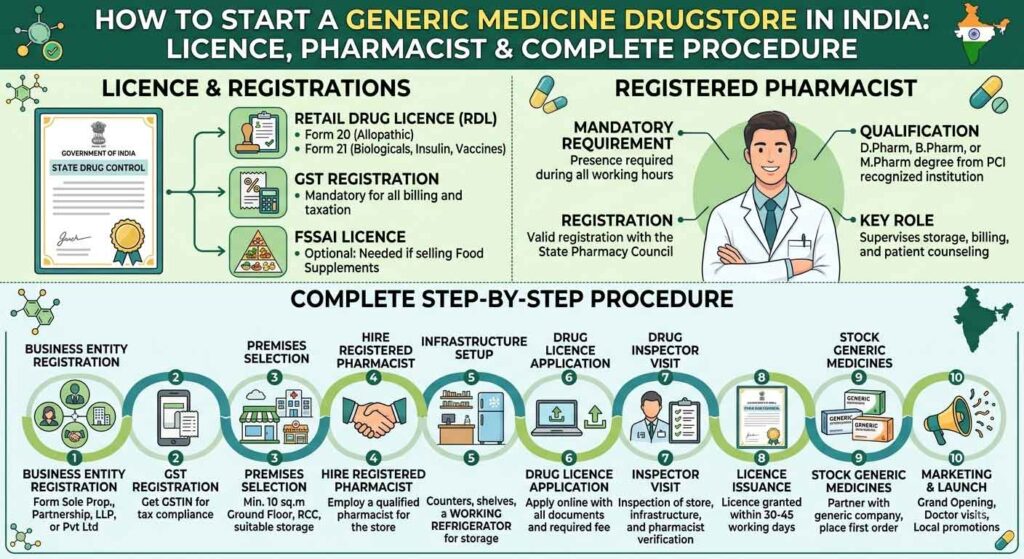
Retail drug licences, commonly Form 20 and Form 21
Proper medicine-storage facilities
Refrigerator/cold storage where the products stocked require it
Business constitution documents
PAN and bank-account documentation
GST registration where applicable
Purchase and sale record systems
Local registrations applicable to the premises
If the same premises will operate both retail and wholesale, the Drugs Rules require at least 15 square metres.
For a charitable trust wishing to operate under the government’s Pradhan Mantri Bhartiya Janaushadhi Pariyojana, a separate application to PMBI is required in addition to securing the drug licence. PMBI expressly permits NGOs, trusts, societies and charitable institutions/hospitals to apply for a Jan Aushadhi Kendra. (Jan Aushadhi)
What Is a Generic Medicine Store?
A generic medicine store is a pharmacy that focuses primarily on medicines sold by:
Generic/proper name
Low-cost generic brands
Branded generics
Affordable pharmaceutical manufacturers
Government generic-medicine schemes
From the drug-licensing point of view, a generic tablet is still a drug.
Therefore:
A generic medicine store is not exempt from the normal retail drug-sale licensing requirements simply because it sells generic medicines.
Is There a Separate Generic Medicine Shop Licence?
No separate licence called a:
Generic medicine licence
Generic pharmacy licence
Generic drug-store licence
is provided merely because a shop deals in generic medicines.
Under the Drugs Rules, retail licences are issued according to the category of drugs being sold, not according to whether the products are branded or generic. Form 20 covers retail sale of drugs other than those in Schedules C, C(1) and X, while Form 21 covers retail sale of Schedule C and C(1) drugs other than Schedule X.
Which Drug Licences Are Normally Required?
A normal full-range generic chemist will commonly require:
Form 20
For retail sale of drugs other than those specified in:
Schedule C
Schedule C(1)
Schedule X
Form 21
For retail sale of applicable drugs in:
Schedule C
Schedule C(1)
excluding Schedule X.
Most full-service retail medical stores therefore commonly obtain both Form 20 and Form 21, depending on their intended product range.
What About Schedule X Drugs?
Schedule X drugs require a separate retail licence in Form 20F and have additional storage, prescription and recordkeeping requirements. A new generic store does not necessarily need to stock Schedule X products.
Application Form for Retail Drug Licence
Under the central Drugs Rules, an application to sell or stock drugs other than Schedule X is made in Form 19 to the State Licensing Authority.
The Rules currently prescribe a fee of ₹1,500 for the Form 19 application. State portals and local procedures may involve additional documentation or charges, so the final amount should be checked with the concerned State Drugs Control Department.
Who Issues the Retail Drug Licence?
Retail drug-sale licences are administered by the State Licensing Authority appointed by the State Government under Part VI of the Drugs Rules.
Therefore, applications are normally handled through the relevant:
State Drugs Control Department
Drug Control Administration
FDA/Drugs Control authority
depending on the state.
It is no longer necessary in every state to physically begin by visiting the District Drug Inspector; many states use online licensing systems. However, the local Drug Inspector/licensing office remains important for inspection and state-specific requirements.
Minimum Area Required
For a retail licence in Form 20 or Form 21, the premises must have an area of at least:
10 square metres
If the same premises will hold both:
Retail licence in Form 20/21, and
Wholesale licence in Form 20B/21B,
the minimum area becomes:
15 square metres.
Registered Pharmacist Is Essential
For normal prescription dispensing at a retail drug store, one of the most important requirements is a registered pharmacist.
The Drugs Rules require medicines supplied on prescription, otherwise than through wholesale dealing, to be supplied by or under the personal supervision of a registered pharmacist. Schedule N also requires a pharmacy to operate under continuous personal supervision of a registered pharmacist.
The pharmacist should hold valid registration with the applicable State Pharmacy Council.
Can the Trust Owner Be Different from the Pharmacist?
Yes, ownership/management of the business and professional dispensing are different functions.
For example:
Applicant/operator: XYZ Charitable Trust
Registered Pharmacist: Mr./Ms. ABC, D.Pharm/B.Pharm and registered with the State Pharmacy Council
The trustees themselves do not all need to be pharmacists merely because the trust owns or manages the store. The pharmacist, however, must genuinely perform the professional role required by the licence.
Documents Required for a for Retail Drug Licence
Exact state checklists vary, but common documents are such as:
Proprietorship declaration/Partnership deed/LLP documents/Certificate of incorporation/Memorandum and Articles of Association
Board resolution, where applicable
PAN
Identity proof of proprietor, partners or directors
Address proof
Non-conviction declaration or affidavit
Shop/premises ownership document
Rent/lease agreement, if rented
Owner NOC
Site plan/layout
Electricity bill/address proof
Pharmacist qualification certificates
State Pharmacy Council registration certificate
Pharmacist appointment letter
Pharmacist identity/address proof
Refrigerator/storage details where necessary
Affidavits/declarations required by the State Licensing Authority
GST details where applicable
The state portal should be checked before submission because the document format can differ from state to state.
Storage Requirements
The shop must have suitable storage arrangements capable of preserving the properties of the medicines covered by the licence.
This includes:
Clean shelves
Protection from direct sunlight
Appropriate temperature
Protection from moisture
Segregation of expired stock
Appropriate security for controlled products
Refrigerator/cold storage where labelled storage conditions require it
A refrigerator should not be viewed as a decorative licensing requirement. It is needed where products requiring refrigeration are stocked.
Examples may include selected:
Insulins
Vaccines
Biologicals
Certain injections
The approved storage condition printed on the product label is the source of truth for each medicine.
Can a Generic Store Sell Prescription Medicines?
Yes, if it holds the applicable licences, but prescription-drug rules still apply.
Schedule H, Schedule H1 and Schedule X medicines cannot be sold by retail except in accordance with a prescription from a Registered Medical Practitioner.
Schedule H1 Records
For Schedule H1 medicines, the retailer must maintain a separate register recording prescribed information such as:
Prescriber
Patient
Drug
Quantity supplied
and those records must be retained for three years.
Schedule X
Schedule X medicines have additional controls, including duplicate prescriptions and secured storage; one copy of the prescription must be retained for two years.
Can a Generic Pharmacy Substitute Another Brand for the Doctor’s Prescribed Brand?
This is an important point for a generic medicine shop.
The current Drugs Rules state that a person dispensing a prescription containing Schedule H, H1 or X substances may not supply another preparation in lieu of the prescribed one.
Therefore, a generic-store business model should not be built on the assumption:
“Whenever a doctor prescribes Brand A, we can automatically dispense cheaper Brand B with the same salt.”
Prescription dispensing must comply with the applicable rules.
The safest model is to encourage generic-name prescribing and supply medicines in accordance with valid prescriptions rather than making unauthorised substitutions.
Where Should Medicines Be Purchased From?
Medicines should be purchased through legitimate licensed channels.
Maintain:
Purchase invoice
Supplier name
Supplier drug-licence details
Product name
Batch number
Quantity
Manufacturer
Expiry information
The Drugs Rules require purchase records for drugs intended for retail sale and require relevant invoices to be maintained.
Avoid purchasing medicines simply because a wholesaler offers unusually low prices.
Retail Billing and Records
Retail drug supply should be supported by appropriate cash/credit memos and records. The Rules specify purchase and retail-sale record requirements and provide for inspection of those records by Drug Inspectors.
A modern pharmacy should use software capable of tracking:
Brand/generic name
Batch
Expiry
MRP
GST
Quantity
Purchase rate
Sale
Return
Near-expiry inventory
Expired Medicines
Expired medicines must not be sold.
Where expired stock is awaiting return, reimbursement or disposal, the Drugs Rules require it to be separated from trade stock and appropriately identified as not for sale.
Use FEFO—First Expiry, First Out for inventory management.
How Long Is a Retail Drug Licence Valid?
The current Drugs Rules provide that Forms 20, 21 and the other listed sale licences remain valid subject to payment of the applicable retention fee every succeeding five years, unless the licence is suspended or cancelled.
Procedure to Start a Normal Private Generic Medicine Store
Step 1: Decide the Ownership
For your example, the store may be operated through the charitable trust, subject to the documentation accepted by the State Licensing Authority.
Step 2: Pass a Trust Resolution
The trust should formally approve:
Opening the medicine store
Location
Authorised signatory
Business bank arrangements
Appointment of pharmacist
Step 3: Select the Premises
For retail-only operations, provide at least:
10 m²
A larger space is advisable for practical operation.
Step 4: Appoint a Registered Pharmacist
Verify:
Qualification
Pharmacy Council registration
Current employment status
Availability during store operation
Step 5: Arrange Storage
Install:
Medicine racks
Appropriate cupboards
Refrigerator where required
Temperature monitoring
Separate expired/rejected stock area
Step 6: Apply for Retail Drug Licence
Apply to the State Licensing Authority, normally through Form 19 for the applicable licences.
Most full retail medicine stores will need:
Form 20
Form 21
depending on the medicines to be stocked.
Step 7: Complete Inspection
The Drug Inspector/licensing authority may verify:
Premises
Area
Pharmacist
Storage
Refrigerator
Documents
Shop arrangement
Step 8: Complete Business Registrations
Depending on the trust and activity, check:
PAN
GST
Local shop/trade registration
Bank account
Accounting system
Charitable status should not be assumed to exempt a retail medicine shop from drug-control requirements.
Step 9: Select Generic-Medicine Suppliers
Compare suppliers on:
Manufacturing licence
GMP compliance
Product range
Price
Availability
Expiry policy
Distribution
Quality documentation
Step 10: Start Procurement Only After Licensing
Do not build commercial drug inventory in an unlicensed retail premises while the licence application is merely pending.
Normal Generic Store vs Jan Aushadhi Kendra
These are not the same thing.
Point
Private Generic Store
Jan Aushadhi Kendra
Ownership
Private/trust/entity
PMBJP-approved applicant
Drug licence
Required
Required
Pharmacist
Required for normal prescription dispensing
Required
Medicines
Selected private suppliers
PMBI product basket/supply system
Brand identity
Own shop identity
PMBJK identity
PMBI approval
No
Yes
Government scheme incentives
No
May apply under PMBJP rules
Can a Charitable Trust Open a Jan Aushadhi Kendra?
Yes. PMBI expressly lists the following among those who may apply:
Individual entrepreneur/proprietor
Partnership
Charitable institute/hospital
NGO
Trust
Society
Government/government-nominated agency
PMBI also requires appropriate space, proof of securing a pharmacist, financial capacity documentation, and a drug licence in the name of the Pradhan Mantri Janaushadhi Kendra.
This can make PMBJK particularly relevant to a charitable trust whose objective is to provide affordable medicines.
How to Open a Jan Aushadhi Kendra
The basic route is:
Register on the official PMBI Jan Aushadhi application portal.
Select the proposed location.
Submit trust/entity documents.
Provide premises details.
Provide pharmacist details.
Demonstrate the required financial capacity.
Complete PMBI’s approval and agreement process.
Obtain the required retail drug licence in the PMBJK name.
Set up the outlet according to PMBI specifications.
Procure medicines through the PMBJP supply system.
PMBI currently provides the application process, updated Kendra-opening guidelines, agreement formats and layout specifications through its official portal. (Jan Aushadhi)
PMBI reported more than 19,000 Jan Aushadhi Kendras operational as of March 2026, with a product basket of about 2,100 drugs and 300 surgical items.
Which Option Is Better?
For a charitable institution/entity focused mainly on affordable generic medicines for the public, there are two practical models:
For a charitable trust/entity whose objective is community service rather than building a private pharmacy brand, PMBJK is worth evaluating before opening an independent generic shop. PMBI specifically accepts trusts and charitable institutions as applicants.
Common Mistakes to Avoid
Thinking generic medicines do not require a drug licence
Opening the store before approval
Hiring a pharmacist only on paper
Using less than the prescribed premises
Buying medicines from unauthorised suppliers
Selling Schedule H/H1 medicines without prescription
Automatically substituting prescribed brands
Ignoring Schedule H1 records
Failing to maintain batch and expiry data
Keeping cold-chain medicines without suitable refrigeration
Selling expired or damaged products
Calling an ordinary generic pharmacy a “Jan Aushadhi Kendra” without PMBI approval
Frequently Asked Questions
1. Which licence is required for a generic medicine shop?
A generic medicine store normally requires the same applicable retail drug licences as an ordinary chemist, commonly Forms 20 and 21 depending on the products stocked.
2. What is the minimum area?
At least 10 m² for retail. If both retail and wholesale licences are operated from the same premises, at least 15 m² is required.
3. Is a pharmacist compulsory?
A registered pharmacist is required for prescription dispensing and a pharmacy must operate under the prescribed pharmacist supervision.
4. Can a charitable trust open a generic medicine shop?
A trust may structure a medicine-store project subject to State Licensing Authority requirements. Charitable status does not remove the normal drug-sale requirements.
5. Can a trust open a Jan Aushadhi Kendra?
Yes. PMBI expressly includes trusts, NGOs, societies and charitable institutions/hospitals among eligible applicants.
6. Can a generic store sell Schedule H drugs?
Yes, where covered by the licence, but Schedule H/H1 medicines must be sold in accordance with prescription requirements.
7. Can the pharmacist replace any prescribed brand with a cheaper generic brand?
Not automatically. The Drugs Rules contain restrictions against supplying another preparation in lieu of prescribed Schedule H/H1/X preparations.
8. Is a refrigerator compulsory?
Suitable special storage must be available for products requiring it. Whether a refrigerator is needed depends on the medicines you intend to stock and their labelled storage requirements.
9. How much is the drug-licence application fee?
The central Drugs Rules currently prescribe ₹1,500 with Form 19 for the applicable non-Schedule-X sale-licence application; check the State Licensing Authority for current state-level charges and procedure.
10. Does the licence need renewal every five years?
The current rule is better described as a retention system: the listed sale licences remain valid if the prescribed retention fee is deposited every succeeding five years, unless suspended or cancelled.
Final Answer
If a charitable trust/entity wants to open a generic medicine drug store, the practical route is:
Trust resolution/firm/company documents → dedicated minimum 10 m² premises → registered pharmacist → retail drug licence in Forms 20/21 as applicable → suitable storage → business/tax formalities → purchase from licensed suppliers → compliant retail operation.
If the purpose is mainly charitable and you want to supply government-scheme generic medicines at affordable prices, it should also consider applying for a Pradhan Mantri Bhartiya Janaushadhi Kendra.
Looking for Ayurvedic Franchise or Distribution Opportunities?
Looking to start an Ayurvedic franchise, become a distributor, or launch your own herbal product range?
Elzac Herbal India offers:
Ayurvedic & Herbal Product Range
Franchise & Distribution Opportunities
Third-Party Manufacturing
Product Development Support
Marketing Guidance
PAN India Business Opportunities
Whether you are an entrepreneur, retailer, distributor, or healthcare professional, our team can help you explore the right business opportunity in the growing Ayurvedic sector.
Ajay Kamboj is an entrepreneur and business owners associated with many Ayurvedic and Pharmaceutical start-ups. With years of experience in Ayurvedic product marketing, pharmaceutical distribution, franchise development, and client relationship management, he regularly shares practical business insights based on real-world experiences. His articles focus on business growth, entrepreneurship, customer management, and lessons learned from the healthcare and wellness industry.






Leave a Reply Cancel reply
You must be logged in to post a comment.