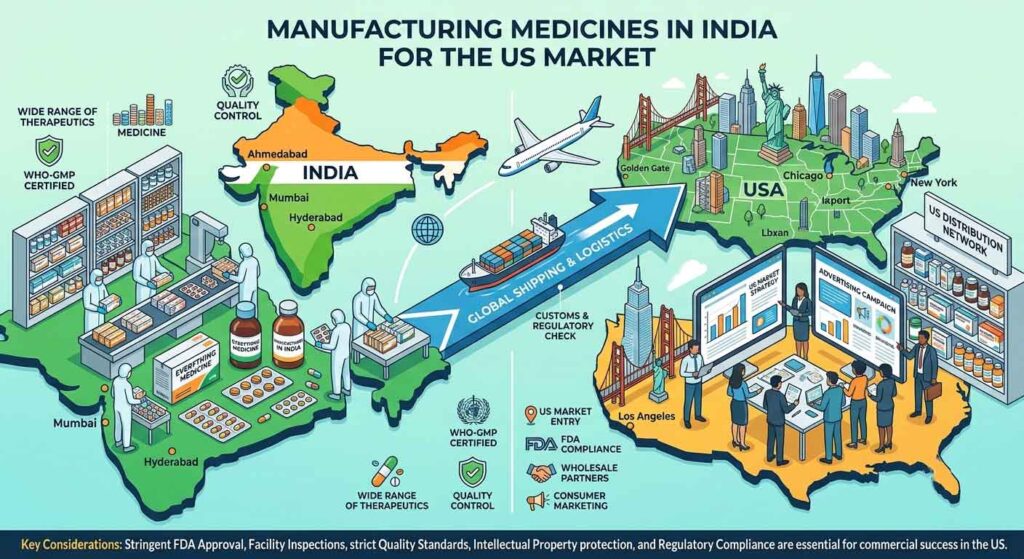
India is one of the world’s major pharmaceutical and healthcare manufacturing centres, and many products sold internationally are manufactured in Indian facilities.
Therefore, it is certainly possible to get products manufactured in India and export them to the United States.
However, the correct answer is not simply:
“Find a USFDA-approved manufacturer in India and ship your products to the USA.”
The process depends entirely on what type of product you want to sell.
A product may be regulated in the United States as:
Prescription drug
Generic drug
OTC drug
Dietary supplement
Cosmetic
Medical device
Traditional herbal product
Food product
Each category has different rules.
A common query is:
“I am a pharmacist and want to start my own company and market my own drug products in the United States. Can I get everything manufactured in India and send it to the U.S. for marketing?”
The practical answer is:
Yes, products can be manufactured in India for the U.S. market, but you must first determine the U.S. regulatory category and complete the applicable FDA, import, manufacturing, labeling and distribution requirements before commercial sale.
Being a Pharmacist Does Not Automatically Allow You to Market Any Drug
A pharmacy qualification is valuable because it gives you knowledge of:
Medicines
Formulations
Pharmacology
Dosage forms
Patient safety
Drug interactions
Pharmaceutical quality
However, being a pharmacist does not itself authorize you to manufacture, import or market an unapproved drug in the United States.
Your business must separately comply with:
Federal FDA requirements
Product approval or applicable marketing pathway
Import requirements
Manufacturing requirements
State licensing requirements
Distribution requirements
Labeling requirements
Advertising requirements
Your professional qualification and your company’s regulatory permissions are separate matters.
First Decide What You Want to Sell
This is the most important step.
Do not start by asking:
“Which products can a manufacturer make for me?”
Start by asking:
“Under which U.S. regulatory category will my product be marketed?”
1. Prescription Drugs
Examples may include:
Antibiotics
Antihypertensive medicines
Anti-diabetic medicines
Prescription pain medicines
Prescription gastrointestinal medicines
Prescription dermatology medicines
Prescription drugs generally require an appropriate FDA-approved marketing application unless a specific lawful exemption applies.
You cannot select an Indian brand or formulation, change the packaging and simply sell it in the United States as your own prescription drug.
2. Generic Drugs
A generic drug is generally marketed through an approved Abbreviated New Drug Application, or ANDA.
A generic product must meet the applicable requirements relating to matters such as:
Active ingredient
Strength
Dosage form
Route of administration
Quality
Performance
Bioequivalence
Labeling
Manufacturing site
If you want your own generic drug brand or private-label arrangement, you need to work within the approved regulatory structure.
3. OTC Drugs
Some medicines may be sold without prescription.
However, “OTC” does not mean “unregulated.”
An OTC drug must comply with the applicable U.S. legal pathway, formulation requirements, labeling requirements and manufacturing standards.
A product sold as an OTC medicine in India may not automatically qualify as an OTC drug in the United States.
4. Dietary Supplements
Products containing vitamins, minerals, botanicals and certain other dietary ingredients may qualify as dietary supplements if they meet U.S. requirements.
Examples may include:
Multivitamins
Mineral supplements
Herbal capsules
Botanical supplements
Protein supplements
Certain wellness products
Dietary supplements are regulated differently from drugs.
However, you cannot market a dietary supplement as if it were an approved medicine.
For example, claims such as:
Cures diabetes
Treats arthritis
Prevents cancer
Reverses thyroid disease
Removes cysts
Treats depression
may cause serious regulatory problems because disease-treatment claims can affect the product’s legal classification.
5. Cosmetics
Products intended mainly for cleansing, beautifying or changing appearance may be regulated as cosmetics.
Examples include:
Face wash
Moisturizer
Shampoo
Hair conditioner
Cosmetic serum
Body lotion
However, claims can change the product category.
For example, a cosmetic cream marketed merely for moisturizing is different from a cream marketed to treat a disease.
6. Ayurvedic and Herbal Products
This category requires particular care.
The United States does not simply recognize every product licensed in India as an “Ayurvedic medicine” that can automatically be sold for disease treatment.
An Indian Ayurvedic product may be classified in the U.S. according to its:
Ingredients
Intended use
Label
Website claims
Advertising
Dosage form
Depending on these factors, it may be treated as:
Dietary supplement
Drug
Cosmetic
Food
Another regulated category
Therefore, an AYUSH manufacturing licence in India does not itself provide U.S. market authorization.
Can an Indian Manufacturer Produce Products for Your U.S. Brand?
Yes.
You may work with an Indian contract manufacturer or third-party manufacturer.
The Indian manufacturer may manufacture products that are:
Owned by your U.S. company
Marketed under your brand
Manufactured under contract
Exported to your U.S. importer or distributor
However, the manufacturer must be suitable for the specific U.S. regulatory category.
Do not select a manufacturer only because it says:
“We are USFDA approved.”
Ask exactly what that statement means.
Important Difference: FDA Registration vs FDA Approval
These terms are often confused.
FDA Establishment Registration
A foreign facility may be required to register with FDA.
This does not automatically mean:
Every product is FDA approved
The factory can manufacture any drug for the U.S.
Your proposed formulation is legally marketable
FDA has endorsed the company
Drug Listing
A drug may be listed with FDA.
Drug listing is also not automatically equal to product approval.
FDA-Approved Application
Where an FDA-approved NDA or ANDA is required, the appropriate approved application must exist.
Therefore:
Registration is not the same as approval.
What to Ask an Indian Drug Manufacturer
Before finalizing the manufacturer, ask:
Is the manufacturing establishment currently registered with FDA?
Which dosage forms are manufactured for the U.S. market?
Which approved products are manufactured at the site?
Is the proposed manufacturing site included in the relevant regulatory application?
Has the facility been inspected by FDA?
What is its current compliance status?
Are there any current import alerts affecting the facility or product?
Can it provide complete quality documentation?
Who will hold the NDA or ANDA?
Who will be responsible for drug listing?
Who will act as U.S. agent?
Who will be the U.S. importer or consignee?
Do not place a commercial order before understanding the complete regulatory pathway.
Basic Process for Prescription or Generic Drugs
A simplified structure may be:
Step 1: Select the Product
Determine:
Active ingredient
Strength
Dosage form
Route of administration
Intended use
Reference product, where applicable
Step 2: Decide the Regulatory Pathway
Depending on the product, this may involve:
NDA
ANDA
Another applicable pathway
Do not manufacture commercial quantities before determining the correct regulatory route.
Step 3: Select the Manufacturer
The Indian manufacturing site must be suitable for the proposed product and regulatory application.
Evaluate:
cGMP compliance
Regulatory history
Manufacturing capability
Analytical capability
Stability capability
Quality systems
Documentation
Data integrity
Supply capacity
Step 4: Develop the Product
Development may include:
Formula development
Analytical method development
Stability studies
Validation
Bioequivalence studies, where required
Packaging development
Labeling development
Regulatory dossier
Step 5: Obtain Required FDA Approval
Where an application is required, commercial marketing should not begin until the necessary approval is obtained.
Step 6: Complete Establishment Registration and Drug Listing
The foreign establishment and product must meet applicable registration and listing requirements.
Step 7: Arrange U.S. Agent
Foreign drug establishments must have the required U.S. agent arrangement.
Step 8: Arrange Importer and Distribution
You will need an appropriate commercial structure for:
Importation
Customs entry
FDA entry
Warehousing
Distribution
Product tracing
Returns
Recalls
Step 9: Manufacture Commercial Batch
Manufacture according to:
Approved application
Registered manufacturing site
Validated process
cGMP
Approved specifications
Approved packaging and labeling
Step 10: Import Into the United States
FDA may verify:
Manufacturer information
Importer information
Product details
Establishment registration
Drug listing
Application information
Labeling
cGMP compliance
Incorrect or incomplete information can delay or prevent entry.
Can You Launch Your Own Generic Brand?
Potentially, yes.
However, the business structure must be planned carefully.
Possible models include:
Model 1: You Own the ANDA
Your company becomes responsible for the regulatory application and commercialization.
This provides more control but requires significant:
Capital
Regulatory expertise
Development work
Technical documentation
Quality systems
Model 2: Partner With an Existing ANDA Holder
You may enter into a commercial or private-label arrangement with a company that already has the appropriate approved product.
The exact structure depends on:
Ownership of application
Manufacturing site
Labeler
Distributor
Drug listing
Brand name
Quality agreement
Model 3: License or Acquire Rights
You may acquire or license commercial rights to an approved product.
This can sometimes be faster than developing a new ANDA from the beginning.
A qualified U.S. regulatory attorney and FDA consultant should review the proposed arrangement.
Can an Indian Medicine Be Sold in the U.S. With the Same Formula?
Not automatically.
A product approved in India may not have the same status in the United States.
Differences may exist in:
Approved active ingredient
Strength
Dosage form
Excipients
Indication
Label
Warning
Manufacturing site
Testing
Packaging
Regulatory category
The U.S. version must comply with U.S. requirements.
Dietary Supplements Manufactured in India
For many startups, dietary supplements may offer a more practical entry route than prescription drugs.
However, this category is still regulated.
Important Areas to Address
You may need to consider:
Ingredient eligibility
New dietary ingredient requirements, where applicable
Manufacturing controls
Facility registration
U.S. agent arrangements, where applicable
U.S. labeling
Supplement Facts panel
Claims
Prior notice of imported shipment
U.S. importer responsibilities
Foreign Supplier Verification Program considerations
Adverse-event procedures
Do Dietary Supplements Need FDA Approval Before Sale?
Dietary supplements generally operate under a different framework from prescription drugs.
However, the company is responsible for ensuring that:
The product is not adulterated
The product is not misbranded
Ingredients are legally suitable
Labels comply
Claims comply
Required notifications are made where applicable
Do not interpret the absence of premarket drug approval as freedom from regulation.
Ayurvedic Products Manufactured in India for the USA
This is especially relevant for Indian herbal companies.
You may be able to manufacture an herbal formula in India and market it in the United States, but first determine its U.S. classification.
Example
Suppose you manufacture herbal capsules in India.
If the U.S. label says:
“Supports healthy digestion”
the product may potentially be positioned within a dietary-supplement framework if all other requirements are met.
But if the same product says:
“Treats peptic ulcer and cures gastritis”
it may create a very different regulatory situation.
The same physical formula can face a different legal classification because of its intended use and claims.
Do Not Simply Translate Indian Ayurvedic Claims
Indian labels may contain therapeutic indications permitted under Indian Ayurvedic regulation.
Those claims should not automatically be copied onto U.S. packaging, Amazon listings or websites.
Review:
Product name
Front label
Supplement facts
Ingredient names
Claims
Website
Social-media advertisements
Testimonials
Amazon listing
Influencer content
All of these can affect regulatory risk.
Cosmetics Manufactured in India for the USA
Yes, cosmetics can also be manufactured in India and exported to the U.S.
Depending on the business and product, requirements may include:
Facility registration
Product listing
U.S. agent arrangements for foreign facilities
Responsible person
Safety substantiation
Adverse-event handling
Proper ingredient declaration
U.S.-compliant labeling
Registration or listing should not be promoted as if FDA has “approved” the cosmetic.
U.S. Company Structure
You may choose to establish a U.S. business entity.
Depending on your model, you may need:
U.S. company
Employer Identification Number
U.S. bank account
Importer structure
Warehouse or 3PL
Product liability insurance
Distribution agreements
State licences
Sales-tax registrations
Trademark registration
The exact structure depends on the product and the states where you operate.
Does Being a Pharmacist Allow You to Distribute Prescription Drugs?
Your pharmacist qualification may help professionally, but distribution and pharmacy operations are governed by separate federal and state requirements.
Depending on your activity, you may need state-specific permissions for:
Pharmacy operation
Wholesale distribution
Drug distribution
Warehousing
Dispensing
Non-resident pharmacy activity
Do not assume that a pharmacist licence in one jurisdiction automatically permits nationwide wholesale distribution.
Can You Advertise Your Own Drug Products?
Marketing is also regulated.
Prescription Drugs
Prescription-drug promotion must comply with U.S. requirements.
Do not launch public advertising before confirming:
Product approval
Approved indication
Approved labeling
Promotional requirements
Dietary Supplements
Avoid disease-treatment claims unless the product is legally authorized for such use.
Cosmetics
Avoid claims that convert a cosmetic into a drug.
For example:
Cosmetic-style claim:
“Helps moisturize dry skin.”
Drug-style claim:
“Treats eczema.”
Claims should be reviewed before publication.
Do You Need a U.S. Distributor?
Not always, but most startups need a U.S. operational partner.
Possible structures include:
Your own U.S. company
U.S. importer
Distributor
Wholesale partner
3PL warehouse
Retail chain
Amazon fulfillment, where product category permits
Specialty pharmacy, where applicable
For prescription drugs, the distribution chain is significantly more regulated than ordinary e-commerce.
Can Products Be Shipped Directly from India to Customers?
For commercial healthcare products, direct shipment from an Indian factory to individual U.S. customers is not automatically a lawful substitute for normal import and regulatory compliance.
Commercial import should be properly structured.
Do not build a business model around labeling commercial shipments as personal parcels or gifts.
Documents to Prepare Before Manufacturing
Depending on product category, you may need:
Product formula
Raw-material specifications
Finished-product specifications
Manufacturing process
Master manufacturing record
Batch record
Certificate of Analysis
Stability data
Packaging specifications
Label artwork
Regulatory application
Facility registration details
Product listing information
U.S. agent information
Importer information
Quality agreement
Supply agreement
Recall procedure
Complaint procedure
How to Select an Indian Manufacturer
Check:
Legal manufacturing licence in India
Product-category expertise
U.S. regulatory experience
FDA registration, where applicable
Inspection history
Import-alert history
cGMP systems
Data-integrity controls
Quality-control laboratory
Stability facilities
Regulatory team
Export experience
Documentation quality
A factory that manufactures products for India is not automatically suitable for the U.S. market.
Common Mistakes to Avoid
Avoid these mistakes:
Assuming every Indian medicine can be exported
Using “FDA registered” as if it means “FDA approved”
Selecting product before deciding regulatory category
Manufacturing first and asking about U.S. compliance later
Using Indian labels in the U.S.
Copying Indian therapeutic claims
Selling unapproved prescription drugs
Using an unverified manufacturer
Ignoring import alerts
Ignoring U.S. agent requirements
Ignoring state licensing
Treating dietary supplements as medicines
Assuming Ayurvedic licence equals U.S. approval
Importing commercial stock as personal-use shipment
Best Startup Strategy
For a new entrepreneur, follow this sequence:
Step 1: Choose One Product Category
Start with:
Drug
Dietary supplement
Cosmetic
Do not mix all categories initially.
Step 2: Select Three to Five Products
Do not begin with 50 products.
Select products based on:
U.S. demand
Competition
Regulatory complexity
Manufacturing MOQ
Margin
Marketing strategy
Step 3: Obtain U.S. Regulatory Opinion
Before investing in:
Brand name
Packaging
Manufacturing
Website
Inventory
get the product classification and regulatory route reviewed.
Step 4: Shortlist Indian Manufacturers
Select manufacturers with proven experience in the relevant category.
Step 5: Review Formula Before Manufacturing
Check whether every:
Ingredient
Strength
Excipient
Claim
Dosage form
is suitable for the U.S. market.
Step 6: Prepare U.S.-Compliant Packaging
Do not print bulk packaging before regulatory review.
Step 7: Complete Registration, Approval or Listing
Complete whatever is applicable to the category.
Step 8: Arrange Import and Distribution
Finalize:
Importer
Customs broker
U.S. agent
Warehouse
Distributor
Insurance
Step 9: Place Commercial Manufacturing Order
Only after the compliance structure is ready.
Which Category Is Easiest for a New Startup?
There is no universally easiest category.
However, from a regulatory and investment perspective, launching an entirely new prescription drug brand can be significantly more complex than launching a properly structured dietary supplement or cosmetic.
Your choice should depend on:
Budget
Experience
Regulatory team
Target customer
Product claims
Time horizon
Risk appetite
Frequently Asked Questions
1. Can medicines be manufactured in India and sold in the USA?
Yes, provided the product, manufacturing site, regulatory application, labeling and import arrangements comply with U.S. requirements.
2. Is an FDA-registered factory the same as an FDA-approved factory?
No. FDA establishment registration does not mean that all products manufactured at the facility are FDA approved.
3. Can I manufacture a generic drug in India under my own brand?
Potentially, but you need the correct approved regulatory and commercial structure, such as an approved ANDA or lawful arrangement with an application holder.
4. Can I export Ayurvedic medicines to the USA?
Potentially, but the product will be classified according to U.S. law. An Indian AYUSH licence does not automatically authorize it for U.S. sale.
5. Can herbal products be sold as dietary supplements?
Some may qualify, depending on ingredients, intended use, labeling and applicable dietary-supplement requirements.
6. Do dietary supplements need an ANDA?
No. ANDA is a generic-drug application pathway, not a dietary-supplement pathway.
7. Can I use the same packaging used in India?
Usually, you should create packaging specifically reviewed for U.S. requirements.
8. Do I need a U.S. company?
The best business structure depends on your role as brand owner, importer, distributor and seller. Many businesses establish a U.S. entity, but the exact structure should be professionally planned.
9. Can I sell prescription drugs through Amazon?
Prescription-drug distribution is not the same as ordinary consumer e-commerce. It requires the appropriate regulatory, pharmacy and distribution structure.
10. What should I do first?
First classify the product and determine the U.S. regulatory pathway. Do this before selecting a manufacturer or printing packaging.
Final Thoughts
India can be an excellent manufacturing base for pharmaceutical, dietary-supplement, herbal and cosmetic products intended for the U.S. market.
However, successful export is not simply a matter of:
The most important mistake to avoid is assuming that because a product is legally manufactured in India, it is automatically legal to sell in the United States.
Work with experienced regulatory professionals on both sides before making a substantial investment.
Looking for Ayurvedic Franchise or Distribution Opportunities?
Looking to start an Ayurvedic franchise, become a distributor, or launch your own herbal product range?
Elzac Herbal India offers:
Ayurvedic & Herbal Product Range
Franchise & Distribution Opportunities
Third-Party Manufacturing Services
Product Development Support
Marketing Guidance
PAN India Business Opportunities
Whether you are an entrepreneur, retailer, distributor, or healthcare professional, our team can help you explore the right business opportunity in the growing Ayurvedic sector.
Ajay Kamboj is an entrepreneur and business owners associated with many Ayurvedic and Pharmaceutical start-ups. With years of experience in Ayurvedic product marketing, pharmaceutical distribution, franchise development, and client relationship management, he regularly shares practical business insights based on real-world experiences. His articles focus on business growth, entrepreneurship, customer management, and lessons learned from the healthcare and wellness industry.




Leave a Reply
You must be logged in to post a comment.