Third-party pharmaceutical manufacturing allows a marketing company to launch products without establishing its own manufacturing plant.
A common question is:
“When giving a product to a third-party manufacturer, do I need to provide the complete formula and manufacturing process, or only the quantity of active ingredients? I do not have manufacturing machinery, so how can I calculate the quantity of additives?”
The practical answer is:
For an established formulation already manufactured and approved at the selected factory, you generally provide the required active ingredients, strength, dosage form, pack size, brand name and commercial specifications. The manufacturer may use its existing approved and validated formula, including excipients and manufacturing process.
However:
You should not remain completely unaware of the excipients, product specifications or manufacturing formula used in a product marketed under your name.
The complete formula must be documented, technically justified, approved and controlled before commercial manufacture.
Active Ingredients and Excipients: What Is the Difference?
Active Pharmaceutical Ingredient
The active pharmaceutical ingredient, or API, is the ingredient responsible for the intended pharmacological action.
Examples include:
Paracetamol
Amoxicillin
Pantoprazole
Telmisartan
Diclofenac
Calcium carbonate
Cholecalciferol
The active ingredient must be specified accurately.
For example, it is not enough to write:
“Calcium 500 mg”
The manufacturer may need to know:
Calcium source
Salt form
Elemental calcium equivalent
Pharmacopoeial grade
Required overage, where scientifically justified
Excipients
Excipients are the other ingredients used to manufacture, protect, preserve or deliver the active ingredient.
Examples include:
Diluent
Binder
Disintegrant
Lubricant
Glidant
Coating material
Preservative
Sweetener
Flavour
Colour
Solvent
Suspensing agent
Stabiliser
Antioxidant
Excipients are sometimes called inactive ingredients, but they are not unimportant.
They can affect:
Tablet hardness
Disintegration
Dissolution
Absorption
Stability
Taste
Appearance
Microbial safety
Shelf life
Product performance
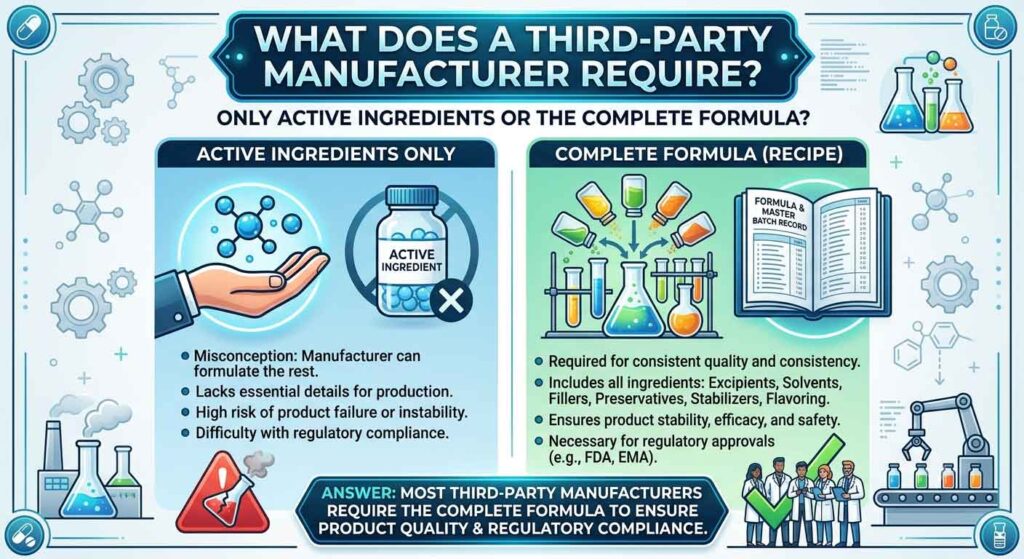
Is It Enough to Give Only the Quantity of Active Ingredients?
It depends on the type of product and manufacturing arrangement.
There are three common situations.
Situation 1: Manufacturer Already Has an Approved Standard Formula
Suppose you want:
Paracetamol Tablets IP 500 mg
The selected manufacturer already:
Manufactures the product
Has product permission
Has an approved Master Formula Record
Has validated the manufacturing process
Has stability data
Uses approved packaging
In this situation, you may provide:
Product composition
Strength
Dosage form
Brand name
Pack size
Required quantity
Artwork details
Commercial requirements
The manufacturer may use its existing standard formula and process.
You do not normally need to calculate the exact quantity of:
Microcrystalline cellulose
Starch
Povidone
Sodium starch glycolate
Magnesium stearate
Coating material
The manufacturer’s formulation, production and quality teams determine these quantities according to the approved formula.
However, the complete formula should still exist in the manufacturer’s-controlled documents.
Situation 2: You Want a Customised Product
Suppose you want:
Sugar-free syrup
Special flavour
Colour-free formulation
Preservative-free product
Smaller tablet size
Special coating
Faster disintegration
Vegetarian capsule shell
Alcohol-free liquid
Low-sodium formulation
Specific combination of vitamins and minerals
This is no longer a simple request for an existing standard product.
The manufacturer may need to:
Develop or modify the formula
Select suitable excipients
Conduct development trials
Prepare pilot batches
Evaluate stability
Test packaging compatibility
Revise product documentation
Obtain new or amended permission
You should provide the required product profile, but formulation scientists must determine the exact formula.
Situation 3: New Drug, New Combination or Special Delivery System
Products such as the following require greater technical and regulatory review:
New fixed-dose combination
Modified-release tablet
Sustained-release capsule
Enteric-coated product
Dispersible tablet
Orodispersible tablet
Liposomal formulation
Novel dosage form
New route of administration
New strength requiring approval
Product containing a new drug
In such cases, supplying only the quantities of active ingredients is not sufficient.
The project may require:
Product-development report
Complete quantitative formula
Compatibility studies
Manufacturing-process development
Analytical methods
Stability studies
Dissolution profile
Process validation
Bioavailability or bioequivalence data, where applicable
Central regulatory approval, where required
Commercial manufacturing should not begin until the necessary regulatory pathway has been completed.
What Information Should the Marketing Company Give the Manufacturer?
A proper product enquiry should include the following information.
1. Product Name or Generic Description
Example:
Paracetamol Tablets IP
or
Calcium, Vitamin D3 and Vitamin B12 Suspension
2. Exact Active Composition
Specify:
Name of every active ingredient
Salt or chemical form
Quantity per unit
Elemental equivalent, where relevant
Pharmacopoeial standard
Permitted overage, where justified
Example:
Each tablet contains:
Calcium carbonate equivalent to elemental calcium 500 mg
Vitamin D3 1,000 IU
Do not merely state:
“Calcium tablet.”
3. Dosage Form
Specify whether the product is:
Tablet
Film-coated tablet
Enteric-coated tablet
Capsule
Softgel
Syrup
Suspension
Dry syrup
Injection
Cream
Ointment
Sachet
Granules
The same active ingredients can require different excipients and processes for different dosage forms.
4. Pharmacopoeial Standard
State whether the product should comply with:
Indian Pharmacopoeia
British Pharmacopoeia
United States Pharmacopeia
Another accepted specification
In-house specification, where legally permissible
5. Pack Size
Examples include:
10 × 10 tablets
10 × 1 × 10 tablets
60-tablet bottle
100 ml syrup
200 ml syrup
30 gm tube
1 gm sachet
Pack size affects pricing, packaging material, MOQ and stability considerations.
6. Packaging Requirement
Specify preferences such as:
PVC blister
Alu-Alu blister
Strip pack
HDPE bottle
PET bottle
Amber glass bottle
Aluminium tube
Laminated tube
The final packaging should be technically suitable for the formulation.
7. Brand Name
Provide:
Proposed brand name
Trademark search or filing details
Brand-name affidavit
Authorization, where applicable
The brand name should be cleared before printing large quantities of packaging.
8. Special Product Requirements
Mention requirements such as:
Sugar-free
Alcohol-free
Gluten-free
Colour-free
Vegetarian capsule
Specific flavour
Child-resistant closure
Measuring cup
Desiccant
Special storage condition
These requirements can change the formula and cost.
9. Expected Quantity
Specify:
Number of tablets
Number of strips
Number of bottles
Number of cartons
Number of batches
Ask the manufacturer to distinguish between:
Manufacturing batch size
Commercial order quantity
Printed packaging MOQ
10. Target Market
Tell the manufacturer whether the product is intended for:
Domestic Indian market
Government tender
Institutional supply
Export
PCD franchise
Hospital supply
Export products may need different:
Specifications
Labels
dossiers
Stability zones
Regulatory documents
Who Decides the Quantity of Additives?
The answer depends on the arrangement.
Existing Manufacturer Formula
The manufacturer decides and controls the excipients according to its approved formula.
Custom Product Developed by Manufacturer
The manufacturer’s R&D or formulation-development team develops the formula based on your product requirements.
Formula Supplied by Brand Owner
Where the marketing company has its own developed formula, it may provide:
Complete formula
Process
Specifications
Stability data
Development report
The manufacturer then evaluates whether the formula can be transferred to its facility.
Joint Development
The marketer and manufacturer may jointly develop the product.
The agreement should define who owns:
Formula
Development data
Process
Stability data
Analytical methods
Product dossier
Special Note for Ayurvedic Products
The process differs for Ayurvedic medicines.
Classical Ayurvedic Medicine
The formula should follow the applicable authoritative text, including:
Ingredients
Quantities
Preparation method
Reference
Dosage form
A classical formula should not be casually altered.
Patent or Proprietary Ayurvedic Medicine
You should provide or jointly develop:
Complete ingredient list
Quantity of each ingredient
Part used
Botanical name
Extract ratio, where applicable
Processing method
Dose
Intended indication
Textual support
Product category
The manufacturer cannot safely create the formula only from a list of claims such as:
“Make a strong liver syrup.”
Ayurvedic Excipients
The product may also contain permitted processing or formulation ingredients such as:
Syrup base
Preservative
Flavour
Colour
Capsule shell
Base oil
Ointment base
These should be compatible and properly documented.
Special Note for Nutraceuticals
For food supplements and nutraceuticals, the complete formula must be checked for:
Permitted ingredients
Permitted forms
Daily usage levels
Additives
Flavours
Colours
Sweeteners
Claims
FSSAI category
A manufacturer should not merely add the requested active nutrients without checking the total daily intake and regulatory limits.
Can You Ask the Manufacturer to Copy Another Product?
Avoid asking:
“Make the same product as this leading company.”
You may provide a target product profile, but the manufacturer should not:
Copy confidential formula
Copy packaging
Copy trademark
Copy proprietary process
Create misleading similarity
Develop a legally compliant and technically suitable product.
Quality Agreement Is Essential
The quality agreement should clarify:
Who approves the formula?
Who purchases raw materials?
Who approves suppliers?
Who prepares the Master Formula Record?
Who releases the batch?
Who conducts stability studies?
Who approves formula changes?
Who investigates complaints?
Who handles recall?
Who owns technical data?
Who pays for failed batches?
A purchase order alone does not properly define these responsibilities.
Common Mistakes to Avoid
Avoid:
Giving only the molecule name without strength
Ignoring salt form
Not specifying elemental equivalent
Asking the manufacturer to select everything without documentation
Calculating excipients without formulation knowledge
Changing an existing formula without stability review
Launching a custom product without development trials
Not checking product permission
Accepting an undisclosed formula
Not signing a quality agreement
Assuming all excipients are harmless
Selecting packaging only by price
Copying another brand’s composition or packaging blindly
Manufacturing an unapproved FDC
Practical Answer to the Query
For routine third-party manufacturing of an established product, you generally provide:
Active ingredients
Strength
Dosage form
Pharmacopoeial standard
Brand name
Pack size
Packaging requirement
Required quantity
Special features
The manufacturer may provide:
Excipients
Complete manufacturing formula
Manufacturing process
In-process controls
Product specifications
Testing
Stability support
Batch documentation
However, the complete formula must be agreed, documented and controlled before commercial manufacture.
For a custom or new product, you need either:
Your own technically developed formula, or
A formulation-development agreement with the manufacturer.
You do not need manufacturing machinery to develop your product, but you do need qualified formulation, quality and regulatory support.
Frequently Asked Questions
1. Do I need to provide all excipients to a third-party manufacturer?
Not necessarily for an established manufacturer formula. The manufacturer may select and control the excipients, but the complete formula should be documented and agreed.
2. Can I provide only the brand name and molecule?
That is not enough for a formal order. You should also provide strength, dosage form, pack size, specifications and special requirements.
3. Who calculates the additives?
The manufacturer’s formulation or R&D team normally calculates them unless you provide your own developed formula.
4. Can the manufacturer use any additives it wants?
No. Excipients must be suitable, compliant, compatible and controlled under the approved formula.
5. Can excipients affect medicine quality?
Yes. They can affect stability, dissolution, absorption, appearance, taste and shelf life.
6. Should the marketer know the complete formula?
The marketer should have adequate knowledge and controlled access to the approved composition and specifications, even where detailed technical know-how is confidential.
7. Can the manufacturer change additives without approval?
Material formula changes should follow change control and regulatory evaluation. The quality agreement should define prior notification and approval.
8. Who owns the formula?
It depends on who developed it and what the manufacturing agreement states.
9. Is a custom formula more expensive?
Generally yes, because it may require development trials, testing, stability studies, validation and regulatory work.
10. Can an unapproved combination be manufactured through third-party manufacturing?
No. Third-party manufacturing does not bypass new-drug, FDC or product-permission requirements.
Final Thoughts
The correct third-party manufacturing process is not:
Give brand name + active ingredients → Manufacturer adds anything → Product is ready
The proper process is:
Define product profile → Verify regulatory status → Select or develop complete formula → Approve specifications → Validate manufacturing process → Conduct testing and stability → Obtain permission → Manufacture and release
For an existing standard product, the manufacturer may handle excipient selection and manufacturing details.
For a custom product, formula development must be performed by qualified professionals.
The marketer and manufacturer should both clearly understand what is being manufactured, how it will be controlled and who owns the formula and technical data.
Looking for Ayurvedic Franchise or Distribution Opportunities?
Looking to start an Ayurvedic franchise, become a distributor, or launch your own herbal product range?
Elzac Herbal India offers:
Ayurvedic & Herbal Product Range
Franchise & Distribution Opportunities
Third-Party Manufacturing Services
Product Development Support
Marketing Guidance
PAN India Business Opportunities
Whether you are an entrepreneur, retailer, distributor, or healthcare professional, our team can help you explore the right business opportunity in the growing Ayurvedic sector.
Ajay Kamboj is an entrepreneur and business owners associated with many Ayurvedic and Pharmaceutical start-ups. With years of experience in Ayurvedic product marketing, pharmaceutical distribution, franchise development, and client relationship management, he regularly shares practical business insights based on real-world experiences. His articles focus on business growth, entrepreneurship, customer management, and lessons learned from the healthcare and wellness industry.





Leave a Reply
You must be logged in to post a comment.