Starting a pharmaceutical manufacturing company in South Africa requires much more than registering a company and purchasing production machinery.
A pharmaceutical manufacturer must establish:
A legally registered business
Suitable and licensed pharmacy premises
A responsible pharmacist
A Good Manufacturing Practice-compliant facility
Production and quality-control systems
A pharmaceutical quality-management system
A Site Master File
Qualified technical personnel
A SAHPRA manufacturing licence
Product registrations or authorisations
A manufacturing licence authorises the approved facility and activities. It does not automatically permit the company to manufacture and sell every proposed medicine.
Quick Answer
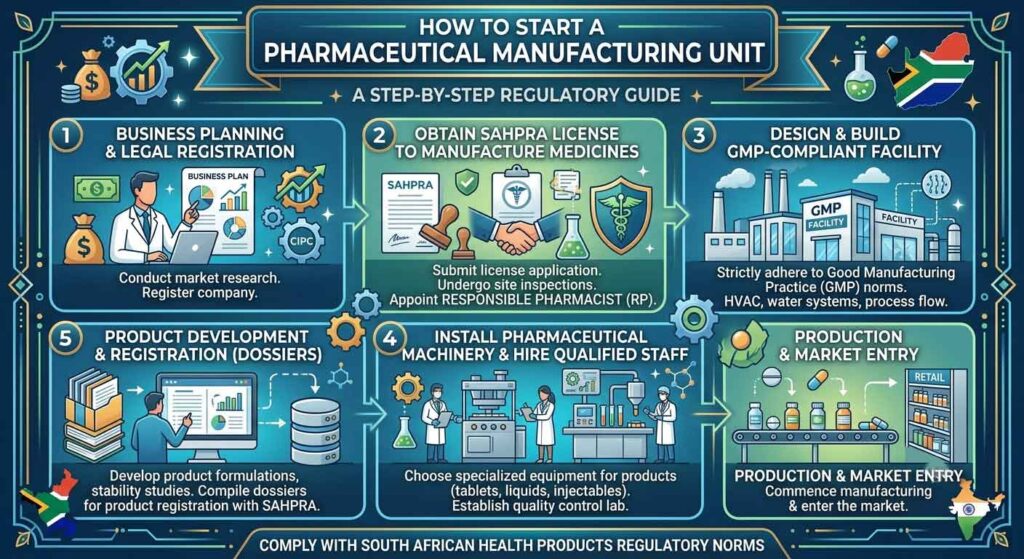
To start a pharmaceutical manufacturing unit in South Africa, the usual practical sequence is:
Decide which medicines and dosage forms you will manufacture.
Register the company in South Africa.
Select an appropriate industrial site.
Appoint a responsible pharmacist.
Apply for the relevant pharmacy-premises licence.
Record the pharmacy, pharmacy owner and responsible pharmacist through the applicable SAPC process.
Design and construct the facility according to South African GMP requirements.
Install and qualify production, laboratory and utility equipment.
Prepare the Site Master File and quality-management system.
Submit SAHPRA Form GLF-LIC-01A with supporting documents and fees.
Complete the SAHPRA GMP inspection.
Correct any inspection deficiencies.
Obtain the manufacturing licence.
Obtain registration or authorisation for each medicine before commercial sale.
SAHPRA issues licences to manufacture, import or export medicines and scheduled substances under Section 22C of the Medicines and Related Substances Act. The current application form is GLF-LIC-01A.
Which Authority Regulates Pharmaceutical Manufacturing?
The main authorities involved are:
South African Health Products Regulatory Authority
SAHPRA regulates:
Pharmaceutical establishment licensing
GMP inspections
Medicine registration
Scheduled substances
Imports and exports
Product quality
Pharmacovigilance
Recalls and regulatory compliance
SAHPRA’s Pharma Licensing unit issues licences to manufacturers, importers, exporters, wholesalers and distributors of medicines or scheduled substances.
National Department of Health
The National Department of Health administers pharmacy-premises licensing under the Pharmacy Act in collaboration with SAPC and SAHPRA.
South African Pharmacy Council
SAPC is involved in matters such as:
Recording of the pharmacy
Recording of the pharmacy owner
Registration of the responsible pharmacist
Pharmacy standards
Professional pharmacy practice
The NDoH’s current guidance states that new pharmacy-premises licence applications are submitted online through the portal hosted by SAPC.
Legal Framework
Pharmaceutical manufacturing in South Africa is regulated principally under:
Medicines and Related Substances Act, 1965
Regulations issued under the Medicines Act
Pharmacy Act, 1974
Applicable pharmacy regulations
South African Guide to Good Manufacturing Practice for Medicines
Product-registration guidelines
Environmental, occupational-safety and municipal laws
The Medicines Act, as amended, established the framework for SAHPRA and licensing of manufacturers and importers of medicines and active pharmaceutical ingredients.
Is a Pharmaceutical Manufacturing Licence Compulsory?
Yes.
A business cannot legally manufacture medicines or scheduled substances merely because it has:
Company registration
Industrial premises
Pharmaceutical machinery
Qualified employees
A contract from another company
A product formula
A registered trademark
The facility must hold the applicable SAHPRA licence before conducting licensed commercial manufacturing activities.
The licence specifies matters such as:
Licensed company
Physical manufacturing address
Approved operations
Dosage forms
Manufacturing activities
Import or export activities, where applicable
Contract testing, where applicable
Licence conditions
Current Manufacturing-Licence Application Form
The current SAHPRA form is:
GLF-LIC-01A – Licence Application to Manufacture, Import or Export Medicines or Scheduled Substances, including Contract Testing Laboratories
The form is used for:
New manufacturing licences
Licence renewals
Licence amendments
Import activities
Export activities
Contract testing laboratories
It is issued under Sections 22C and 22D of the Medicines Act, read with Regulations 23 and 24.
Current SAHPRA Guidelines
Applicants should use the latest versions of:
Document
Purpose
SAHPGL-LIC-01
Licence to manufacture, import or export
GLF-LIC-01A
Manufacturing/import/export licence application
SAHPGL-INSP-02
South African GMP guide for medicines
SAHPGL-INSP-04
Preparation of the Site Master File
SAHPRA fee guideline
Application and inspection fees
As of August 2026, SAHPGL-LIC-01 Version 4 was updated on April 13, 2026, and the South African GMP guide, SAHPGL-INSP-02 Version 10, was updated on April 24, 2026.
Step 1: Decide What You Will Manufacture
Before selecting land or preparing a factory layout, decide:
Product category
Dosage form
Production capacity
Product market
Whether products are sterile or non-sterile
Whether the facility will manufacture active ingredients
Whether testing will be in-house or contracted
Whether the company will import or export
Whether products are human, veterinary or complementary medicines
Possible product categories include:
Conventional human medicines
Biological medicines
Veterinary medicines
Complementary medicines
Active pharmaceutical ingredients
Medical devices
Cannabis products for medicinal purposes
These categories do not necessarily follow the same application route.
Step 2: Prepare a Feasibility Report
A pharmaceutical feasibility report should examine:
Market demand
Dosage forms
Manufacturing capacity
Machinery
Land and construction
HVAC
Pharmaceutical water systems
Quality-control laboratory
Technical staff
Utilities
Product-development cost
Product-registration cost
Validation
Stability studies
Working capital
Distribution
Export potential
Do not base the investment decision only on the cost of production machinery. Facility construction, utilities, quality systems, testing and regulatory work can represent a major part of the project.
Step 3: Register the Business
The manufacturing company should be properly registered in South Africa.
Business documents commonly include:
CIPC registration documents
Company registration certificate
Memorandum of Incorporation
Details of directors
Shareholding or ownership information
Registered address
Tax registration
Banking details
Board resolution authorising the project
Authorised representative details
SAHPRA currently asks applicants to submit CIPC, CIPRO or DTI documents proving ownership of the business as part of the licensing package.
Step 4: Select a Suitable Industrial Site
The site should be appropriate for pharmaceutical manufacturing.
Check:
Municipal zoning
Industrial-use permission
Environmental restrictions
Availability of electricity
Backup-power feasibility
Water supply
Drainage
Waste disposal
Road access
Staff access
Security
Fire safety
Expansion potential
Nearby contamination sources
Avoid selecting a site close to operations that could create:
Dust
Fumes
Chemical contamination
Microbial contamination
Pest problems
Excessive vibration
Flooding risk
Obtain professional advice before purchasing land or signing a long-term lease.
Step 5: Appoint a Responsible Pharmacist
The responsible pharmacist is a central person in the pharmaceutical establishment.
The responsible pharmacist should be appropriately registered and acceptable under the South African pharmacy framework.
His or her responsibilities may include:
Regulatory compliance
Pharmaceutical quality system oversight
GMP implementation
Batch-release oversight
Product storage
Complaint handling
Recall coordination
Staff supervision
Licence maintenance
Interaction with authorities
Ensuring compliance with licence conditions
SAHPRA’s licence checklist requires either proof of registration as the responsible pharmacist or the relevant SAPC case number.
The responsible pharmacist should not be appointed merely for paperwork. He or she must have genuine authority, sufficient time and access to the facility.
Step 6: Apply for Pharmacy-Premises Licensing
A pharmaceutical manufacturing establishment may also need the applicable pharmacy-premises licence through the National Department of Health process.
The NDoH administers pharmacy-premises licences in collaboration with SAPC and SAHPRA. Applications for new pharmacy premises are currently made online through the portal hosted by SAPC.
SAHPRA’s manufacturer-licence checklist asks for:
NDoH premises licence, or proof that the application has been submitted
SAPC certificate recording the pharmacy, or SAPC case number
SAPC certificate recording the pharmacy owner, or SAPC case number
Responsible pharmacist registration, or SAPC case number
These processes should be started early because they are linked to the final SAHPRA application.
Step 7: Prepare the Pharmaceutical Factory Layout
The layout should be prepared by professionals who understand pharmaceutical GMP.
It should show:
Site boundaries
Production areas
Warehouses
Quality-control laboratories
Quality-assurance offices
Personnel entrances
Material entrances
Change rooms
Airlocks
Washrooms
Utility areas
Waste routes
Equipment placement
Personnel flow
Material flow
HVAC zoning
Pressure differentials
Emergency exits
Fire-safety equipment
The layout should reduce:
Cross-contamination
Mix-ups
Uncontrolled movement
Entry of unauthorized personnel
Confusion between approved and rejected materials
Contact between clean and dirty operations
Personnel and Material Flow
Personnel and materials should not move randomly through the facility.
A typical material flow may be:
Receipt
Quarantine
Sampling
Quality-control testing
Approval
Dispensing
Manufacturing
Packing
Finished-goods quarantine
Batch release
Dispatch
Separate routes may be required for:
Personnel
Raw materials
Packing materials
Finished goods
Waste
Returned products
Recalled products
Step 8: Construct the Facility According to GMP
The factory should be constructed with materials that permit:
Easy cleaning
Effective sanitation
Maintenance
Prevention of dust accumulation
Pest control
Prevention of water leakage
Control of contamination
Suitable finishes may be needed for:
Floors
Walls
Ceilings
Corners
Doors
Windows
Service penetrations
The applicable construction standard depends on whether the section is:
Non-sterile
Sterile
Potent-product
Hormonal
Cytotoxic
Biological
Microbiological
High-containment
Step 9: Establish Pharmaceutical Utilities
Important utilities may include:
HVAC system
Purified-water system
Water for injection, where applicable
Clean steam
Compressed air
Vacuum system
Boiler
Chilled-water system
Electrical backup
Building-management system
Environmental-monitoring system
Utilities should be:
Properly designed
Installed
Qualified
Monitored
Maintained
Documented
HVAC Requirements
HVAC systems may need to control:
Temperature
Relative humidity
Air filtration
Air changes
Pressure differentials
Dust
Cross-contamination
Product protection
Personnel protection
The design must match the product and process risk.
A simple oral-liquid factory and a sterile-injection factory will not require the same HVAC design.
Pharmaceutical Water System
The required water quality depends on the intended product.
Possible systems include:
Potable water
Purified water
Water for injection
Clean steam
The water system should have documented:
Design qualification
Installation qualification
Operational qualification
Performance qualification
Sampling points
Microbiological monitoring
Chemical monitoring
Sanitisation
Maintenance
Step 10: Install Manufacturing Machinery
Machinery depends on dosage forms and production capacity.
Tablet Manufacturing Section
Typical equipment may include:
Dispensing booth
Sifter
Mill
Rapid mixer granulator
Fluid-bed dryer
Tray dryer
Blender
Tablet compression machine
Deduster
Metal detector
Tablet coater
Tablet inspection machine
Blister or bottle packing line
Capsule Manufacturing Section
Equipment may include:
Sifter
Blender
Granulation equipment
Capsule-filling machine
Capsule-polishing machine
Metal detector
Capsule inspection
Blister or bottle packing line
Oral-Liquid Section
Equipment may include:
Purified-water storage tank
Sugar-syrup vessel
Manufacturing vessel
Storage vessel
Homogenizer
Colloid mill
Filter
Transfer pump
Bottle-washing machine
Filling machine
Capping machine
Labelling machine
Dry-Powder Section
Equipment may include:
Sifter
Blender
Powder-filling machine
Sachet-packing machine
Bottle-filling machine
Capping and labelling systems
Dust-extraction system
Cream and Ointment Section
Equipment may include:
Oil-phase vessel
Water-phase vessel
Manufacturing vessel
Vacuum emulsifier
Homogenizer
Colloid mill
Storage vessel
Tube-filling machine
Tube-sealing machine
Jar-filling machine
Suppository Section
Typical equipment may include:
Melting vessel
Mixing vessel
Temperature-control system
Suppository-filling machine
Cooling unit
Packing machine
Inhaler and Spray Section
Depending on the product:
Pressure vessels
Filling equipment
Crimping machine
Leak-testing system
Aerosol safety controls
Explosion-protected equipment
Environmental controls
Sterile Injectable Section
Sterile-product manufacturing may require:
Component washing
Autoclaves
Depyrogenation tunnel
Solution-preparation vessels
Sterile filtration
Aseptic filling
Vial or ampoule sealing
Lyophilizer
Restricted-access barrier system
Isolator, where appropriate
Visual inspection
Container-closure integrity testing
Environmental monitoring
Sterile production carries significantly greater technical and regulatory risk than non-sterile manufacturing.
Separate Sections for Different Dosage Forms
Different products may require separate rooms, areas or buildings depending on contamination risk.
Special consideration is required for products such as:
Penicillins
Cephalosporins
Hormones
Cytotoxic medicines
Highly potent products
Biological products
Live microorganisms
Sensitising substances
Do not assume that all dosage forms can share the same production area merely by cleaning the equipment.
A documented contamination-control strategy and quality-risk assessment are needed.
Medical Devices Require a Separate Route
Syringes, diagnostic products, surgical products and other medical devices should not automatically be included under an ordinary pharmaceutical manufacturing licence.
SAHPRA has a separate medical-device manufacturer application, GLF-MD-06A, under the medical-device regulatory system.
Classify each proposed product before designing the facility.
Complementary and Ayurvedic Medicines
In South Africa, Ayurveda is recognised as one of the disciplines included in the complementary-medicines framework.
SAHPRA identifies disciplines including:
Ayurveda
Aromatherapy
Homeopathy
Traditional Chinese Medicine
Unani Tibb
Western Herbal Medicine
Complementary medicines must be manufactured, imported, exported, wholesaled or distributed by the holder of the relevant Section 22C licence. Product-registration and category-specific requirements must also be checked.
Do not treat an Ayurvedic, herbal or health-supplement product as an ordinary pharmaceutical medicine without confirming its South African classification.
Quality-Control Laboratory
The factory should have adequate quality-control capability for its products and processes.
Laboratory sections may include:
Chemical laboratory
Instrumental laboratory
Microbiology laboratory
Sterility-testing area
Stability section
Sampling room
Reference-standard room
Retained-sample room
Typical Quality-Control Equipment
Depending on products, equipment may include:
Analytical balances
pH meter
UV-visible spectrophotometer
High-performance liquid chromatograph
Gas chromatograph
Dissolution tester
Disintegration tester
Friability tester
Hardness tester
Moisture analyser
Karl Fischer apparatus
Viscometer
Melting-point apparatus
Incubators
Autoclave
Laminar-flow cabinet
Stability chambers
Microbiological-testing equipment
The equipment list should be based on actual specifications, pharmacopoeial tests and registered product requirements.
Can Quality-Control Testing Be Outsourced?
Some specialised testing may be assigned to an authorised contract testing laboratory.
However:
Responsibilities must be defined in a written quality agreement.
The laboratory should hold the applicable authorisation.
Methods and specifications must be approved.
Samples must remain traceable.
Results must be reviewed by the manufacturer’s quality unit.
Original data should remain accessible.
Out-of-specification results must be properly investigated.
Outsourcing testing does not transfer the manufacturer’s ultimate responsibility for product quality.
Quality Assurance and Quality Control
Quality assurance and quality control are separate but connected functions.
Quality Assurance Responsibilities
Pharmaceutical quality system
Documentation
Change control
Deviations
CAPA
Risk management
Validation
Training
Self-inspection
Supplier qualification
Product-quality review
Complaints
Recalls
Data integrity
Quality Control Responsibilities
Raw-material testing
Packing-material testing
In-process testing
Finished-product testing
Environmental monitoring
Stability testing
Reference standards
Retained samples
Analytical-method control
Laboratory investigations
The quality unit should have enough authority to approve or reject materials and batches independently of production pressure.
Site Master File
A Site Master File provides an overview of the facility and its pharmaceutical quality systems.
SAHPRA maintains a specific guideline, SAHPGL-INSP-04, for preparing Site Master Files for pharmaceutical sites.
A Site Master File commonly covers:
Company information
Licensed activities
Quality-management system
Personnel
Premises
Equipment
Documentation
Production
Quality control
Contract activities
Distribution
Complaints and recalls
Self-inspections
The document should describe the actual site. It should not be a copied generic document.
Standard Operating Procedures
The facility should have controlled SOPs for areas such as:
Document control
Staff training
Entry and gowning
Cleaning and sanitation
Equipment operation
Equipment cleaning
Calibration
Maintenance
Material receipt
Sampling
Material release
Dispensing
Manufacturing
Packing
Batch release
Deviation management
CAPA
Change control
Complaints
Recalls
Returns
Stability
Waste disposal
Data backup
Computerised systems
Self-inspection
Equipment Qualification and Validation
Major equipment and systems should be qualified.
Qualification may include:
Design qualification
Installation qualification
Operational qualification
Performance qualification
Validation may include:
Process validation
Cleaning validation
Analytical-method validation
Computerised-system validation
HVAC qualification
Water-system validation
Sterilisation validation
Aseptic-process simulation
Hold-time studies
Transport validation
Technical Staff Required
Staff requirements depend on products and scale.
A pharmaceutical facility may need:
Responsible pharmacist
Production pharmacist
Quality-assurance manager
Quality-control manager
Analytical chemists
Microbiologists
Validation personnel
Regulatory-affairs personnel
Engineering personnel
Warehouse personnel
Maintenance technicians
Trained production operators
Prepare:
Organisational chart
Job descriptions
Qualification records
Experience records
Training matrix
Initial training
Periodic retraining
Health and hygiene procedures
Documents Required for the Manufacturing-Licence Application
The exact checklist should be confirmed from the latest SAHPRA documents. Common supporting documents include:
Business Documents
Completed GLF-LIC-01A
Application cover letter
CIPC or other ownership documents
Company registration
Directors’ details
Authorised representative details
Existing licence, for renewal or amendment
Proof of payment
Pharmacy and Pharmacist Documents
NDoH pharmacy-premises licence or proof of application
Responsible pharmacist registration or SAPC case number
SAPC certificate recording the pharmacy or case number
SAPC certificate recording the pharmacy owner or case number
Premises Documents
Physical address
Local-area plan
Site plan
Floor plan
Building layout
Personnel-flow plan
Material-flow plan
HVAC zoning
Warehouse layout
Laboratory layout
Utility diagrams
Technical Documents
Site Master File
Quality manual
List of manufacturing activities
Dosage-form list
Product list
Machinery list
Laboratory-equipment list
Technical-staff list
Organisational chart
Validation Master Plan
Major SOP index
Water-system details
HVAC details
Contract agreements, where applicable
SAHPRA’s published checklist specifically lists the application cover letter, proof of payment, ownership documents, NDoH premises documentation, responsible pharmacist documentation, SAPC pharmacy and owner recording, and a product list.
Application Submission
Applicants should:
Download the latest GLF-LIC-01A.
Read the current SAHPGL-LIC-01 guideline.
Check the current SAHPRA fee schedule.
Prepare the full supporting package.
Submit the application using SAHPRA’s current submission method.
Retain proof of submission.
Respond promptly to screening queries.
Submit the Site Master File through the prescribed channel.
Prepare for inspection.
SAHPRA may request additional information where necessary to determine compliance, quality, safety and efficacy.
SAHPRA Inspection
A SAHPRA inspection may evaluate:
Premises
HVAC
Water systems
Manufacturing equipment
Laboratory facilities
Warehouses
Staff qualifications
GMP documentation
Data integrity
Qualification
Validation
Cleaning
Material controls
Batch records
Complaints
Recalls
Contract activities
Self-inspection
Computerised systems
The current South African GMP guide is SAHPGL-INSP-02 Version 10, updated April 24, 2026.
Inspection Deficiencies and CAPA
Following inspection, the company may receive observations or deficiencies.
The company should:
Analyse the root cause.
Determine the extent of the problem.
Prepare corrective actions.
Prepare preventive actions.
Assign responsible persons.
Provide realistic completion dates.
Submit supporting evidence.
Verify effectiveness.
Responses should address the deficiency rather than merely promise future compliance.
Grant of Manufacturing Licence
A licence may be issued after SAHPRA is satisfied that:
The application is complete.
The premises is suitable.
Required pharmacy approvals are in place.
The responsible pharmacist is properly registered.
Manufacturing operations comply with GMP.
Equipment and utilities are qualified.
Quality systems are operational.
Inspection deficiencies have been resolved.
The licence may contain restrictions or conditions covering approved activities and dosage forms.
Product Registration Is a Separate Requirement
A facility licence and a medicine registration are different approvals.
Manufacturing Licence
Approves the establishment and authorised manufacturing activities.
Product Registration
Approves a particular medicine based on its:
Quality
Safety
Efficacy
Formula
Manufacturing process
Specifications
Stability
Labelling
Professional information
Patient information
SAHPRA’s medicine-application form is used for registration, variation or renewal of human or veterinary medicinal products.
In general, medicines must be registered before they are marketed, except where a specific lawful exemption or Section 21 authorisation applies.
Product-Registration Dossier
A human-medicine dossier may include:
Administrative information
Active ingredient information
Finished-product formula
Pharmaceutical development
Manufacturing process
Process controls
Specifications
Analytical methods
Method validation
Container-closure system
Stability data
Bioequivalence data, where applicable
Non-clinical data
Clinical data
Professional Information
Patient Information Leaflet
Labelling and packaging
The exact dossier depends on whether the product is:
New chemical entity
Generic medicine
Biological medicine
Complementary medicine
Veterinary medicine
Line extension
OTC medicine
Stability Studies
Stability studies support:
Shelf life
Storage conditions
Packaging suitability
In-use period
Reconstitution period
Product quality throughout its shelf life
Stability chambers should be:
Qualified
Calibrated
Continuously monitored
Alarmed
Supported by contingency arrangements
Packaging and Labelling
Packaging should protect medicines from:
Moisture
Light
Oxygen
Contamination
Breakage
Tampering
Temperature
Labels and package inserts must correspond to the approved product information.
The manufacturer should have controls for:
Artwork approval
Version control
Printed-material receipt
Reconciliation
Line clearance
Overprinting
Batch coding
Destruction of obsolete material
Warehouse Requirements
Separate or controlled areas may be needed for:
Incoming materials
Quarantined materials
Approved materials
Rejected materials
Printed packaging
Finished-product quarantine
Released finished products
Returned goods
Recalled goods
Expired goods
Cold-chain products
Controlled substances
Stock should be traceable by:
Product
Batch
Supplier
Quantity
Status
Expiry date
Storage condition
Contract Manufacturing
A company may use a licensed contract manufacturer rather than establishing its own factory.
Under contract manufacturing:
The product owner controls the brand and product registration arrangement.
The contract manufacturer carries out approved manufacturing activities.
Responsibilities are documented in a quality agreement.
Product and facility approvals must be maintained.
Contract manufacturing may reduce capital investment, but it does not eliminate product-registration, quality and legal responsibilities.
Contract Testing Laboratory
A contract testing laboratory that performs regulated pharmaceutical testing may require inclusion in the relevant licensing framework.
GLF-LIC-01A specifically includes contract testing laboratories within its scope.
Responsibilities should be covered by a written agreement addressing:
Sampling
Test methods
Specifications
Investigations
Data retention
Change control
Regulatory inspection
Results approval
Import and Export Activities
A manufacturer planning to import or export should include the applicable activities in its licensing strategy.
Possible additional requirements include:
SAHPRA import or export activity approval
Customs registration
Import permits
Export documentation
Certificates of Pharmaceutical Product
GMP certificates
Destination-country product registration
Post-importation testing, where applicable
Do not assume that a domestic manufacturing licence automatically covers every import or export activity.
Licence Renewal
SAHPRA advises pharmaceutical licence holders to renew their licences every five years and to submit the renewal application at least 180 days before the existing licence expires.
Maintain a regulatory calendar covering:
Licence expiry
Renewal submission
Annual retention fees
Responsible pharmacist changes
Ownership changes
Product retention fees
Inspection commitments
CAPA deadlines
Licence Amendments and Facility Changes
Critical changes should be reviewed and, where required, approved before implementation.
Examples include:
Change of ownership
Change of responsible pharmacist
Change in premises
New manufacturing section
New dosage form
Major equipment change
Major HVAC modification
New production building
Change in warehouse
New import or export activity
Contract-testing change
SAHPRA specifically reminds licence holders that critical facility changes falling under Regulation 23(7) should be approved before implementation.
Cost of Starting a Pharmaceutical Manufacturing Unit
There is no standard fixed investment.
The total cost depends on:
Location
Land or lease
Factory size
Dosage forms
Production capacity
Sterile or non-sterile operations
HVAC
Water systems
Laboratory instruments
Imported machinery
Validation
Staff
Product development
Registration
Stability studies
Working capital
Major Budget Heads
Prepare costs for:
Business incorporation
Land or factory lease
Architectural and engineering design
Construction
HVAC
Pharmaceutical water
Electrical supply
Backup generator
Production machinery
Packing machinery
QC laboratory
Stability chambers
Warehouses
IT systems
Regulatory fees
Inspection fees
Consultants
Technical staff
Validation
Raw materials
Packaging materials
Product registration
Distribution
Working capital
Sterile injectable, biological, high-potency and specialised manufacturing facilities require substantially greater investment than basic non-sterile oral or topical facilities.
Best Startup Strategy
A first-time manufacturer should consider:
Starting with one or two non-sterile dosage forms.
Selecting a limited product range.
Completing a detailed feasibility study.
Engaging the responsible pharmacist early.
Obtaining regulatory and pharmacy-premises guidance before construction.
Using an experienced pharmaceutical architect.
Designing for future expansion.
Installing scalable machinery.
Building quality systems before inspection.
Registering products in stages.
Beginning with sterile injections, biological medicines or highly potent products may expose an inexperienced company to very high technical and financial risk.
Common Mistakes to Avoid
Avoid these mistakes:
Referring to the old Medicines Control Council instead of SAHPRA
Registering a company and assuming manufacturing can begin
Purchasing machinery before finalising dosage forms
Signing a factory lease without checking zoning
Constructing without a GMP-qualified design
Ignoring the NDoH pharmacy-premises process
Appointing a responsible pharmacist only on paper
Confusing facility licensing with product registration
Mixing pharmaceutical and medical-device licence routes
Treating complementary medicines as unregulated products
Underestimating HVAC and water-system costs
Copying SOPs from another factory
Failing to qualify equipment
Starting commercial manufacture before approval
Not planning stability studies
Underestimating laboratory cost
Making critical changes without prior approval
Missing the licence-renewal deadline
Ignoring working capital
Practical Manufacturing-Unit Checklist
Before applying, confirm:
Company registered
Product categories classified
Dosage forms finalised
Feasibility study completed
Industrial site selected
Zoning confirmed
Responsible pharmacist appointed
NDoH premises application submitted
SAPC recording processes initiated
GMP layout completed
Facility constructed
HVAC installed
Water system installed
Machinery installed
QC laboratory operational
Warehouses operational
Site Master File completed
Quality manual completed
SOPs approved
Equipment qualification completed
Validation Master Plan approved
Staff trained
GLF-LIC-01A completed
Fee paid
Product list prepared
Internal inspection completed
SAHPRA inspection readiness confirmed
Final Answer
To start a pharmaceutical manufacturing unit in South Africa, you need an approved business structure, suitable pharmacy premises, a registered responsible pharmacist, a GMP-compliant facility and a SAHPRA manufacturing licence.
The current SAHPRA application is made using Form GLF-LIC-01A under Section 22C of the Medicines and Related Substances Act.
The practical process includes:
Product and dosage-form selection
Business registration
Site and premises approval
Responsible pharmacist appointment
Pharmacy and owner recording
GMP facility design
Machinery and laboratory setup
Quality-system implementation
Site Master File preparation
SAHPRA application
GMP inspection
Resolution of deficiencies
Licence grant
Individual product registration
A manufacturing licence alone does not permit unrestricted sale of every medicine. Each product must also follow the applicable registration or authorisation route.
Use the latest SAHPRA, NDoH and SAPC forms and guidelines because forms, fees, submission channels and technical standards may change.
Frequently Asked Questions
1. Which authority licenses pharmaceutical manufacturers in South Africa?
SAHPRA issues licences to manufacture, import or export medicines and scheduled substances.
2. Has the Medicines Control Council been replaced?
Yes. SAHPRA replaced the former Medicines Control Council regulatory structure.
3. Which application form is used?
The current manufacturer application is GLF-LIC-01A.
4. Is a responsible pharmacist required?
Yes. The licensing package requires responsible-pharmacist registration or the applicable SAPC case number.
5. Is a pharmacy-premises licence required?
The SAHPRA checklist asks for the NDoH premises licence or evidence that the application has been submitted.
6. Is SAPC recording required?
The application package includes SAPC recording of the pharmacy and pharmacy owner, or relevant case numbers.
7. Is GMP compulsory?
Yes. Manufacturers must comply with acceptable quality-assurance principles and South African GMP requirements.
8. Is a Site Master File required?
A Site Master File is an important part of the pharmaceutical facility’s licensing and inspection documentation.
9. Does the manufacturing licence register products?
No. Facility licensing and product registration are separate regulatory processes.
10. Can medical devices be manufactured under the same application?
Medical-device manufacturing follows a separate SAHPRA application route, including GLF-MD-06A.
11. Are Ayurvedic products regulated?
Yes. Ayurveda is included within South Africa’s complementary-medicines framework, and relevant establishment and product requirements apply.
12. How long is a pharmaceutical licence valid?
SAHPRA advises licence holders to renew every five years.
13. When should renewal be submitted?
The renewal should be submitted at least 180 days before the existing licence expires.
14. Can testing be outsourced?
Certain testing may be outsourced to a suitable contract laboratory under a written quality agreement, but the manufacturer remains responsible for product quality.
15. Can I manufacture products before registration?
Commercial marketing generally requires product registration or another lawful authorisation in addition to the manufacturing licence.
Looking for Ayurvedic Franchise or Distribution Opportunities?
Looking to start an Ayurvedic franchise, become a distributor, or launch your own herbal product range?
Elzac Herbal India offers:
Ayurvedic & Herbal Product Range
Franchise & Distribution Opportunities
Third-Party Manufacturing
Product Development Support
Marketing Guidance
PAN India Business Opportunities
Whether you are an entrepreneur, retailer, distributor, or healthcare professional, our team can help you explore the right business opportunity in the growing Ayurvedic sector.
Ajay Kamboj is an entrepreneur and business owners associated with many Ayurvedic and Pharmaceutical start-ups. With years of experience in Ayurvedic product marketing, pharmaceutical distribution, franchise development, and client relationship management, he regularly shares practical business insights based on real-world experiences. His articles focus on business growth, entrepreneurship, customer management, and lessons learned from the healthcare and wellness industry.
One response to “How to Start a Pharmaceutical Manufacturing Unit in South Africa”
Hi iam a business person in the republic of South africa busy registering for a pharmaceutical licence and other regulations in the republic. I need a partner that ca be able tio offer the service to manufacture pharmaceutical products here in our country for export for other african markets .I bring in public funds for investment and i provide knowledge and experience . Respond to thi mail as i will need your prompt response . Thank you



Hi iam a business person in the republic of South africa busy registering for a pharmaceutical licence and other regulations in the republic. I need a partner that ca be able tio offer the service to manufacture pharmaceutical products here in our country for export for other african markets .I bring in public funds for investment and i provide knowledge and experience . Respond to thi mail as i will need your prompt response . Thank you