Many beginners hear the term PCD Pharma Franchise and assume that the medicines will automatically be manufactured in their own company name.
That is not always the case.
Before starting, you should understand the difference between:
PCD pharma franchise
Pharma marketing company
Third-party manufacturing
Own-brand manufacturing
Pharma manufacturing company
A common query is:
“We already have a Private Limited Company in India and recently came across the term PCD. Do we need any licence or company registration to get medicines through PCD? What exactly does PCD mean? Will medicines be manufactured in our company name? Can we have our own brand name for every product? Our long-term goal is to build our own pharma company with many medicines.”
The practical answer is:
You can start with PCD franchise without owning a manufacturing plant. You may also later launch your own brands through third-party manufacturing. However, the licences and registrations required depend on whether you only promote products or also purchase, stock, sell, bill and distribute medicines.
What Does PCD Mean?
PCD stands for:
Propaganda Cum Distribution
In practical pharma business language, PCD usually means a business arrangement in which an established pharmaceutical company gives another person or firm the right to promote and distribute its products in a defined territory.
The PCD partner generally:
Purchases products from the parent company
Promotes the company’s brands
Works with doctors, chemists and distributors
Develops sales in an allotted territory
May receive monopoly or exclusive rights, subject to agreement
The parent PCD company generally provides:
Products
Brand names
Product literature
Promotional material
Price list
Territory rights
Business support
Does PCD Mean the Products Will Be Manufactured in Your Company Name?
Usually, no.
In a normal PCD franchise model, you sell and promote the existing brands of the PCD company.
For example:
Your firm:
XYZ Pharma Private Limited
You take franchise of:
ABC Lifesciences
ABC Lifesciences may already have brands such as:
ABCMOX
ABCPAN
ABCCAL
ABCVIT
You promote and distribute those brands in your territory.
The medicines are not automatically converted into XYZ Pharma brands merely because you took a PCD franchise.
Can You Have Your Own Brand Names?
Yes, but this is normally a different model called:
Third-party manufacturing
Contract manufacturing
Private-label manufacturing
Under this model:
You select the product.
You select your own brand name.
A licensed manufacturer manufactures it.
Your company is shown as the marketer or brand owner, subject to the agreed structure.
In this case, the manufacturing plant belongs to ABC Pharmaceuticals, but XYMOX may be your own brand.
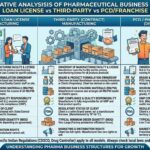
PCD Franchise vs Own-Brand Third-Party Manufacturing
PCD Franchise
You sell another company’s existing brands.
Example:
Manufactured for / Marketed by: Parent PCD company Distributed in your area by: Your business
You generally do not own the product trademarks.
Third-Party Manufacturing
You create your own brands and get them manufactured by another licensed company.
Example:
Manufactured by: Third-party manufacturer Marketed by: Your company
You may own the trademark, subject to proper registration and legal clearance.
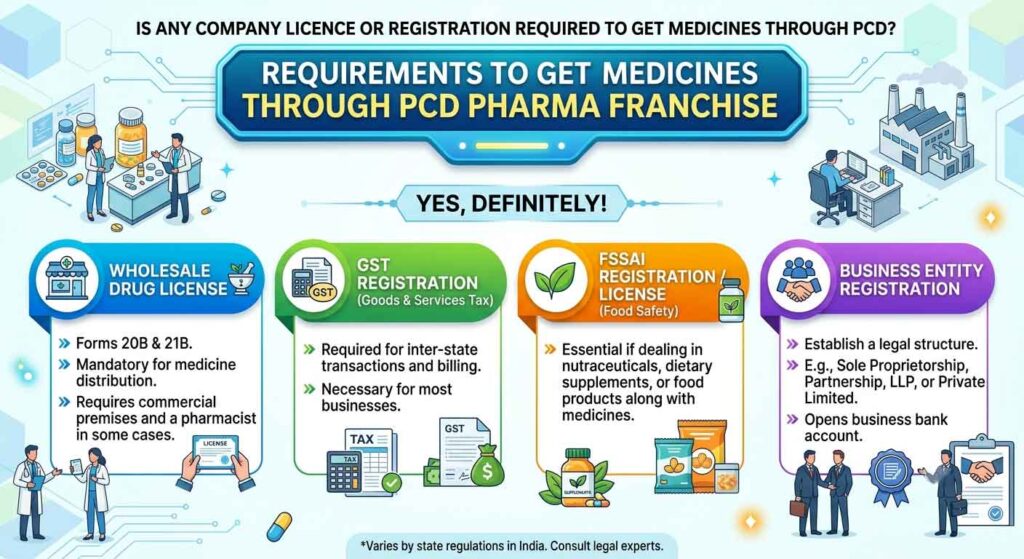
Do You Need Company Registration to Start PCD Business?
You need a valid legal business structure.
Possible structures include:
Proprietorship
Partnership
LLP
Private Limited Company
Since you already have a Private Limited Company, you may not need to create another company only for starting PCD business, provided:
Your company objects permit the intended business activity.
Your tax and licensing structure is suitable.
The medicines are purchased, stocked and sold through the correct licensed premises.
However, company incorporation alone is not a drug-sale licence.
Do You Need a Drug Licence for PCD Business?
This depends on what you will actually do.
If your company will:
Purchase medicines
Stock medicines
Sell medicines
Supply retailers
Supply hospitals
Dispatch products
Issue invoices for medicines
then proper wholesale drug-licence support is generally required for the premises carrying out those activities.
A drug licence is connected with the licensed business and premises.
What If You Only Do Marketing?
Suppose your company only performs:
Doctor promotion
Distributor appointment
Marketing
Sales coordination
Brand promotion
and the physical medicine stock and billing are handled entirely by a properly licensed distributor.
In that case, your own licensing requirement may differ.
The commercial and legal structure should clearly show:
Who purchases the products?
Who holds stock?
Who issues invoices?
Who sells to retailers?
Who handles returns?
Who maintains drug-sale records?
Do not create an informal structure where one company markets, another company’s drug licence is used casually, and no one clearly knows who is legally selling the medicines.
Can You Start PCD Without Your Own Wholesale Drug Licence?
A possible beginner structure is to work through a licensed distributor or stockist.
For example:
PCD Company ↓ Licensed Distributor in Your Territory ↓ Retail Chemists
You may focus on promotion and market development while the licensed distributor handles:
Purchase
Stock
Invoicing
Retail supply
However, the arrangement should be accepted by the parent company and structured properly.
For long-term independent business, obtaining your own wholesale drug licence is often cleaner and gives more control.
Is GST Registration Required?
GST registration depends on your legal and tax situation.
In normal pharma trade, companies usually require:
GST details
Drug licence details
Firm or company documents
Billing address
Shipping address
A PCD company may ask for these before opening your account.
GST registration and drug licence serve different purposes.
GST registration relates mainly to taxation.
Drug licence relates to lawful sale, stock and distribution of drugs.
One does not replace the other.
Common Documents Required to Start PCD Pharma Business
A PCD company may ask for:
Company or firm registration documents
PAN
GST certificate
Wholesale drug licence
Address proof
Contact details
Bank details
Purchase order
Distributor details, if working through a distributor
Requirements can vary according to the company and business structure.
What Is Monopoly PCD Franchise?
Some PCD companies provide area-wise monopoly or exclusive rights.
For example:
One city
One district
One group of towns
One territory
A monopoly agreement may specify:
Territory
Products
Minimum order
Sales target
Payment terms
Duration
Conditions for cancellation
Do not rely only on a verbal promise that:
“This whole district is yours.”
Take written territory terms.
Can Your Private Limited Company Become a PCD Franchisee?
Yes.
A Private Limited Company may take PCD franchise rights from another pharmaceutical company.
Your company may operate as:
PCD franchisee
Distributor
Marketing company
Brand owner
Third-party manufacturing client
depending on your business structure.
Can You Get Every Medicine Manufactured Under Your Own Brand?
Potentially, you can develop a broad product range through third-party manufacturing, but not literally “every combination” without checks.
Before launching a product, verify:
Whether the formulation is legally permitted
Whether the manufacturer has product permission
Whether it is a new drug
Whether the fixed-dose combination is approved
Whether it is banned or restricted
Whether it is under price control
Whether special warnings apply
Whether the proposed brand name is legally available
Do not select products only from a manufacturer’s price list.
Can You Use a Different Brand Name for Every Medicine?
Yes.
A pharma company commonly has multiple product brands.
Example:
Company:
XYZ Pharma Private Limited
Brands:
XYZPAN for one product
XYZCAL for another product
XYZVIT for another product
However, every brand name should be checked carefully before use.
You should consider:
Trademark availability
Similar-sounding pharma brands
Existing market use
Risk of medication confusion
A single trademark registration for the company name does not automatically protect every product brand.
Does Every Brand Need Trademark Registration?
Trademark registration is not the same as drug approval, but protecting important product brands is strongly advisable.
You may:
Select the proposed brand name.
Conduct a trademark and market search.
File a trademark application.
Finalize manufacturing and packaging after proper clearance.
Do not invest heavily in packaging before checking whether the brand is already used by another company.
Will Manufacturers Be Ready to Manufacture Products in Your Company Name?
Yes.
Many pharmaceutical manufacturers specialize in:
Third-party manufacturing
Contract manufacturing
Private-label manufacturing
They may manufacture products for your company under your brand names.
The label may show:
Manufactured by: Actual licensed manufacturer
Marketed by: Your company
You do not need to own a manufacturing plant for this model.
What Is Third-Party Manufacturing?
Third-party manufacturing means that another licensed pharmaceutical manufacturer produces medicines for your company.
Your company may handle:
Brand selection
Trademark
Product selection
Packaging design
Marketing
Distribution
Sales
The manufacturer handles:
Manufacturing
Quality control
Batch documentation
Production
Packing
Responsibilities should be clearly defined in agreements.
PCD Franchise vs Third-Party Manufacturing: Which Is Better for a Beginner?
Start With PCD Franchise When:
You have limited capital.
You have little pharma experience.
You want ready brands.
You want to learn market working.
You do not want high manufacturing MOQ.
Start With Own Brands When:
You want long-term brand ownership.
You have enough working capital.
You understand product selection.
You can manage trademark and packaging.
You can handle MOQ and inventory risk.
You want to build your own company identity.
Best Long-Term Strategy for Your Situation
Since you already have a Private Limited Company but are new to the pharma business, a phased approach may be safer.
Phase 1: Learn Through PCD or Distribution
Start with:
One territory
Limited products
One reliable company
Proper licensed distribution
Learn:
Doctor promotion
Chemist supply
Stock management
Product movement
Distributor working
Expiry control
Phase 2: Launch Selected Own Brands
After understanding demand, launch:
5 to 10 strong own-brand products
through third-party manufacturing.
Choose products that already show demand in your market.
Phase 3: Expand Your Own Portfolio
Gradually add:
Tablets
Capsules
Syrups
Nutraceuticals
Specialty products
according to your market.
Phase 4: Build Pan-India Distribution
Expand through:
PCD franchise
Distributors
Super stockists
C&F agents
Own sales team
Phase 5: Consider Own Manufacturing
Only after you have:
Strong turnover
Reliable product demand
Capital
Technical team
Regulatory understanding
Long-term production requirement
You do not need to build a factory on day one to become a successful pharma company.
Three Business Models Explained Simply
Model 1: PCD Franchise
Products belong to another company.
You market and distribute them in your territory.
Model 2: Own Marketing Company with Third-Party Manufacturing
Brands belong to you.
Another licensed company manufactures them for you.
Model 3: Own Manufacturing Company
Brands and manufacturing facility belong to your company.
You manufacture products yourself under the applicable licences.
Common Mistakes Beginners Make
Avoid:
Confusing PCD with third-party manufacturing
Assuming company registration is enough to sell medicines
Stocking drugs without licence support
Launching too many products
Using unsearched brand names
Choosing manufacturers only by low price
Not checking product permission
Taking verbal monopoly rights
Giving excessive credit
Ignoring expiry
Starting own factory too early
Practical Answer to the Query
You already have a Private Limited Company, so you may use that company for your pharma business if its legal structure and business objects are suitable.
For PCD:
You usually market another pharma company’s existing brands.
You may need wholesale drug-licence support if your company purchases, stocks, sells or distributes medicines.
You can also work through a properly licensed distributor, depending on the business structure.
For your own brands:
Select your own brand names.
Protect them through trademark strategy.
Take wholesale drug license and Choose a licensed third-party manufacturer.
Verify product permissions.
Get the products manufactured with your company shown as the marketer.
For your long-term goal:
Start with distribution and market learning → launch own brands through third-party manufacturing → expand your network → consider own manufacturing later.
Frequently Asked Questions
1. What is the full form of PCD?
PCD stands for Propaganda Cum Distribution.
2. Do I need a Private Limited Company for PCD?
No. A proprietorship, partnership, LLP or Private Limited Company may enter the business, subject to applicable licences and documentation.
3. Is company registration enough to sell medicines?
No. If you purchase, stock, sell or distribute medicines, proper drug-licence support is generally required.
4. Can I use my own brand names in PCD?
Normal PCD involves another company’s brands. For your own brands, third-party manufacturing is usually the more relevant model.
5. Can another company manufacture medicines under my brand?
Yes. A licensed third-party manufacturer can manufacture products under your brand name.
6. Do I need my own manufacturing licence for third-party manufacturing?
Not if the actual manufacturing is performed by a properly licensed manufacturer under a compliant arrangement.
7. Can I own 100 different pharma brands?
Potentially yes, but each brand should be legally cleared and each product must have the appropriate regulatory status.
8. Can I start without my own wholesale licence?
You may work through a licensed distributor depending on the business structure. For long-term independent stocking and billing, your own wholesale licence is often preferable.
9. Should I start with PCD or own brands?
For a complete beginner, PCD can provide practical market experience. Own brands offer greater long-term brand value but require more planning and investment.
10. Do I need my own factory to become a pharma company?
No. Many companies build their brands through third-party manufacturing.
Final Thoughts
PCD is a distribution and marketing opportunity.
Third-party manufacturing is an own-brand manufacturing arrangement.
Own manufacturing is a separate and much more complex business.
Do not confuse these three models.
For a beginner with an existing Private Limited Company, the safest growth path is often:
Learn the market through PCD or distribution → Launch selected own brands through third-party manufacturing → Build sales and distribution → Consider own manufacturing when commercially justified.
Looking for Ayurvedic Franchise or Distribution Opportunities?
Looking to start an Ayurvedic franchise, become a distributor, or launch your own herbal product range?
Elzac Herbal India offers:
Ayurvedic & Herbal Product Range
Franchise & Distribution Opportunities
Third-Party Manufacturing Services
Product Development Support
Marketing Guidance
PAN India Business Opportunities
Whether you are an entrepreneur, retailer, distributor, or healthcare professional, our team can help you explore the right business opportunity in the growing Ayurvedic sector.
Ajay Kamboj is an entrepreneur and business owners associated with many Ayurvedic and Pharmaceutical start-ups. With years of experience in Ayurvedic product marketing, pharmaceutical distribution, franchise development, and client relationship management, he regularly shares practical business insights based on real-world experiences. His articles focus on business growth, entrepreneurship, customer management, and lessons learned from the healthcare and wellness industry.


Leave a Reply Cancel reply
You must be logged in to post a comment.