A pharmaceutical marketing company can generally select its own brand or trade name and get the product manufactured through a licensed third-party manufacturer.
However, there is an important difference between:
Registering a brand name as a trademark
Obtaining permission to manufacture and market the actual drug formulation
These are separate processes.
A common query is:
“We are a registered pharmaceutical marketing company operating as a proprietorship firm. We want to launch pharmaceutical products under our own trade names in Maharashtra. The formula and manufacturing documents will belong to the manufacturer, who will manufacture the products for us. Can we register our own trade-name product and market it? Our first product of interest is amoxicillin suspension.”
The practical answer is:
Yes, you can own and market a pharmaceutical brand while getting the actual medicine manufactured by a licensed third-party manufacturer. However, the brand name should be legally cleared and preferably protected through trademark registration, while the manufacturer must hold the required licence and product permission for the exact formulation.
Understand the Difference Between Brand Registration and Product Permission
Many new pharma companies confuse these two processes.
1. Trademark Registration
Trademark registration protects your:
Brand name
Product name
Logo
Device mark
For example, if you create a unique brand name for an amoxicillin suspension, you may apply to protect that name under trademark law.
Trademark registration is an intellectual-property matter.
2. Drug Product Permission
Drug product permission concerns:
Active ingredient
Strength
Dosage form
Formulation
Manufacturing site
Applicable regulatory category
This permission is related to drug regulation.
A trademark certificate does not authorize manufacture of a medicine.
Similarly, a manufacturing licence does not automatically give the manufacturer ownership of your trademark.
Can a Proprietorship Firm Own a Pharma Brand?
Yes.
A proprietorship firm can generally apply for and own a trademark.
The proprietor may apply in:
Individual/proprietor name
Trading name, as legally appropriate
Ensure that the ownership details are consistent across:
Trademark application
GST registration
Drug licence
Manufacturing agreement
Product artwork
Invoices
This reduces future disputes.
Can You Choose Your Own Brand Name?
Yes, but the name should be selected carefully.
Before finalizing a pharma brand name, check:
Existing registered trademarks
Pending trademark applications
Similar-sounding pharma brands
Similar spelling
Similar therapeutic-category brands
Existing market use
Manufacturer’s own brands
Regulatory objections
Risk of prescription or dispensing confusion
Do not print packaging before conducting a proper search.
Why Pharma Brand-Name Search Is Especially Important
Pharmaceutical brand names can create patient-safety risks if they:
Sound similar
Look similar
Have similar spelling
Are used for different compositions
For example, two medicines with nearly identical brand names but completely different active ingredients may create:
Prescription errors
Dispensing errors
Patient confusion
Trademark disputes
Therefore, a simple Google search is not enough.
Use:
Official trademark database search
Market search
Drug-directory search
Internet search
Legal trademark search, where appropriate
Can You Start Using ™ Before Registration?
A company may commonly use the ™ symbol to indicate a claimed trademark.
However, the ® symbol should generally be used only after the trademark has been formally registered.
Filing an application does not guarantee registration.
There may be:
Examination objections
Opposition from another party
Prior-use disputes
Similar-mark objections
Therefore, choose the name carefully before investing heavily in packaging and promotion.
Which Trademark Class Is Used for Pharmaceutical Products?
Pharmaceutical and many medicinal products are commonly associated with Class 5 under trademark classification.
However, the correct class and specification should be selected according to the exact goods.
Depending on your broader business, other trademark classes may also be relevant for services or different product categories.
A trademark professional can help draft the correct goods description.
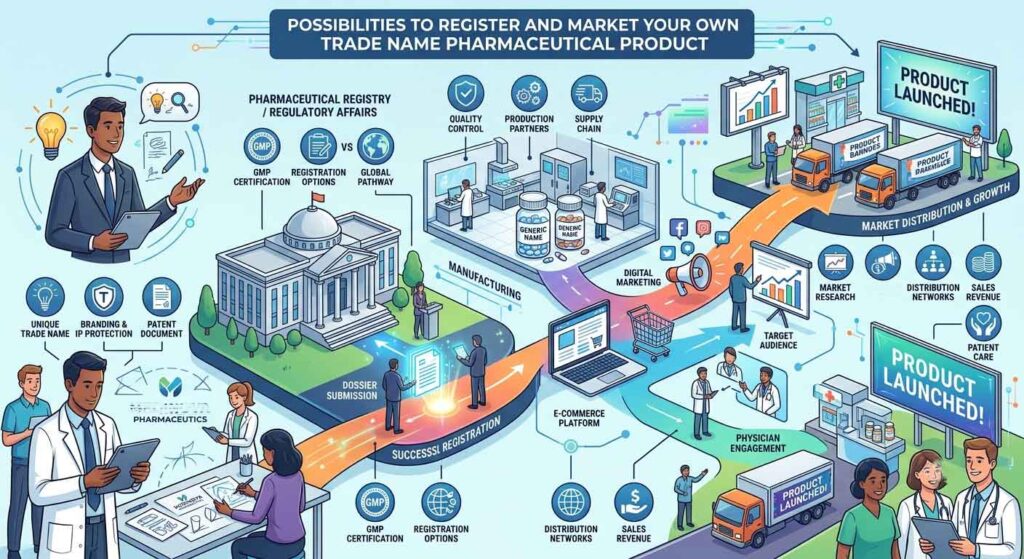
Step-by-Step Process to Launch Your Own Pharma Brand
Step 1: Select the Molecule and Dosage Form
For example:
Amoxicillin Oral Suspension
You must finalize:
Exact active ingredient
Strength
Dosage form
Pack size
Whether it is dry syrup/powder for oral suspension
Target market
Do not use a vague description.
Step 2: Select Proposed Brand Names
Prepare several options.
Do not depend on only one name.
For example, prepare:
First-choice brand
Second-choice brand
Third-choice brand
This helps if one name has a conflict.
Step 3: Conduct Trademark Search
Check:
Exact match
Phonetic similarity
Spelling similarity
Similar marks in Class 5
Similar products already in pharma market
Do not search only for identical spellings.
A name can face objection even when spelling is different but pronunciation is confusingly similar.
Step 4: File Trademark Application
After satisfactory clearance, file the trademark application.
Keep:
Application number
Filing receipt
Applicant details
Brand representation
Remember that filing does not automatically mean final registration.
Step 5: Select a Licensed Third-Party Manufacturer
The manufacturer should have:
Valid manufacturing licence
Suitable dosage-form section
GMP compliance
Permission for the exact formulation
Quality-control capability
Adequate production capacity
For amoxicillin suspension, select a manufacturer experienced in antibiotic oral preparations.
Step 6: Verify Product Permission
Ask the manufacturer for evidence that it is permitted to manufacture the exact product.
Check:
Active ingredient
Strength
Dosage form
Manufacturing-site address
Applicable approval details
Do not assume that because the factory manufactures tablets or antibiotics, it can automatically manufacture every formulation.
Step 7: Sign a Third-Party Manufacturing Agreement
The agreement should define:
Brand ownership
Product composition
Manufacturing responsibility
Product quality
Packaging
Artwork approval
MOQ
Delivery timeline
Testing
COA
Complaints
Recall
Defective-product replacement
Trademark use
The agreement should clearly state that your brand belongs to you and is being used by the manufacturer only for contract manufacturing.
Step 8: Prepare Artwork
The product label or carton may need to contain applicable information such as:
Brand name
Generic name
Strength
Dosage form
Composition
Batch number
Manufacturing date
Expiry date
MRP
Storage conditions
Prescription warning
Manufacturer name and address
Manufacturing-licence details
Marketed-by company details
The exact wording should be reviewed product-wise.
Step 9: Obtain Artwork Approval
Before printing large quantities, confirm:
Manufacturer approval
Regulatory compliance
Correct composition
Correct strength
Correct warnings
Correct addresses
Correct trademark details
A printing error can result in complete packaging loss.
Step 10: Place Manufacturing Order
Once everything is finalized:
Issue purchase order
Confirm MOQ
Make agreed payment
Approve artwork
Confirm delivery schedule
Step 11: Receive Batch Documents
With the finished product, obtain or maintain access to:
Invoice
Batch-wise COA
Product permission
Manufacturing details
Batch and expiry information
Step 12: Market Through a Licensed Distribution Structure
If your company purchases, stocks, sells or distributes allopathic medicines, ensure proper wholesale drug-licence support at the relevant premises.
Your company may operate through:
Own wholesale licence
Licensed C&F agent
Licensed super stockist
Licensed distributor
The exact structure should be properly documented.
Does the Marketing Company Need to Register the Product Separately?
This depends on the regulatory structure.
In a typical third-party manufacturing arrangement:
The licensed manufacturer manufactures the product.
The manufacturer holds the applicable manufacturing and product permissions.
Your company owns or uses the brand name.
Your company is shown as “Marketed by,” where applicable.
However, the exact documents and State Licensing Authority requirements should be confirmed before launch.
Do not assume that trademark registration itself is drug-product registration.
Can the Manufacturer Own the Formula While You Own the Brand?
Yes, this can happen.
For example:
Manufacturer has the approved formulation.
You select your own unique brand name.
Manufacturer produces the formulation under your brand.
You own the trademark.
This is a common third-party manufacturing model.
However, your agreement should clearly define:
Who owns the brand?
Who owns any custom formulation?
Can the manufacturer sell the same formulation to others?
Can it use your artwork?
Can it manufacture your brand for another party?
Who owns product data?
Who bears trademark-dispute risk?
Never depend only on verbal understanding.
What Documents Should You Provide to the Manufacturer?
Common documents may include:
Firm registration details
GST certificate
PAN
Wholesale drug licence, where applicable
Address proof
Trademark application or authorization
Brand-name confirmation
Final artwork
Purchase order
Manufacturing agreement
Requirements vary according to the manufacturer and business model.
Documents to Collect From the Manufacturer
Ask for:
Manufacturing licence
GMP certificate
Product permission
GST details
Manufacturing agreement
Batch-wise COA
Product specification, where appropriate
Approved artwork copy
Complaint and recall contact
Can You Market the Product Across India?
A brand may be promoted across India, but physical sale and distribution should occur through legally compliant licensed channels.
If you are based in Maharashtra, you may:
Stock and bill from your licensed premises
Appoint distributors in other states
Appoint C&F agents
Use super stockists
Each stocking and distribution point must comply with applicable licensing requirements.
Trademark protection itself is not limited to Maharashtra if filed and protected nationally under Indian trademark law.
Can Two Companies Sell the Same Molecule Under Different Brand Names?
Yes.
For example, multiple companies may market the same approved active ingredient under different trademarks.
What must differ is the legally protectable brand identity.
However, each marketed product must still comply with:
Product approval
Label requirements
Manufacturing permissions
Pricing rules
Prescription requirements
Can You Register a Generic Name as Trademark?
Purely descriptive or generic terms may face difficulty in trademark registration because trademarks should distinguish one trader’s goods from another’s.
For example, attempting to monopolize only the common generic name of the active ingredient may be problematic.
A more distinctive coined brand name is usually preferable.
Should You Search the Brand Name Before Asking Manufacturer for Quotation?
Yes.
A practical sequence is:
Select molecule.
Prepare proposed brand names.
Conduct preliminary trademark search.
Shortlist manufacturer.
Verify product permission.
Conduct detailed brand clearance.
File trademark application.
Sign agreement.
Approve artwork.
Manufacture.
Do not print 50,000 cartons and then discover that another company already owns a confusingly similar trademark.
The brand and company name are separate intellectual-property assets.
What If the Manufacturer Already Has the Same Brand?
Do not use it unless you have clear legal rights.
Before manufacturing, check whether:
Manufacturer is already using the brand.
Another marketing company has rights to it.
Trademark is registered to another party.
Manufacturer has promised the same name to multiple customers.
Brand ownership should be written into the agreement.
What If Trademark Registration Is Rejected Later?
This is a business risk.
Possible consequences include:
Rebranding
New packaging
Destroying unused printed material
Market confusion
Legal dispute
Therefore:
Conduct a strong search first.
Avoid highly similar names.
File early.
Keep backup names.
Limit first packaging quantity until risk is understood.
Can You Use the Manufacturer’s Formula Under Your Own Brand?
Yes, if:
The formulation is legally permitted.
The manufacturer has the necessary approval.
The manufacturer agrees to manufacture it for you.
Your brand name is legally available.
Packaging and marketing are compliant.
This is one of the most common third-party manufacturing models.
Common Mistakes to Avoid
Avoid:
Selecting a brand without trademark search
Assuming trademark means drug approval
Assuming drug permission gives trademark ownership
Printing before artwork approval
Using a manufacturer without product permission
Copying another company’s brand style
Selecting confusingly similar medicine names
Using the ® symbol before registration
Using an unrelated brand extension for different compositions
Launching antibiotics without correct prescription warnings
Keeping brand ownership unclear in agreement
Depending only on verbal assurances
Practical Answer to the Query
Yes, as a registered pharmaceutical marketing firm, you can launch pharmaceutical products under your own trade name through third-party manufacturing.
For your proposed amoxicillin suspension:
Finalize the exact composition and strength.
Select several unique proposed brand names.
Conduct trademark and market searches.
File a trademark application for the selected brand.
Select a licensed manufacturer.
Verify that the manufacturer has permission for the exact product.
Sign a manufacturing and quality agreement.
Prepare compliant artwork.
Manufacture and obtain batch documentation.
Market and distribute through a properly licensed channel.
Remember:
Trademark registration protects the name.
Drug manufacturing permission authorizes the product to be manufactured.
Drug-sale licensing supports purchase, stocking and distribution.
All three should be handled correctly.
Frequently Asked Questions
1. Can I launch medicine under my own brand name?
Yes. You can select and own a brand while getting the medicine manufactured by a licensed third-party manufacturer.
2. Do I need my own manufacturing licence?
Not if a properly licensed third-party manufacturer is manufacturing the product for you under the applicable arrangement.
3. Is trademark registration compulsory before manufacturing?
Trademark registration is an intellectual-property protection mechanism rather than a substitute for drug approval. However, conducting a proper search and filing early is strongly advisable.
4. Can I use ™ after filing?
The ™ symbol is commonly used to indicate a claimed trademark. The ® symbol should generally be used only after registration.
5. Who owns the brand in third-party manufacturing?
Ownership depends on the trademark and agreement. Your contract should clearly state that the brand belongs to your company.
6. Can a manufacturer use my brand for another customer?
It should not do so if your trademark and manufacturing agreement give you exclusive rights. Put this clearly in writing.
7. Does the manufacturer need product permission for amoxicillin suspension?
Yes, the manufacturing site should have the applicable permission for the exact formulation and dosage form.
8. Can I market amoxicillin suspension as an OTC medicine?
No. Antibiotics are prescription medicines and must be marketed and sold according to applicable prescription-drug requirements.
9. Can I market my brand throughout India?
Potentially yes, through legally compliant distribution and licensing arrangements.
10. What is the biggest mistake when launching a pharma brand?
Printing and launching a brand without first checking trademark availability and product permission.
Final Thoughts
Creating your own pharmaceutical brand is possible without owning a manufacturing plant.
A successful third-party model separates three important assets:
Your Brand + Manufacturer’s Licensed Production Capability + Your Marketing and Distribution Network
Protect your brand, verify the formulation permission, clearly define ownership in agreements and maintain a compliant distribution system.
For a prescription antibiotic such as amoxicillin suspension, regulatory and quality due diligence should be completed before investing in packaging or market launch.
Looking for Ayurvedic Franchise or Distribution Opportunities?
Looking to start an Ayurvedic franchise, become a distributor, or launch your own herbal product range?
Elzac Herbal India offers:
Ayurvedic & Herbal Product Range
Franchise & Distribution Opportunities
Third-Party Manufacturing Services
Product Development Support
Marketing Guidance
PAN India Business Opportunities
Whether you are an entrepreneur, retailer, distributor, or healthcare professional, our team can help you explore the right business opportunity in the growing Ayurvedic sector.
Ajay Kamboj is an entrepreneur and business owners associated with many Ayurvedic and Pharmaceutical start-ups. With years of experience in Ayurvedic product marketing, pharmaceutical distribution, franchise development, and client relationship management, he regularly shares practical business insights based on real-world experiences. His articles focus on business growth, entrepreneurship, customer management, and lessons learned from the healthcare and wellness industry.







Leave a Reply Cancel reply
You must be logged in to post a comment.