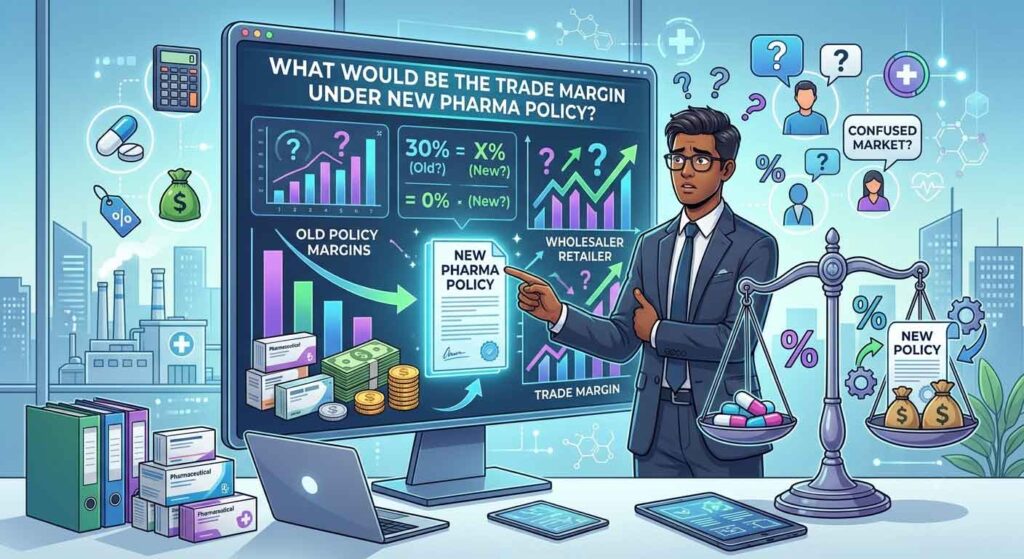
Trade margin in the pharmaceutical sector is always a sensitive topic. Whenever there is discussion about a new pharma policy, many rumours start circulating in the market.
Common rumours include:
Contract manufacturing may be banned.
Loan licence manufacturing may be stopped.
Trade margins may be fixed.
Brand names may be removed from single-salt medicines.
Generic medicines may be promoted more aggressively.
Branded generics may come under stricter pricing control.
Some of these points may be policy discussions, but they should not be treated as final law unless officially notified by the Government.
This article explains what trade margin means, what was discussed earlier, what is currently applicable, and how trade margin fixation may affect manufacturers, wholesalers, retailers, pharma franchise companies, and patients.
What Is Trade Margin in Pharma?
Trade margin is the difference between the price at which medicine is sold to the trade channel and the final price charged to the consumer.
In simple words:
Trade Margin = Margin available between company price, stockist price, retailer price, and MRP
In the pharmaceutical sector, trade margin may involve:
Company to C&F margin
C&F to super stockist margin
Super stockist margin
Wholesaler margin
Distributor margin
Retailer margin
Hospital pharmacy margin
Online pharmacy discount margin
The final medicine price paid by the patient depends on MRP, trade scheme, distribution margin, and retailer discount.
Why Trade Margin Is Important
Trade margin is important because it affects:
Medicine affordability for patients
Retailer profitability
Wholesaler viability
Company pricing strategy
Generic medicine promotion
Franchise business model
Hospital pharmacy pricing
Online pharmacy discounting
Competition between branded and generic medicines
If margins are very high, patients may pay more. If margins are too low, retailers and wholesalers may lose interest in stocking certain products.
Therefore, trade margin policy has to balance affordability and market availability.
Current Price Control System in India
At present, medicine pricing in India is regulated mainly under:
National Pharmaceutical Pricing Policy 2012
Drugs Prices Control Order 2013
NPPA price notifications
Para 19 public-interest orders, where invoked
NLEM-based scheduled formulation price control
NPPA fixes ceiling prices for scheduled formulations listed under Schedule I of DPCO 2013.
These scheduled medicines are generally based on the National List of Essential Medicines.
Trade Margin for Scheduled Medicines
For scheduled medicines under DPCO 2013, ceiling price is calculated through market-based pricing.
The broad method is:
Average Price to Retailer is calculated for brands and generic versions having market share of 1% or more.
A 16% margin to retailer is added.
Ceiling price is notified by NPPA.
Manufacturer cannot sell above the notified ceiling price plus applicable GST/local taxes.
So, for scheduled medicines, the key margin built into ceiling price calculation is:
Retailer Margin: 16%
This does not mean every trade channel can freely add margin above the notified ceiling price. Once ceiling price is fixed, the final MRP must remain within the allowed limit.
Example of Scheduled Medicine Price Calculation
Suppose the average Price to Retailer of a scheduled formulation is ₹100.
Retailer margin allowed in calculation: 16%
Ceiling price may be calculated approximately as:
₹100 + 16% = ₹116
This means the ceiling price before applicable tax may be ₹116.
The manufacturer cannot print MRP above the permitted ceiling price plus applicable tax.
This is only a simple example for understanding. Actual NPPA calculation depends on official data and notified price.
Trade Margin for Non-Scheduled Medicines
Non-scheduled medicines are medicines not directly covered under scheduled price control.
For non-scheduled formulations:
Prior NPPA price approval is generally not required.
Manufacturer can fix MRP.
But MRP cannot be increased by more than 10% during the preceding 12 months.
NPPA can monitor prices.
NPPA can take action if overpricing or public interest issue arises.
For non-scheduled medicines, there is generally no universal fixed wholesaler and retailer margin for every product under current DPCO framework.
Market practice may vary according to product category.
Common Market Margins in Pharma
In normal market practice, margins may differ between ethical, generic, PCD, OTC, hospital, and online channels.
Commonly seen trade margins may include:
Ethical branded medicines: lower trade margin
Generic medicines: higher trade margin
PCD franchise products: higher margin structure
OTC products: variable retail margin
Hospital supply: negotiated margin
Online pharmacy: discount-based model
Specialty medicines: category-based margin
These are business practices and may vary from company to company.
What Is Trade Margin Rationalisation?
Trade Margin Rationalisation means limiting the maximum margin between the price charged by manufacturer or distributor and the final MRP.
Instead of directly fixing production cost or manufacturing margin, the regulator may cap the margin in the distribution chain.
For example, if trade margin is capped at 30%, then MRP cannot be excessively higher than the selected base price such as price to stockist or price to distributor, depending on the order.
Trade Margin Rationalisation has been used in selected product categories in public interest.
Example: Anti-Cancer Medicines
NPPA used Trade Margin Rationalisation for selected non-scheduled anti-cancer medicines.
In that case, trade margin of selected products was capped at 30%, which resulted in reduction of MRPs of many brands.
This was a special public-interest intervention and not a general trade margin cap for all medicines.
Will Government Fix Trade Margin for All Medicines?
Trade margin fixation for all medicines has been discussed many times, but as of now, there is no single universal fixed margin for all pharmaceutical products.
Selected products: NPPA may use Para 19 in public interest.
Special categories: trade margin may be rationalised through specific orders.
General market: margins vary depending on product and business model.
Therefore, pharma businesses should follow official NPPA notifications rather than market rumours.
Impact of Trade Margin Fixation on Pharma Companies
If trade margins are fixed strictly in future, pharma companies may need to revise their business model.
Possible impact:
Lower MRP flexibility
Reduced trade schemes
Lower retailer attraction for high-margin brands
Pressure on PCD franchise model
More focus on volume sales
More transparent price structure
Stronger need for product differentiation
Reduction in excessive MRP-based discounting
Possible benefit to patients
Companies with very high MRP and high trade margin may face more pressure.
Impact on Wholesalers
Wholesalers may be affected if fixed margins reduce their earning per invoice.
Possible impact:
Lower margin on some products
More focus on volume
Need for faster stock rotation
Less room for extra schemes
Stronger need for payment discipline
Reduced benefit from high-MRP generic products
Wholesalers may need to focus on fast-moving products, controlled credit, and efficient distribution.
Impact on Retailers
Retailers may be affected depending on the final margin structure.
Possible impact:
Reduction in high-margin generic sales
Lower discount flexibility
More dependence on prescription products
Need for volume-based business
More competition from online pharmacies
Better transparency for consumers
If retailer margins are reduced too much, availability of some low-demand products may also be affected.
Impact on PCD Pharma Franchise Business
PCD pharma franchise business often works on high-margin and monopoly-based distribution model.
If trade margins are strictly fixed in future, PCD companies may need to change:
Price list structure
MRP strategy
Promotional schemes
Distributor margin
Franchise support model
Product selection
Marketing expenses
PCD businesses may need to move from very high margin to more practical pricing, better quality, and stronger brand support.
Impact on Generic Medicines
Generic medicine margins are often higher in the market because companies use high trade margin to push non-prescription or substitution-based sales.
If generic margins are capped in future, it may:
Reduce retailer incentive
Reduce MRP variation
Help patients get lower prices
Increase competition on quality and availability
Affect high-margin generic distribution models
But final impact depends on actual government notification.
Impact on Patients
Patients may benefit if trade margin rationalisation reduces excessive MRP.
Possible benefits:
Lower medicine prices
Better price transparency
Reduced difference between similar brands
Lower out-of-pocket expenditure
Less exploitation in hospital pharmacies and high-margin channels
However, policy must also ensure that medicines remain available and distributors continue to stock them.
Trade Margin vs Discount
Trade margin and discount are different.
Trade Margin
Trade margin is the margin between trade price and MRP.
Discount
Discount is the reduction offered to buyer from MRP or invoice price.
Example:
If MRP is ₹100 and retailer purchase price is ₹80, the retailer has trade margin.
If retailer sells to patient at ₹90, the patient receives ₹10 discount.
A product may have high trade margin but low patient discount, or low trade margin but better transparent pricing.
How Pharma Businesses Should Prepare
Pharma companies, distributors, and retailers should prepare for more pricing transparency.
Practical steps include:
Avoid unrealistic MRPs.
Keep price structure reasonable.
Track NPPA notifications regularly.
Check whether product is scheduled or non-scheduled.
Maintain proper price records.
Avoid overcharging above notified price.
Inform trade partners about revised prices.
Build sales on quality and service, not only margin.
Use compliant promotional practices.
Plan business model with sustainable margins.
How to Check Whether a Product Is Under Price Control
To check whether a medicine is under price control:
Check whether the formulation is included in NLEM.
Search NPPA ceiling price notifications.
Check DPCO Schedule I.
Verify molecule, strength, dosage form, and pack.
Check NPPA retail price orders for new drugs.
Confirm latest MRP and ceiling price before sale.
Consult a regulatory expert if there is confusion.
A small change in strength or dosage form can affect applicability, so check carefully.
Common Mistakes to Avoid
Avoid these mistakes:
Treating draft policy as final law
Assuming all medicines have fixed trade margins
Selling scheduled medicine above notified price
Increasing non-scheduled medicine MRP beyond permitted limit
Not updating retailers after NPPA price notification
Confusing retailer margin with wholesaler margin
Ignoring Para 19 public-interest orders
Using very high MRP only to show high discount
Not checking product category before pricing
Depending only on market rumours
Final Answer
At present, there is no universal fixed trade margin for all pharmaceutical products in India.
For scheduled medicines under DPCO 2013, NPPA fixes ceiling prices and the calculation includes 16% retailer margin over average Price to Retailer.
For non-scheduled medicines, manufacturers generally do not require prior price approval, but MRP increase cannot exceed 10% in the preceding 12 months.
NPPA can also intervene in public interest and use Trade Margin Rationalisation for selected products, as it has done for certain anti-cancer medicines.
Therefore, any article about “new pharma policy trade margin” should clearly mention whether the margin structure is officially applicable or only a draft/proposed discussion.
Frequently Asked Questions
1. What is trade margin in pharma?
Trade margin is the difference between the trade price and final selling price or MRP of a medicine.
2. Is trade margin fixed for all medicines in India?
No. There is no single universal fixed trade margin for all medicines. Scheduled medicines are under NPPA ceiling price control, while non-scheduled medicines are monitored under DPCO provisions.
3. What is retailer margin for scheduled medicines?
Under DPCO 2013 price calculation, scheduled formulation ceiling price is derived by adding 16% retailer margin to the average Price to Retailer.
4. What is wholesaler margin under DPCO?
The current DPCO 2013 ceiling price formula mainly refers to Price to Retailer and retailer margin. Wholesaler margin may vary according to business arrangement unless specifically controlled by an applicable order.
5. Can non-scheduled medicine MRP be increased freely?
No. For non-scheduled formulations, MRP cannot be increased by more than 10% during the preceding 12 months.
6. What is Trade Margin Rationalisation?
Trade Margin Rationalisation is a pricing method where the regulator caps the margin between trade price and MRP to reduce excessive pricing.
7. Has Trade Margin Rationalisation been applied in India?
Yes. It has been applied to selected non-scheduled anti-cancer medicines and some medical devices in public interest.
8. Are generic medicine margins fixed?
There is no universal fixed margin for all generic medicines unless the product falls under price control or a specific order applies.
9. Can NPPA regulate non-scheduled medicines?
Yes. NPPA monitors non-scheduled medicine prices and can intervene under DPCO provisions in public interest.
10. What should pharma companies do if margin rules change?
Companies should revise price lists, update MRPs, inform stockists and retailers, maintain records, and ensure compliance with NPPA notifications.
Looking for Ayurvedic Franchise or Distribution Opportunities?
Looking to start an Ayurvedic franchise, become a distributor, or launch your own herbal product range?
Elzac Herbal India offers:
Ayurvedic & Herbal Product Range
Franchise & Distribution Opportunities
Third-Party Manufacturing
Product Development Support
Marketing Guidance
PAN India Business Opportunities
Whether you are an entrepreneur, retailer, distributor, or healthcare professional, our team can help you explore the right business opportunity in the growing Ayurvedic sector.
Ajay Kamboj is an entrepreneur and business owners associated with many Ayurvedic and Pharmaceutical start-ups. With years of experience in Ayurvedic product marketing, pharmaceutical distribution, franchise development, and client relationship management, he regularly shares practical business insights based on real-world experiences. His articles focus on business growth, entrepreneurship, customer management, and lessons learned from the healthcare and wellness industry.


Leave a Reply
You must be logged in to post a comment.