Many entrepreneurs want to open an Ayurvedic medicine shop, franchise outlet, herbal store or Ayurvedic pharmacy but are unsure whether they need a drug licence or a registered pharmacist.
The general position is:
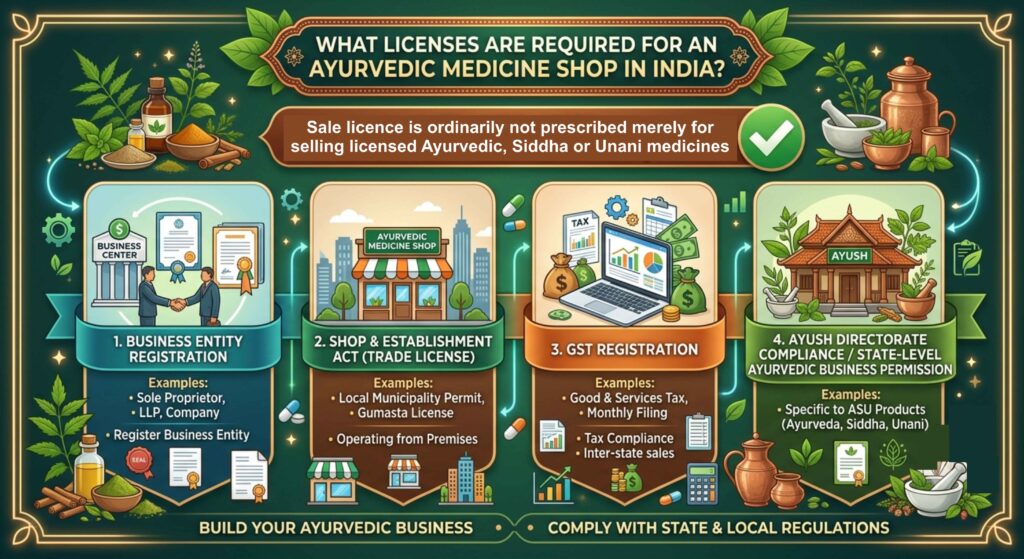
Under the central Drugs and Cosmetics Act and Drugs Rules, a separate retail or wholesale drug-sale licence is ordinarily not prescribed merely for selling licensed Ayurvedic, Siddha or Unani medicines.
The Ministry of Ayush has officially stated that a sale licence is not required for Ayurvedic medicines. Current official guidance from Kerala and Puducherry also states that Ayurvedic medicines do not require a special sale licence, provided the products are manufactured under a valid Ayurvedic manufacturing licence.
However, this does not mean that an Ayurvedic shop can always begin without any registration.
The business may still require:
State-specific AYUSH shop permission
Shop and Establishment registration
Municipal trade licence
GST registration
FSSAI registration or licence
Medical-device registration
Registrations for allopathic or homoeopathic medicines
Other local business approvals
The requirements depend on the state, products sold and nature of the business.
Clear Answer
Is a Drug Licence Required for an Ayurvedic Medicine Shop?
Ordinarily, no separate drug-sale licence is required under the central Drugs Rules when the shop sells only legally manufactured Ayurvedic, Siddha or Unani medicines.
However:
The shop must sell genuine products manufactured by licensed manufacturers.
State-specific AYUSH shop-registration rules must be checked.
Products containing Schedule E(1) ingredients require special precautions.
Separate licences apply when allopathic medicines, homoeopathic medicines, food supplements or medical devices are sold.
Normal business, tax and municipal registrations may still be required.
Why Is a Sale Licence Generally Not Required?
The Drugs and Cosmetics Rules contain specific licensing provisions for the manufacture of Ayurvedic, Siddha and Unani medicines.
The main manufacturing provisions appear in Part XVI and include matters relating to:
Manufacturing licences
Loan licences
Product permissions
Technical personnel
Good Manufacturing Practices
Quality standards
Part XVII deals with:
Labelling
Packing
Ingredient declarations
Alcohol limits
Schedule E(1) warnings
The central Rules do not prescribe retail and wholesale sale-licence forms for Ayurvedic, Siddha and Unani medicines comparable to Forms 20, 20-B, 21 and 21-B used for allopathic drugs. CDSCO’s official traditional-drugs page identifies the main regulatory provisions for these medicines under Parts XVI, XVII and XVIII.
The Ministry of Ayush has also expressly clarified that a sale licence is not required for Ayurvedic medicines.
Important State-Level Exception
The central position should not be interpreted as a guarantee that no state-level shop permission exists anywhere in India.
For example, the Government of India’s National Government Services Portal currently lists an online service in Karnataka titled:
“License for Establishment of Drug Store by Ayush Department, Karnataka.”
The service covers establishments selling or storing Ayurvedic, Siddha, Unani and homoeopathic medicines.
Therefore, before opening the shop, obtain written or portal-based confirmation from the concerned:
State AYUSH Department
State Drug Controller
District AYUSH Officer
Municipal authority
Shops and Establishments authority
The safer conclusion is:
No separate central ASU drug-sale licence is ordinarily prescribed, but state-specific establishment or shop registration may apply.
Is Any Qualification Required?
Under the central Ayurvedic drug-sale framework, no particular qualification such as the following is ordinarily prescribed merely for owning and operating a shop selling Ayurvedic medicines:
BAMS
B.Pharm
D.Pharm
Registered pharmacist
Diploma in Ayurveda
Therefore, a person without a pharmacy or Ayurveda qualification may generally own an Ayurvedic medicine shop, subject to state-specific requirements.
However, selling packaged medicines and practising Ayurveda are different activities.
Selling Medicines vs Medical Practice
A shop owner may:
Purchase approved medicines
Display products
Sell packaged products
Explain printed directions
Issue invoices
A person should not diagnose disease, prescribe treatment or present themselves as an Ayurvedic doctor unless they possess a recognized qualification and valid professional registration.
The Ministry of Ayush has clarified that recognized qualifications and practitioner registration are required for the medical practice of Ayurveda.
An unqualified shopkeeper should avoid statements such as:
“You have arthritis.”
“Stop your existing medicine.”
“This will cure your diabetes.”
“Take this combination instead of seeing a doctor.”
“This product is safe during pregnancy.”
“No medical consultation is necessary.”
Schedule E(1) Ayurvedic Medicines
Schedule E(1) contains substances that require special caution because improper use may cause serious harm.
Rule 161 requires an internal Ayurvedic, Siddha or Unani medicine containing a Schedule E(1) substance to carry the warning:
“Caution: To be taken under medical supervision”
in both English and Hindi.
Examples of products requiring careful handling may include certain formulations containing specified toxic or potent ingredients.
The shop should:
Check the caution statement.
Avoid recommending the medicine without medical supervision.
Keep such products separately identified.
Train employees not to self-prescribe them.
Preserve the purchase and sale trail.
Follow any state-specific prescription requirement.
Online Sale of Schedule E(1) Medicines
The Central Consumer Protection Authority advised e-commerce platforms that Ayurvedic, Siddha and Unani medicines containing Schedule E(1) ingredients should be sold only after the customer uploads a valid prescription from a registered practitioner of the relevant system.
Therefore, an online Ayurvedic store should not treat every Ayurvedic product as an unrestricted wellness product.
Its system should be capable of:
Identifying Schedule E(1) products
Blocking automatic checkout
Collecting the prescription
Verifying the prescription
Maintaining the transaction record
Displaying warnings prominently
What Registrations May an Ayurvedic Shop Need?
1. Business Constitution
The business may operate as:
Proprietorship
Partnership
LLP
Private Limited Company
A small shop owned by one person commonly begins as a proprietorship.
Basic documents may include:
PAN
Aadhaar
Address proof
Business-name proof
Rent agreement
Owner’s NOC
Bank account
2. Shop and Establishment Registration
Registration under the applicable state Shops and Establishments law may be required.
This generally relates to matters such as:
Business establishment
Working hours
Employee records
Weekly holidays
Wages
Leave
Display of registration
Requirements vary by state.
3. Municipal Trade Licence
A municipal corporation, committee, council or panchayat may require a local trade licence.
The requirement depends on:
Shop location
Local body
Nature of goods
Commercial-use status
Local municipal rules
4. GST Registration
GST registration depends on:
Aggregate turnover
Interstate supplies
E-commerce activity
Compulsory-registration provisions
Business structure
State of operation
A shop may also register voluntarily where commercially useful.
From 22 September 2025, drugs and medicines generally attract 5% GST, except products specifically placed under the nil-rate category. Product classification must still be checked because herbal foods, cosmetics and general wellness products may fall under different HSN entries.
5. FSSAI Registration or Licence
An Ayurvedic drug licence and an FSSAI licence cover different products.
FSSAI registration or licensing is required where the shop sells food-category products such as:
Nutraceuticals
Health supplements
Herbal foods
Protein powders
Functional beverages
Herbal teas sold as food
Food gummies
Dietary supplements
Food for special dietary use
Do not assume that every capsule, syrup or powder is an Ayurvedic medicine.
Check whether the product label carries:
AYUSH manufacturing-licence details
FSSAI logo and licence number
Cosmetic manufacturing details
Another regulatory classification
6. Medical-Device Registration
Where the shop sells regulated medical devices, the requirements of the Medical Devices Rules should be examined.
A person intending to sell, stock, exhibit, offer for sale or distribute applicable medical devices generally applies in Form MD-41, and the State Licensing Authority grants the premises registration certificate in Form MD-42.
Possible devices may include certain:
Diagnostic devices
Monitoring devices
Therapeutic devices
In-vitro diagnostic products
Medical equipment
7. Allopathic Retail Drug Licence
If the shop also sells allopathic medicines, it needs the applicable allopathic retail drug licences.
Common licences include:
Form 20
Form 21
Additional applicable licences for special categories
A registered pharmacist and compliant premises are ordinarily required for a regular retail pharmacy.
Delhi’s official drug-control guidance separately lists Forms 20 and 21 for allopathic retail sale and Forms 20-B and 21-B for wholesale activity.
An Ayurvedic-only shop cannot sell allopathic prescription medicines merely because both are described as medicines.
8. Homoeopathic Retail Licence
Retail sale of homoeopathic medicines ordinarily requires a licence in Form 20-C.
Wholesale homoeopathic activity ordinarily requires Form 20-D.
A shop selling both Ayurvedic and homoeopathic products should therefore check the homoeopathic licence requirement separately.
Product-Wise Licence Guide
Product sold
Common regulatory requirement
Only licensed Ayurvedic, Siddha or Unani medicines
No separate central ASU sale licence ordinarily prescribed; verify state rules
Allopathic medicines
Applicable retail or wholesale drug licence
Homoeopathic medicines
Form 20-C for retail or Form 20-D for wholesale
Nutraceuticals and food supplements
Applicable FSSAI registration or licence
Cosmetics
Normal business compliance; verify product and local requirements
Medical devices
Form MD-42 premises registration may apply
Own manufactured Ayurvedic medicines
Form 25-D manufacturing licence
Ayurvedic products made under a loan licence
Form 25-E arrangement
Imported products
Applicable import, registration and category requirements
Can an Allopathic Medical Store Sell Ayurvedic Medicines?
Generally, an allopathic medical store may stock legally manufactured Ayurvedic medicines without obtaining a separate central Ayurvedic sale licence.
Puducherry’s official Drug Control Department states that Ayurvedic drugs may be stocked in a medical shop where sufficient storage space is available and that no separate licence is required for dealing with them.
The shop should still:
Separate product categories.
Maintain adequate storage.
Avoid billing mistakes.
Follow Schedule E(1) precautions.
Comply with state-specific requirements.
Can an Ayurvedic Shop Sell Allopathic Medicines?
No—not merely because it sells Ayurvedic medicines.
The shop must obtain the applicable allopathic retail drug licences and meet requirements relating to:
Registered pharmacist
Premises
Storage
Refrigerator
Purchase records
Sales records
Prescription medicines
Scheduled drugs
Can an Ayurvedic Shop Sell Cosmetics?
It may sell legally manufactured cosmetic products, subject to ordinary business, tax and local requirements.
However, the shop should verify that the product is genuinely licensed as a cosmetic and is not an unlicensed medicinal preparation.
Do not make unapproved medicinal claims for cosmetics.
Can an Ayurvedic Shop Sell Nutraceuticals?
Yes, but the shop may require the applicable FSSAI registration or licence.
Examples include:
Protein powder
Calcium food supplement
Vitamin gummies
Nutrition bars
Dietary fibre
Herbal tea
Food-category health drinks
The shop should not describe an FSSAI-licensed food supplement as an Ayurvedic medicine unless it separately meets the drug requirements.
Can an Ayurvedic Shop Sell Loose Herbs?
Selling raw herbs may involve separate considerations depending on whether the herbs are presented as:
Raw agricultural commodities
Food ingredients
Medicinal raw materials
Formulated medicines
Powdered retail preparations
The shop should avoid preparing and packing its own medicinal formulas without an applicable manufacturing licence.
Activities such as the following may amount to manufacturing or processing:
Mixing multiple herbs
Grinding medicines
Filling capsules
Preparing syrups
Making oils
Relabelling medicines
Repacking finished medicine under a new brand
Can the Shop Make Its Own Churna or Oil?
Not without the applicable manufacturing approval.
A person should not:
Purchase loose herbs
Mix them into a formula
Pack them under a brand
Print medicinal indications
Sell them as Ayurvedic medicine
unless the product is manufactured through a valid licensed structure.
Possible compliant models include:
Own Form 25-D manufacturing facility
Form 25-E loan licence
Third-party manufacturing by a licensed manufacturer
Verify the Manufacturer Before Purchasing
An Ayurvedic shop should purchase medicines only from reliable and traceable sources.
Before purchasing, check:
Manufacturer’s legal name
Manufacturing address
Manufacturing-licence number
Batch number
Manufacturing date
Expiry or use-before date
Ingredient declaration
Net contents
Seal and packaging
Schedule E(1) warning
Supplier invoice
Government authorities continue to inspect and sample AYUSH medicines from both manufacturing firms and retail shops. Where samples are found not of standard quality, authorities may prevent sale and initiate legal action.
Do Not Purchase From Unverified Suppliers
Avoid purchasing medicines from:
Unidentified WhatsApp sellers
Suppliers refusing to issue invoices
Manufacturers without licence details
Products without batch numbers
Products with altered labels
Short-expiry clearance brokers
Sellers offering unexplained deep discounts
Unlicensed home manufacturers
A low purchase price does not compensate for:
Counterfeit risk
Substandard quality
Regulatory seizure
Customer injury
Loss of reputation
Documents to Collect From Suppliers
Maintain copies of:
Supplier GST details
Supplier address
Manufacturer’s licence
Product list
Invoice
Batch information
Expiry policy
Return policy
Product authorization where applicable
Quality certificate where necessary
Recommended Shop Documents
Even where a special Ayurvedic drug-sale licence is not prescribed, the shop should maintain:
Purchase register
Sales register
Batch-wise stock register
Supplier register
Expiry register
Damage register
Return register
Schedule E(1) product list
Complaint register
Recall register
GST invoices
Customer prescription records where applicable
Storage Requirements
The shop should provide storage suitable for the product label.
Basic controls include:
Clean shelves
Dry premises
Pest control
Protection from sunlight
Adequate ventilation
Temperature monitoring where needed
Separate expired stock
Separate damaged stock
Separate returned stock
Secure storage for sensitive formulations
Do not store medicines:
Directly on the floor
Near drains
In damp areas
Beside pesticides
In direct sunlight
In an overheated vehicle
With food items likely to contaminate them
FEFO Stock Management
FEFO means:
First Expiry, First Out
The earliest-expiring acceptable batch should ordinarily be sold first.
Example:
Batch
Expiry
Quantity
A101
December 2026
20
A102
June 2027
30
Batch A101 should generally be issued first, provided it has sufficient remaining shelf life.
Expired Medicines
Expired medicines must not be sold.
They should be:
Removed from saleable shelves
Clearly marked
Stored separately
Recorded batch-wise
Returned to the supplier where permitted
Disposed of through an appropriate process
Do not cover or alter an expiry date.
Returned Medicines
Customer returns should not be immediately mixed with saleable inventory.
Check:
Product seal
Batch
Expiry
Storage history
Damage
Leakage
Original invoice
Reason for return
Products with uncertain storage conditions should not be resold merely because the package appears unopened.
Shop Signboard
The shop may use descriptions such as:
Ayurvedic Medicine Shop
Ayurvedic Product Store
Ayurvedic Wellness Store
Ayurvedic and Herbal Products
Authorized Ayurvedic Retail Outlet
Avoid signboards that falsely imply:
Government approval
Hospital status
Doctor availability
Pharmacy registration
Guaranteed cures
Official Ministry affiliation
Use of the Word “Pharmacy”
The word “pharmacy” may create the impression of a licensed retail drug establishment staffed by a registered pharmacist.
Before using names such as:
Ayurvedic Pharmacy
Medical Pharmacy
Herbal Pharmacy
confirm whether the local authority permits that business description and whether it could mislead consumers.
Online Ayurvedic Medicine Shop
An online Ayurvedic store should comply with:
Business registration
GST requirements
Consumer-protection rules
E-commerce disclosures
Product-category requirements
Prescription safeguards
Schedule E(1) restrictions
Advertising restrictions
Return and refund rules
Data protection
The website should display:
Seller’s legal name
Address
Contact information
GSTIN where applicable
Product manufacturer
Ingredient information
Batch and expiry information where appropriate
Cautions
Return policy
Customer-care details
Advertising Restrictions
An Ayurvedic shop should not advertise medicines using misleading claims.
Avoid claims such as:
Guaranteed cure
No side effects
Permanent treatment
Works in three days
Government approved
Clinically proven without evidence
Replaces surgery
Stops all medicines
Safe for everyone
Cure for serious diseases
The shop is responsible for the claims it independently publishes, even where the manufacturer supplied promotional content.
Step-by-Step Process to Open an Ayurvedic Medicine Shop
Step 1: Decide the Product Range
Determine whether the shop will sell:
Only Ayurvedic medicines
Ayurvedic and Unani medicines
Nutraceuticals
Cosmetics
Homoeopathic medicines
Medical devices
Allopathic medicines
Every additional category may introduce a separate regulatory requirement.
Step 2: Check State-Specific Rules
Contact the State AYUSH Department or State Licensing Authority and ask:
Is an AYUSH drug-store licence required?
Is registration required for the premises?
Are Schedule E(1) sales separately regulated?
Are local qualifications prescribed?
Is an online application available?
Obtain a written response or portal reference.
Step 3: Register the Business
Choose:
Proprietorship
Partnership
LLP
Private Limited Company
Step 4: Finalize the Premises
Check:
Commercial use
Rent agreement
Owner’s NOC
Storage space
Accessibility
Municipal permissions
Step 5: Obtain Local Registrations
Arrange applicable:
Shop and Establishment registration
Trade licence
GST registration
FSSAI registration
Medical-device registration
Category-specific drug licences
Step 6: Select Licensed Suppliers
Collect supplier and manufacturer documents before placing orders.
Step 7: Install Inventory Software
The software should record:
Product
Batch
Expiry
Purchase
Sale
GST
Stock balance
Schedule E(1) status
Step 8: Prepare Storage
Arrange:
Racks
Pest control
Expiry segregation
Damage area
Temperature control
Security
Step 9: Train Employees
Employees should understand:
Product categories
Schedule E(1) caution
Expiry
Storage
Billing
Complaint reporting
Limits on medical advice
Step 10: Begin Sales
Sell only:
Properly labelled products
Licensed products
Products within shelf life
Products supported by purchase invoices
Common Mistakes
Avoid:
Assuming no business registration is required
Ignoring state-specific AYUSH shop rules
Selling allopathic medicines without a drug licence
Selling homoeopathic medicines without Form 20-C
Selling food supplements without FSSAI compliance
Selling medical devices without checking MD-42 registration
Offering medical consultation without qualification
Recommending Schedule E(1) medicines casually
Buying products without invoices
Stocking unlicensed products
Selling expired medicines
Repacking loose herbs as medicines
Mixing returned goods with saleable stock
Making guaranteed-cure claims
Calling every herbal product Ayurvedic medicine
Frequently Asked Questions
1. Is a drug licence required for an Ayurvedic medicine shop?
Under the central Drugs Rules, a separate sale licence is ordinarily not required merely for selling licensed Ayurvedic, Siddha or Unani medicines. State-specific establishment requirements must still be checked.
2. Is a pharmacist required?
A registered pharmacist is not ordinarily required merely for selling Ayurvedic medicines under the central rules. A pharmacist is required for applicable allopathic retail-pharmacy operations.
3. Is BAMS required to open the shop?
No specific BAMS qualification is ordinarily required merely to own an Ayurvedic medicine shop. BAMS qualification and registration are relevant where medical practice or consultation is offered.
4. Can anyone prescribe Ayurvedic medicine?
No. Diagnosis, prescription and medical treatment should be provided only by a duly qualified and registered practitioner.
5. Is a licence required in Karnataka?
Karnataka currently lists a state online service for licensing the establishment of an AYUSH drug store. Applicants in Karnataka should check the current Seva Sindhu and AYUSH Department requirements before opening.
6. Can Ayurvedic medicines be sold in an allopathic medical store?
Generally yes, subject to adequate storage and state-specific rules. No separate central Ayurvedic sale licence is ordinarily required.
7. Can an Ayurvedic shop sell allopathic medicines?
Only after obtaining the applicable allopathic retail drug licences and meeting pharmacist and premises requirements.
8. Is FSSAI required?
FSSAI registration or licensing is required when the shop sells food supplements, nutraceuticals or other food-category products.
9. Can Schedule E(1) medicines be sold freely?
They require prominent medical-supervision warnings. E-commerce platforms have been advised to sell them only after a valid prescription is uploaded.
10. Is GST registration compulsory?
It depends on turnover, interstate transactions, e-commerce and compulsory-registration provisions. Product-wise GST classification must also be checked.
11. Can I make my own Ayurvedic medicines in the shop?
No. Manufacturing, mixing, processing, repacking or branding medicines requires an appropriate licensed manufacturing arrangement.
12. Can I sell Ayurvedic medicines online?
Yes, subject to business, tax, consumer, product-category and prescription requirements, especially for Schedule E(1) products.
Final Conclusion
The correct legal position is not simply:
“No licence is required.”
The more accurate conclusion is:
A separate central drug-sale licence is ordinarily not prescribed for selling properly licensed Ayurvedic, Siddha or Unani medicines. However, state-specific AYUSH shop permissions and normal business registrations may apply. Separate licences are required for allopathic medicines, homoeopathic medicines, food supplements and medical devices.
The safest procedure is:
Confirm the state rule → Register the business → Obtain local permissions → Check every product category → Purchase only licensed products → Maintain batch and expiry records → Follow Schedule E(1) restrictions → Avoid unqualified medical practice
Looking for Ayurvedic Franchise or Distribution Opportunities?
Looking to start an Ayurvedic franchise, become a distributor, or launch your own herbal product range?
Elzac Herbal India offers:
Ayurvedic & Herbal Product Range
Franchise & Distribution Opportunities
Third-Party Manufacturing Services
Product Development Support
Marketing Guidance
PAN India Business Opportunities
Whether you are an entrepreneur, retailer, distributor, or healthcare professional, our team can help you explore the right business opportunity in the growing Ayurvedic sector.
Ajay Kamboj is an entrepreneur and business owners associated with many Ayurvedic and Pharmaceutical start-ups. With years of experience in Ayurvedic product marketing, pharmaceutical distribution, franchise development, and client relationship management, he regularly shares practical business insights based on real-world experiences. His articles focus on business growth, entrepreneurship, customer management, and lessons learned from the healthcare and wellness industry.
4 responses to “What Licence Is Required for an Ayurvedic Medicine Shop in India?”
hello sir..
you can open ayurvedic medicine shop easily following procedure
Agar aap kisi manufacturer se apne ayurvedic medicines ya herbal products bnwate ho to aap usko bech skte ho. Usme apko koi problem nhi aayegi…
Aap food license le skte ho usme koi jyada formalties ki jrurt nhi hoti
I would like to open ayurvedic pharmacy (Shop) where I already selling electronic items as well as,its very small space , budget 50 thousands or 1 lacks only so is required any licence for this? I have experienced in this more than 3 years.please advice








hello sir..
you can open ayurvedic medicine shop easily following procedure
Agar aap kisi manufacturer se apne ayurvedic medicines ya herbal products bnwate ho to aap usko bech skte ho. Usme apko koi problem nhi aayegi…
Aap food license le skte ho usme koi jyada formalties ki jrurt nhi hoti
You won’t need license for open ayurvedic retail store but you can use words like medical, pharmacy etc.
Hi sir,
Good morning,
Sir I need your help,
I would like to open ayurvedic pharmacy (Shop) where I already selling electronic items as well as,its very small space , budget 50 thousands or 1 lacks only so is required any licence for this? I have experienced in this more than 3 years.please advice