Many entrepreneurs want to start supplying OTC products to hospitals, clinics, pharmacies, supermarkets, and healthcare stores. A common question is:
“I have GST and proprietorship registration. Can I supply OTC products to hospitals without a drug licence?”
The answer depends on the product category.
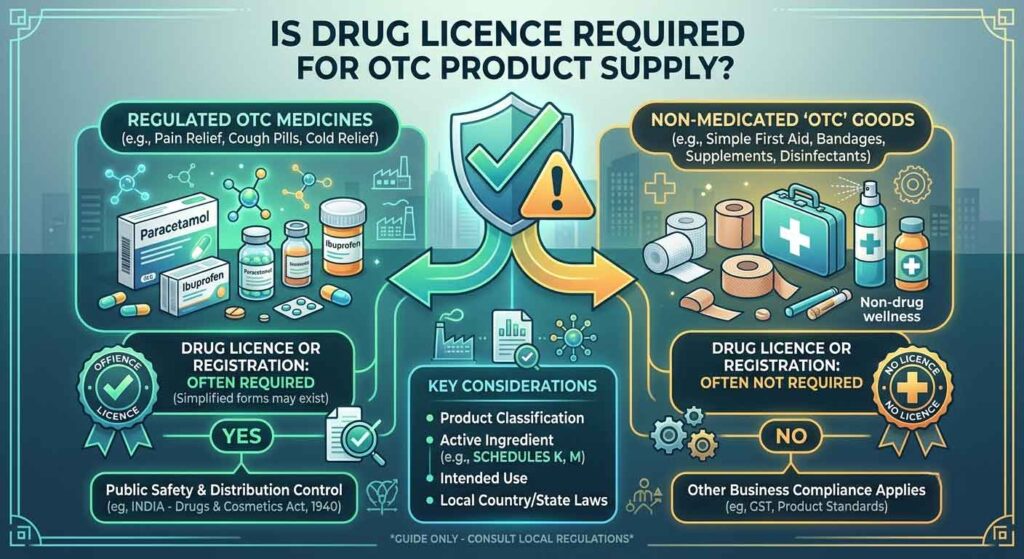
You cannot decide licence requirement only by calling a product “OTC”. In India, OTC is commonly used in the market for products that are sold without prescription, but the legal requirement depends on whether the product is a drug, food supplement, cosmetic, Ayurvedic medicine, medical device, or general consumer product.
If the OTC product is legally a drug, you need the applicable drug licence for sale, stocking, distribution, or wholesale supply.
If the product is a food supplement, FSSAI licence or registration may be required.
If the product is a cosmetic, it should be manufactured or imported under applicable cosmetic rules, but ordinary trading may not require a retail or wholesale drug sale licence in the same way as medicines.
Therefore, product classification is the first step.
What Are OTC Products?
OTC means Over-the-Counter.
In common market language, OTC products are those products that customers can buy without a doctor’s prescription.
But all these products do not fall under one legal category.
Some are drugs, some are food products, some are cosmetics, and some are Ayurvedic or herbal medicines.
OTC Is Not a Separate Legal Licence Category
The biggest confusion is that many people think OTC means no licence is required.
This is wrong.
OTC does not automatically mean licence-free.
For example, a medicine may be sold without prescription in practice, but it may still be a drug under the Drugs and Cosmetics Act and Rules. In that case, drug sale licence may be required for supply and distribution.
So, before starting OTC supply, ask:
What is the legal category of the product?
Not:
Is it OTC or non-OTC?
Main Categories of OTC Products
OTC products may fall under different categories:
Allopathic pharmaceutical drugs
Food supplements and nutraceuticals
Cosmetics and personal care products
Ayurvedic, Siddha, Unani or herbal medicines
Medical devices
General consumer healthcare products
Each category has different regulatory requirements.
1. OTC Pharmaceutical Products
If the product is an allopathic pharmaceutical preparation, drug licence is generally required for wholesale supply.
Examples may include:
Antacid tablets or liquids
Paracetamol products
Pain relief sprays containing drug actives
Medicated antiseptic preparations
Cough and cold medicines
Anti-allergic products
Laxatives
ORS, where classified as drug
Medicated ointments
External analgesic preparations
Even if the product is commonly available without prescription, it may still be legally treated as a drug.
For supply to hospitals, pharmacies, institutions, or healthcare outlets, you should have the required wholesale drug licence.
Common wholesale licences may include:
Form 20-B
Form 21-B
Other applicable licence depending on drug category
2. Food Supplements and Nutraceuticals
If the product is a food supplement, health supplement, nutraceutical, protein powder, vitamin food product, or wellness food product, it generally comes under FSSAI.
For this category, you may need:
FSSAI registration or licence
GST registration
Proper food category selection
Compliant label
Valid manufacturer licence
Food safety compliance
Examples may include:
Protein powder
Multivitamin food supplement
Health drink
Nutraceutical capsule
Dietary supplement
Energy powder
Functional food
Probiotic supplement
Such products should not make disease-treatment claims like medicines.
If the label claims cure, treatment, prevention, or management of disease, the product may be questioned and may not remain only a food product.
3. Cosmetic and Personal Care OTC Products
Cosmetic products are used for cleansing, beautifying, promoting attractiveness, or altering appearance.
For trading or supplying properly manufactured cosmetics, a normal drug retail or wholesale sale licence may not be required in the same way as medicines.
However, cosmetics are still regulated. They must be manufactured by a licensed cosmetic manufacturer or imported under valid cosmetic registration.
For cosmetics, you should ensure:
Manufacturer has cosmetic manufacturing licence
Imported product has valid cosmetic import registration
Label complies with cosmetic rules
Claims are not false or misleading
Product is not making medicinal claims
If a product claims to treat fungal infection, pain, eczema, acne disease, wound, infection, or other medical conditions, it may be treated as a drug, not a simple cosmetic.
4. Ayurvedic, Siddha, Unani and Herbal Products
Ayurvedic, Siddha and Unani medicines are also regulated under the Drugs and Cosmetics Act and Rules.
For manufacturing, proper AYUSH manufacturing licence is required.
For sale and distribution, the position may vary depending on product type and state practice. In many cases, a separate sale licence like allopathic retail or wholesale licence may not be applicable for ordinary Ayurvedic medicines, but this should be confirmed from the local AYUSH or Drug Licensing Authority.
Important points:
Product must be manufactured by a licensed AYUSH manufacturer.
Label should mention required details.
Ingredients and claims should be compliant.
Schedule E(1) drugs require special care.
Misleading disease-cure claims should be avoided.
Online sale and prescription-related products may require additional caution.
Only GST is not enough if the product itself is not legally manufactured or properly labelled.
5. Medical Devices
Some OTC healthcare items may be medical devices.
Examples may include:
Thermometer
BP monitor
Glucometer
Pregnancy test kit
Nebulizer
Pulse oximeter
Certain surgical items
Certain diagnostic kits
Medical devices are regulated separately depending on classification.
Before supplying medical devices to hospitals, check whether the product requires medical device registration, import licence, manufacturing licence, or distribution compliance.
Can I Supply OTC Products to Hospitals Only on GST?
GST alone is sufficient only for products that do not require a drug licence, FSSAI licence, medical device licence, cosmetic compliance, or any other specific regulatory permission.
For hospital supply, GST alone is usually not enough if the product is a medicine or drug.
Hospitals usually ask for:
GST certificate
Drug licence copy, if medicine
FSSAI licence, if food supplement
Manufacturer licence copy
Product COA, where applicable
Product catalogue
Price list
Invoice
Batch details
Expiry details
Company authorization
So, if you want to supply OTC pharmaceutical products to hospitals, you should obtain a wholesale drug licence.
How to Identify Whether OTC Product Is a Drug
You can check the following points:
Does the product contain pharmacopoeial ingredients such as IP, BP, USP, etc.?
Does the label mention drug manufacturing licence?
Does it have batch number, manufacturing licence number, and drug category details?
Does it claim treatment, relief, cure, prevention, or diagnosis?
Is it used for disease or symptoms?
Is it sold through pharmacies?
Does it contain active pharmaceutical ingredients?
Is it manufactured by a pharmaceutical manufacturer?
Does the invoice come from a licensed drug manufacturer or wholesaler?
If yes, drug licence may be required for trading or supply.
Common OTC Product Categories and Licence Requirement
Product Type
Likely Category
Licence Requirement
Paracetamol tablet
Allopathic drug
Drug sale licence required
Antacid tablet/liquid
Drug, depending formulation
Drug licence generally required
Cough syrup
Drug
Licensed pharmacy/sale compliance required
Pain relief spray with pharma actives
Drug
Drug licence generally required
Protein powder
Food supplement
FSSAI licence/registration
Nutraceutical capsule
Food supplement/nutraceutical
FSSAI licence/registration
Face wash
Cosmetic
Cosmetic-compliant source; trading usually GST-based
Medicated antifungal cream
Drug
Drug licence required
Herbal cosmetic cream
Cosmetic or AYUSH, depending claim
Depends on claim and composition
Ayurvedic syrup
AYUSH drug
Licensed AYUSH manufacturer; sale requirement to be confirmed locally
Glucometer
Medical device
Medical device compliance may apply
Important Correction About Old Understanding
Earlier, many people used to say:
“OTC products do not need drug licence.”
This statement is incomplete and risky.
The correct statement is:
Drug licence is not required only if the product is not legally a drug and does not fall under a product category requiring drug sale licence.
If the OTC product is a medicine, pharmaceutical preparation, or drug, wholesale or retail drug licence is required as applicable.
What About Cosmetics and Ayurvedic Products?
For cosmetics and Ayurvedic products, the sale licence requirement is different from allopathic medicines.
But that does not mean there is no regulation.
For cosmetics:
Manufacturer must have cosmetic manufacturing licence.
Importer must have cosmetic import registration.
Product must comply with cosmetic rules.
Claims should not be medicinal or misleading.
For Ayurvedic products:
Manufacturer must have AYUSH manufacturing licence.
Product must comply with applicable AYUSH rules.
Label and claims must be proper.
Some products may need prescription or special caution.
So, for trading, GST may be enough in some cases, but only if the product is properly manufactured, labelled, and legally saleable.
Do Hospitals Require Drug Licence from Suppliers?
If you supply medicines to hospitals, hospitals usually prefer or require suppliers with wholesale drug licence.
For hospital supply, a supplier should maintain:
Valid wholesale drug licence
GST registration
Proper invoices
Batch number records
Expiry records
Storage conditions
Cold chain, if applicable
Product documentation
Manufacturer authorization, if required
Hospitals are regulated institutions and generally avoid purchasing medicines from unlicensed suppliers.
Documents Required for OTC Product Supply Business
Depending on product category, documents may include:
For Pharmaceutical OTC Drugs
Wholesale drug licence
GST registration
Firm registration
Competent person documents
Premises documents
Purchase invoices
Sale invoices
Batch and expiry records
For Food Supplements
FSSAI licence or registration
GST registration
Product category details
Manufacturer FSSAI licence
Label compliance
Food safety documents
For Cosmetics
GST registration
Manufacturer cosmetic licence copy
Import registration copy, if imported
Product label
Invoice
Claim compliance
For Ayurvedic Products
GST registration
Manufacturer AYUSH licence copy
Product list
Label details
Batch and expiry details
Invoice
Local sale requirement confirmation, where needed
For Medical Devices
GST registration
Medical device registration or licence documents, where applicable
Manufacturer/importer details
Product certificate
Invoice
Warranty/service details, where applicable
Step-by-Step Process Before Starting OTC Supply
Step 1: Prepare Product List
Make a list of all products you want to supply.
Mention:
Product name
Composition
Category
Manufacturer
Claim
Label details
Target customer
Step 2: Classify Each Product
Classify each product as:
Drug
Food supplement
Cosmetic
Ayurvedic medicine
Medical device
General healthcare item
Do not mix all products under one “OTC” heading.
Step 3: Check Licence Requirement
For each category, check required licence.
If any product is a drug, apply for wholesale drug licence before supplying.
Step 4: Arrange Proper Premises
For drug wholesale, premises should meet area, storage, and inspection requirements.
For food or cosmetic supply, storage should still be clean and suitable.
Step 5: Take Required Licence
Apply for:
Wholesale drug licence, if drug products
FSSAI licence/registration, if food supplements
GST registration
Any other product-specific approval
Step 6: Source from Licensed Manufacturers
Do not purchase from unauthorized suppliers.
Always check:
Manufacturer licence
GST details
Product label
Invoice
Batch number
Expiry date
COA, where applicable
Step 7: Maintain Records
Maintain proper purchase and sale records.
For drug products, batch-wise and expiry-wise records are important.
Step 8: Supply to Hospitals Professionally
Hospitals may ask for:
Quotation
Product catalogue
Licence copy
GST certificate
Samples
Test reports
Rate contract
Delivery terms
Payment terms
Prepare a professional supply file before approaching hospitals.
Can a Proprietor with GST Start OTC Business?
Yes, a proprietor with GST can start OTC business only for product categories that do not require additional licence.
But if you want to supply OTC medicines or pharmaceutical products, GST alone is not enough.
You need the relevant drug sale licence.
For food supplements, GST alone is also not enough; FSSAI licence or registration may be required.
Practical Examples
Example 1: Supplying Paracetamol Tablets to Hospital
Category: Allopathic drug Requirement: Wholesale drug licence + GST GST alone: Not enough
Example 2: Supplying Protein Powder to Hospital
Category: Food supplement Requirement: FSSAI licence/registration + GST Drug licence: Usually not required, unless drug claims are made
Example 3: Supplying Face Wash to Hospital
Category: Cosmetic Requirement: GST for trading; product should be from licensed cosmetic manufacturer or registered importer Drug licence: Usually not required unless medicinal claims are made
Example 4: Supplying Ayurvedic Digestive Syrup
Category: Ayurvedic medicine Requirement: Product must be manufactured by licensed AYUSH manufacturer; sale licence position should be confirmed locally GST: Required for business billing
Example 5: Supplying Cough Syrup
Category: Drug Requirement: Licensed pharmacy/sale compliance; wholesale drug licence for supplier GST alone: Not enough
Common Mistakes to Avoid
Avoid these mistakes:
Assuming OTC means licence-free
Supplying medicines only on GST
Not checking product category
Selling drug products without wholesale licence
Treating medicated products as cosmetics
Selling supplements with disease-cure claims
Not checking manufacturer licence
Not maintaining batch and expiry records
Supplying hospitals without regulatory documents
Mixing food, drug, cosmetic, and AYUSH products without separate compliance
Final Answer
Drug licence is required for OTC products if the product is legally a drug or pharmaceutical preparation.
If the product is a food supplement or nutraceutical, FSSAI licence or registration is required.
If the product is cosmetic, trading may not require a retail or wholesale drug sale licence, but the product must come from a licensed manufacturer or registered importer and must not make medicinal claims.
If the product is Ayurvedic or herbal medicine, it must be manufactured by a licensed AYUSH manufacturer, and local sale/distribution requirements should be confirmed.
Therefore, GST alone is not enough for all OTC products.
The correct approach is:
First classify the product, then decide the licence.
Frequently Asked Questions
1. Is drug licence required for OTC products?
Yes, if the OTC product is legally a drug or pharmaceutical preparation, drug licence is required for sale, stock, distribution, or wholesale supply.
2. Can I supply OTC medicines to hospitals with only GST?
No. If the products are medicines, GST alone is not enough. You need the applicable wholesale drug licence.
3. Is OTC a legal category in India?
OTC is commonly used as a market term, but licence requirement depends on legal product category such as drug, food, cosmetic, AYUSH medicine, or medical device.
4. Is FSSAI required for health supplements?
Yes, food supplements, nutraceuticals, health supplements, and similar food products generally require FSSAI licence or registration.
5. Is drug licence required for cosmetics?
For ordinary trading of cosmetics, retail or wholesale drug sale licence may not be required like medicines. But cosmetics must be manufactured or imported under applicable cosmetic rules.
6. Is drug licence required for Ayurvedic OTC products?
Ayurvedic medicines must be manufactured by a licensed AYUSH manufacturer. Separate sale licence requirement may vary by state and product type, so confirm locally.
7. How can I identify a pharmaceutical OTC product?
Check composition, IP/BP/USP standards, manufacturing licence, label claim, use, active ingredients, and whether it is sold as a medicine.
8. Can protein powder be sold without drug licence?
Protein powder is usually treated as a food or health supplement, so FSSAI licence or registration is required. Drug licence is usually not required unless it is positioned as a drug.
9. Can pain relief spray be sold without drug licence?
If pain relief spray contains pharmaceutical active ingredients or makes pain-relief claims, it is likely to be treated as a drug and may require drug licence.
10. What should I do before starting OTC supply business?
Prepare product list, classify each product, check licence requirement, obtain required approvals, source from licensed manufacturers, and maintain proper records.
Looking for Ayurvedic Franchise or Distribution Opportunities?
Elzac Herbal India offers opportunities for entrepreneurs interested in Ayurvedic and herbal product distribution, franchise marketing and third-party manufacturing.
Elzac Herbal India offers:
Ayurvedic & Herbal Product Range
Franchise & Distribution Opportunities
Third-Party Manufacturing
Product Development Support
Marketing Guidance
PAN India Business Opportunities
Whether you are an entrepreneur, retailer, distributor, or healthcare professional, our team can help you explore the right business opportunity in the growing Ayurvedic sector.
Ajay Kamboj is an entrepreneur and business owners associated with many Ayurvedic and Pharmaceutical start-ups. With years of experience in Ayurvedic product marketing, pharmaceutical distribution, franchise development, and client relationship management, he regularly shares practical business insights based on real-world experiences. His articles focus on business growth, entrepreneurship, customer management, and lessons learned from the healthcare and wellness industry.
One response to “Is Drug Licence Required for OTC Product Supply?”



Sar ji James marketing karna h to kese kare