If you have developed a new herbal formulation but do not have your own manufacturing facility, you can get it manufactured through a third-party manufacturer. The appropriate regulatory pathway depends on whether you intend to market the product as an Ayurvedic medicine or as a dietary/food supplement.
Protecting your formulation is equally important. Confidentiality agreements, trademark protection, and intellectual property strategies should be considered before sharing your formula with manufacturers.
Disclaimer: Regulatory requirements and intellectual property rights can vary depending on the nature of the product and the jurisdiction involved. Always consult qualified regulatory and legal professionals before commercializing a new formulation.
Query
We are a group of professionals from medical and pharmaceutical backgrounds. We have developed a few herbal products based on research and scientific evidence, but we do not have manufacturing facilities.
We would like guidance on:
Where can we manufacture these products in Maharashtra or Telangana?
How can we ensure that our formulation is not used by others?
This is a common challenge faced by researchers, healthcare professionals, and entrepreneurs entering the herbal products industry.
The good news is that you do not necessarily need your own factory to bring an innovative herbal product to market.
Step 1: Decide the Regulatory Category of Your Product
The first and most important decision is determining under which category your product falls.
In India, herbal formulations are commonly marketed under two broad categories.
Option 1: Dietary or Food Supplements
These products are generally regulated as food products.
Characteristics
Intended to supplement the diet.
Cannot generally make medicinal treatment claims.
Must comply with applicable food regulations.
Labels typically include statements such as:
“Dietary Supplement” or “Food Supplement”
depending on the applicable regulatory framework.
Examples
Herbal nutrition supplements
Wellness formulations
Herbal blends for general health support
Functional nutrition products
Advantages
✓ Faster route to market in many cases.
✓ Growing consumer demand.
✓ Easier positioning as wellness products.
Limitations
Restricted health claims.
Specific labeling requirements.
Compliance with applicable food regulations.
You can get such products manufactured by companies specializing in nutraceuticals and food supplements.
Option 2: Ayurvedic Medicinal Products
If your formulation is intended to be marketed as an Ayurvedic medicine with traditional therapeutic indications, the regulatory pathway differs.
Characteristics
Manufactured by licensed Ayurvedic manufacturers.
Subject to applicable AYUSH requirements.
Product approval may be required depending on the formulation category.
Medicinal claims must comply with regulations.
Examples
Proprietary Ayurvedic formulations
Classical Ayurvedic medicines
Herbal therapeutic products
Advantages
✓ Ability to position products within the Ayurvedic healthcare segment.
✓ Strong consumer trust in traditional medicine.
Considerations
Additional regulatory scrutiny.
Product documentation requirements.
Labeling restrictions.
Where Can You Manufacture Herbal Products?
You can partner with licensed third-party manufacturers located in Maharashtra, Telangana, or other parts of India.
When selecting a manufacturing partner, evaluate the following:
Manufacturing Capabilities
Ayurvedic manufacturing licence
Nutraceutical manufacturing capabilities
Dosage forms offered
Production capacity
Quality Standards
Look for manufacturers with systems such as:
GMP-compliant facilities
Quality control laboratories
Batch documentation systems
Traceability procedures
Experience
Choose manufacturers with experience in:
Similar formulations
Herbal ingredients
Export requirements (if applicable)
Regulatory documentation
Confidentiality
Ensure proper agreements are executed before sharing sensitive information.
How Can You Protect Your Formula?
This is often the biggest concern for innovators.
“If I share my formulation with a manufacturer, can they use it for someone else?”
The answer depends on how well you protect your intellectual property.
1. Use Confidentiality Agreements
Before disclosing your complete formulation, execute:
Non-Disclosure Agreements (NDAs)
Confidentiality Agreements
These agreements establish contractual obligations regarding the use and disclosure of your information.
2. Protect Your Brand
Even if the formulation itself is not patented, your brand can be protected through:
Trademark Registration
This protects:
Product names
Logos
Brand identity
A strong brand often becomes one of the most valuable assets of a healthcare business.
3. Explore Intellectual Property Protection
In certain situations, intellectual property protection may be available.
Potential options include:
Patent applications (where eligibility requirements are met)
Trade secret protection
Proprietary know-how documentation
However:
Not every herbal formulation is eligible for patent protection.
Patentability depends on factors such as novelty, inventiveness, and compliance with applicable patent laws.
Consult an intellectual property attorney before assuming that a formulation can be patented.
4. Work with Reputable Manufacturers
Choosing the right manufacturing partner is often the most practical protection strategy.
Look for companies that:
Have established reputations
Serve long-term clients
Follow professional practices
Respect confidentiality obligations
Trust and due diligence remain important.
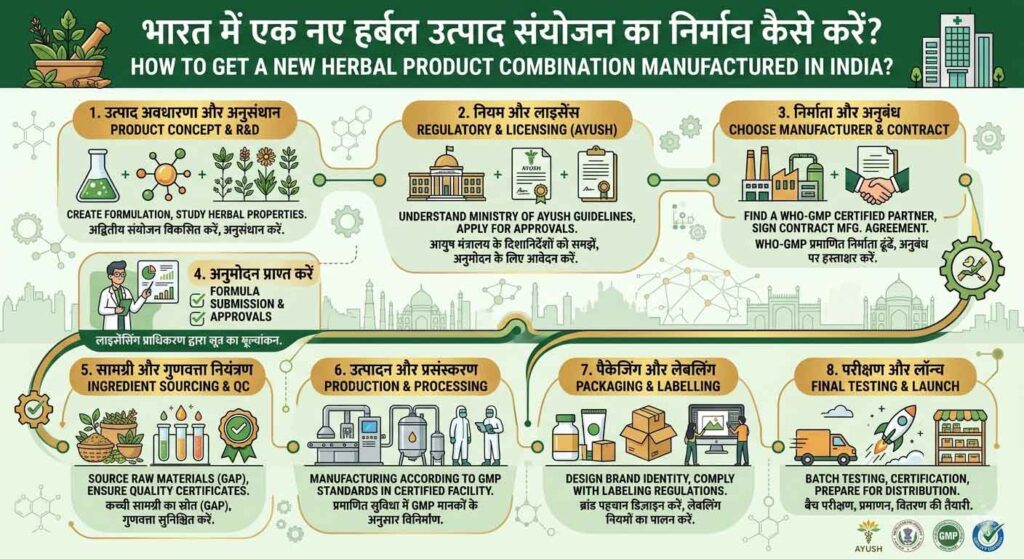
Recommended Commercialization Process
If you have developed a new herbal combination, the following roadmap can help:
Step 1
Document your formulation thoroughly.
Step 2
Determine the regulatory category.
Step 3
Assess intellectual property options.
Step 4
Shortlist suitable manufacturers.
Step 5
Sign confidentiality agreements.
Step 6
Conduct pilot manufacturing.
Step 7
Validate product quality and stability.
Step 8
Develop packaging and branding.
Step 9
Launch through appropriate marketing channels.
Final Thoughts
Having a great herbal formulation is only the beginning.
The true challenge lies in transforming an innovative idea into a commercially successful product while protecting your interests.
By selecting the right regulatory pathway, partnering with reputable manufacturers, protecting your brand, and implementing suitable confidentiality measures, you can confidently bring your herbal innovations to market.
Innovation deserves protection—but it also requires thoughtful execution.
Frequently Asked Questions
Can I launch a herbal product without owning a manufacturing facility?
Yes. Third-party manufacturing is a common practice in the herbal industry.
Which is better: Ayurvedic medicine or dietary supplement?
The right category depends on your intended use, desired claims, and regulatory strategy.
Can herbal formulations be patented?
Some formulations may qualify for patent protection, but eligibility depends on applicable patent laws and the specific characteristics of the invention.
Is an NDA enough to protect my formula?
NDAs help establish confidentiality obligations but should ideally form part of a broader intellectual property strategy.
Should I choose a manufacturer based only on price?
No. Quality systems, reputation, confidentiality practices, and regulatory compliance are equally important.
Can I manufacture in Maharashtra or Telangana?
Yes. Both states have established manufacturers offering third-party services for Ayurvedic products and nutraceuticals.
Partner with Elzac Herbal India
Looking to start an Ayurvedic franchise, become a distributor, or launch your own herbal product range?
Elzac Herbal India offers:
Ayurvedic & Herbal Product Range
Franchise & Distribution Opportunities
Third-Party Manufacturing Services
Product Development Support
Marketing Guidance
PAN India Business Opportunities
Whether you are an entrepreneur, retailer, distributor, or healthcare professional, our team can help you explore the right business opportunity in the growing Ayurvedic sector.
Ajay Kamboj is an entrepreneur and business owners associated with many Ayurvedic and Pharmaceutical start-ups. With years of experience in Ayurvedic product marketing, pharmaceutical distribution, franchise development, and client relationship management, he regularly shares practical business insights based on real-world experiences. His articles focus on business growth, entrepreneurship, customer management, and lessons learned from the healthcare and wellness industry.





Leave a Reply
You must be logged in to post a comment.