The United States is the world’s largest pharmaceutical market and one of the most important export destinations for Indian pharmaceutical companies. India has become a major supplier of affordable generic medicines to the U.S., and many Indian pharma companies have built strong positions in the American market through ANDA filings, USFDA-approved manufacturing plants, acquisitions, complex generics, specialty products, and strong distribution networks.
Indian pharmaceutical manufacturers have played an important role in improving access to cost-effective generic medicines in the U.S. market. For many large Indian pharma companies, the U.S. is one of the biggest revenue-contributing regions.
However, the U.S. market is also highly regulated, competitive, and challenging. Companies need strong quality systems, USFDA compliance, product filings, manufacturing discipline, legal strength, and continuous investment in R&D to remain successful.
This article discusses five major Indian pharmaceutical manufacturers with strong presence in the U.S. pharmaceutical market.
Why the U.S. Market Is Important for Indian Pharma Companies
The U.S. pharmaceutical market is important because:
It is the largest regulated pharma market in the world.
Generic medicine demand is very high.
ANDA approval can create strong business opportunities.
Complex generics and specialty medicines offer better margins.
U.S. sales contribute significantly to revenue of many Indian companies.
U.S. presence improves global credibility.
USFDA approval strengthens company reputation in other regulated markets.
For Indian companies, success in the U.S. market is not only about exporting medicines. It is also about regulatory compliance, quality consistency, intellectual property understanding, litigation handling, product pipeline strength, and market access.
India’s Role in the U.S. Generic Medicine Market
India is one of the most important suppliers of generic medicines to the United States.
Indian companies supply a large number of generic tablets, capsules, injectables, topical products, respiratory products, APIs, complex generics, and specialty products to the U.S. market.
The main strengths of Indian pharma companies include:
Cost-effective manufacturing
Large USFDA-approved manufacturing base
Strong chemistry and formulation development
Large ANDA filing capability
Experience in regulated markets
Competitive generic medicine pricing
Skilled technical manpower
Strong API and formulation integration
Because of these strengths, Indian companies have become important partners in the U.S. healthcare system.
Challenges Faced by Indian Pharma Companies in the U.S.
The U.S. market offers big opportunity, but it is not easy.
Common challenges include:
USFDA inspections
Warning letters and observations
Price erosion in generics
High competition
Product litigation
Patent challenges
Supply-chain pressure
Quality-compliance cost
Need for complex product development
Tariff and import-policy uncertainty
Requirement for U.S.-based manufacturing or local presence
Due to these challenges, Indian companies are now focusing more on complex generics, specialty medicines, biosimilars, injectables, inhalation products, dermatology, ophthalmology, oncology, and strategic acquisitions.
Top Five Indian Pharmaceutical Manufacturers in the U.S. Market
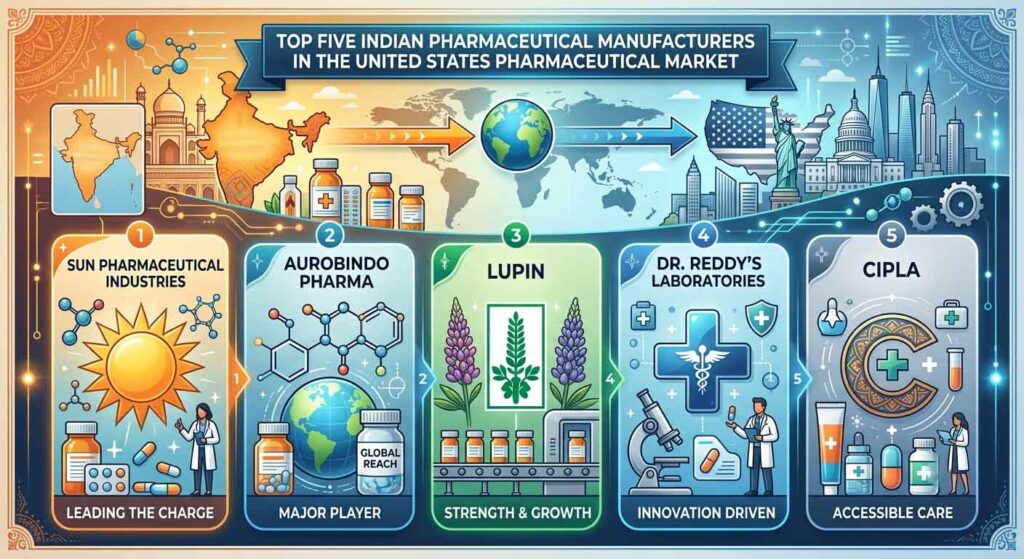
The following companies are among the most important Indian pharmaceutical manufacturers operating in the U.S. market:
Sun Pharmaceutical Industries
Aurobindo Pharma
Lupin
Dr. Reddy’s Laboratories
Cipla
This list is based on overall U.S. presence, brand strength, generic portfolio, manufacturing footprint, revenue contribution, and historical role in the American pharmaceutical market.
1. Sun Pharmaceutical Industries
Sun Pharmaceutical Industries is India’s largest pharmaceutical company and one of the world’s leading specialty generic pharmaceutical companies.
Founded in 1983 by Dilip Shanghvi, Sun Pharma has grown from a small Indian pharmaceutical company into a major global player with operations across regulated and emerging markets.
Sun Pharma’s U.S. Presence
The U.S. is one of Sun Pharma’s most important markets. The company has a strong presence in:
Generic medicines
Specialty medicines
Innovative medicines
Dermatology
Ophthalmology
Oncology
Consumer healthcare
Complex products
Sun Pharma’s U.S. business is no longer limited to simple generics. The company has been increasingly focusing on specialty and innovative medicines, which can provide better margins compared to traditional generic products.
Why Sun Pharma Is Important in the U.S. Market
Sun Pharma is important in the U.S. market because:
It has a large generic and specialty portfolio.
It has strong U.S. commercial presence.
It has experience in complex product development.
It has built a specialty medicine business in dermatology, oncology, and ophthalmology.
Its U.S. business contributes significantly to global revenue.
It has expanded through acquisitions and product development.
Sun Pharma’s growth strategy shows how Indian companies are shifting from only low-cost generic supply to higher-value specialty pharma business.
2. Aurobindo Pharma
Aurobindo Pharma is one of India’s leading pharmaceutical companies with a strong presence in generic formulations and APIs.
The company was founded in 1986 and is headquartered in Hyderabad, India. Aurobindo is known for its large-scale manufacturing, vertical integration, cost efficiency, and strong U.S. generic presence.
Aurobindo’s U.S. Presence
Aurobindo Pharma USA Inc., commonly known as APUSA, is the U.S. sales and marketing arm of Aurobindo Pharma.
APUSA distributes oral solid dosage products and other generic medicines in the U.S. through its network of subsidiaries.
Important U.S. subsidiaries and entities include:
Aurolife Pharma
AuroHealth
Acrotech Biopharma
Aurologistics
Auropackaging
Aurobindo has built a strong U.S. platform through marketing, manufacturing, logistics, packaging, OTC products, oncology, and specialty presence.
Aurolife Pharma
Aurolife Pharma is a U.S.-based manufacturing entity of Aurobindo Pharma USA.
It supports the group’s U.S. manufacturing needs and strengthens Aurobindo’s local presence in the American market.
Why Aurobindo Is Important in the U.S. Market
Aurobindo is important because:
It has strong generic prescription volume in the U.S.
It has vertical integration from API to finished formulation.
It has a large ANDA portfolio.
It has U.S.-based subsidiaries for marketing, manufacturing, logistics, OTC, and specialty business.
It supplies a broad range of oral solids and other dosage forms.
U.S. business contributes a large part of its revenue.
Aurobindo’s strength is its scale, cost competitiveness, and broad product portfolio.
3. Lupin
Lupin is another major Indian pharmaceutical company with a strong U.S. presence.
Founded by Dr. Desh Bandhu Gupta, Lupin started as an Indian pharmaceutical company and later became a global player with a strong position in the U.S. generic market.
Lupin’s U.S. Presence
Lupin entered the U.S. generic pharmaceutical market in the early 2000s and gradually built a strong portfolio through ANDA approvals and product launches.
The company has a significant presence in:
U.S. generics
Respiratory products
Cardiovascular products
Anti-diabetic products
Anti-infectives
Women’s health
Complex generics
Injectables
Biosimilars
Lupin has also focused on differentiated and complex products to reduce dependence on plain-vanilla generics.
U.S. Manufacturing and Acquisitions
Lupin strengthened its U.S. presence through acquisitions and local manufacturing capability.
Its acquisition of GAVIS Pharmaceuticals and Novel Laboratories helped Lupin expand its U.S. manufacturing and product platform.
Why Lupin Is Important in the U.S. Market
Lupin is important because:
It has a strong U.S. prescription ranking.
It has many products among leading market positions.
It has built capabilities in complex generics.
It has a large U.S. product portfolio.
It has strong R&D focus.
It has manufacturing presence across multiple geographies.
Lupin’s U.S. strategy is focused on higher-value products, complex generics, and sustainable market share.
4. Dr. Reddy’s Laboratories
Dr. Reddy’s Laboratories is a Hyderabad-based Indian multinational pharmaceutical company founded in 1984 by Dr. K. Anji Reddy.
The company is known globally for generic medicines, APIs, biosimilars, proprietary products, and affordable medicines.
Dr. Reddy’s U.S. Presence
Dr. Reddy’s has been present in North America since the mid-1990s. The U.S. and Canada together form one of the company’s largest business regions.
The company has a strong U.S. portfolio across:
Retail generics
Institutional products
OTC products
Complex generics
Injectables
Peptides
Drug-device combinations
Biosimilars
Women’s health products
Dr. Reddy’s has launched several important generic products in the U.S. and has also participated in first-to-market and exclusivity opportunities.
U.S. Manufacturing and Business Expansion
Dr. Reddy’s has expanded its U.S. presence through product launches, acquisitions, collaborations, and specialty-product development.
The company has also focused on patient-support services and specialty-pharmacy partnerships for selected complex products.
Why Dr. Reddy’s Is Important in the U.S. Market
Dr. Reddy’s is important because:
North America is one of its largest business regions.
It has a strong portfolio of generic and OTC products.
It has experience in complex generic launches.
It has built a strong institutional and retail presence.
It has invested in biosimilars and specialty products.
It has long experience with USFDA-regulated markets.
Dr. Reddy’s represents the evolution of Indian pharma from generic exports to complex, differentiated, and patient-focused products.
5. Cipla
Cipla is one of India’s oldest and most respected pharmaceutical companies. It was founded in 1935 by Dr. K.A. Hamied and is headquartered in Mumbai.
Cipla is known for its work in respiratory medicines, anti-retrovirals, urology, cardiology, anti-infectives, CNS, and affordable healthcare.
Cipla’s U.S. Presence
Cipla has built a strong North America business with focus on:
Generic medicines
Respiratory products
Complex generics
Differentiated assets
Inhalation products
Oncology and specialty products
U.S.-based manufacturing through InvaGen
Cipla’s acquisition of InvaGen Pharmaceuticals and Exelan Pharmaceuticals strengthened its U.S. platform.
InvaGen Pharmaceuticals
InvaGen Pharmaceuticals is a Cipla subsidiary in the U.S. It is involved in development, manufacturing, marketing, and distribution of generic prescription medicines.
InvaGen has helped Cipla deepen its U.S. manufacturing and commercial presence.
Why Cipla Is Important in the U.S. Market
Cipla is important because:
It has a strong respiratory focus.
It has built U.S. manufacturing capability.
It is focusing on complex generics and inhalation products.
North America is one of its important business regions.
It has a strong product pipeline for the U.S. market.
It combines Indian manufacturing strength with U.S. regulatory and commercial presence.
Cipla’s future U.S. growth is expected to depend strongly on respiratory, complex generics, and differentiated products.
Why Indian Companies Are Acquiring or Building U.S. Facilities
Earlier, many Indian companies mainly exported medicines from India to the United States.
Now, companies are also focusing on:
Acquiring U.S. companies
Building local manufacturing facilities
Expanding packaging and logistics networks
Strengthening U.S. regulatory teams
Improving supply-chain resilience
Reducing import-policy risk
Moving into specialty and complex products
This shift is important because the U.S. market is moving beyond simple generics. Companies need local presence, regulatory reliability, specialty pipelines, and supply continuity.
Impact of U.S. Policy and Tariff Discussions
Recent U.S. discussions around import policies, local manufacturing, tariffs, and supply-chain security have made Indian pharma companies more careful about their U.S. strategy.
Possible impact may include:
More U.S. acquisitions
More local manufacturing investment
Higher compliance cost
More focus on complex generics
Supply-chain restructuring
Greater need for U.S.-based presence
Pressure on low-margin generic products
Indian pharma companies with stronger U.S. manufacturing or local commercial infrastructure may be better positioned to manage future policy changes.
Future of Indian Pharma in the U.S. Market
The future of Indian pharma in the U.S. will not depend only on low-cost generics.
Growth will likely come from:
Complex generics
Biosimilars
Specialty medicines
Injectables
Respiratory products
Dermatology
Ophthalmology
Oncology
Peptides
Drug-device combinations
OTC and consumer healthcare
U.S.-based manufacturing and acquisitions
Companies that can maintain USFDA compliance, launch complex products, and reduce dependence on price-sensitive generics will have better long-term prospects.
Lessons for Indian Pharma Entrepreneurs
The success of Indian companies in the U.S. market gives important lessons:
Quality compliance is non-negotiable.
Regulated markets need documentation discipline.
Low cost alone is not enough.
Strong R&D is essential.
Product selection decides profitability.
Complex generics offer better opportunity than simple generics.
Acquisitions can help build local market presence.
USFDA inspection readiness must be continuous.
Reputation takes years to build and can be damaged quickly.
Long-term strategy is more important than short-term sales.
Final Thoughts
Indian pharmaceutical companies have become major players in the United States pharmaceutical market, especially in generic medicines.
Sun Pharma, Aurobindo Pharma, Lupin, Dr. Reddy’s Laboratories, and Cipla are among the leading Indian companies with strong U.S. presence.
Their growth in the U.S. has been built through manufacturing capability, ANDA approvals, regulatory compliance, acquisitions, local subsidiaries, specialty portfolios, and affordable medicine supply.
However, the U.S. market is becoming more competitive and complex. Price erosion, regulatory inspections, supply-chain challenges, and policy uncertainty continue to create pressure.
The next stage of Indian pharma growth in the U.S. will depend on quality, innovation, complex generics, specialty medicines, biosimilars, and local market strength.
India has already proved its importance in the U.S. generic medicine market. Now, Indian companies are moving toward higher-value and more differentiated pharmaceutical business.
Frequently Asked Questions
1. Which Indian pharma companies have strong presence in the U.S. market?
Sun Pharma, Aurobindo Pharma, Lupin, Dr. Reddy’s Laboratories, Cipla, Zydus Lifesciences, Gland Pharma, Glenmark, and several other Indian companies have strong U.S. market presence.
2. Which are the top five Indian pharma companies in the U.S. market?
Five major Indian companies with strong U.S. presence are Sun Pharma, Aurobindo Pharma, Lupin, Dr. Reddy’s Laboratories, and Cipla.
3. Why is the U.S. market important for Indian pharma companies?
The U.S. is the world’s largest pharmaceutical market and has high demand for generic medicines. U.S. approvals can generate strong revenue and global credibility.
4. What is ANDA?
ANDA means Abbreviated New Drug Application. It is filed with the U.S. FDA for approval to market a generic version of an already approved branded drug.
5. Why do Indian pharma companies acquire U.S. companies?
Indian companies acquire U.S. companies to strengthen local manufacturing, product portfolio, distribution, regulatory presence, and market access.
6. Are Indian medicines important for the U.S. healthcare system?
Yes. Indian generic medicines are important for affordable medicine access in the U.S. market.
7. What are the biggest challenges for Indian pharma companies in the U.S.?
Main challenges include USFDA inspections, price erosion, competition, patent litigation, supply-chain pressure, and import-policy uncertainty.
8. What products are Indian companies focusing on in the U.S.?
Indian companies are focusing on generics, complex generics, injectables, respiratory products, biosimilars, dermatology, oncology, ophthalmology, and OTC medicines.
9. Is the U.S. generic market still profitable?
The U.S. generic market is profitable for companies with strong product selection, complex generic capability, and regulatory discipline. Simple generics face heavy price erosion.
10. What is the future of Indian pharma in the U.S.?
The future will depend on complex generics, biosimilars, specialty medicines, local manufacturing, regulatory compliance, and strong supply-chain management.
Looking for Ayurvedic Franchise or Distribution Opportunities?
Looking to start an Ayurvedic franchise, become a distributor, or launch your own herbal product range?
Elzac Herbal India offers:
Ayurvedic & Herbal Product Range
Franchise & Distribution Opportunities
Third-Party Manufacturing
Product Development Support
Marketing Guidance
PAN India Business Opportunities
Whether you are an entrepreneur, retailer, distributor, or healthcare professional, our team can help you explore the right business opportunity in the growing Ayurvedic sector.
Ajay Kamboj is an entrepreneur and business owners associated with many Ayurvedic and Pharmaceutical start-ups. With years of experience in Ayurvedic product marketing, pharmaceutical distribution, franchise development, and client relationship management, he regularly shares practical business insights based on real-world experiences. His articles focus on business growth, entrepreneurship, customer management, and lessons learned from the healthcare and wellness industry.





Leave a Reply
You must be logged in to post a comment.