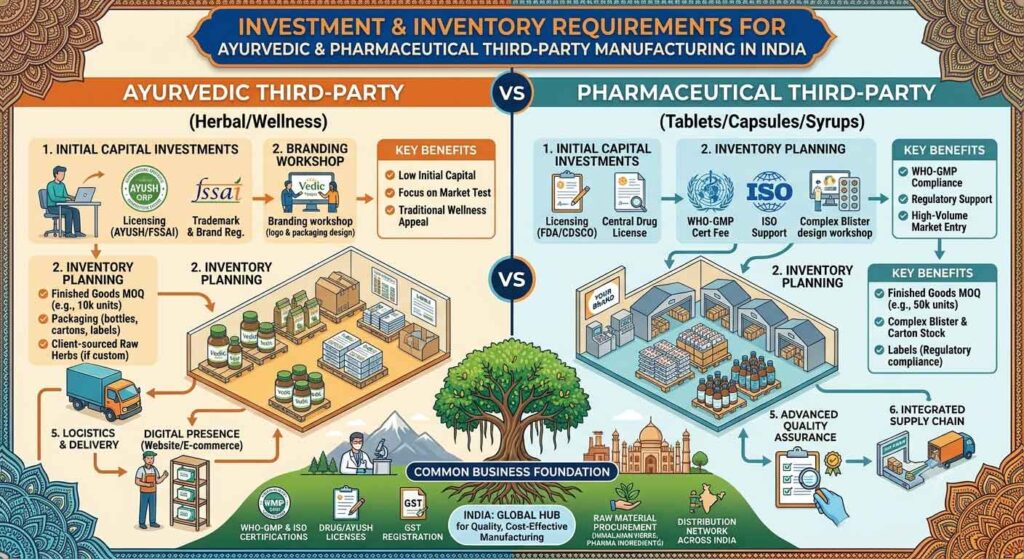
The investment required to launch a pharmaceutical or Ayurvedic brand through third‑party manufacturing is not fixed. It depends on factors such as formulation, dosage form, batch size, packaging materials and minimum order quantities (MOQs). Third‑party manufacturing allows a company to outsource production to a GMP/AYUSH‑approved unit while keeping the brand’s focus on marketing and distribution. The manufacturer produces to the brand’s specifications and often handles regulatory compliance and quality testing.
Two major cost components must be considered:
Packaging‑related inventory – printed boxes, foil/blister rolls, tubes, bottles, cartons and labels. Printers typically require minimum quantities (e.g., 500 or 1000 boxes and 5 kg foil). Cylinder or plate charges for foil and tube printing (₹1100 for one colour; ₹2200 for two colours) are usually one‑time costs.
Manufacturing cost per unit – the price the manufacturer charges to produce the tablets, capsules, syrup, cream or injection. This cost depends on active ingredients, formulation complexity and order size.
Below is a summary of how these costs influence total investment across common dosage forms. The numbers are illustrative and may vary by manufacturer and year; they show how to estimate the working capital needed for the initial batch and subsequent batches.
A cost comparison notes that third‑party manufacturing per‑unit pricing for Ayurvedic syrups, tablets or powders typically ranges between ₹8 and ₹50 per unit, depending on formulation complexity and order volume. Custom formulation development can cost ₹50 000–₹2 lakh, and packaging adds ₹2–10 per unit.
Minimum order quantities (MOQs) for third‑party manufacturing usually range from 1000 to 15000 units per SKU. Orders below these thresholds can result in higher per‑unit costs due to leftover packaging and processing overhead.
An article comparing in‑house vs third‑party manufacturing explains that setting up an in‑house Ayurvedic unit requires ₹3–8 crore in land, machinery, compliance and staffing costs, whereas third‑party manufacturing needs ₹2–10 lakh per SKU batch as working capital. Hence third‑party manufacturing is often the only feasible option for start‑ups.
For budgets under ₹5 lakh, experts recommend third‑party manufacturing rather than contract/loan licensing because it demands less capital and still allows new brands to test products in the market.
Choose your product and dosage form. Different forms have different MOQs and packaging requirements. Costly products (e.g., herbal extracts or specialized nutraceuticals) may allow smaller batch sizes, while low‑cost generics often require larger runs to remain economical.
Identify the manufacturer’s MOQ and manufacturing cost. Obtain quotations from several manufacturers; costs can vary widely. Larger batch sizes generally reduce the per‑unit price.
Calculate packaging inventory. Determine the minimum number of boxes, labels, foils or tubes the printer will produce. Include cylinder or plate charges. Packaging often represents 10‑20% of the first‑batch cost. Leftover packaging can be reused, reducing subsequent batch costs.
Estimate the first‑batch working capital. Multiply the manufacturing cost by the number of units in your initial batch and add the packaging inventory cost. This gives you the total cash required to place your first order. Examples above show first‑batch investments ranging from ₹8250 for 1‑ml injections to ₹30000 for creams/gels.
Plan for repeat orders. Once packaging inventory is used, subsequent batches will require only the manufacturing cost (plus minimal packaging such as foil refills). Averaging the cost over two or more batches gives a realistic per‑unit estimate.
Budget for formulation development and compliance. If you require a custom herbal formulation, expect development charges (₹50 000–₹2 lakh). Regulatory testing costs are usually included in the manufacturer’s price, but confirm this.
The capital required to start a pharmaceutical or Ayurvedic brand through third‑party manufacturing can range from ₹20000 to 10 lakh per SKU for the initial batches. The major variables are batch size, packaging inventory and the manufacturing cost per unit. Table‑top calculations show that tablets may cost about ₹100 per box for the first batch and then ₹90 per box thereafter; liquids around ₹7–8 per bottle; creams approximately ₹9–10 per tube averaged over multiple batches; and injections around ₹3–4 per vial. Always obtain updated quotations, verify MOQs, and include packaging and formulation development charges to plan your working capital accurately.
Partner with Elzac Herbal India
Looking to start an Ayurvedic franchise, become a distributor, or launch your own herbal product range?
Elzac Herbal India offers:
Ayurvedic & Herbal Product Range
Franchise & Distribution Opportunities
Third-Party Manufacturing Services
Product Development Support
Marketing Guidance
PAN India Business Opportunities
Whether you are an entrepreneur, retailer, distributor, or healthcare professional, our team can help you explore the right business opportunity in the growing Ayurvedic sector.
Ajay Kamboj is an entrepreneur and business owners associated with many Ayurvedic and Pharmaceutical start-ups. With years of experience in Ayurvedic product marketing, pharmaceutical distribution, franchise development, and client relationship management, he regularly shares practical business insights based on real-world experiences. His articles focus on business growth, entrepreneurship, customer management, and lessons learned from the healthcare and wellness industry.
3 responses to “Investment and Inventory Requirements for Ayurvedic/Pharmaceutical Third‑Party Manufacturing”
We are manufaturing of Pharmaceuticals Beeta & Non Beeta (Tablets , Capsules & Sacheies ) our unit at Distt. Patiala(Pb) We are looking for third parties PCD & Franchies for our units





We are manufaturing of Pharmaceuticals Beeta & Non Beeta (Tablets , Capsules & Sacheies ) our unit at Distt. Patiala(Pb) We are looking for third parties PCD & Franchies for our units
I will work with you
Please contact me for third party requirements