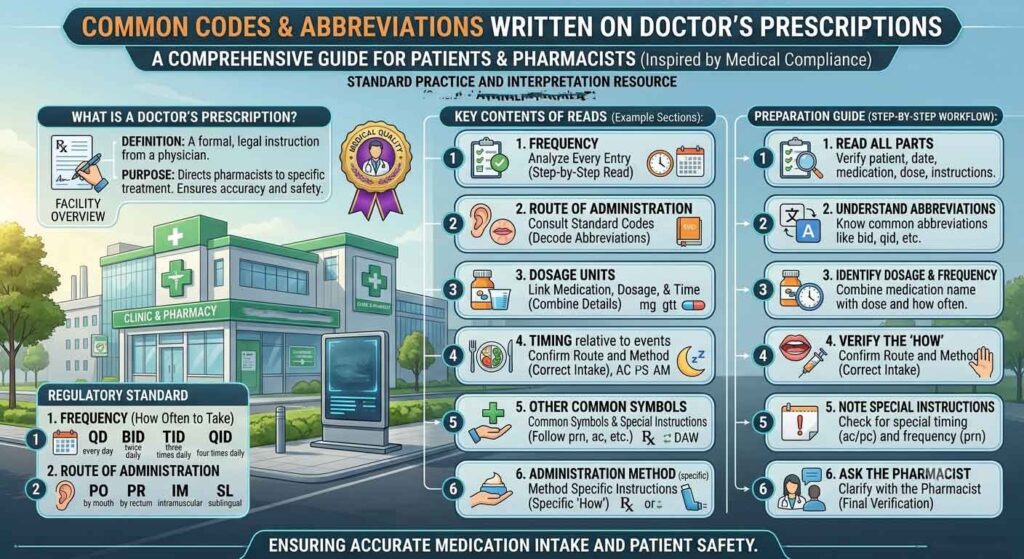
Doctors, pharmacists, nurses, and other healthcare professionals often use short codes and abbreviations on medical prescriptions. These codes are used to save time and communicate instructions related to medicine dose, frequency, timing, route of administration, and quantity to be dispensed.
However, prescription abbreviations can sometimes create confusion if they are unclear, poorly written, or interpreted differently in different medical settings. That is why modern prescription writing increasingly recommends clear, complete, and patient-friendly instructions.
This article explains the most commonly used prescription codes, their meanings, and important precautions for patients, pharmacists, and healthcare professionals.
What Are Prescription Codes?
Prescription codes are short forms or abbreviations used by doctors and healthcare professionals while writing prescriptions.
For example:
Rx means prescription
BD means twice daily
TDS means three times daily
SOS means when required
AC means before meals
PC means after meals
These abbreviations help communicate medical instructions quickly, but they must be used carefully because wrong interpretation can affect patient safety.
Why Are Prescription Abbreviations Used?
Prescription abbreviations are used for:
Writing instructions quickly
Giving dosage directions
Telling when medicine should be taken
Mentioning whether medicine is before or after food
Guiding the pharmacist about dispensing
Reducing space on prescription forms
But today, many hospitals, pharmacies, and healthcare systems prefer writing full instructions instead of unclear abbreviations.
For example, instead of writing:
1 tab BD PC
It is safer to write:
Take one tablet twice daily after meals.
Common Prescription Codes and Their Meanings
Abbreviation
Meaning
Simple Explanation
Rx
Prescription / Take
Indicates that medicine is prescribed
Sig.
Signa / Label
Directions to be written on the medicine label
Disp.
Dispense
Quantity to be supplied by pharmacist
OD
Once daily / Right eye, depending on context
Can be confusing; better to write full instruction
BD / BID
Twice daily
Take two times a day
TDS / TID
Three times daily
Take three times a day
QID
Four times daily
Take four times a day
HS
At bedtime
Take before sleeping
BT
Bedtime
Take at bedtime
BBF
Before breakfast
Take before breakfast
AC
Before meals
Take before food
PC
After meals
Take after food
SOS
If required / when necessary
Take only when needed
PRN
As needed
Take when symptoms occur or as advised
QAM
Every morning
Take in the morning
QPM
Every evening
Take in the evening
Q4H
Every 4 hours
Take every four hours
qH
Every hour
Take every hour, only if clearly prescribed
q
Every
Used with time interval
qD / QD
Every day
Better to write “once daily”
qOD / QOD
Every other day
Better to write “every other day”
AU
Both ears
Used for ear medicines
AD
Right ear
Used for right ear
AS
Left ear
Used for left ear
OU
Both eyes
Used for eye medicines
OD
Right eye in ophthalmology
Can also mean once daily in other contexts
OS
Left eye
Used for left eye
C
With
Example: with food
S
Without
Example: without food
Tw
Three times a week
Take three times weekly
Important Note About OD
The abbreviation OD is one of the most confusing prescription abbreviations.
In some prescriptions, OD may mean once daily.
In ophthalmology, OD may mean right eye.
Because of this confusion, it is better to write:
Once daily instead of OD
Right eye instead of OD
Left eye instead of OS
Both eyes instead of OU
Clear instructions reduce the chance of medicine errors.
Common Timing Instructions on Prescriptions
Before Food
Common abbreviations:
AC
BBF
Meaning:
Medicine should be taken before meals or before breakfast as instructed.
Example:
Take one tablet before breakfast.
After Food
Common abbreviation:
PC
Meaning:
Medicine should be taken after meals.
Example:
Take one capsule after meals twice daily.
At Bedtime
Common abbreviations:
HS
BT
Meaning:
Medicine should be taken before sleeping.
Example:
Take one tablet at bedtime.
When Required
Common abbreviations:
SOS
PRN
Meaning:
Medicine should be taken only when needed or when symptoms occur, as advised by the doctor.
Example:
Take one tablet only when pain occurs, maximum as advised by your doctor.
Frequency-Related Prescription Codes
Code
Meaning
Patient-Friendly Meaning
OD
Once daily
One time a day
BD / BID
Twice daily
Two times a day
TDS / TID
Three times daily
Three times a day
QID
Four times daily
Four times a day
Q4H
Every 4 hours
After every four hours
qH
Every hour
Every hour, only under strict medical advice
QAM
Every morning
Take in the morning
QPM
Every evening
Take in the evening
HS
At bedtime
Take before sleeping
Eye and Ear Prescription Codes
Eye and ear medicines often use special abbreviations.
Code
Meaning
OU
Both eyes
OD
Right eye
OS
Left eye
AU
Both ears
AD
Right ear
AS
Left ear
Because some of these abbreviations can be misread, writing full words is safer.
Example:
Instead of writing:
Put 1 drop OD
It is safer to write:
Put one drop in the right eye.
Why Some Prescription Abbreviations Can Be Risky
Prescription abbreviations can become risky when:
Handwriting is unclear
Similar abbreviations look alike
Capital and small letters are confused
The same abbreviation has different meanings
The patient tries to interpret the prescription without help
The pharmacist cannot clearly read the instruction
For example, OD may mean once daily or right eye depending on context. Similarly, QD and QOD can be misread.
To improve patient safety, many healthcare systems now prefer writing full words such as:
Once daily
Twice daily
Three times daily
Before meals
After meals
At bedtime
Every other day
Best Practice for Doctors and Healthcare Professionals
Doctors and prescribers should try to write prescriptions in a clear, readable, and patient-friendly way.
Recommended practices include:
Write medicine names clearly
Prefer capital letters where required
Avoid dangerous or confusing abbreviations
Mention dose, frequency, and duration clearly
Mention before food or after food in full words
Write special instructions clearly
Avoid unclear handwriting
Use digital or typed prescriptions where possible
A clear prescription improves patient safety and reduces the chance of dispensing mistakes.
Best Practice for Pharmacists
Pharmacists should carefully review every prescription before dispensing.
If there is any doubt, the pharmacist should clarify with the prescriber before giving the medicine.
Pharmacists should also explain the medicine directions to the patient in simple language.
For example:
Instead of saying:
Take BD PC
The pharmacist should explain:
Take one tablet two times daily after food.
Advice for Patients
Patients should never guess the meaning of prescription codes.
If you do not understand any abbreviation, ask your doctor or pharmacist.
Important patient tips:
Do not take medicine by guessing the dose.
Do not repeat old prescriptions without medical advice.
Do not share prescription medicines with others.
Ask whether medicine is before food or after food.
Ask how many days medicine should be taken.
Ask about missed dose instructions.
Keep your prescription safely.
Inform the doctor about allergies and current medicines.
Simple Examples of Prescription Instructions
Example 1
Tab ABC 500 mg BD PC for 5 days
Meaning:
Take one tablet of ABC 500 mg two times daily after meals for five days.
Example 2
Syrup XYZ 5 ml TDS
Meaning:
Take 5 ml syrup three times daily.
Example 3
Cap DEF OD HS
Meaning:
Take one capsule once daily at bedtime.
Example 4
Eye drop 1 drop OU QID
Meaning:
Put one drop in both eyes four times daily.
Example 5
Tab Pain Relief SOS
Meaning:
Take the tablet only when required, as advised by the doctor.
Common Prescription Abbreviations: Quick Reference List
Code
Meaning
Rx
Prescription
Sig.
Directions for label
Disp.
Dispense
OD
Once daily / right eye depending on context
BD / BID
Twice daily
TDS / TID
Three times daily
QID
Four times daily
SOS
If necessary
PRN
As needed
AC
Before meals
PC
After meals
HS
At bedtime
BBF
Before breakfast
QAM
Every morning
QPM
Every evening
Q4H
Every 4 hours
AU
Both ears
AD
Right ear
AS
Left ear
OU
Both eyes
OS
Left eye
Final Thoughts
Prescription abbreviations are commonly used in medical practice, but they should be used carefully.
For healthcare professionals, clear prescription writing is essential for patient safety. For pharmacists, correct interpretation and patient counseling are equally important. For patients, the safest approach is to ask questions whenever instructions are unclear.
A good prescription should not create confusion. It should clearly tell the patient:
Which medicine to take
How much to take
When to take it
How long to take it
What precautions to follow
Clear instructions save time, reduce errors, and improve treatment safety.
Frequently Asked Questions
1. What does Rx mean in prescription?
Rx means prescription. It is used to indicate that a medicine has been prescribed by a healthcare professional.
2. What does BD mean in prescription?
BD means twice daily. It indicates that the medicine should be taken two times a day.
3. What does TDS mean in prescription?
TDS means three times daily. It indicates that the medicine should be taken three times a day.
4. What does SOS mean in prescription?
SOS means if necessary or when required. The medicine should be taken only when needed, as advised by the doctor.
5. What does PC mean in prescription?
PC means after meals. It tells the patient to take the medicine after food.
6. What does AC mean in prescription?
AC means before meals. It tells the patient to take the medicine before food.
7. What does HS mean in prescription?
HS means at bedtime. It tells the patient to take the medicine before sleeping.
8. Is OD once daily or right eye?
OD can mean once daily in some prescriptions, but in eye-related prescriptions it may mean right eye. Because it can create confusion, it is better to write the full instruction.
9. Should patients understand prescription abbreviations themselves?
Patients should not guess prescription abbreviations. If any instruction is unclear, they should ask the doctor or pharmacist.
10. Are prescription abbreviations safe to use?
Some abbreviations are common, but many can be misread. Modern prescription writing prefers clear full words instead of confusing abbreviations.
Want to Learn More About Pharmacy and Prescription Basics?
Understanding prescription language is useful for pharmacy students, medical representatives, pharmacists, healthcare workers, distributors, and patients.
Clear knowledge of prescription terms helps improve safe medicine use and professional pharmacy practice.
Looking for Ayurvedic Franchise or Distribution Opportunities?
Looking to start an Ayurvedic franchise, become a distributor, or launch your own herbal product range?
Elzac Herbal India offers:
Ayurvedic & Herbal Product Range
Franchise & Distribution Opportunities
Third-Party Manufacturing Services
Product Development Support
Marketing Guidance
PAN India Business Opportunities
Whether you are an entrepreneur, retailer, distributor, or healthcare professional, our team can help you explore the right business opportunity in the growing Ayurvedic sector.
Ajay Kamboj is an entrepreneur and business owners associated with many Ayurvedic and Pharmaceutical start-ups. With years of experience in Ayurvedic product marketing, pharmaceutical distribution, franchise development, and client relationship management, he regularly shares practical business insights based on real-world experiences. His articles focus on business growth, entrepreneurship, customer management, and lessons learned from the healthcare and wellness industry.






Leave a Reply Cancel reply
You must be logged in to post a comment.