A B.Pharm fresher may consider a pharmaceutical franchise as a future business opportunity, but it should be approached carefully—especially when the person is about to join another pharmaceutical company as a medical representative.
A common query is:
“I am a B.Pharm fresher and will soon start working as a medical representative. Can I run a pharma franchise as a part-time business? How will it benefit me? What licences and investment will be required?”
The practical answer is:
A fresher can eventually benefit from a pharma franchise, but beginning it secretly alongside an MR job is usually not advisable. The safer approach is to first gain market experience, understand the employment restrictions and then start through a licensed distributor or a properly licensed own firm.
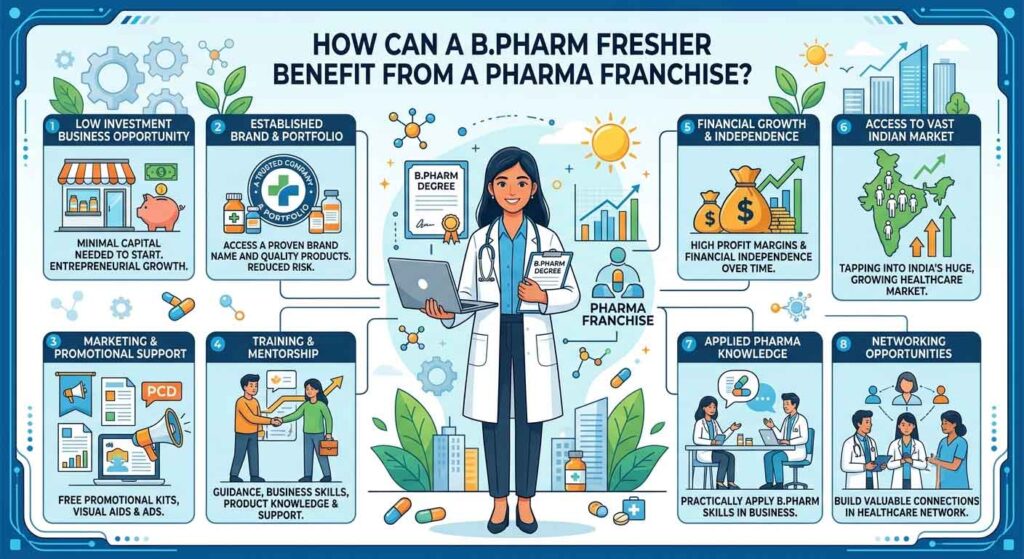
A pharma franchise can provide:
Practical business experience
Additional income potential
Local market knowledge
Distributor and retailer relationships
Experience in product selection
A path toward an independent pharma marketing company
However, these benefits arise only when the business is operated legally, ethically and without violating the conditions of the person’s employment.
What Is a Pharma Franchise?
Under a typical pharma franchise or PCD arrangement, a pharmaceutical company authorizes a person or firm to promote and distribute its products in a defined territory.
The parent company generally provides:
Existing product brands
Finished medicines
Product price list
Promotional materials
Product information
Territory authorization
Commercial support
The franchise partner generally handles:
Local market development
Doctor communication
Chemist availability
Order generation
Distributor coordination
Payment
Stock planning
Market feedback
The exact rights and responsibilities depend on the written agreement.
Can a Fresher Start a Pharma Franchise?
Yes, a fresher can start, but qualification alone does not guarantee business success.
A B.Pharm graduate may understand:
Pharmacology
Dosage forms
Product composition
Basic pharmaceutical regulations
Medicine storage
Product quality
However, a new graduate may not yet understand:
Doctor-call planning
Prescription behaviour
Distributor operations
Retailer credit
Product movement
Territory selection
Expiry management
Payment collection
Sales forecasting
Commercial negotiation
These skills are usually learned through practical field experience.
Benefits of Working as an MR First
Working as a medical representative can teach a fresher several important skills.
1. Product Communication
The person learns how to explain:
Product composition
Approved indication
Dose and dosage form
Product features
Precautions
Availability
2. Territory Planning
An MR learns how to divide a territory according to:
Doctors
Hospitals
Chemists
Travel routes
Call frequency
Prescription potential
3. Doctor Relationship Management
The person learns:
How appointments work
Which information doctors expect
How to conduct a brief professional call
How to follow up without causing irritation
How to respond to product questions
4. Pharmacy Availability
The person understands that prescription generation alone is insufficient.
The product must also be available with:
Nearby chemists
Hospital pharmacies
Local distributors
Stockists
5. Competitor Understanding
Fieldwork helps identify:
Leading brands
Common compositions
Price ranges
Product shortages
Promotional practices
Distributor performance
6. Sales Discipline
An MR learns:
Daily reporting
Target management
Follow-up
Expense control
Secondary-sales tracking
Monthly planning
These skills are highly useful when starting a franchise later.
Can Pharma Franchise Be Run as a Part-Time Business?
It may be possible only when the business structure does not require your continuous physical presence.
A part-time model is more practical when:
A licensed distributor handles stock and invoices.
The parent company supplies the distributor directly.
Another responsible partner handles daily operations.
Deliveries and collections are properly arranged.
Your employer permits outside business.
The franchise products do not conflict with your employment.
Business activities are performed outside working hours.
It becomes difficult when you personally have to manage:
Stock
Billing
Deliveries
Retail collections
Doctor calls
Product complaints
Returns
Expiry
Distributor follow-up
A full-time MR role already requires substantial travel, reporting and market attention.
Check Your Employment Agreement First
Before starting any parallel business, review your:
Appointment letter
Employment contract
HR policy
Code of conduct
Confidentiality agreement
Conflict-of-interest policy
Non-solicitation conditions
Outside-employment restrictions
Some employers prohibit employees from:
Running another pharmaceutical business
Promoting competing products
Receiving commission from another company
Using company working hours for personal business
Using company contacts or data
Soliciting company doctors or distributors
Diverting orders
Do not assume that the business is acceptable merely because it is registered in a family member’s name.
If you control or benefit from the business, a conflict may still exist.
Activities That Should Never Be Mixed with the MR Job
Do not:
Promote franchise products during the employer’s working hours.
Use the employer’s doctor list.
Copy the employer’s distributor database.
Use company samples or promotional material.
Use the employer’s travel allowance for your own business.
Promote a competing product during an official doctor call.
Divert orders from the employer.
Share confidential price or sales information.
Ask retailers to replace the employer’s products with your own.
hide the business when disclosure is required.
Such conduct can result in:
Employment termination
Loss of professional reputation
Commercial disputes
Confidentiality claims
Damage to doctor and distributor trust
Safer Business Models for a Fresher
Model 1: Learn First and Start Later
This is the safest model for most freshers.
Spend the initial period learning:
Sales
Territory management
Product demand
Distribution
Collections
Market ethics
After acquiring practical experience, start the franchise with better planning.
Advantages
Lower risk
Better product selection
Better industry contacts
Greater confidence
More realistic investment planning
Better understanding of market demand
Model 2: Work Only as a Commission-Based Marketing Associate
Under this model:
You do not purchase stock.
You do not maintain a warehouse.
You introduce suitable business contacts.
The parent company or distributor invoices customers.
You receive an agreed commission.
This model requires:
Written appointment
Clear commission terms
Compliance with employment conditions
Transparent tax treatment
It is less capital-intensive but provides less control.
Model 3: Franchise Through an Existing Licensed Distributor
Under this arrangement:
You handle product promotion.
The licensed distributor keeps stock.
The distributor supplies chemists.
The distributor collects retailer payments.
You coordinate market development.
This may be suitable when:
You cannot establish your own warehouse.
You have limited funds.
You are working full time.
A reliable distributor is available.
The agreement should clarify:
Who purchases stock
Who receives the company invoice
Who earns which margin
Who handles expiry
Who bears bad debts
Who maintains retailer accounts
Who owns the territory rights
Model 4: Start an Own Licensed Wholesale Firm
This model provides greater control but requires more attention.
Your firm handles:
Product purchase
Stock
Invoicing
Dispatch
Collections
Returns
Expiry
Complaints
It normally requires:
Suitable premises
Wholesale drug licence
Competent-person arrangement
GST structure
Billing software
Storage
Working capital
Daily supervision
This is not usually the easiest part-time model for a new MR.
Is a Separate PCD Licence Required?
There is generally no government licence called a:
PCD licence or Pharma franchise licence
The licences depend on the activities performed.
When a Wholesale Drug Licence Is Generally Required
An appropriate wholesale drug licence is generally needed when your firm:
Purchases allopathic medicines
Receives stock
Stores medicines
Raises wholesale invoices
Supplies chemists
Supplies hospitals
Dispatches medicines
Handles wholesale returns
For common allopathic products, Forms 20-B and 21-B are ordinarily relevant.
Additional licensing may apply to:
Schedule X medicines
Special biological products
Cold-chain products
Controlled categories
The licence is connected with the approved premises and legal entity.
When You May Operate Without Your Own Wholesale Licence
Your own wholesale drug licence may not be necessary when:
You only promote products.
You do not purchase or own stock.
You do not store medicines.
You do not issue medicine invoices.
A licensed parent company or distributor supplies customers.
Your role is clearly documented as a marketing or commission agent.
The exact structure should be confirmed with Maharashtra FDA before starting.
Does B.Pharm Qualification Replace the Drug Licence?
No.
B.Pharm is an educational qualification.
It does not itself authorize a person to:
Open a wholesale firm
Store medicines
Sell medicines
Operate a medical store
Issue drug invoices
The business still requires the applicable:
Drug licence
Premises
Business registration
GST registration
Storage arrangements
Records
A B.Pharm graduate may be considered for a competent-person role in wholesale operations, subject to the applicable rules and acceptance by the Licensing Authority.
Business Registrations
A small franchise business may be established as:
Proprietorship
Partnership
LLP
Private Limited Company
A single person may begin with a proprietorship.
Where family members or partners are investing together, a partnership or LLP may be considered.
Common registrations and documents may include:
PAN
Current bank account
GST registration, where applicable
Wholesale drug licence
Shop and Establishment registration
Udyam registration, where suitable
Local business registration
Written franchise agreement
GST Requirement
GST and drug licensing are separate.
GST registration depends on:
Aggregate turnover
Nature of supply
Interstate transactions
E-commerce activity
Compulsory-registration provisions
Business structure
Many pharmaceutical franchise businesses obtain GST registration early because:
Products may be purchased from another state.
The company may require a GSTIN.
Distributors expect tax invoices.
Input tax credit is important.
Interstate expansion may be planned.
The specific requirement should be reviewed with a tax professional.
Wholesale Premises Requirements
Where your own wholesale licence is planned, the premises generally needs:
Adequate legally acceptable area
Suitable racks
Clean and dry storage
Temperature control
Refrigerator where required
Pest-control arrangements
Separate expired and returned-goods area
Billing and record system
Approved competent person
Do not keep pharmaceutical stock at:
Your residence without approval
Your vehicle
An MR’s bag in commercial quantities
An unlicensed office
A friend’s shop
A distributor’s warehouse without documentation
Documents Commonly Required
The exact FDA checklist should be verified, but documents may include:
Business Documents
Proprietorship declaration, partnership deed or company documents
PAN
GST
Authorization
Identity and address proof
Premises Documents
Rent agreement or ownership proof
Landlord NOC
Utility bill
Premises layout
Storage details
Refrigerator details, where applicable
Competent-Person Documents
Qualification certificate
Experience certificate, where applicable
Appointment letter
Identity proof
Address proof
Photographs
Declarations
Application Documents
Prescribed application
Government fee
Affidavits
Firm constitution
Inspection documents
How Much Investment Is Required?
There is no universal minimum investment.
Your fund requirement depends on:
Number of products
Product category
Initial order
Stock ownership
Distributor arrangement
Promotional materials
Territory size
Credit offered
Travel
Delivery
Licence and premises
Working expenses
Can a Fresher Start With Very Low Investment?
A low-investment start is more practical when:
A licensed distributor maintains stock.
The parent company offers a small first order.
Product range is focused.
Advance payment is used.
No separate employee is appointed initially.
Territory is compact.
Large printed promotional material is avoided.
Low investment should not mean:
No licence
Unapproved stock storage
No invoices
Poor-quality products
Uncontrolled credit
Verbal monopoly rights
Which Territory Is Better for a Fresher?
For most freshers, the best territory is not necessarily the largest one.
Choose the territory where you have:
Residence
Familiarity
Local language comfort
Doctor relationships
Reliable distributor
Easy travel
Lower daily cost
Regular physical presence
A compact cluster may be easier to manage than the big region.
Territory Selection Scorecard
Score each proposed territory from 1 to 5.
Factor
Score
Number of target doctors
1–5
Number of chemists
1–5
Distributor availability
1–5
Existing contacts
1–5
Travel convenience
1–5
Competition level
1–5
Product demand
1–5
Payment quality
1–5
Delivery cost
1–5
Time available
1–5
Do not choose the territory only by population.
How to Conduct Local Market Research
Before signing a franchise agreement, spend at least several field visits studying the market.
Visit Doctors
Record:
Speciality
Patient flow
Commonly used product categories
Appointment system
Existing brands
Nearby pharmacy availability
Do not seek commitments before selecting the products.
Visit Chemists
Ask:
Which compositions move regularly?
Which brands are frequently unavailable?
Which distributors provide good service?
What expiry policy is expected?
Which pack sizes move?
What is the normal payment cycle?
Visit Distributors
Assess:
Drug licences
Retail coverage
Delivery staff
Company portfolio
Credit expectations
Interest in new products
Reporting ability
Visit Hospitals and Clinics
Study:
Purchase system
Pharmacy
Vendor registration
Product demand
Payment cycle
Tender process
Product Selection for a Fresher
Do not begin with 100 products.
Select products according to:
Doctor speciality
Local demand
Competition
Product availability
Prescription frequency
Price
Shelf life
Company supply consistency
A focused range might cover one or two segments such as:
General medicine
Paediatrics
Orthopaedics
Gynaecology
Gastroenterology
Dermatology
Nutritional support
Avoid complex or highly controlled categories until you understand their legal and commercial requirements.
Selecting the Pharma Franchise Company
Evaluate at least three companies.
Ask for:
Company constitution
GST
Wholesale drug licence
Manufacturer details
Manufacturing licences
Product permissions
Applicable GMP documentation
Product list
Net rates
MRP
Expiry policy
Monopoly terms
Promotional support
Batch-wise COA
Complaint procedure
Recall support
Important Questions Before Finalizing
Ask:
Is the territory available?
Is monopoly written or verbal?
Which products are covered?
What is the minimum first order?
Is there a monthly target?
What is the payment condition?
Who pays freight?
What is the expiry-return policy?
Are samples provided?
Are promotional materials chargeable?
How quickly are repeat orders dispatched?
What happens if the company appoints another franchisee?
Can the company supply hospitals directly?
Is the product manufactured consistently at one site?
Are batch-wise test documents available?
Recommended Roadmap for a B.Pharm Fresher
Stage 1: First 6–12 Months
Focus on the MR role.
Learn:
Territory management
Doctor calls
Chemist availability
Distributor operations
Reporting
Product knowledge
Save money and study different franchise models.
Stage 2: Market Evaluation
Identify:
Preferred territory
Product segment
Distributor
Required investment
Employer restrictions
Suitable franchise companies
Stage 3: Decide the Operating Model
Choose among:
Start after leaving the job
Obtain written employer permission
Work through a family or business partner with complete transparency
Use a licensed distributor
Begin as a commission-based marketing associate
Stage 4: Complete Documentation
Arrange:
Business entity
GST, where required
Wholesale drug licence, where applicable
Distributor documents
Franchise agreement
Bank account
Accounting system
Stage 5: Controlled Launch
Start with:
Compact territory
Limited products
Limited stock
Defined credit
Reliable delivery
Regular secondary-sales review
Stage 6: Expand Only After Repeat Sales
Add:
New products
Nearby territories
Sales staff
Own wholesale premises
Own brands
only after the initial business produces repeat orders and timely payments.
When Should the Fresher Avoid Starting?
Postpone the franchise when:
The employer prohibits outside business.
There is no reliable distributor.
The person has no time for follow-up.
Initial funds are borrowed at high cost.
The company demands excessive stock.
Territory rights are only verbal.
Product quality documents are unavailable.
The person intends to use the employer’s doctors or data.
There is no clear expiry policy.
The person has no understanding of payment collection.
Advantages of Starting After Experience
After gaining experience, you may have:
Better doctor communication
Stronger market understanding
Distributor contacts
Better product selection
More realistic financial expectations
Greater negotiation ability
Better credit discipline
More savings
Clearer career direction
Waiting for experience does not mean abandoning entrepreneurship.
It means reducing avoidable risk.
Common Mistakes Made by Freshers
Avoid:
Starting secretly while employed
Believing B.Pharm is a business licence
Selecting products only by margin
Taking the whole Region as one territory
Taking the whole Region without logistics
Buying too much stock
Giving uncontrolled credit
Relying on verbal monopoly
Appointing an unlicensed distributor
Promoting competing products during employment
Spending heavily on promotional items
Ignoring expiry
Expecting immediate prescriptions
Leaving a stable job before validating the business
Practical Answer to the Query
A B.Pharm fresher can benefit from pharma franchise through:
Practical business experience
Additional income
Market relationships
Distribution knowledge
Future independent entrepreneurship
However, the safest sequence is:
Join the MR job and learn the market.
Review the employment agreement.
Avoid competing or undisclosed business.
Select a compact territory.
Conduct doctor, chemist and distributor surveys.
Choose a reliable franchise company.
Work through a licensed distributor initially.
Start with a limited product range.
Maintain controlled investment and credit.
Expand only after repeat orders.
Frequently Asked Questions
1. Can a B.Pharm fresher take a pharma franchise?
Yes. There is no general experience condition for signing a commercial franchise agreement, but practical experience greatly improves the chance of success.
2. Can an MR run a pharma franchise part time?
Possibly, but only when permitted by the employer and when there is no conflict of interest. The operating model must also provide proper stock, distribution and compliance support.
3. Is a separate PCD licence required?
There is generally no separate government PCD licence. Drug-sale licensing depends on whether you purchase, store, invoice or distribute medicines.
4. Do I need a wholesale drug licence?
Generally yes, when your own firm purchases, stores, invoices or supplies allopathic medicines from its premises.
5. Can I work through a distributor without my own warehouse?
Potentially yes. The licensed distributor may handle stock and invoices while you undertake marketing, subject to a properly documented arrangement.
6. Does B.Pharm automatically qualify me to sell medicines?
No. The qualification does not replace a drug licence or business registration.
7. Which is better for a fresher—whole region or single district?
A compact territory where you have local relationships and reliable distribution is usually better than choosing an entire large market.
8. How many products should a fresher start with?
A limited range of approximately 10–30 carefully selected products is often easier to manage than a very large catalogue.
9. Should I leave my MR job to start the franchise?
Not before validating the market, calculating working capital and confirming that the business can support your regular expenses.
10. What is the biggest risk for a fresher?
Major risks include conflict with the employer, poor company selection, excessive inventory, uncontrolled credit and insufficient time for market follow-up.
Final Thoughts
A pharma franchise can become a useful business opportunity for a B.Pharm graduate, but it should not be treated as easy part-time income.
The business requires:
**Product knowledge
Market relationships
Licensing
Stock availability
Distribution
Collections
Ethical promotion
Financial discipline**
The strongest approach is:
Learn first → Survey the market → Check employment restrictions → Select a compact territory → Start through a licensed structure → Expand gradually
A fresher who builds genuine field experience before making a large investment is usually in a stronger position than someone who starts immediately without understanding the market.
Looking for Ayurvedic Franchise or Distribution Opportunities?
Looking to start an Ayurvedic franchise, become a distributor, or launch your own herbal product range?
Elzac Herbal India offers:
Ayurvedic & Herbal Product Range
Franchise & Distribution Opportunities
Third-Party Manufacturing Services
Product Development Support
Marketing Guidance
PAN India Business Opportunities
Whether you are an entrepreneur, retailer, distributor, or healthcare professional, our team can help you explore the right business opportunity in the growing Ayurvedic sector.
Ajay Kamboj is an entrepreneur and business owners associated with many Ayurvedic and Pharmaceutical start-ups. With years of experience in Ayurvedic product marketing, pharmaceutical distribution, franchise development, and client relationship management, he regularly shares practical business insights based on real-world experiences. His articles focus on business growth, entrepreneurship, customer management, and lessons learned from the healthcare and wellness industry.






Leave a Reply Cancel reply
You must be logged in to post a comment.