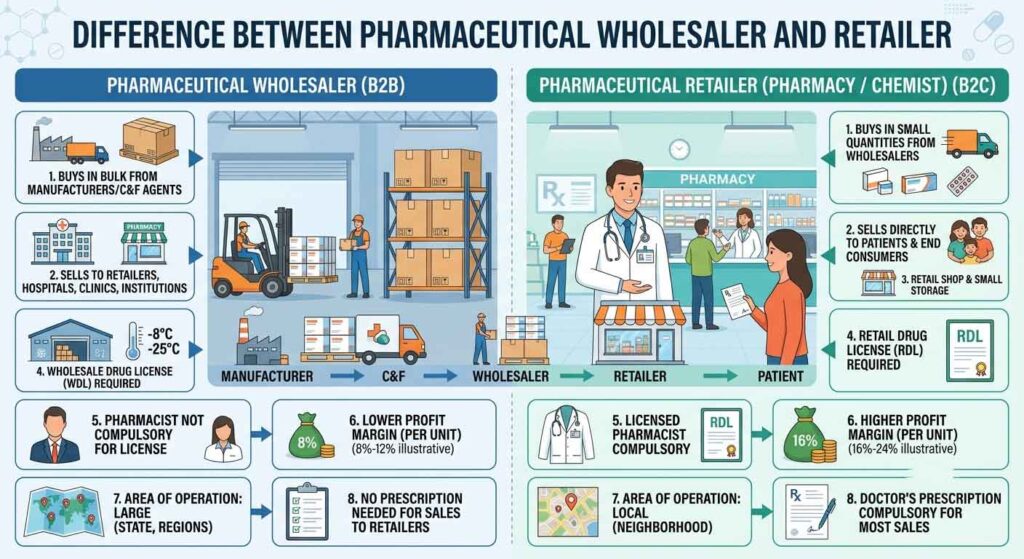
Wholesalers and retailers are two important parts of the pharmaceutical distribution channel. Both are connected with each other, but their role, licence requirement, customer type, margin, working style and business model are different.
In simple words:
A wholesaler supplies medicines to retailers, hospitals, institutions and other licensed buyers, while a retailer sells medicines directly to patients or final consumers.
In the pharma sector, both wholesale and retail businesses are regulated, so proper drug licence, documentation and compliance are very important.
Quick Answer
A wholesaler works on a business-to-business model and supplies medicines in bulk to retailers, chemists, hospitals, institutions and other licensed parties.
A retailer works on a business-to-consumer model and sells medicines directly to patients or customers, usually through a medical store, pharmacy, chemist shop or drug store.
What Is a Wholesaler in Pharma?
A wholesaler is a person, firm or company that purchases medicines from pharmaceutical companies, C&F agents, distributors or super stockists and supplies them to retailers, pharmacies, chemists, hospitals, institutions and other trade buyers.
Wholesalers usually do not sell medicines directly to patients.
They work in bulk quantity and handle business-to-business supply.
Common names for wholesalers include:
Pharma wholesaler
Medicine wholesaler
Distributor
Stockist
Authorized stockist
Super stockist
Semi-wholesaler
For pharmaceutical wholesale business, a wholesale drug licence is generally required.
What Is a Retailer in Pharma?
A retailer is a person, firm or pharmacy that sells medicines directly to patients, customers or final users.
Retailers usually operate through:
Medical store
Chemist shop
Pharmacy
Drug store
Hospital pharmacy
Retail pharmacy counter
Retailers purchase medicines from wholesalers or distributors and sell them to patients as per prescription requirement and applicable rules.
For retail pharmacy business, a retail drug licence is generally required.
Main Difference Between Wholesaler and Retailer
Point
Wholesaler
Retailer
Business model
Business to business
Business to customer
Main customers
Retailers, chemists, hospitals, institutions
Patients and final consumers
Quantity
Bulk quantity
Small quantity
Licence
Wholesale drug licence
Retail drug licence
Purchase source
Company, C&F, distributor or super stockist
Wholesaler or distributor
Selling price basis
Usually PTR or trade rate
Usually MRP or discounted MRP
Margin
Generally lower per unit
Generally higher per unit
Location importance
Less dependent on prime location
Prime location is very important
Pharmacist requirement
Competent person requirement applies
Registered pharmacist is generally required
Working style
Supply and distribution
Patient-facing sale
Area coverage
Larger area
Local surrounding area
Main focus
Stock movement and supply
Customer service and prescription handling
Difference in Customer Type
Wholesaler Customers
A wholesaler usually deals with:
Retail pharmacies
Chemists
Medical stores
Hospitals
Nursing homes
Clinics
Institutions
Dispensaries
Other distributors
Sub-stockists
The wholesaler’s work is mainly trade supply.
Retailer Customers
A retailer usually deals with:
Patients
Walk-in customers
Doctors’ prescriptions
Local families
Hospital patients
Clinic patients
The retailer’s work is mainly direct sale to final consumers.
Difference in Licence Requirement
Wholesale Drug Licence
A wholesaler needs a wholesale drug licence for stocking, selling and distributing medicines to trade customers.
Wholesale licence is generally required for premises where medicines are:
Stocked
Stored
Sold
Distributed
Supplied
Exhibited for sale
Retail Drug Licence
A retailer needs a retail drug licence for selling medicines directly to patients or final customers.
A retail pharmacy must follow prescription rules, storage conditions, pharmacist requirement and other drug-law compliances.
Difference in Qualification Requirement
For wholesale drug licence, a competent person is generally required.
The competent person may be:
Registered pharmacist, or
Person with required experience in drug sale, or
Person fulfilling criteria accepted by the State Licensing Authority
For retail pharmacy licence, a registered pharmacist is generally required for sale and supervision of medicines.
Exact requirements may vary by state and licence category, so always check with the concerned State Drug Control Department.
Difference in Purchase Source
Wholesaler Purchase Source
A wholesaler purchases goods from:
Pharmaceutical company
C&F agent
Super stockist
Main distributor
Manufacturer
Marketing company
Retailer Purchase Source
A retailer purchases goods from:
Wholesaler
Distributor
Authorized stockist
Local supplier
Company-appointed distributor
Retailers usually do not purchase directly from big pharma companies unless the company has such a direct supply model.
Difference in Profit Margin
Profit margin depends on company policy, product category, MRP, scheme, competition and business model.
Generally:
Wholesaler margin may be lower per unit but business volume is higher.
Retailer margin may be higher per unit but quantity per customer is smaller.
In pharma trade, traditional margins may vary between different product categories such as prescription medicines, generic medicines, OTC products, nutraceuticals, Ayurvedic products and cosmetics.
Do not rely on fixed margin percentages for all products. Always check company price list, PTR, PTS, MRP and scheme structure.
Difference in Location Requirement
Wholesaler Location
A wholesaler does not always need a prime retail location.
Important factors for wholesale location include:
Storage space
Transport access
Market connectivity
Delivery convenience
Warehouse suitability
Billing and dispatch system
Reach to retailers and hospitals
A wholesale shop can work from a commercial market, medicine market or godown-type location.
Retailer Location
A retailer needs a good customer-facing location.
Best locations for pharmacy include:
Near hospitals
Near clinics
Near doctor chambers
Residential areas
Main markets
Busy roads
Near diagnostic centres
Near nursing homes
Retail business depends heavily on footfall, visibility and local customer trust.
Difference in Quantity
Wholesalers deal in bulk quantity.
They may supply:
Full boxes
Cartons
Strips in larger quantity
Multiple SKUs
Institutional bulk orders
Regular retailer orders
Retailers deal in small quantity.
They may sell:
One strip
Few tablets
One bottle
One tube
One pack
Prescription-based quantity
Difference in Selling Price
Wholesaler Selling Price
Wholesalers usually sell at trade price, PTR or agreed distributor rate.
Their pricing depends on:
Company billing rate
Scheme
Stockist margin
Retailer margin
Credit policy
Product demand
Competition
Retailer Selling Price
Retailers usually sell to customers at MRP or discounted MRP.
MRP means Maximum Retail Price.
Retailers cannot charge above MRP.
Difference in Working Hours
Wholesale business usually has more flexible working hours than retail pharmacy.
Wholesalers may work according to:
Market timing
Retailer order schedule
Dispatch timing
Company supply schedule
Transport timing
Retail pharmacy usually requires longer and more disciplined working hours because patients and customers visit throughout the day.
Many pharmacies operate morning to night, and some work 24 hours near hospitals.
Difference in Prescription Requirement
Wholesalers generally supply medicines to licensed buyers and do not directly handle patient prescriptions in routine business.
Retailers directly sell medicines to patients. For prescription medicines, the retailer must follow prescription requirements as per applicable drug rules.
Not every product requires prescription, but Schedule H, H1, X and other restricted medicines must be sold only according to applicable prescription rules.
Difference in Area Coverage
Wholesaler Area Coverage
A wholesaler may cover:
City
District
Nearby towns
Multiple markets
Hospitals
Institutions
Retail pharmacy network
Wholesale business depends on distribution reach.
Retailer Area Coverage
A retailer mainly covers:
Local area
Nearby patients
Nearby doctors
Nearby hospitals
Regular local customers
Retail business depends on local trust and customer convenience.
Difference in Business Investment
Wholesaler Investment
Wholesale business may require higher investment because it needs:
Larger stock
More working capital
Credit to retailers
Storage space
Billing system
Delivery staff
Transport
Expiry and breakage management
Retailer Investment
Retail business may require investment in:
Shop location
Interior
Stock
Pharmacist salary
Billing software
Refrigerator
Customer counter
Local promotion
Daily operation expenses
Retailer investment may be lower or higher depending on location, shop size and product range.
Difference in Credit Risk
Wholesalers often give credit to retailers and institutions.
So, they face risks such as:
Payment delay
Bad debts
Expiry returns
Claim settlement
Market competition
Retailers may also give credit to regular customers, but generally retail sales involve more cash, UPI or card payments.
Difference in Stock Management
Wholesaler Stock Management
Wholesaler must manage:
Large inventory
Multiple brands
Multiple batches
Expiry dates
Scheme stock
Retailer orders
Returns
Breakage
Company claims
Retailer Stock Management
Retailer must manage:
Patient-demand products
Prescription products
Fast-moving medicines
Seasonal medicines
Daily customer requirements
Expiry control
Small quantity stock
Both must follow proper FEFO system.
FEFO means First Expiry, First Out.
Difference in Relationship Building
Wholesaler Relationships
A wholesaler must build relationships with:
Retailers
Distributors
Company sales team
Hospitals
Institutions
Stockists
Transporters
Retailer Relationships
A retailer must build relationships with:
Patients
Doctors
Local customers
Wholesalers
Hospital staff
Regular families
Retail business depends strongly on trust and service.
Can a Wholesaler Sell Directly to Patients?
Generally, a wholesaler should not sell medicines directly to patients as a retail pharmacy.
A wholesaler is licensed for wholesale supply, not routine patient-facing retail sale.
If a person wants to conduct both wholesale and retail business from the same premises, proper combined licence and compliance may be required as per state rules.
Can a Retailer Sell to Hospitals or Institutions?
A retailer mainly sells to patients and final customers.
Hospitals and institutions usually purchase from wholesalers, distributors or authorized suppliers because they need bulk supply, tax invoices, credit terms and batch documentation.
However, business arrangements can vary, and the correct licence and billing compliance should always be followed.
Wholesale Business vs Retail Business: Which Is Better?
Both businesses can be profitable, but they suit different types of people.
Wholesale Business Is Better If You Have:
Higher working capital
Strong market network
Distribution experience
Ability to manage credit
Storage space
Delivery system
Relationship with retailers
Good stock management skills
Retail Business Is Better If You Have:
Good shop location
Registered pharmacist support
Customer-service attitude
Local area knowledge
Daily sitting capacity
Patient-handling skills
Ability to manage prescriptions
Regular shop timing discipline
Common Mistakes in Wholesale Business
Avoid these mistakes:
Starting without wholesale drug licence
Giving too much credit
Overstocking slow-moving products
Ignoring expiry dates
Not maintaining batch records
Not checking retailer payment history
Poor stock rotation
Not understanding scheme calculations
Ignoring GST documentation
Depending on one company only
Common Mistakes in Retail Business
Avoid these mistakes:
Starting without retail drug licence
Running pharmacy without registered pharmacist
Selling prescription medicines without proper prescription
Poor customer service
Opening shop in weak location
Keeping expired medicines
Not maintaining temperature-sensitive products
Not maintaining purchase bills
Not checking banned or restricted medicines
Ignoring local doctor demand
Final Thoughts
Wholesalers and retailers are both important parts of the pharmaceutical distribution channel.
A wholesaler supplies medicines to retailers, hospitals, institutions and other trade buyers in bulk. A retailer sells medicines directly to patients and final consumers.
The wholesaler focuses on distribution, stock movement and trade relationships. The retailer focuses on prescription handling, patient service and local customer trust.
Before starting either business, understand the licence requirement, investment, margin, stock management, GST compliance and market demand.
A properly managed wholesale or retail pharmacy business can become a strong and stable business opportunity in the pharmaceutical sector.
Frequently Asked Questions
1. What is the main difference between wholesaler and retailer?
A wholesaler sells goods in bulk to retailers or institutions, while a retailer sells goods directly to final customers or patients.
2. Does a wholesaler need a drug licence?
Yes. A pharma wholesaler generally needs a wholesale drug licence for stocking, selling and distributing medicines.
3. Does a retailer need a drug licence?
Yes. A pharmacy or medical store generally needs a retail drug licence.
4. Is pharmacist required for wholesale drug licence?
A registered pharmacist or competent person may be required depending on licence type and state rules.
5. Is pharmacist required for retail pharmacy?
Yes. A registered pharmacist is generally required for retail pharmacy operation.
6. Can wholesaler sell medicines directly to patients?
A wholesale licence is meant for wholesale trade. Direct patient-facing sale generally requires retail licence or combined licence.
7. Can retailer buy directly from company?
Usually retailers buy from wholesalers or distributors. Some companies may have direct supply models, but this depends on company policy.
8. Which business needs more investment?
Wholesale business usually needs higher working capital because of bulk stock and market credit. Retail business investment depends on shop location, stock and setup.
9. Which business gives more margin?
Retail margin is usually higher per unit, while wholesale margin is lower per unit but business volume is higher.
10. Is GST required for wholesaler and retailer?
GST requirement depends on turnover, interstate supply, business type and current GST rules. Many pharma wholesalers and retailers take GST registration for proper billing and business operations.
Looking for Ayurvedic Franchise or Distribution Opportunities?
Looking to start an Ayurvedic franchise, become a distributor, or launch your own herbal product range?
Elzac Herbal India offers:
Ayurvedic & Herbal Product Range
Franchise & Distribution Opportunities
Third-Party Manufacturing Services
Product Development Support
Marketing Guidance
PAN India Business Opportunities
Whether you are an entrepreneur, retailer, distributor, or healthcare professional, our team can help you explore the right business opportunity in the growing Ayurvedic sector.
Ajay Kamboj is an entrepreneur and business owners associated with many Ayurvedic and Pharmaceutical start-ups. With years of experience in Ayurvedic product marketing, pharmaceutical distribution, franchise development, and client relationship management, he regularly shares practical business insights based on real-world experiences. His articles focus on business growth, entrepreneurship, customer management, and lessons learned from the healthcare and wellness industry.








Leave a Reply Cancel reply
You must be logged in to post a comment.