Starting a pharma marketing company requires more than product selection and third-party manufacturing. You also need to understand billing, distribution chain, GST, trade margins, C&F working, stockist pricing, retailer pricing, and MRP calculation.
A common question is:
“I want to start my own pharma marketing company. How should billing be done from C&F to stockist?”
To understand this, you first need to understand the complete pharma distribution chain and pricing structure.
Common Pharma Distribution Chain
A normal pharma marketing company may follow this distribution chain:
Company → Super Stockist → Distributor → Retailer → Patient
The billing method depends on your actual business model.
What Is C&F or CFA in Pharma?
C&F means Carrying and Forwarding Agent.
CFA means Carrying and Forwarding Agent or Clearing and Forwarding Agent, depending on business usage.
In pharma, a C&F/CFA generally handles:
Stock receipt
Warehousing
Storage
Dispatch
Billing support
Stock transfer
Stockist supply
Inventory reporting
Expiry and breakage coordination
Company stock management in a particular state or region
A C&F may work as an agent, consignment handler, or sometimes as a super stockist depending on agreement and invoice structure.
Important Point: C&F Is Not Always a Buyer
Many new pharma entrepreneurs think they will always “sell” goods to C&F.
But in many pharma companies, C&F is not treated as a buyer. The C&F only stores and dispatches goods on behalf of the company and earns service charges or commission.
There are two common models:
Model 1: C&F as Agent
In this model:
Company sends stock to C&F.
C&F stores goods.
C&F dispatches to stockists.
Invoice may be issued as per company arrangement.
C&F earns commission or service charge.
Ownership may remain with company until sale.
Model 2: C&F/Super Stockist as Buyer
In this model:
Company bills goods to C&F or super stockist.
C&F/super stockist purchases goods.
C&F/super stockist bills stockists.
C&F/super stockist earns margin.
Stock ownership transfers to C&F/super stockist.
Before deciding billing, you must decide which model you are following.
Difference Between C&F and Stockist
Point
C&F/CFA
Stockist
Main role
Stores and forwards company stock
Purchases and sells to retailers
Area
Usually state or large region
Usually district/city/territory
Ownership
May or may not own stock
Usually owns stock after purchase
Earning
Commission/service charge or margin
Stockist margin
Billing
Depends on agreement
Bills retailers
Customer
Stockists/distributors
Retailers/chemists
What Is Billing to C&F?
Billing to C&F means the company issues invoice or stock transfer document to the C&F/CFA at a decided price.
This price is generally called:
Price to CFA
C&F price
CFA billing price
Company billing price to C&F
Net billing rate to C&F
If the C&F is acting only as an agent, billing may be handled differently from a sale transaction.
If the C&F is purchasing stock, then normal tax invoice is issued at C&F price plus GST.
What Is Billing from C&F to Stockist?
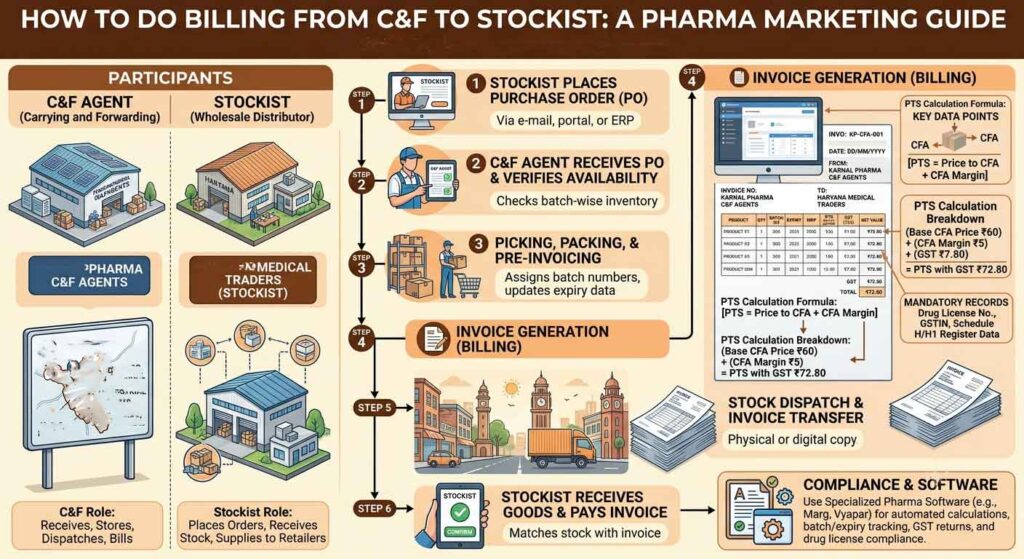
Billing from C&F to stockist means the C&F/CFA supplies goods to stockist at Price to Stockist, commonly called PTS.
The C&F will bill the stockist at:
PTS + applicable GST
The stockist will then sell to retailer at:
PTR + applicable GST
Retailer finally sells to customer at MRP, which is inclusive of all taxes.
Important Price Terms in Pharma Billing
1. MRP
MRP means Maximum Retail Price.
This is the maximum price at which the product can be sold to the consumer.
MRP is inclusive of GST.
2. PTR
PTR means Price to Retailer.
This is the price at which stockist sells goods to retailer.
PTR is generally calculated by deducting retailer margin and GST from MRP.
3. PTS
PTS means Price to Stockist.
This is the price at which company or C&F sells goods to stockist.
PTS is calculated after giving stockist margin from PTR.
4. Price to CFA
Price to CFA is the rate at which the company bills goods to C&F/CFA or super stockist.
This is calculated after keeping CFA margin from PTS.
5. GST
GST is added on taxable invoice value.
MRP is inclusive of GST, but trade invoices are usually prepared as:
Basic value + GST = Invoice value
6. Trade Margin
Trade margin is the difference between one trade level and the next trade level.
Example:
Retailer margin
Stockist margin
CFA margin
Step-by-Step Billing Flow
Step 1: Third-Party Manufacturer Bills to Marketing Company
If your pharma marketing company gets products manufactured from a third-party manufacturer, then manufacturer will bill finished goods to your company.
This invoice will include:
Product name
Batch number
Manufacturing date
Expiry date
Quantity
Rate
GST
HSN
Manufacturer details
This is your purchase cost.
Step 2: Marketing Company Sends Goods to C&F
After receiving goods, the marketing company may send goods to C&F.
Depending on model, this may be:
Sale invoice to C&F
Stock transfer
Consignment transfer
Dispatch challan
Delivery challan
Principal-agent supply document
Branch transfer, if C&F is your own branch or GST registration
Your GST consultant should decide the correct document according to your agreement and GST registration structure.
Step 3: C&F Bills Stockist
C&F supplies goods to stockist at PTS.
Invoice is generally prepared as:
PTS + GST
The stockist pays the C&F/company according to agreed credit terms.
Step 4: Stockist Bills Retailer
Stockist sells to retailer at PTR.
Invoice is prepared as:
PTR + GST
Retailer margin is available between PTR and MRP.
Step 5: Retailer Sells to Customer
Retailer sells to customer at MRP or below MRP.
MRP already includes GST.
How to Calculate PTR, PTS and CFA Price
To calculate billing, you need the following details:
After calculating PTR, calculate PTS by deducting stockist margin.
PTS = PTR – Stockist Margin
Or:
PTS = PTR × [100 – Stockist Margin%] ÷ 100
This gives PTS excluding GST.
Basic Formula for CFA Price
If CFA margin is to be given over CFA billing price, then:
Price to CFA = PTS ÷ [1 + CFA Margin%]
Or:
Price to CFA = PTS × 100 ÷ [100 + CFA Margin%]
This gives CFA price excluding GST.
Example Calculation
Suppose:
MRP = ₹95
Retailer margin = 20%
Stockist margin = 10%
CFA margin = 6%
GST = 12%
Step 1: Calculate Retailer Margin
Retailer margin:
₹95 × 20% = ₹19
MRP after retailer margin:
₹95 – ₹19 = ₹76
Step 2: Calculate PTR Without GST
PTR:
₹76 ÷ 1.12 = ₹67.86
So, PTR excluding GST = ₹67.86
Stockist will bill retailer at:
₹67.86 + 12% GST = ₹76.00 invoice value
Retailer can sell up to MRP ₹95.
Step 3: Calculate PTS Without GST
Stockist margin = 10%
PTS:
₹67.86 × 90% = ₹61.07
So, PTS excluding GST = ₹61.07
C&F/company will bill stockist at:
₹61.07 + 12% GST = ₹68.40 invoice value
Step 4: Calculate CFA Price Without GST
CFA margin = 6%
Price to CFA:
₹61.07 ÷ 1.06 = ₹57.61
So, company may bill C&F at:
₹57.61 + 12% GST = ₹64.52 invoice value
Summary of Example
Level
Basic Rate
GST 12%
Invoice Value
Company to C&F
₹57.61
₹6.91
₹64.52
C&F to Stockist
₹61.07
₹7.33
₹68.40
Stockist to Retailer
₹67.86
₹8.14
₹76.00
Retailer to Customer
MRP ₹95
Included
₹95 maximum
This is only an example. Actual calculation should be done according to product GST rate, margin structure, DPCO status and company policy.
Important Note About GST
GST should not be guessed.
Before finalizing billing, check:
HSN code
Product category
GST rate
Whether product is medicine, Ayurvedic medicine, food supplement, cosmetic or device
Whether any special rate applies
Whether the product is exempt, 5%, 12%, 18% or other rate
Wrong GST rate can create tax and accounting problems.
Important Note About DPCO Products
If your product is under DPCO or NPPA price control, you cannot freely calculate MRP only according to your desired margin.
For scheduled formulations or products with NPPA notified price:
Check ceiling price
Check retail price notification
Check applicable GST
Do not print MRP above allowed price
Update price list after NPPA changes
Maintain price compliance records
For non-DPCO products, you still need to follow GST, MRP, labelling and general pricing rules.
Difference Between Billing Price and Net Rate
In pharma, billing price and net rate may be different due to schemes and discounts.
Billing Price
This is the rate shown in invoice.
Net Rate
This is the effective rate after:
Scheme
Free goods
Quantity discount
Cash discount
Credit note
Rate difference
Expiry/breakage adjustment
For example, invoice may be at PTS, but if company gives 10+1 scheme, effective net rate becomes lower.
How to Handle Schemes in Billing
Common pharma schemes include:
10+1
10+2
20+5
Cash discount
Special rate
Replacement support
Launch scheme
Target scheme
Schemes should be clearly documented.
Mention:
Scheme period
Applicable product
Minimum quantity
Free quantity
GST treatment
Credit note method
Expiry and breakage conditions
Take GST advice because free goods and discounts can have tax implications depending on invoice structure.
How C&F Earns Money
C&F may earn through:
1. Fixed Service Charges
Company pays monthly fixed amount for storage and dispatch.
2. Commission on Sales
C&F receives percentage commission on sales value.
3. Margin Difference
Company bills C&F at CFA price and C&F bills stockist at PTS.
4. Handling Charges
C&F charges per box, per invoice, per carton, or per dispatch.
5. Combination Model
Some companies use fixed charge plus sales commission.
The model should be clearly written in C&F agreement.
Documents Required for C&F Billing
Common documents include:
C&F agreement
GST registration
Drug licence copy
Company authorization letter
Product price list
Tax invoice format
Delivery challan
Transport documents
Batch-wise stock statement
Stock transfer note
E-way bill, where applicable
Credit note/debit note records
Expiry and breakage records
Stock reconciliation statement
Documents Required from Stockist
Before supplying to stockist, collect:
Wholesale drug licence copy
GST certificate
PAN card
Firm address
Proprietor/partner/director details
Bank details
Contact details
Transport details
Security cheque, if company policy
Agreement or appointment letter
Territory details
Payment terms acceptance
Do not supply medicines to unlicensed parties.
How to Prepare Stockist Invoice
A stockist invoice should include:
Seller name and GST number
Buyer name and GST number
Drug licence number
Invoice number
Invoice date
Product name
Pack size
HSN code
Batch number
Expiry date
MRP
Quantity
Free quantity, if any
Rate
Taxable value
GST rate
CGST/SGST or IGST
Total invoice value
Transport details
Terms and conditions
For interstate supply, IGST may apply.
For intrastate supply, CGST and SGST apply.
How to Maintain Records
A pharma marketing company should maintain:
Manufacturer purchase invoices
Finished goods stock register
C&F stock statement
Stockist sales invoices
Batch-wise stock records
Expiry records
Scheme records
Credit notes
Debit notes
Payment collection record
GST return data
E-way bill records
Product complaint records
Recall records
Batch-wise traceability is important in pharma business.
Important Calculations Before Launch
Before launching any product, calculate:
Third-party manufacturing cost
Packing material cost
Freight
GST
CFA margin
Stockist margin
Retailer margin
Marketing expenses
MR expense
Promotional expense
Expiry/breakage provision
Credit cost
Replacement cost
Company profit
MRP feasibility
DPCO status
Competitor pricing
Do not finalize MRP only by multiplying manufacturing cost.
Example of Pricing Planning
Suppose third-party manufacturer gives you a finished product at ₹35 plus GST.
You calculate:
Company to C&F price
C&F to stockist price
Stockist to retailer price
Retailer to customer MRP
Company margin
Field expense
Promotional expense
Replacement cost
If your company-to-C&F price is lower than your total cost-plus expenses, your business will lose money even if MRP looks attractive.
Common Mistakes in C&F Billing
Avoid these mistakes:
Confusing C&F with stockist
Not deciding whether C&F is agent or buyer
Calculating GST wrongly
Treating MRP as GST-exclusive
Not checking DPCO status
Giving excessive scheme without net-rate calculation
Not maintaining batch-wise stock
Supplying to stockist without drug licence copy
Not reconciling C&F stock
Not defining expiry and breakage responsibility
Not preparing written C&F agreement
Ignoring e-way bill requirement
Not updating price list after MRP revision
Practical Billing Structure
A simple billing structure may be:
Company to C&F
Company bills or transfers goods at CFA price as per agreement.
C&F to Stockist
C&F bills stockist at PTS plus GST.
Stockist to Retailer
Stockist bills retailer at PTR plus GST.
Retailer to Patient
Retailer sells at MRP or below MRP.
What Should Be Mentioned in C&F Agreement?
A C&F agreement should mention:
Territory
Product range
Stock ownership
Billing authority
GST responsibility
Drug licence responsibility
Storage conditions
Cold-chain requirement
Dispatch process
C&F margin or service charge
Stockist billing process
Payment collection responsibility
Expiry and breakage handling
Insurance
Stock audit
Inventory reporting
Damaged goods
Confidentiality
Termination conditions
Always prepare the agreement professionally.
Final Answer
In a pharma marketing company, billing from C&F to stockist is generally done at Price to Stockist, called PTS.
The basic flow is:
Company bills C&F at CFA price + GST. C&F bills stockist at PTS + GST. Stockist bills retailer at PTR + GST. Retailer sells to patient at MRP.
But before billing, decide whether the C&F is acting as a true agent, consignment handler, or buyer/super stockist.
Also check GST rate, DPCO status, drug licence details, batch records, stockist documents, schemes, expiry policy and C&F agreement.
Correct billing protects your company from pricing loss, GST problems, stock disputes and distribution confusion.
Frequently Asked Questions
1. What is C&F in pharma?
C&F means Carrying and Forwarding Agent. It stores company stock and forwards goods to stockists or distributors as per company instructions.
2. At what rate does C&F bill stockist?
C&F generally bills stockist at Price to Stockist, commonly called PTS, plus applicable GST.
3. At what rate does company bill C&F?
Company may bill C&F at CFA price or transfer stock as per agreement. CFA price is calculated after keeping CFA margin from PTS.
4. What is PTR?
PTR means Price to Retailer. It is the rate at which stockist sells goods to retailer, excluding GST.
5. What is PTS?
PTS means Price to Stockist. It is the rate at which company or C&F sells goods to stockist, excluding GST.
6. Is MRP inclusive of GST?
Yes. MRP is the maximum retail price paid by the consumer and is inclusive of applicable taxes.
7. How is PTR calculated?
PTR is commonly calculated by deducting retailer margin from MRP and then removing GST.
8. How is PTS calculated?
PTS is calculated by deducting stockist margin from PTR.
9. Is C&F always a buyer?
No. C&F may be an agent or stock handler. In some models, it may act as buyer or super stockist. Billing depends on agreement and GST structure.
10. What should a new pharma marketing company calculate before launch?
A new company should calculate manufacturing cost, PTR, PTS, CFA price, GST, MRP, margins, marketing expenses, field expenses, schemes, expiry provision and profit margin.
Looking for Ayurvedic Franchise or Distribution Opportunities?
Elzac Herbal India offers opportunities for entrepreneurs interested in Ayurvedic and herbal product distribution, franchise marketing and third-party manufacturing.
Elzac Herbal India offers:
Ayurvedic & Herbal Product Range
Franchise & Distribution Opportunities
Third-Party Manufacturing
Product Development Support
Marketing Guidance
PAN India Business Opportunities
Whether you are an entrepreneur, retailer, distributor, or healthcare professional, our team can help you explore the right business opportunity in the growing Ayurvedic sector.
Ajay Kamboj is an entrepreneur and business owners associated with many Ayurvedic and Pharmaceutical start-ups. With years of experience in Ayurvedic product marketing, pharmaceutical distribution, franchise development, and client relationship management, he regularly shares practical business insights based on real-world experiences. His articles focus on business growth, entrepreneurship, customer management, and lessons learned from the healthcare and wellness industry.







Leave a Reply Cancel reply
You must be logged in to post a comment.