Loan licence manufacturing and third-party manufacturing are two common ways for a pharma marketing company to get products manufactured without setting up its own manufacturing plant.
But many entrepreneurs are confused about one important point:
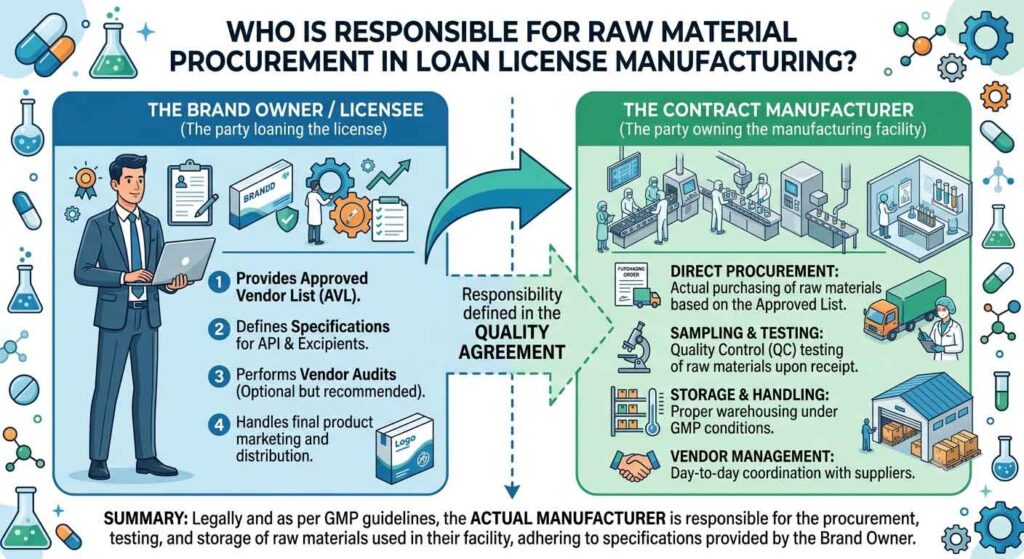
Who is responsible for procurement of raw material in loan licence manufacturing — the original manufacturer or the loan licensee?
The answer is:
In loan licence manufacturing, the loan licensee is generally responsible for arranging or owning the raw material, unless the agreement says otherwise. However, the raw material must be received, stored, tested, approved, issued and recorded through the licensed manufacturing premises as per GMP and regulatory requirements.
In third-party manufacturing, the manufacturer generally procures raw materials and provides finished goods to the marketing company, unless both parties agree to a different arrangement.
What Is Loan Licence Manufacturing?
Loan licence manufacturing is a system where a company that does not own a manufacturing unit gets permission to use the manufacturing facility of an existing licensed manufacturer.
In this model:
The loan licensee does not own the manufacturing plant.
The principal manufacturer owns the plant, machinery, premises and technical setup.
The loan licensee applies for a loan licence to manufacture products using that facility.
The licensing authority approves the arrangement.
Products are manufactured at the approved premises.
Separate records are maintained for the loan licensee’s products.
In simple words, loan licence allows one company to manufacture its own products by using another company’s licensed manufacturing facility.
What Is Third-Party or Contract Manufacturing?
Third-party manufacturing, also called contract manufacturing, is different from loan licence manufacturing.
In third-party manufacturing:
The marketing company places an order.
The manufacturer procures raw material and packing material.
The manufacturer manufactures the product.
The manufacturer tests and packs the product.
Finished goods are supplied to the marketing company.
The product may show “Manufactured by” and “Marketed by” details as applicable.
The marketing company mainly focuses on brand, sales, distribution and promotion.
Difference Between Loan Licence and Third-Party Manufacturing
Point
Loan Licence
Third-Party Manufacturing
Legal role
Loan licensee uses licensed facility
Manufacturer manufactures for marketing company
Licence
Loan licence is issued to applicant
Manufacturer uses own manufacturing licence
Raw material
Generally arranged/owned by loan licensee, or as per agreement
Generally arranged by manufacturer
Manufacturing premises
Principal manufacturer’s premises
Manufacturer’s premises
Records
Separate records maintained for loan licensee
Manufacturer maintains records
Control
More control for loan licensee
Less operational control for marketing company
Investment
Higher than simple third-party
Lower than loan licence
Documentation
More regulatory documentation
Simpler commercial documentation
Product responsibility
Shared regulatory/commercial responsibility as per licence and agreement
Manufacturer responsible for manufacturing quality; marketer responsible for marketing/distribution claims
Who Procures Raw Material in Loan Licence?
In practical loan licence manufacturing, the loan licensee generally procures or arranges the raw materials because the loan licensee is manufacturing its own products by using another manufacturer’s facility.
However, there are two possible arrangements:
1. Raw Material Procured by Loan Licensee
This is the common loan licence understanding.
The loan licensee purchases raw material from approved vendors and sends it to the licensed manufacturing premises.
The manufacturing unit then:
Receives the material
Checks documents
Stores it properly
Samples it
Tests or arranges testing
Approves or rejects it
Issues it for manufacturing
Maintains raw material records
This model gives more control to the loan licensee over quality, vendor selection and costing.
2. Raw Material Procured by Principal Manufacturer on Behalf of Loan Licensee
In some cases, the principal manufacturer may procure raw materials on behalf of the loan licensee.
This should be clearly mentioned in the agreement.
Even in this case, proper records should show:
Supplier details
Invoice details
Batch number
Material receipt
Testing status
Approval status
Issue for production
Consumption record
The commercial payment may be made by the loan licensee, but material handling should remain under the approved quality system of the licensed manufacturing unit.
What Is the Best Practice?
The best practice is to clearly mention raw material responsibility in the loan licence agreement.
The agreement should mention:
Who will select vendors
Who will purchase raw materials
Who will pay for raw materials
Who will arrange testing
Who will bear rejection loss
Who will maintain stock records
Who will own unused material
Who will handle expired or rejected material
Who will bear price variation
Who will maintain batch traceability
Without a written agreement, disputes can arise later.
Why Raw Material Responsibility Is Important
Raw material is the foundation of product quality.
If raw material quality is poor, the finished product may fail in:
Assay
Dissolution
Microbial limits
Stability
Appearance
Safety
Efficacy
Market complaints
In pharma manufacturing, raw material cannot be treated casually. Every material should be traceable from supplier to finished product batch.
Raw Material Records in Loan Licence
Whether raw material is purchased by the loan licensee or principal manufacturer, records must be maintained properly.
Common records include:
Raw material purchase invoice
Supplier name
Manufacturer name
Batch number
Supplier batch number
Date of receipt
Quantity received
AR number
Sampling record
Test report
Approval or rejection status
Material issue record
Batch consumption record
Balance stock record
Rejected material record
Destruction or return record
In loan licence, separate records should be maintained for the loan licensee’s products.
Who Tests Raw Material?
Raw material should be tested and approved before use.
Testing may be done by:
In-house quality control laboratory of the principal manufacturer
Approved outside laboratory
Government-approved laboratory, where applicable
Any other approved arrangement as permitted
The material should not be used in production until it is approved by quality control.
Who Maintains Raw Material Register?
In a loan licence arrangement, the manufacturing premises must maintain proper raw material registers and production records.
The principal manufacturer’s facility is used for production, so records are normally maintained at that licensed premises.
However, because products belong to the loan licensee, the loan licensee should also keep copies of important records for business and traceability.
The loan licensee should maintain copies of:
Raw material invoices
COA
Finished product COA
Batch manufacturing record summary
Product release documents
Stock transfer documents
Finished goods invoices
Complaint and recall records
What About Packing Material?
Packing material responsibility should also be defined clearly.
In many loan licence arrangements:
The loan licensee provides brand name, artwork and packing design.
Printed packing material may be procured by the loan licensee.
The manufacturer verifies label compliance before use.
Printed material is stored and reconciled at the manufacturing premises.
Packing material includes:
Foil
Labels
Cartons
Bottles
Caps
Tubes
Shippers
Leaflets
Stickers
Printed packing material should be controlled carefully because wrong packing material can create serious regulatory and market problems.
Who Is Responsible in Third-Party Manufacturing?
In third-party manufacturing, raw material procurement is generally the responsibility of the manufacturer.
The marketing company usually gives:
Product name
Composition
Packing size
Brand name
Artwork
Purchase order
Marketed by details
Special requirements, if any
The manufacturer usually handles:
Raw material procurement
Packing material procurement
Manufacturing
Testing
Packing
Finished goods supply
Batch records
Quality release
However, this may vary depending on commercial agreement.
If the marketing company wants to provide its own raw material or special ingredient, it should be clearly documented.
Loan Licence vs Third-Party: Raw Material Responsibility
Activity
Loan Licence
Third-Party Manufacturing
Vendor selection
Usually loan licensee or jointly approved
Usually manufacturer
Raw material purchase
Usually loan licensee or as per agreement
Usually manufacturer
Raw material receipt
At licensed manufacturing premises
At manufacturer premises
Raw material testing
Manufacturer QC/approved lab
Manufacturer QC/approved lab
Batch manufacturing
At licensed premises under loan licence
By manufacturer
Record maintenance
Separate records for loan licensee
Manufacturer records
Finished goods ownership
Loan licensee
Marketing company after purchase
Quality responsibility
Shared as per licence/agreement
Manufacturer for manufacturing quality
Is Loan Licence Mandatory in Contract Manufacturing?
No. Loan licence is not mandatory for every contract manufacturing or third-party manufacturing arrangement.
A pharma marketing company can get products manufactured from an existing licensed manufacturer on a third-party or contract manufacturing basis without taking a loan licence, provided the manufacturer has the required manufacturing licence and product permission.
Loan licence is needed when the applicant wants a formal licence in its own name to manufacture products using another manufacturer’s facility.
When Should You Choose Loan Licence?
Loan licence may be suitable when:
You want stronger control over production.
You want to procure your own raw material.
You want manufacturing in your own licensed name.
You want better control over formulation confidentiality.
You have regular large-volume production.
You want to build a manufacturing identity without owning a plant.
You can handle documentation and regulatory compliance.
When Should You Choose Third-Party Manufacturing?
Third-party manufacturing is suitable when:
You are a beginner.
You have limited investment.
You want quick product launch.
You do not want to handle raw material procurement.
You want the manufacturer to manage production.
Your main focus is sales and marketing.
Your order quantity is not very large.
For most small marketing companies, third-party manufacturing is easier than loan licence.
What Is Dual Use NOC?
Many people use the term “Dual Use NOC” informally when one manufacturing unit’s facility is used for another company’s products.
In practical terms, the loan licence process itself requires consent or permission from the principal manufacturer whose facility is being used.
The principal manufacturer generally gives a consent letter or NOC stating that it agrees to allow use of premises, machinery, staff and testing facility for the applicant’s products.
However, “Dual Use NOC” is not always used as a standard legal term in all states. Different state drug departments may use different wording such as:
Consent letter
No objection certificate
Agreement from principal manufacturer
Letter of permission
Facility-use consent
Undertaking from manufacturing unit
Therefore, instead of depending on terminology, follow the checklist of your State Drug Licensing Authority.
Is Separate Dual Use NOC Required in Loan Licence?
Usually, the loan licence approval process itself includes permission to use the principal manufacturer’s facility.
But the applicant must submit the required documents, including consent from the principal manufacturer.
If the state licensing authority asks for a separate NOC or undertaking, then it should be submitted as per state checklist.
So, the practical answer is:
Loan licence is the formal regulatory approval for using another licensed manufacturing facility, but supporting consent/NOC from the principal manufacturer is still required.
Example 1: Loan Licence Model
A marketing company wants to manufacture its own brand tablets through a licensed tablet manufacturer.
The marketing company applies for loan licence using that manufacturer’s facility.
In this model:
Loan licensee may purchase API and excipients.
Raw material is received at licensed premises.
QC tests and approves material.
Batch is manufactured under approved facility.
Separate records are maintained.
Finished goods are released after testing.
This is a loan licence model.
Example 2: Third-Party Manufacturing Model
A marketing company places order for 10,000 boxes of tablets.
The manufacturer quotes rate including raw material, packing material, manufacturing, testing and packing.
In this model:
Manufacturer purchases raw material.
Manufacturer manufactures product.
Manufacturer supplies finished goods.
Marketing company pays agreed rate.
This is third-party manufacturing.
Important Clauses to Add in Loan Licence Agreement
A loan licence agreement should clearly mention:
Scope of manufacturing
Product list
Raw material procurement responsibility
Vendor approval process
Packing material responsibility
Testing responsibility
Batch record ownership
Product rejection responsibility
Quality failure responsibility
Regulatory inspection support
Confidentiality
Intellectual property
Formula ownership
Non-disclosure
Non-compete or non-supply clause
Payment terms
Stock ownership
Recall responsibility
Complaint handling
Destruction of rejected goods
Dispute resolution
This agreement should be prepared carefully with legal and regulatory guidance.
Common Mistakes to Avoid
Avoid these mistakes:
Assuming loan licence and third-party manufacturing are the same
Not defining raw material responsibility in agreement
Sending raw material without proper invoice and COA
Using unapproved vendors
Using raw material without QC approval
Not maintaining separate records
Not reconciling packing material
Ignoring batch-wise traceability
Depending only on verbal agreement
Not checking product permission
Confusing consent letter with final licence approval
Starting manufacturing before loan licence approval
Final Answer
In loan licence manufacturing, raw material procurement is generally the responsibility of the loan licensee because the loan licensee is manufacturing its own products by using another manufacturer’s licensed facility.
However, the exact commercial responsibility should be clearly written in the agreement.
Even if the loan licensee procures raw material, the material must be received, tested, approved, stored, issued and recorded through the licensed manufacturing premises.
The safest approach is:
Define responsibility in writing, maintain separate records, use approved raw material, and follow the State Drug Licensing Authority’s checklist.
Frequently Asked Questions
1. Who purchases raw material in loan licence manufacturing?
Generally, the loan licensee purchases or arranges raw material, unless the agreement assigns procurement to the principal manufacturer.
2. Can the principal manufacturer purchase raw material in loan licence?
Yes, if agreed between both parties. But records, testing, approval and traceability should be maintained properly.
3. Who maintains raw material records in loan licence?
Records are maintained at the licensed manufacturing premises, and separate registers should be maintained for loan licence products. The loan licensee should keep copies for traceability.
4. Who procures raw material in third-party manufacturing?
In third-party manufacturing, the manufacturer generally procures raw materials and supplies finished goods to the marketing company.
5. Is loan licence mandatory for contract manufacturing?
No. Loan licence is not mandatory for every contract manufacturing arrangement. Products can be manufactured on third-party basis by a licensed manufacturer.
6. What is the main difference between loan licence and third-party manufacturing?
In loan licence, the applicant gets regulatory approval to use another manufacturer’s facility. In third-party manufacturing, the licensed manufacturer manufactures and supplies finished products as per commercial order.
7. Is Dual Use NOC required for loan licence?
The loan licence process itself is the formal approval to use another licensed facility, but consent/NOC from the principal manufacturer is normally required as part of documentation.
8. Who provides Fire NOC and Pollution NOC in loan licence?
Facility-related NOCs usually belong to the principal manufacturing unit and are provided by that unit during documentation.
9. Can raw material be used without testing?
No. Raw material should be tested and approved before use in manufacturing.
10. Who is responsible if product fails quality test?
Responsibility depends on the cause and agreement. If failure is due to raw material quality, procurement responsibility matters. If failure is due to manufacturing process, the principal manufacturer’s process may be involved. Therefore, agreement and investigation are important.
Looking for Ayurvedic Franchise or Distribution Opportunities?
Elzac Herbal India offers opportunities for entrepreneurs interested in Ayurvedic and herbal product distribution, franchise marketing and third-party manufacturing.
Elzac Herbal India offers:
Ayurvedic & Herbal Product Range
Franchise & Distribution Opportunities
Third-Party Manufacturing
Product Development Support
Marketing Guidance
PAN India Business Opportunities
Whether you are an entrepreneur, retailer, distributor, or healthcare professional, our team can help you explore the right business opportunity in the growing Ayurvedic sector.
Ajay Kamboj is an entrepreneur and business owners associated with many Ayurvedic and Pharmaceutical start-ups. With years of experience in Ayurvedic product marketing, pharmaceutical distribution, franchise development, and client relationship management, he regularly shares practical business insights based on real-world experiences. His articles focus on business growth, entrepreneurship, customer management, and lessons learned from the healthcare and wellness industry.